


There is a familiar piece of career advice in Japan: “At least get a university degree.” The equally familiar comeback is that a degree from a third-rate university is hardly worth the trouble.
Both arguments sound convincing. But what happens when we put actual wage figures next to them?
According to Japan’s 2025 wage survey, the average monthly base wage was ¥297,200 for high school graduates and ¥396,300 for university graduates. That is a difference of ¥99,100, or approximately 33.3%.
Does that mean someone who spends four years at a low-ranked university can expect to collect the same financial reward?
The research reveals an uncomfortable contradiction: university education can produce positive economic returns even at a low-ranked institution. Yet in one study of 36 graduates from a particular faculty, 12 were classified as cases of unsuccessful educational investment.
High School, Vocational School or University: What Do Japanese Workers Earn?
Japan’s Ministry of Health, Labour and Welfare released the final results of its 2025 Basic Survey on Wage Structure on March 24, 2026.
The figures show a substantial difference in average monthly wages by educational attainment.
| Highest educational qualification | Average monthly wage |
|---|---|
| High school | ¥297,200 |
| Specialized vocational school | ¥313,700 |
| College of technology / junior college | ¥321,200 |
| University (bachelor’s level) | ¥396,300 |
| Graduate school | ¥517,400 |
Source: Ministry of Health, Labour and Welfare, 2025 Basic Survey on Wage Structure. All ages and both sexes combined, general employees. Figures represent scheduled cash earnings, excluding overtime pay and bonuses. Japan’s specialized vocational schools (senmon gakko) and colleges of technology have distinct educational pathways; their qualifications should not be assumed to be identical to those in other countries.
The university graduate’s monthly advantage over the high school graduate is ¥99,100. Dividing that by ¥297,200 gives an advantage of approximately 33.3%.
Compared with specialized vocational school graduates, university graduates earn an average of ¥82,600 more per month. Multiplying that difference by 12 gives ¥991,200, although actual annual earnings also depend on bonuses and other compensation.
Those are impressive figures. But there is a rather large catch.
The survey puts graduates of famous national universities and little-known private universities into the same broad university category. It does not provide an average salary for graduates of every individual institution.
We cannot take the national university-graduate average of ¥396,300 and claim it represents what graduates of low-ranked universities earn.
That distinction matters enormously when a student is deciding whether a particular university is worth attending.
The Wage Gap Looks Very Different at 25 and 55
We went back to the same government dataset and compared high school and university graduates within the same age brackets.
| Age | High school | University | University wage premium |
|---|---|---|---|
| 25–29 | ¥251,700 | ¥296,400 | +17.8% |
| 40–44 | ¥309,000 | ¥425,300 | +37.6% |
| 55–59 | ¥332,100 | ¥529,100 | +59.3% |
Original calculations based on the 2025 Basic Survey on Wage Structure. Both sexes combined, scheduled cash earnings excluding overtime and bonuses.
Among workers aged 25–29, the monthly difference is ¥44,700. For those aged 55–59, it is ¥197,000.
The difference between those two wage gaps is striking:
¥197,000 ÷ ¥44,700 = approximately 4.4.
The observed monthly wage gap between educational groups is about 4.4 times as large among workers in their late fifties as among those in their late twenties.
In other words, judging the economic value of a degree solely by starting salaries or early-career wages misses an important part of the picture.
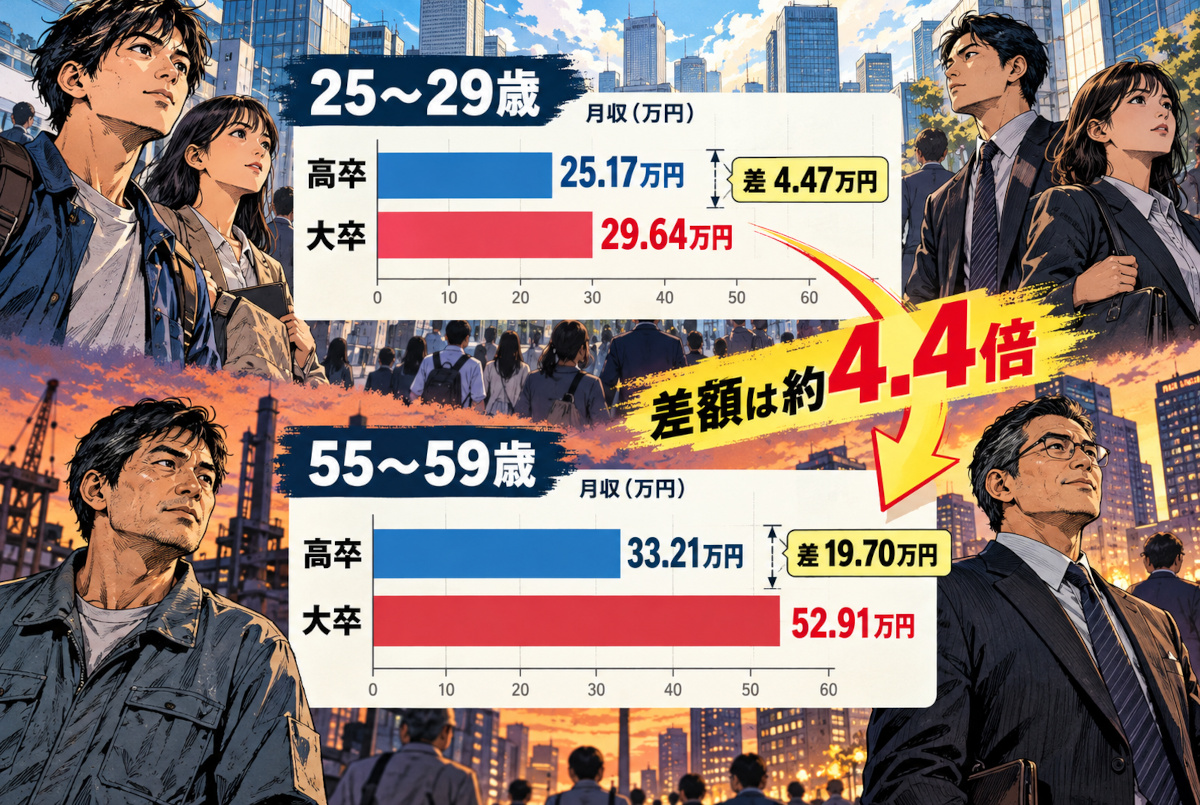
Original visualization based on Japan’s 2025 Basic Survey on Wage Structure. The image uses Japanese labels: 高卒 = high school graduate; 大卒 = university graduate. These figures compare different age groups in 2025, not the wage histories of the same individuals. They do not establish that education alone caused the gap. AI-generated editorial illustration; the people and workplaces are fictional.
There is an important statistical limitation here. These are different groups of workers observed in the same year, not the same individuals followed over three decades.
Job type, promotion opportunities, company size, work experience and personal characteristics may all affect earnings. The figures describe an association between educational attainment and wages, not proof that a degree caused the entire difference.
A Lifetime Earnings Gap of Over ¥60 Million—But Another Gap Is Even Larger
The Japan Institute for Labour Policy and Training (JILPT) provides another way to examine this question in its Useful Labor Statistics 2025.
Using wage data from 2024, JILPT estimated lifetime earnings under a model in which people start working immediately after finishing school, remain full-time regular employees until age 60, receive retirement benefits, and then continue working as full-time non-regular employees until the average retirement age.
Under those assumptions, estimated lifetime earnings for men were ¥275.3 million for high school graduates and ¥339.5 million for university graduates.
That is a ¥64.2 million difference.
For women, the corresponding estimates were ¥200 million and ¥267.2 million, a difference of ¥67.2 million.
These are modeled career earnings, not records tracking individual graduates over their entire lives. The calculations also assume relatively continuous employment.
But here is where the numbers become especially revealing.
In the same JILPT publication, estimated earnings for male university graduates through age 60, excluding retirement benefits, differ sharply by company size.
At companies with at least 1,000 employees, the estimate reaches approximately ¥300 million. At companies employing 10–99 people, it is approximately ¥210 million.
That is a company-size-associated difference of roughly ¥90 million, even among workers classified as university graduates.
These two comparisons use different models: the first includes retirement benefits and post-60 employment, while the second stops at age 60 and excludes retirement benefits. Their differences cannot simply be treated as directly interchangeable.
Nevertheless, the contrast is worth examining. Educational attainment is associated with earnings, but where a graduate eventually works is also associated with enormous variation.
It is difficult to argue that the university diploma alone explains everything.
Does Attending a Low-Ranked University Actually Pay Off?
To get closer to that question, we turned to a 2021 academic paper by Kazunori Shima, a professor at Tohoku University.
The paper, Empirical Study on Rate of Return to University Education Investment by University Rank and Faculty: Focusing on the Possibility of Failure in University Education Investment, examined the expected economic returns from attending universities at different academic selectivity levels.
The comparison used one humanities or social sciences faculty at each of two universities in Japan’s Tohoku region. One university had an entrance-exam deviation score of 60 or higher; the other had a score of 40 or lower.
Japan’s hensachi, or deviation-score system, is a standardized measure commonly used in entrance-exam guidance. It is not an international university ranking, and a low entrance score does not automatically mean that every course or graduate has little value.
Likewise, “third-rate university” is an informal and subjective label, not an official Japanese classification.
Shima’s analysis examined the employment destinations of male graduates who entered private-sector or comparable employment after graduating in 2015, using these destinations and earnings assumptions to estimate the expected rate of return on university education.
| Measure | Higher-selectivity university (score 60+) | Lower-selectivity university (score 40 or below) |
|---|---|---|
| Graduates analyzed | 20 | 36 |
| Average expected rate of return | 9.1% | 4.0% |
| Highest expected rate of return | 13.0% | 12.9% |
| Cases classified as investment failures | 0 | 12 |
Source: Shima (2021), Tables 3 and 4. Investment failures include negative or uncalculable expected rates of return. The reported 4.0% mean excludes cases for which the rate could not be calculated. These percentages are modeled investment returns, not annual salary increases or guaranteed financial yields.
The average expected rate of return at the lower-selectivity university was positive, at 4.0%.
Some graduates were estimated to receive much higher returns. The highest figure reached 12.9%, almost matching the 13.0% maximum at the higher-selectivity university.
So it would be wrong to say that graduating from a low-ranked university necessarily produces no economic benefit.
But the same study also identified a much less comfortable result.
Of the 36 graduates analyzed at the lower-selectivity institution, nine had a negative expected rate of return, while another three had returns that could not be calculated under the model.
That is 12 out of 36, or 33.3%.
The study challenges both easy answers: “Low-ranked universities are always a waste of money” and “Any university degree will eventually pay for itself.”

Based on Shima (2021), a study of one specific faculty at a lower-selectivity university in Japan’s Tohoku region. Among 36 male graduates, 24 had positive expected returns, nine had negative returns and three had uncalculable returns. The 12 cases (33.3%) classified as investment failures are an economic-model category, not a judgment about anyone’s life or abilities. These findings do not represent all low-ranked Japanese universities. AI-generated illustrative graphic; no actual graduates or campus are depicted.
That 33.3% figure must not be presented as the nationwide failure rate for graduates of low-ranked universities.
The study covered particular faculties at two universities and a specific group of male graduates who entered employment. Dropouts and graduates entering public service were not included in that comparison.
Nor did the researchers observe everyone’s future lifetime earnings. The results were estimates built from employment information and the wage structures available at the time.
There is also an important distinction between an investment that performs poorly in financial terms and an education that has no personal or professional value. They are not the same thing.
Are Employers Paying for University Knowledge—or the Diploma Itself?
A university education may increase someone’s knowledge and professional skills. But a degree can also act as a signal to employers who cannot directly measure every applicant’s capabilities.
In Japan, this is more than an abstract question.
A survey discussed by Recruit Works Institute on June 4, 2026, covered executives, managers and human-resources professionals at organizations with at least 100 employees.
In that survey, 58.6% of respondents reported that starting salaries differed according to educational attainment.
This is evidence that educational qualifications are explicitly reflected in starting-pay structures at many Japanese workplaces.
It does not prove that every employer ignores university reputation, nor does it prove that the salary difference exists solely because the diploma acts as a signal.
Individual employers may consider university name, field of study, skills, work experience and other characteristics when recruiting.
Research published through Japan’s Research Institute of Economy, Trade and Industry (RIETI) also cautions against assuming employers universally regard university learning as useless. A survey of hiring interviewers found differing views on the practical value of academic study.
A university degree may be a credential that opens certain doors. It is not a universal pass to employment, promotion or high earnings.
So Is a Degree From a Low-Ranked University Worth Having?
The evidence does not support a universal yes or no.
A university degree is associated with higher average wages in Japan. A limited academic study also found that graduates of a lower-selectivity university could achieve positive economic returns, sometimes substantial ones.
But neither result means a particular student will receive the national university-graduate wage premium simply by graduating.
For students and parents comparing options, the more useful questions are specific: What does the faculty teach? Where do its graduates work? What qualifications can students earn? Can they commute from home? What will completing the degree cost? And how likely are they to finish?
The lower overall average wage for vocational school graduates also does not mean vocational education is the worse choice for every career. A qualification or technical skill directly connected to a desired occupation may be more valuable than a degree chosen without a clear purpose.
The point is not to dismiss low-ranked universities. It is to stop treating “university graduate” as if it were a single, predictable financial outcome.
Editor’s Note
I’ve never been entirely comfortable with the old advice to “get a degree, any degree.” It sounds suspiciously like a sales pitch for a product whose price and performance nobody has bothered to check.
Then again, the wage data contain a rather inconvenient fact: many Japanese employers really do organize starting salaries around educational qualifications. Whatever we think of the system, a diploma can have an economic price tag attached to it.
What bothers me more is the variation hidden behind the averages. In the study we examined, a graduate from the lower-ranked institution could achieve an impressive expected return. Someone from the same faculty could also end up with a negative one.
So obsessing over university entrance scores is too simplistic. But assuming graduation guarantees a financial payoff is hardly any better.
Which brings us to the next awkward question: if obtaining that degree requires four years of your life and a substantial amount of money, how much extra must you earn to make the investment worthwhile?
That’s what Part 2 will put on the calculator.
Terms That May Need a Quick Explanation
- Expected Rate of Return on University Education
- A modeled measure comparing the costs of university attendance, including tuition and earnings forgone while studying, with the additional earnings expected after graduation. It does not mean a graduate’s salary will rise by that percentage each year.
- Signaling Effect
- An idea in economics describing how employers may use educational credentials as clues about an applicant’s abilities or learning experience when those characteristics are difficult to observe directly.
The Value of a Low-Ranked University Degree — Three-Part Series
Is a degree from a low-ranked university worth it? Across three articles, we examine wage differences, the real costs of university education, and the long-term career outcomes of university graduates compared with those who enter the workforce after high school.
- Part 1: Is a Low-Ranked University Degree Still Worth It? Japan’s Wage Data Have a Catch (Part 1)
- Part 2: English edition Coming soon
- Final Part: English edition Coming soon
References
- Ministry of Health, Labour and Welfare, “2025 Basic Survey on Wage Structure,” Table 3: Wages by Education, Sex and Age Group (in Japanese). Released March 24, 2026. Primary source for the monthly wage figures and age-group comparisons.
- Japan Institute for Labour Policy and Training (JILPT), Useful Labor Statistics 2025, Chapter 21: Lifetime Earnings and Related Indicators (in Japanese). Based on 2024 wage data. Primary source for modeled lifetime earnings and differences by company size.
- Kazunori Shima, “Empirical Study on Rate of Return to University Education Investment by University Rank and Faculty: Focusing on the Possibility of Failure in University Education Investment,” Nagoya Journal of Higher Education, Vol. 21, pp. 167–183 (2021) (in Japanese). See Tables 3 and 4 for the expected-return distributions.
- Recruit Works Institute, “Overqualification from Employers’ Perspectives, Part 2: Which Is Harder to Recruit, University or High School Graduates?” (in Japanese). June 4, 2026. Source for the survey on education-based starting salaries.
- Research Institute of Economy, Trade and Industry (RIETI), “Reconsidering the Claim That University Education Is Useless: Evidence from a Survey of Interviewers Recruiting General Administrative Staff” (in Japanese). 2016. Background research on how employers evaluate university learning.