

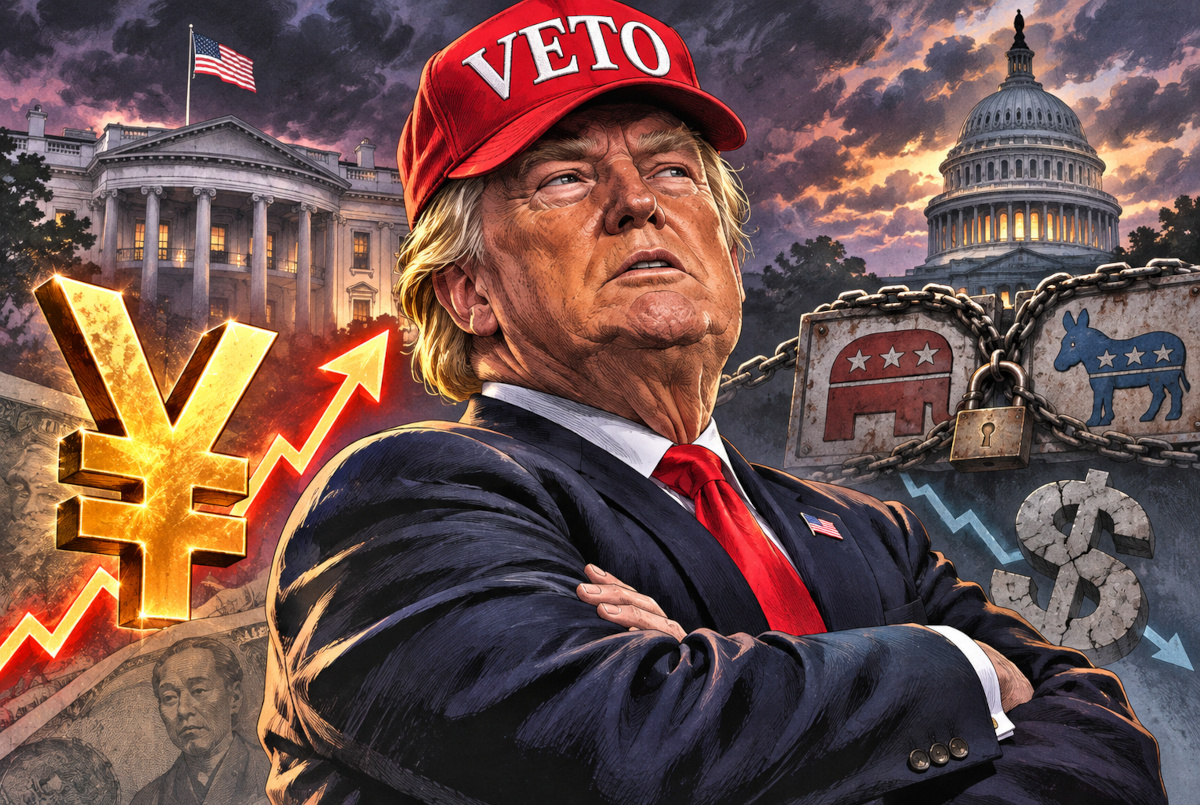
Donald Trump’s Republican Party suffered a sweeping defeat in the US midterm elections on November 3, 2026. Democrats won control of both the House of Representatives and the Senate, setting up a divided government for the remainder of Trump’s presidency.
For Japanese companies dealing with US tariffs, that might sound like welcome news. Could Washington’s political shift finally weaken the dollar and give Japan some relief from the persistently weak yen?
Not so fast. On November 4, the dollar briefly fell to around ¥157.40 before climbing back above ¥158. And despite losing his congressional majority, Trump still has considerable presidential authority.
A Republican defeat does not automatically mean lower tariffs, a stronger yen, or cheaper imports for Japan. The reasons become clearer when we examine the laws and the numbers rather than the election headlines alone.
Trump Lost Congress. Where Will His Anger Go?
According to Reuters, Democrats won major victories in Republican strongholds, including Senate contests in Texas and Kansas. Voter dissatisfaction over living costs, trade policies, and the war with Iran helped shape the results.
Trump’s response was a curious mixture of congratulations and defiance. He congratulated the Democrats and accepted the election results, yet suggested Republicans would have won overwhelmingly if he had been on the ballot. He also began criticizing unsuccessful Republican candidates.
Then came a particularly revealing image.
On November 4, Trump posted a photograph of a red baseball cap embroidered with a single word: VETO. The photograph contained no accompanying explanation, but Trump had separately indicated that he was prepared to reject Democratic legislation he opposed.
The president also acknowledged that the Iran war had contributed to Republican losses, while continuing to defend his decision to launch the conflict.
His immediate response pointed in three directions: criticism of fellow Republicans, resistance to Democratic legislation, and defense of his Iran policy.
None of those statements, however, establishes that new military action or retaliatory trade measures are imminent.
Losing Congress Does Not Make Trump’s Tariffs Disappear
When the new Congress convenes on January 3, 2027, Democrats will have greater power to investigate the administration, scrutinize spending, and challenge presidential appointments. But does that mean they can simply cancel Trump’s tariffs?
A review of US trade law, including Congressional Research Service (CRS) materials, shows why the answer is no.
Under the 2025 US–Japan trade framework, many Japanese exports were subject to a tariff arrangement generally set at 15%. In February 2026, however, the US Supreme Court ruled that the International Emergency Economic Powers Act (IEEPA) did not authorize the president to impose tariffs.
That ruling did not eliminate every available tariff authority. The administration subsequently relied on other trade laws.
| Period | What Changed for Japanese Trade? |
|---|---|
| July 2025 | The United States and Japan agreed to a trade framework involving a general 15% tariff arrangement for many Japanese products. |
| February 2026 | The Supreme Court rejected the use of IEEPA as legal authority for presidential tariffs. |
| July 2026 | The administration introduced new Section 301 tariffs related to forced-labor import restrictions. For covered Japanese products, the normal most-favored-nation (MFN) tariff and the new Section 301 tariff generally totaled 12.5%, subject to exemptions and specific rules. |
| November 2026 | Democrats won control of Congress, but existing tariffs did not automatically expire. |
That 12.5% figure deserves a closer look. It does not generally mean an additional 12.5 percentage points on top of an existing tariff.
For example, if a covered Japanese product already carried a 2.5% MFN duty, the new Section 301 component would be 10%, bringing the combined rate to 12.5%. Where the existing MFN rate was already 12.5% or higher, the additional Section 301 component under this particular measure would be zero. Product exemptions also apply.
Automobiles and certain other products fall under separate tariff arrangements, including provisions associated with the 15% US–Japan framework. The applicable rate therefore depends on the product and the legal authority involved.
There is another distinction that matters to businesses: the importer of record is generally responsible for paying US customs duties. Japanese exporters may ultimately absorb some of that cost through price reductions or commercial negotiations, but the company paying the tariff at the border is not necessarily the company bearing its full economic burden.
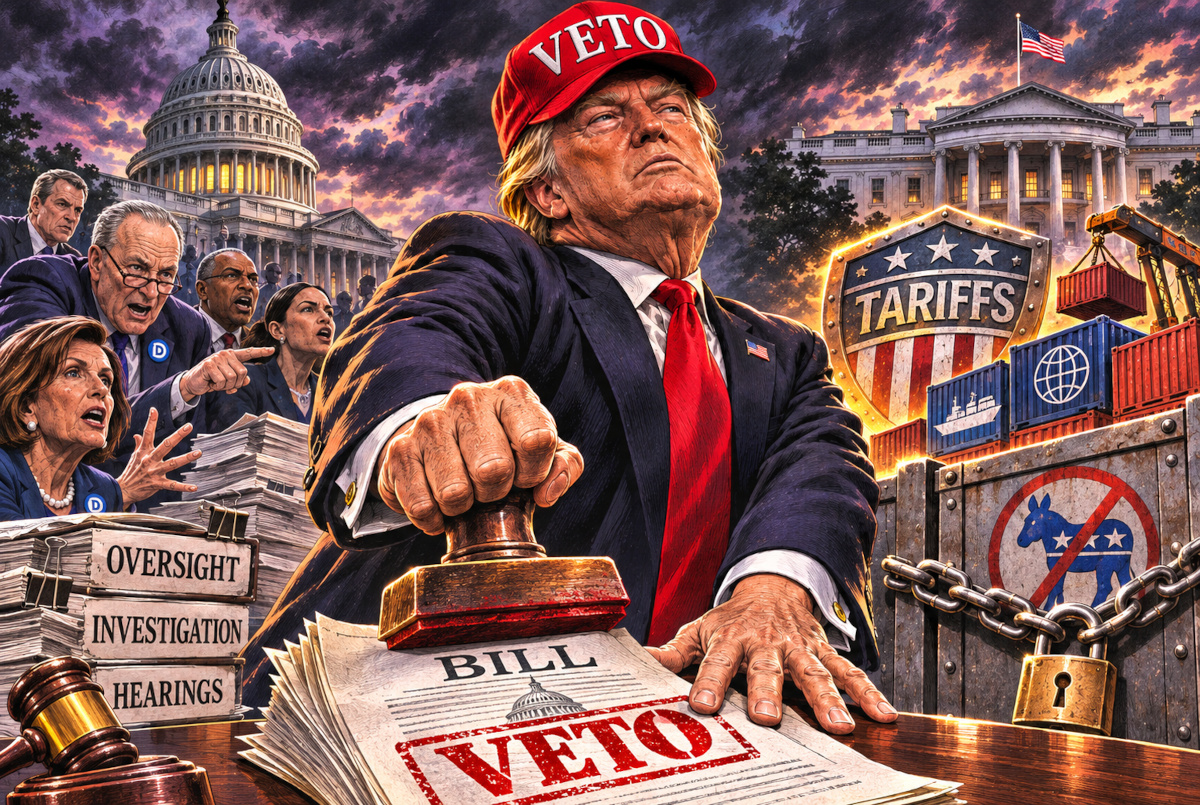
AI-generated conceptual illustration. Democratic control of Congress does not remove the president’s veto power, and existing tariffs operate under separate legal authorities. This image does not depict an actual veto ceremony or congressional confrontation.
Congress can pass legislation changing tariff authority, but the president can veto a bill. Overriding that veto generally requires a two-thirds vote in each chamber among members voting.
The practical result: even a decisive electoral defeat for Trump’s party does not instantly remove tariffs on Japanese goods.
The Yen Strengthened. Then the Dollar Came Back
The currency market offered its own warning against easy conclusions.
According to Japanese market reports from FISCO, USD/JPY traded between 158.74 and 157.40 during the Tokyo session on November 4, 2026. That is a difference of ¥1.34 per dollar, equivalent to about 0.84% of the higher exchange-rate quotation.
The dollar subsequently recovered above ¥158. These figures represent the reported trading range, not a comparison of closing prices.
What does a ¥1.34 movement actually mean for a business?
Consider a Japanese manufacturer expecting to receive $1 million from an overseas customer.
At ¥158.74 per dollar, the proceeds would be:
$1,000,000 × 158.74 = ¥158,740,000
At ¥157.40 per dollar, the same payment would be worth:
$1,000,000 × 157.40 = ¥157,400,000
The difference is ¥1,340,000, or ¥1.34 million.
For an exporter receiving dollars, a stronger yen reduces the amount received in yen. For a Japanese importer paying a $1 million invoice, the same currency movement reduces the yen-denominated payment by ¥1.34 million.
Now consider a hypothetical move from ¥158 to ¥150 per dollar. On a $1 million transaction, that produces an ¥8 million difference.
These are simple currency-conversion examples, not forecasts or actual company earnings. They exclude hedging, transaction fees, and other commercial arrangements.
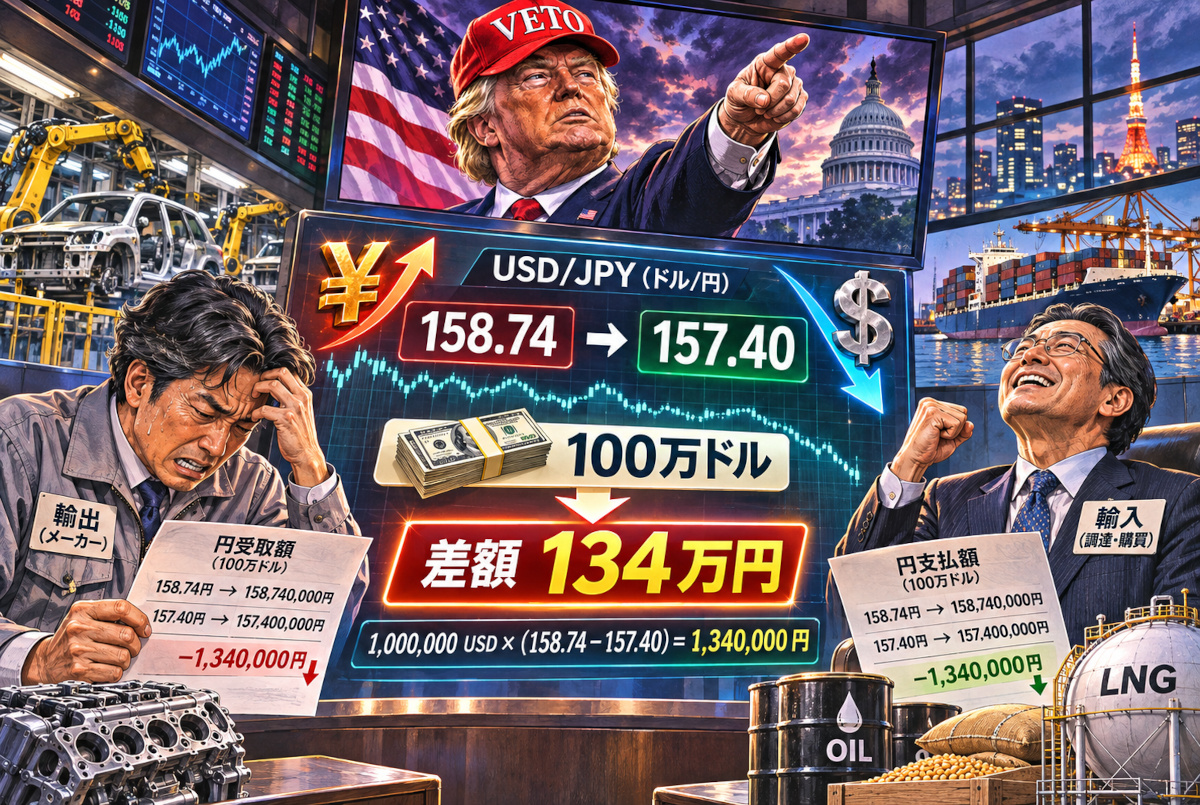
Original calculation using the reported November 4, 2026 Tokyo trading range of ¥158.74 and ¥157.40 per US dollar. A $1 million transaction differs by ¥1.34 million between these two rates. The people, businesses, equipment, and exchange-rate chart are illustrative; no actual corporate transaction or precise historical chart is depicted. Hedging and fees are excluded.
Why a Stronger Yen May Still Fail to Lower Japan’s Import Costs
Election results are only one influence on exchange rates. Interest rates and energy prices may prove just as important.
At the end of October 2026, the US Federal Reserve’s target policy-rate range stood at 3.75%–4.00%. The Bank of Japan’s corresponding short-term policy-rate target was approximately 1.25%.
That leaves a policy-rate gap of 2.50–2.75 percentage points. Such a gap can continue to support demand for dollar-denominated assets, although exchange rates also reflect expectations about future policy, inflation, and risk.
Lower US interest rates could encourage yen appreciation. Persistent American inflation, however, might keep US rates higher and support the dollar.
Then there is the Iran war and its potential effect on oil prices.
Suppose crude oil costs $100 per barrel and the exchange rate is ¥158 per dollar. The yen-denominated price would be:
$100 × ¥158 = ¥15,800 per barrel.
Now suppose the yen strengthens to ¥150 per dollar, but oil rises to $110 per barrel:
$110 × ¥150 = ¥16,500 per barrel.
Despite a roughly 5.1% decline in the USD/JPY quotation, the yen-denominated crude oil price would rise by approximately 4.4%.
A stronger yen does not guarantee cheaper imports when the underlying dollar price rises faster.
This is a hypothetical calculation, not an actual oil-price forecast. Freight, insurance, taxes, refining, and distribution costs are excluded.
What Japanese Businesses Should Watch Next
The midterm election changes the balance of power in Washington. It does not automatically rewrite existing trade agreements, cancel tariff measures, or close the interest-rate gap between Japan and the United States.
For exporters and importers, three developments deserve particular attention: whether the new Congress seeks to restrict presidential tariff authority, whether Federal Reserve and Bank of Japan policies narrow the rate gap, and whether the Iran conflict continues to affect global energy prices.
Companies also need to distinguish the customs duties formally payable by US importers from the wider costs that may be passed through to Japanese suppliers or buyers.
Making pricing, purchasing, or hedging decisions on the assumption that a Republican defeat guarantees a stronger yen would be risky.
Political momentum and business cash flow are not the same thing.
Editor’s Note
What caught my attention was not simply that Trump’s party lost Congress. It was the obvious follow-up question: what does a president who has spent so much political energy on tariffs do when his party loses control of the legislature?
I initially wondered whether this might finally bring an end to the tariff battles. Then I started looking at the legal authorities. One route was blocked by the Supreme Court, yet other routes remained available. Close one door, and there seems to be another corridor in the building.
And that red VETO cap? As political imagery goes, four letters on a baseball hat are remarkably effective. But a photograph of a hat does not make a customs bill disappear, nor does it settle a foreign-exchange market.
From Japan’s perspective, I would welcome some relief from costly dollar-denominated imports. Yet the numbers are less cooperative than the headlines. A stronger yen can help an importer while squeezing an exporter. Rising oil prices can erase the currency benefit altogether.
Washington can change its political direction overnight. The economics of doing business with America do not change quite so neatly.
That, for me, is the part worth watching.
References
- Reuters (November 4, 2026): Democrats seize control of both chambers of Congress in the US midterms
- Agence France-Presse (November 4, 2026): Trump congratulates Democrats and discusses the Iran war and presidential vetoes
- FNN Prime Online (November 4, 2026): Trump posts an image of a red VETO cap (Japanese-language report)
- Supreme Court of the United States: Learning Resources, Inc. v. Trump, February 20, 2026 (official opinion, PDF)
- Office of the United States Trade Representative: July 2026 Section 301 tariff actions concerning forced-labor import restrictions
- Congressional Research Service: U.S.-Japan Trade Agreements and Tariff Negotiations, updated September 22, 2026 (CRS report reproduced by EveryCRSReport)
- U.S. Customs and Border Protection: Tips for New Importers and Exporters, including importer-of-record responsibilities
- FISCO / Kabutan (November 4, 2026): Tokyo foreign-exchange trading range and dollar rebound (Japanese-language market report)
- Federal Reserve: Federal Open Market Committee statement, October 28, 2026
- Bank of Japan: Monetary Policy Decision, October 30, 2026 (official Japanese-language PDF)