

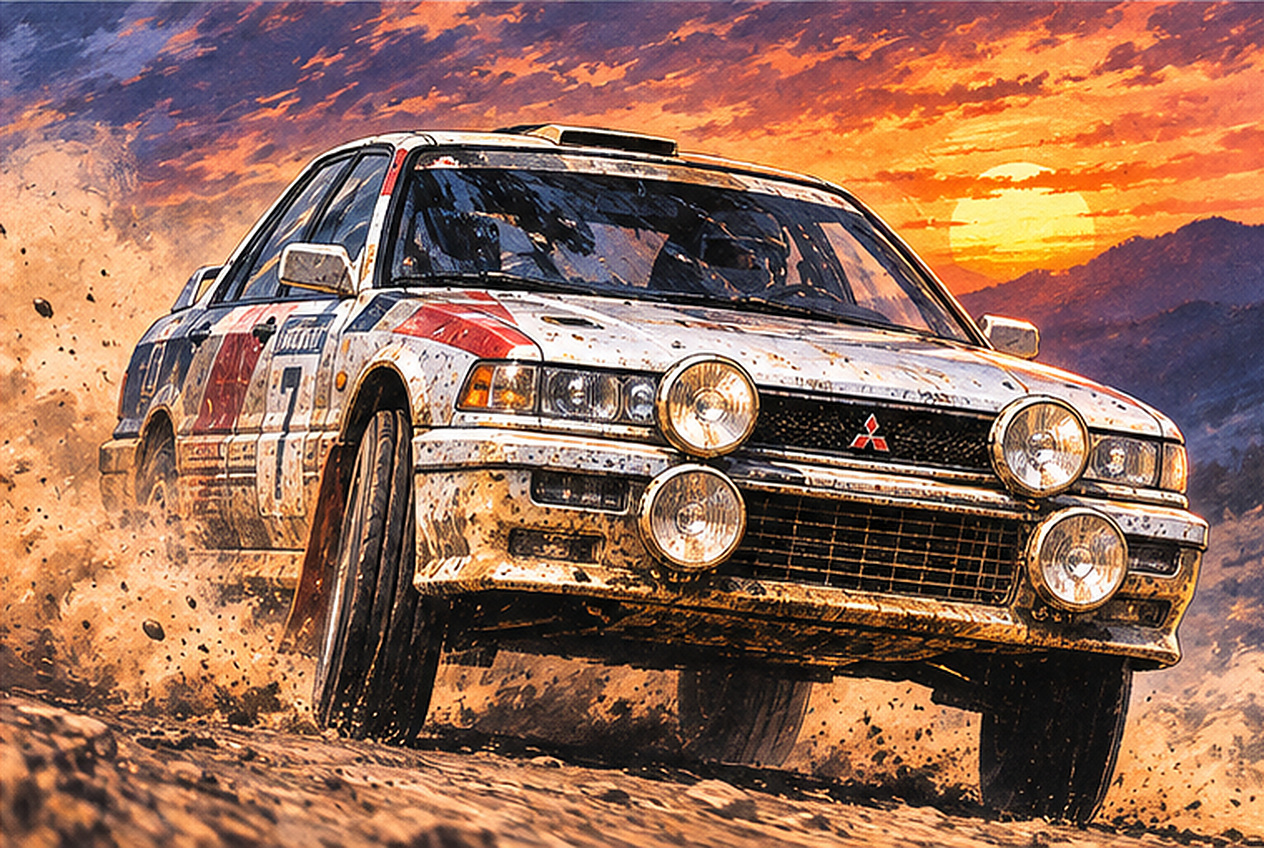
Before the Lancer Evolution became Mitsubishi’s defining rally car, another four-door sedan was doing the hard work in the World Rally Championship (WRC).
It was the Galant VR-4, the high-performance version of the sixth-generation Galant introduced in 1987. With its 2.0-liter turbocharged engine, full-time four-wheel drive, and four-wheel steering, it was considerably more than an ordinary family sedan. Road-car output eventually rose from 205 PS to 240 PS, while its Group A rally counterpart recorded six overall WRC victories between 1989 and 1992.
And there is a particularly interesting detail about its final season. At the last WRC round of 1992, Mitsubishi entered a Galant VR-4 equipped with a new four-wheel-drive system intended for the forthcoming Group A Lancer Evolution.
How did a relatively large sedan win six WRC rallies, and why did Mitsubishi replace it with the smaller Lancer while it was still capable of winning? The manufacturer’s competition records, period specifications, and a few revealing comparisons offer a more interesting answer than simply calling the Galant a predecessor to the Evo.
1987: Mitsubishi Turned Its Comfortable Sedan into a Serious Performance Car
Mitsubishi launched the sixth-generation Galant in October 1987. The familiar Sigma name disappeared, replaced by a new design philosophy advertised in Japan as the “Individual 4-Door.”
The styling was a substantial departure from the long, low sedans that preceded it. The Galant featured a reverse-sloping nose, pronounced fenders, and a comparatively tall cabin. It looked muscular rather than merely elegant.
In December 1987, Mitsubishi introduced the VR-4, powered by the 4G63: a 1,997cc inline-four with twin overhead camshafts, 16 valves, turbocharging, and an intercooler.
The original Japanese-market VR-4 produced 205 PS and 30.0 kg-m of torque.
But the engine was only part of the story. Mitsubishi brought several technologies together under the name ACTIVE FOUR.
The package combined a four-valve DOHC engine, full-time four-wheel drive, four-wheel independent suspension, four-wheel steering (4WS), and four-wheel anti-lock braking (4ABS).
The drivetrain used a center differential with a viscous coupling, allowing power to reach both axles while accommodating differences in rotational speed. The four-wheel steering system also turned the rear wheels slightly to improve stability and handling.
Mitsubishi was not simply fitting a powerful engine to a family car. It was rethinking acceleration, traction, cornering, braking, and stability as a complete package.
The sixth-generation Galant subsequently earned Mitsubishi Motors its first Car of the Year Japan award. It was recognition that the company’s ambitious sedan had achieved more than impressive straight-line performance.
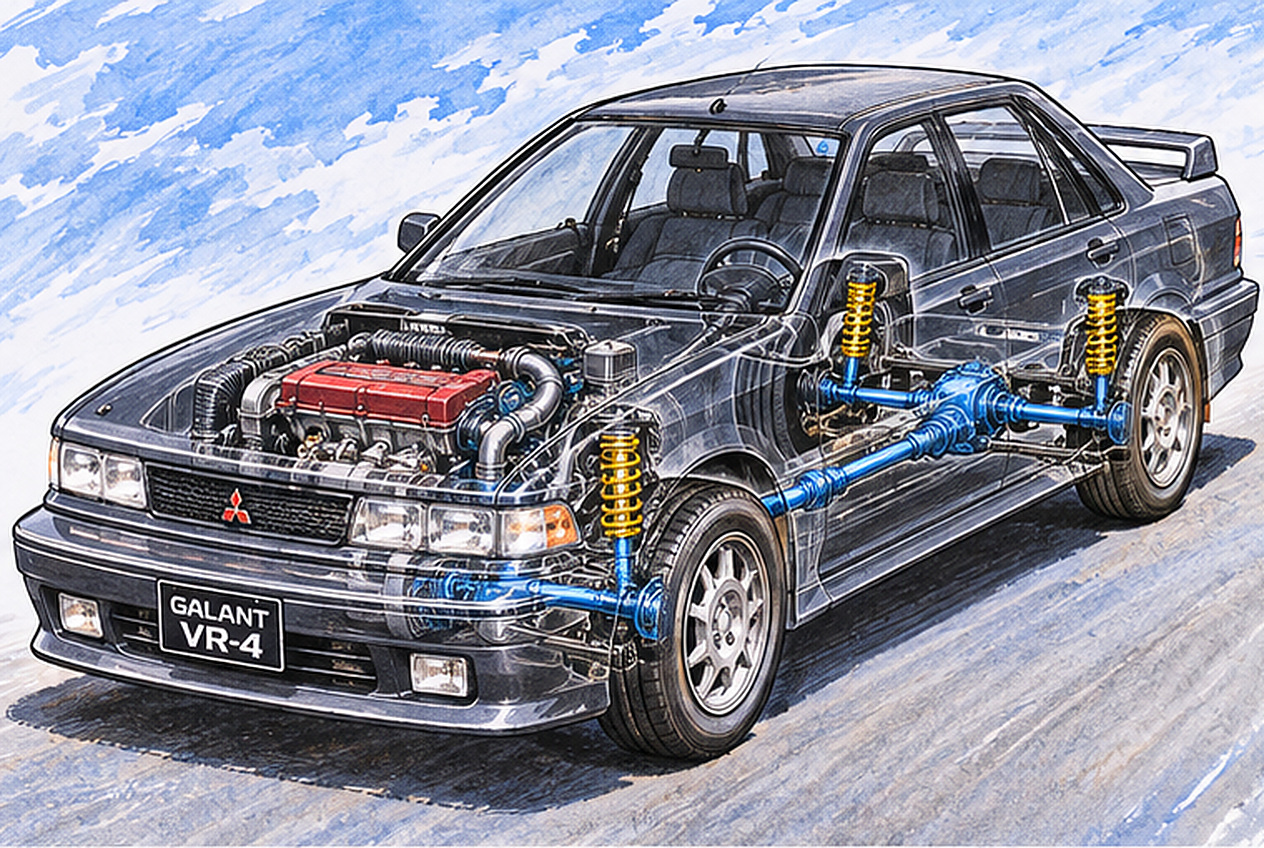
AI-generated conceptual illustration of the ACTIVE FOUR technology fitted to the Galant VR-4 introduced in 1987. It represents the 4G63 turbo engine, full-time four-wheel drive, and independent suspension. The hydraulic 4WS mechanism, center differential, driveshafts, suspension components, and their exact positions do not faithfully reproduce the production vehicle. This is not a technical engineering drawing.
The 4G63 Went from 205 to 240 PS—A 17% Increase
The VR-4’s turbocharged 4G63 did not stand still after its introduction.
The five-speed manual version gained power in successive revisions: 220 PS in 1989 and 240 PS in October 1990. Its displacement remained 1,997cc.
| Period | 5-speed MT output | Increase over launch |
|---|---|---|
| December 1987 | 205 PS | Baseline |
| 1989 | 220 PS | +15 PS |
| October 1990 | 240 PS | +35 PS |
The increase from 205 to 240 PS can be calculated as follows:
(240 − 205) ÷ 205 × 100 = approximately 17.1%.
That is a substantial improvement without increasing engine displacement. However, these figures refer to the specified manual-transmission versions. Later automatic VR-4 models included 210 PS specifications, so it would be incorrect to claim every late-production VR-4 produced 240 PS.
Meanwhile, Mitsubishi continued developing the Group A competition version of the 4G63.
The company’s official WRC history describes its rally engine as producing more than 300 PS from the beginning of the program. Curiously, the specification table on that same official page lists 290 PS for the Galant VR-4 rally car.
Those figures may represent different configurations or periods, but the available official material does not explain the discrepancy clearly enough to establish that as fact.
The competition drivetrain evolved as well. In 1990, Mitsubishi introduced a revised competition viscous coupling in the center differential. Further changes followed with the updated Group A Galant in 1991.
That distinction matters. Under the Group A regulations, rally cars had to be based on qualifying production models, but their competition specifications were not identical to those sold to ordinary customers.
In other words, the road-going 240 PS VR-4 and the competition Galant should not be treated as mechanically identical cars merely because both carried the 4G63 name.
The Galant AMG Wasn’t a Faster VR-4. It Was a Different Kind of Performance Car
Then came one of the oddest members of the Galant family.
In October 1989, Mitsubishi introduced the Galant AMG, developed in collaboration with the West German tuning company AMG.
From a modern perspective, the name might suggest an even more powerful turbocharged, four-wheel-drive version of the VR-4.
It was nothing of the sort.
The Galant AMG used a naturally aspirated, DOHC 4G63 engine driving the front wheels. Maximum output was 170 PS—50 PS less than the contemporary 220 PS manual VR-4.
That comparison makes the AMG look almost backward if horsepower is the only measurement that matters.
But its purpose was different. Instead of chasing turbocharged power and all-wheel-drive traction, the AMG focused on engine response, high-revving characteristics, and its own interior and exterior treatment.
Mitsubishi’s historical account also highlights the use of titanium-alloy valve-spring retainers, described by the company as a world first for a production automobile.
Two cars, both bearing the 4G63 name: the VR-4 pursued turbocharged power and all-wheel-drive capability, while the AMG favored naturally aspirated engine character.
They were not arranged in a simple hierarchy with the AMG as the faster, more expensive-looking VR-4. They represented two different approaches to building a sporting sedan.
Half of the Galant’s Six WRC Victories Came in Africa
The Galant VR-4 made its WRC debut in July 1988 at Rally New Zealand, driven by Kenjiro Shinozuka. Later that year, Ralliart Europe entered the RAC Rally in Britain.
Mitsubishi’s first Galant VR-4 WRC victory arrived in 1989, when Mikael Ericsson won Finland’s 1000 Lakes Rally. Pentti Airikkala followed with victory at the RAC Rally later that season.
Those European results are often the headline achievements in brief histories of the car.
But where did the remaining four victories come from?
We reorganized Mitsubishi’s official list of six WRC victories by year, location, and winning driver.
| Year | Rally / Country | Winning driver |
|---|---|---|
| 1989 | 1000 Lakes Rally / Finland | Mikael Ericsson |
| 1989 | RAC Rally / United Kingdom | Pentti Airikkala |
| 1990 | Rallye Côte d’Ivoire / Ivory Coast | Patrick Tauziac |
| 1991 | Swedish Rally / Sweden | Kenneth Eriksson |
| 1991 | Rallye Côte d’Ivoire / Ivory Coast | Kenjiro Shinozuka |
| 1992 | Rallye Côte d’Ivoire / Ivory Coast | Kenjiro Shinozuka |
Three victories came in European rallies. The other three were recorded in Côte d’Ivoire, the West African nation also known as Ivory Coast.
Three of six wins means exactly 50% of the Galant VR-4’s WRC victories came from the same African rally.
That does not mean half of its competitive ability can somehow be attributed to African events. It is simply a geographic breakdown of the car’s recorded overall wins.
The Côte d’Ivoire event was a particularly demanding long-distance rally, frequently held on rough, unpaved roads. Its conditions differed considerably from those of Finland, Britain, or Sweden, but all six results are recorded by Mitsubishi as WRC event victories.
Nor should six event victories be confused with six World Rally Championship titles. The Galant VR-4 did not win six annual world championships.
The African victories also include a major milestone in Japanese motorsport history.
In 1991, Kenjiro Shinozuka, accompanied by British co-driver John Meadows, won the Côte d’Ivoire Rally in car number 7. Shinozuka became the first Japanese driver to win a WRC event overall.
He repeated the victory in 1992, bringing the Galant VR-4’s WRC total to six.
Mitsubishi also finished third in the WRC manufacturers’ standings in both 1990 and 1991.
There is no convincing way to explain all six victories with one mechanical feature alone. Mitsubishi was developing the competition 4G63, revising its drivetrain, and operating both a European works program and a semi-works effort associated with Shinozuka.
The records show a continuous process of technical development and competition experience. They do not, however, allow us to assign an exact share of each victory to engine performance, driving, durability, or team strategy.
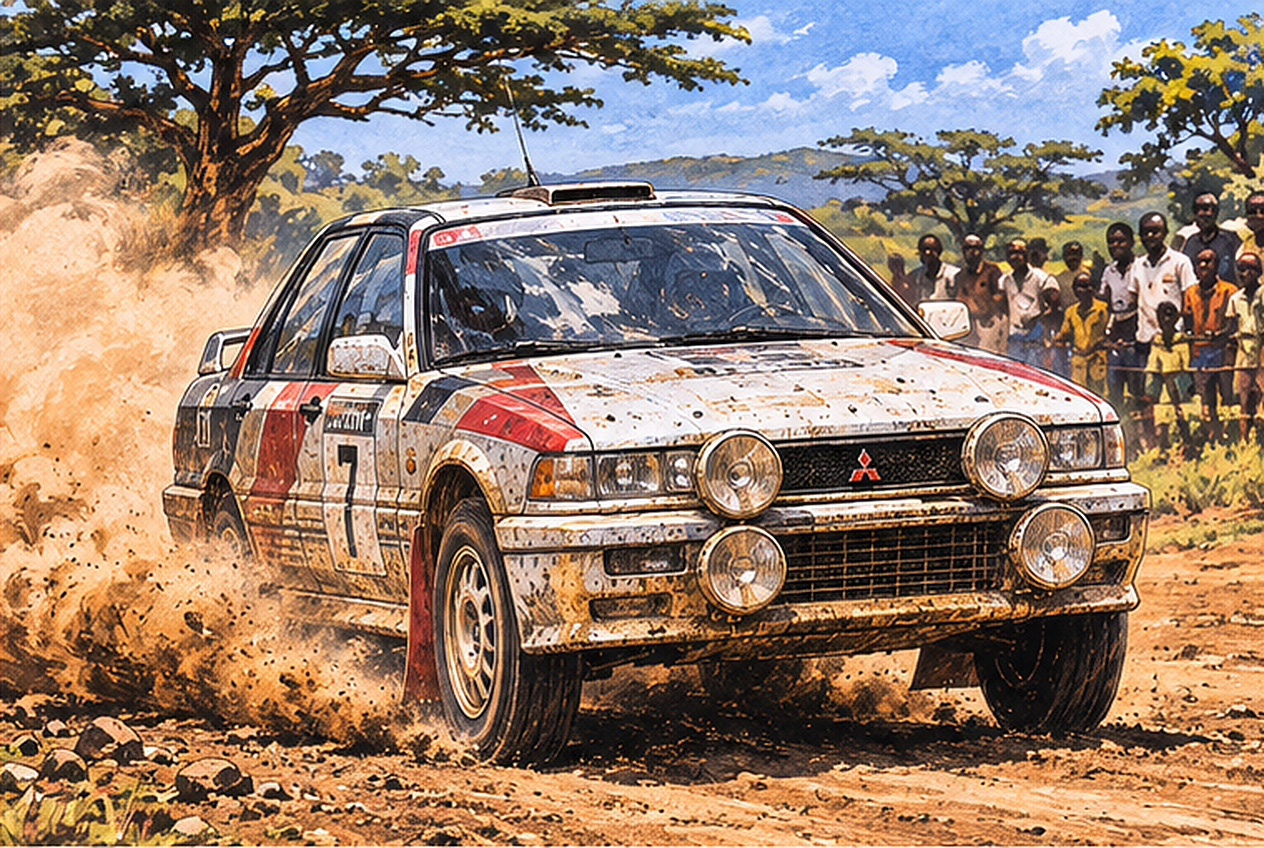
AI-generated historical interpretation inspired by the Galant VR-4 that won the 1991 Rallye Côte d’Ivoire. Kenjiro Shinozuka and John Meadows actually competed in car number 7 and won the event. Sponsor markings, vehicle decoration, equipment details, spectators, and the depicted location are artistic reconstructions and do not reproduce an authentic photograph or a specific stage of the rally.
1992: Mitsubishi Moved Its Rally Hardware into a Car 250mm Shorter
Six WRC victories were an impressive achievement for a relatively large four-door sedan. So why did Mitsubishi move away from the Galant?
In October 1992, the company introduced the original Lancer Evolution.
The basic strategy was to take the turbocharged 4G63 and the full-time four-wheel-drive technology developed through the Galant VR-4 program and fit them into a smaller Lancer-based car.
Comparing representative Japanese-market production specifications makes the change immediately apparent.
| Specification | Late Galant VR-4 5-speed MT |
Lancer Evolution I GSR |
|---|---|---|
| Overall length | 4,560mm | 4,310mm |
| Overall width | 1,695mm | 1,695mm |
| Wheelbase | 2,600mm | 2,500mm |
| Maximum output | 240 PS | 250 PS |
The original Lancer Evolution was 250mm shorter in overall length, a reduction of approximately 5.5% compared with the Galant.
Its wheelbase was shorter by 100mm. Yet both cars measured 1,695mm across the body, and the Lancer’s production engine made an additional 10 PS.
The relative length difference is straightforward to calculate:
(4,560 − 4,310) ÷ 4,560 × 100 = approximately 5.48%.
These dimensions show Mitsubishi moving its proven performance hardware from a larger sedan into a more compact platform while preserving the same overall width.
They do not, by themselves, prove a particular lap-time advantage or a fixed improvement in rally handling. Vehicle mass, suspension geometry, drivetrain setup, gearing, and many other factors also matter.
But they help explain why the Lancer represented more than a simple change of badge.
The most revealing evidence, however, comes from the Galant’s final WRC appearance.
According to Mitsubishi’s official competition history, the Galant VR-4 entered the season-ending 1992 RAC Rally with a new four-wheel-drive system intended for the Group A Lancer Evolution scheduled to debut in 1993.
The purpose was to test the new system under actual rally conditions before the replacement car began its WRC campaign.
The Galant VR-4 was still being used to develop the next generation of Mitsubishi rally machinery at its final WRC event.
There is an important qualification. Mitsubishi’s published account does not provide a complete breakdown of the new system’s components or the results of the test. It would therefore be misleading to claim that every future Lancer Evolution drivetrain feature had been finalized during that event.
What can be established is more than interesting enough: the outgoing Galant was used for an advance competition trial of the equipment intended for its successor.
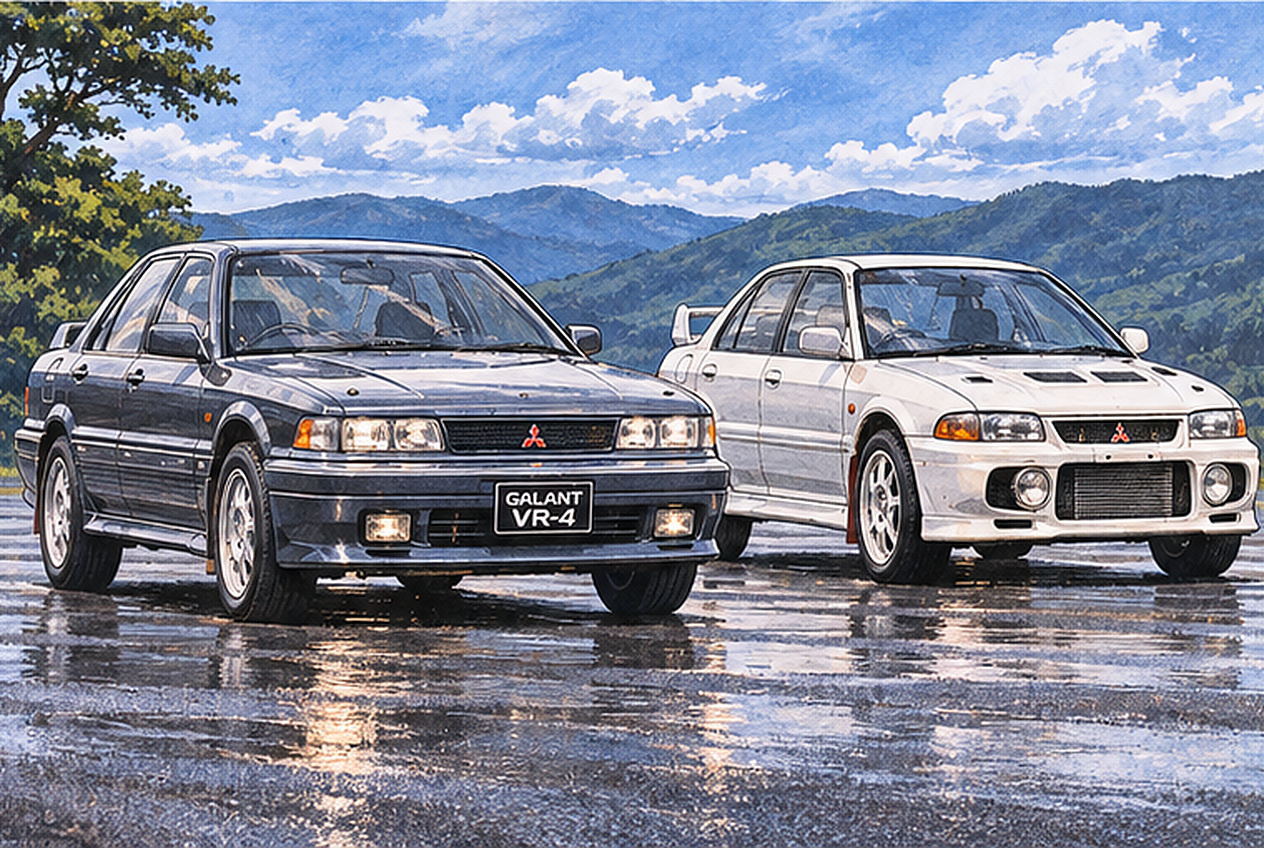
AI-generated illustration comparing the sixth-generation Galant VR-4 (left) with the original 1992 Lancer Evolution (right). The production cars measured 4,560mm and 4,310mm in overall length respectively, a difference of 250mm. Their wheelbases were 2,600mm and 2,500mm, a difference of 100mm. The illustration conveys their relative size and design character but is not drawn to an exact common scale, and exterior details do not precisely reproduce every original component.
The Galant Didn’t Simply Lose Its Place. It Passed the Technology On
By May 1992, Mitsubishi had already introduced the seventh-generation road-going Galant. Yet the older VR-4 continued its rally career until the end of that year.
In October, it recorded its sixth WRC victory in Côte d’Ivoire. At the season-ending RAC Rally, it helped test the four-wheel-drive technology intended for the Lancer Evolution’s WRC debut.
That sequence makes the changeover look less like a sudden admission of defeat and more like a deliberate transfer of accumulated engineering experience.
The Galant had proved the potential of a turbocharged 4G63 and full-time four-wheel drive in international rally competition. Mitsubishi then moved that combination into a smaller, more purpose-focused car.
The Lancer Evolution would go on to build an extraordinary rally reputation of its own. But its success did not emerge from nowhere.
The Galant VR-4 had already won six WRC rallies and helped establish much of the engineering foundation on which the Lancer Evolution was built.
Editor’s Note
The thing that caught my attention wasn’t simply the Galant VR-4’s six WRC wins. It was discovering that half of them came from Côte d’Ivoire.
When people talk about this car, Finland and the RAC Rally tend to get the attention. Yet Mitsubishi was winning in demanding African conditions too, and Kenjiro Shinozuka managed back-to-back victories there. That deserves more recognition than it usually receives.
Then there is the Galant AMG. I originally expected something even more extreme than the VR-4. Instead, Mitsubishi brought in AMG and produced a 170 PS, naturally aspirated, front-wheel-drive sedan. Not exactly the obvious way to win a horsepower contest, is it?
But that is precisely why I like it. The company was willing to explore a completely different idea of performance within the same model family.
And the final RAC appearance is a particularly satisfying detail. Mitsubishi didn’t merely park the Galant and move on. It sent the old rally car out with a new job: helping to develop the system that would be used by its replacement.
Before the Lancer Evolution became the legend, a sedan called the Galant had already gone remarkably far. For me, that is the real discovery in this chapter.
Next in this seven-part series: what happened to the Galant after the rally spotlight moved to the Lancer? From 1992 onward, Mitsubishi began redefining the role of its established sedan once again.
Mitsubishi Galant: Seven-Part History Series
From the original Colt Galant and the Galant Sigma to the rally-winning VR-4, GDI technology, and the end of the Galant name. Across seven articles, we explore the cars, engineering, motorsport history, and legacy of one of Mitsubishi's defining model lines.
- Part 1: The Colt Galant Came Before Mitsubishi Motors—and Led to the GTO and FTO (Part 1)
- Part 2: The Galant Sigma Was a Hit—So Why Did Mitsubishi Abandon RWD? (Part 2)
- Part 3: The Galant VR-4 Won Six WRC Rallies. Why Did Mitsubishi Replace It? (Part 3)
- Part 4: English edition Coming soon
- Part 5: English edition Coming soon
- Part 6: English edition Coming soon
- Final Part: English edition Coming soon
Terms That May Need a Quick Explanation
- Group A
- An international motorsport category based on production cars meeting homologation requirements. Competition modifications were permitted within defined regulations. Group A was a major category in the World Rally Championship during the late 1980s and 1990s.
References
- Mitsubishi Motors — Car History (English). Official descriptions of the sixth-generation Galant, ACTIVE FOUR technology, the Galant AMG, and the original Lancer Evolution.
- Mitsubishi Motors — Vehicle History (Japanese). The original model history, equipment details, technical developments, and representative production specifications.
- Mitsubishi Motors — Company History (Japanese). Corporate and technical chronology, including the 4G63 engine and the launch-period Galant VR-4.
- Mitsubishi Motors — World Rally Championship, 1988–1992 (Japanese). Primary source for the six WRC victories, manufacturers’ results, competition drivetrain development, differing rally-engine power figures, and the 1992 RAC Rally test.
- Mitsubishi Motors — The Evolution of Four-Wheel Control Technology, Part 1 (Japanese). Official explanation of ACTIVE FOUR and Mitsubishi’s development of all-wheel-control systems.
- Car and Driver Japan — The 1987 Mitsubishi Galant and Car of the Year Japan (Japanese). A contemporary-catalog retrospective covering the VR-4’s engine, drivetrain, steering, suspension, and equipment.
- Web Motor Magazine — Classic Japanese Cars No. 105: Mitsubishi Galant VR-4 (Japanese). Historical review of the VR-4 and the progression from 205 PS to 220 PS and 240 PS.
- GAZOO — 1989 Mitsubishi Galant AMG Specifications (Japanese). Specifications of the naturally aspirated, front-wheel-drive AMG variant.
- GAZOO — 1990 Mitsubishi Galant VR-4 Monte Carlo Specifications (Japanese). Representative late-model dimensions, 4G63 turbo specifications, and 240 PS output.
- GAZOO — 1992 Mitsubishi Lancer GSR Evolution Specifications (Japanese). Original Lancer Evolution GSR dimensions and 250 PS specification. The individual listing gives November 1992, while Mitsubishi’s official model history dates the model launch to October 1992.
- JUWRA — 1991 Ivory Coast Rally Final Results (English). Historical results confirming Kenjiro Shinozuka’s overall victory and car number 7.
- JUWRA — 1991 Ivory Coast Rally Entry List (English). Entry record identifying Kenjiro Shinozuka and co-driver John Meadows in the number 7 Galant VR-4.