

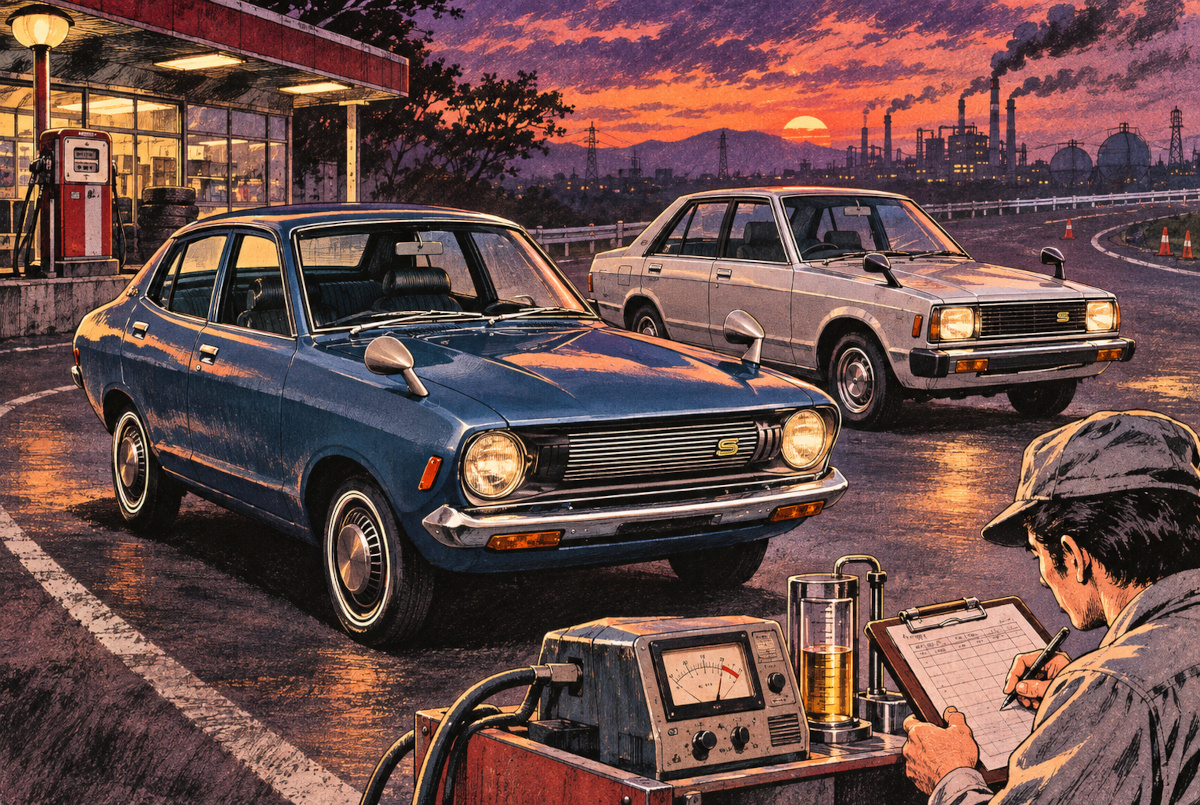
In 1975, the Datsun Sunny reportedly became the world’s second-most-produced car model. That is quite a claim for a modest Japanese family car, especially in a decade dominated by the oil crisis and increasingly demanding emissions regulations.
The Sunny is often remembered as the car that never quite managed to dethrone Toyota’s Corolla in Japan. So a second-place global ranking sounds like a remarkable achievement.
But when I checked the production figures, something peculiar appeared: the Corolla numbers in the historical ranking did not match Toyota’s own production records.
Was the Sunny really the world’s No. 2 car in 1975? And how did Nissan keep its small rear-wheel-drive family car competitive through an era of oil shortages and tougher pollution controls?
To investigate, we follow the rounded third-generation B210 and the fourth-generation B310, the last rear-wheel-drive passenger-car Sunny in Japan. Along the way, we examine historical production figures, exhaust-emissions standards, fuel economy, and the extraordinary survival of the Sunny Truck.
1973: The Sunny Got Rounder. Then Came the Oil Crisis.
Nissan introduced the third-generation Sunny B210 in May 1973. Gone was much of the crisp, straightforward styling of the B110. The new model adopted a noticeably rounder, more sculpted body.
The coupe was particularly distinctive, with a large rear hatch and an unusually abrupt tail treatment. The Sunny Excellent coupe also attracted attention with its six round taillights.
Nissan improved safety equipment, expanding the availability of collapsible steering columns, seat belts, head restraints, and front disc brakes. The Sunny was moving beyond its original role as simple, inexpensive family transport.
Then, in October 1973, the first oil crisis began. According to Japan’s Agency for Natural Resources and Energy, international crude oil prices rose roughly fourfold in about three months.
The timing matters. The B210 was not developed in response to the oil crisis. It had already gone on sale before the crisis erupted.
Nissan had designed a more substantial and better-equipped Sunny, only to find that fuel consumption and emissions were suddenly becoming even more pressing concerns for car buyers and engineers alike.
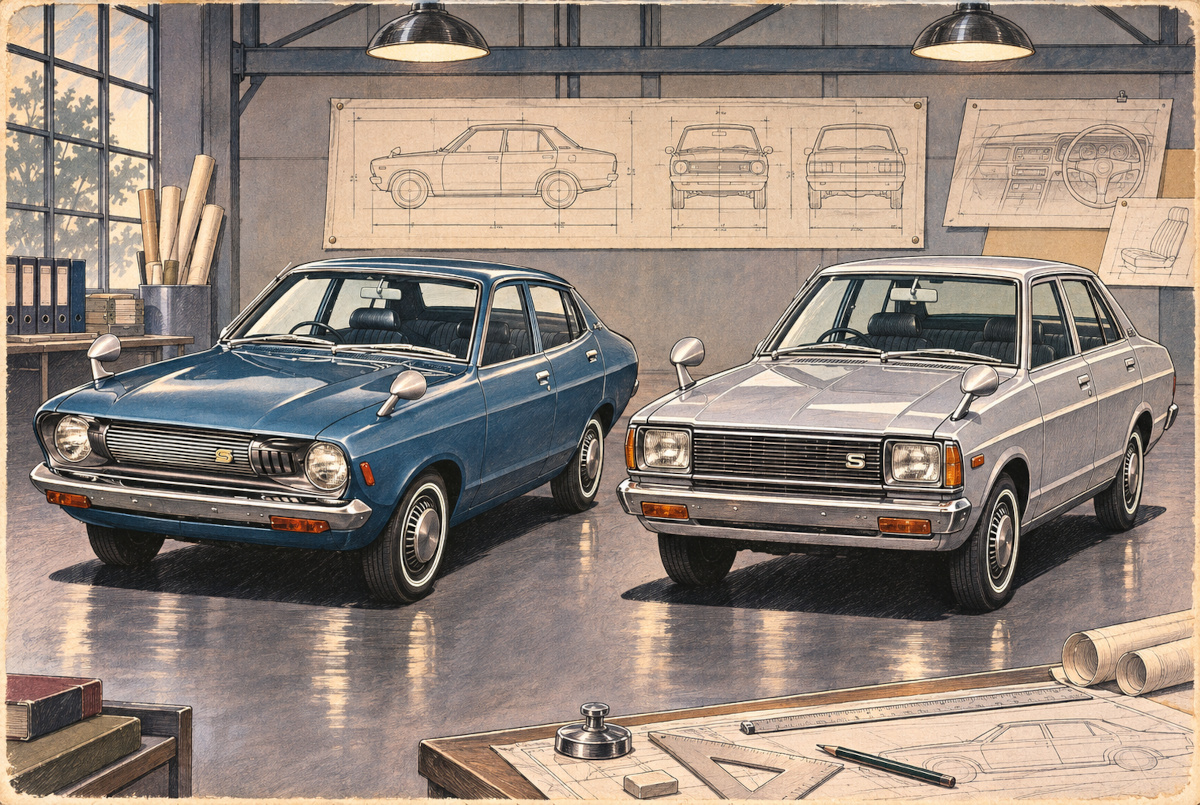
AI-generated editorial comparison based on the 1973 Sunny B210 and the Sunny B310 with rectangular headlights introduced in the October 1979 facelift. The image illustrates the change in design direction; it is not an exact reproduction of the original 1977 B310 or every factory trim detail.
Did the Sunny Really Become the World’s No. 2 Car?
According to the Japanese automotive-history publication Meisha Bunka Kenkyujo, the Sunny ranked second in a worldwide production ranking by vehicle model in 1975, with 531,430 units.
The same source lists 431,903 units for 1974, when the Sunny reportedly ranked fourth, and 541,838 units for 1976, when it placed third.
| Year | Reported Sunny production | Reported world ranking |
|---|---|---|
| 1974 | 431,903 units | 4th |
| 1975 | 531,430 units | 2nd |
| 1976 | 541,838 units | 3rd |
Source: Meisha Bunka Kenkyujo, “1974 Toyota Corolla vs. 1973 Nissan Sunny.” These are figures reproduced by the publication. The original ranking dataset and its complete counting methodology have not been independently verified.
Using the published figures, the Sunny’s output increased by 99,527 units between 1974 and 1975.
The percentage increase is:
(531,430 – 431,903) / 431,903 x 100 = approximately 23.0%.
That is a substantial increase in the figures reported for a period affected by the oil crisis.
But here is where the ranking becomes more complicated.
The same automotive-history source reports Corolla production of 648,965 units for 1975. Toyota’s official 75-Year History, however, records 757,265 Corollas produced in Japan alone during that year.
The difference is:
757,265 – 648,965 = 108,300 vehicles.
That is not a minor rounding discrepancy. It means the two published series cannot simply be treated as interchangeable.
There is another clue. In an August 1976 announcement, Toyota described the Corolla as the world’s leading production model in 1974 and 1975, but specified that its ranking covered cars produced in their home countries and excluded production in Communist countries.
We cannot establish from the available material whether Meisha Bunka Kenkyujo used exactly those conditions, or what explains the difference between its Corolla figure and Toyota’s historical domestic total.
The lesson is that a “world production ranking” is only meaningful when we know precisely what was counted. Was it a particular model range, a manufacturer’s domestic output, or another defined production category? Without the original dataset, the answer remains uncertain.
So the correct conclusion is a qualified one: a published historical ranking places the Sunny second in 1975, but we cannot independently confirm that it ranked second under a comprehensive, consistently defined worldwide production count.
Even with that limitation, the reported annual output of more than half a million Sunnys illustrates how far this once-humble Japanese family car had spread.
The Emissions Regulations That Kept Nissan’s Engineers Busy
For Japanese manufacturers, the 1970s were not just about fuel prices. They also brought a succession of increasingly demanding exhaust-emissions regulations, including the 1975, 1976, and 1978 standards.
One of the toughest challenges was reducing nitrogen oxides, or NOx, which are formed during high-temperature combustion and contribute to air pollution.
Japan’s Environment Agency set a 1978 target of 0.25 grams of NOx per kilometer as an average emissions value under the prescribed 10-mode test.
For the applicable passenger-car category with an equivalent inertia weight of 1,000kg or less, the corresponding 1976 average value was 0.6g/km.
Comparing those two values gives:
(0.60 – 0.25) / 0.60 x 100 = approximately 58.3%.
In other words, the later average target was roughly 58% lower.
There is an important distinction, though. The 0.25g/km figure was the average target, whereas the allowable limit incorporating the prescribed margin was 0.48g/km. Calling both figures the same legal maximum would be misleading.
To meet the new requirements, Nissan developed and refined its NAPS emissions-control technology, short for Nissan Anti-Pollution System.
The basic strategy involved several complementary methods. Exhaust gas recirculation (EGR) helped reduce NOx formation by lowering combustion temperatures. Secondary-air injection and oxidation catalysts were used in suitable systems to reduce carbon monoxide (CO) and unburned hydrocarbons (HC).
These functions were not necessarily combined in precisely the same way on every Nissan engine. NAPS was a family of emissions-control approaches, not one identical device fitted to every model.
Meanwhile, Nissan continued revising the Sunny’s engine range. In 1976, the B210 lineup gained a 1.4-liter A14-powered range, while the more upmarket Sunny Excellent developed into a 1.6-liter L16-powered model.
The engineers had to balance performance, fuel consumption, and cleaner exhaust while still producing cars ordinary families could afford.
1977: The Last Rear-Wheel-Drive Sunny Arrives
The fourth-generation Sunny B310 was announced in the autumn of 1977 and went on sale that November.
After the rounded B210, Nissan returned to a cleaner, more angular design. Mechanically, the car remained a conventional front-engine, rear-wheel-drive family sedan, but there were meaningful changes underneath.
Its principal initial engine choices included the A12A, with an actual displacement of 1,237cc, in the nominal 1.2-liter class, and the 1,397cc A14 in the 1.4-liter class.
The passenger car’s rear suspension moved from leaf springs to a four-link arrangement with coil springs, although it retained a live rear axle.
According to Nissan’s Heritage Collection, one of the B310’s major development objectives was meeting Japan’s stringent 1978 exhaust-emissions standards.
Using NAPS technology, Nissan achieved compliance while advertising a Japanese 10-mode fuel-economy figure of 15.5km/L for a 1.2-liter-class Sunny.
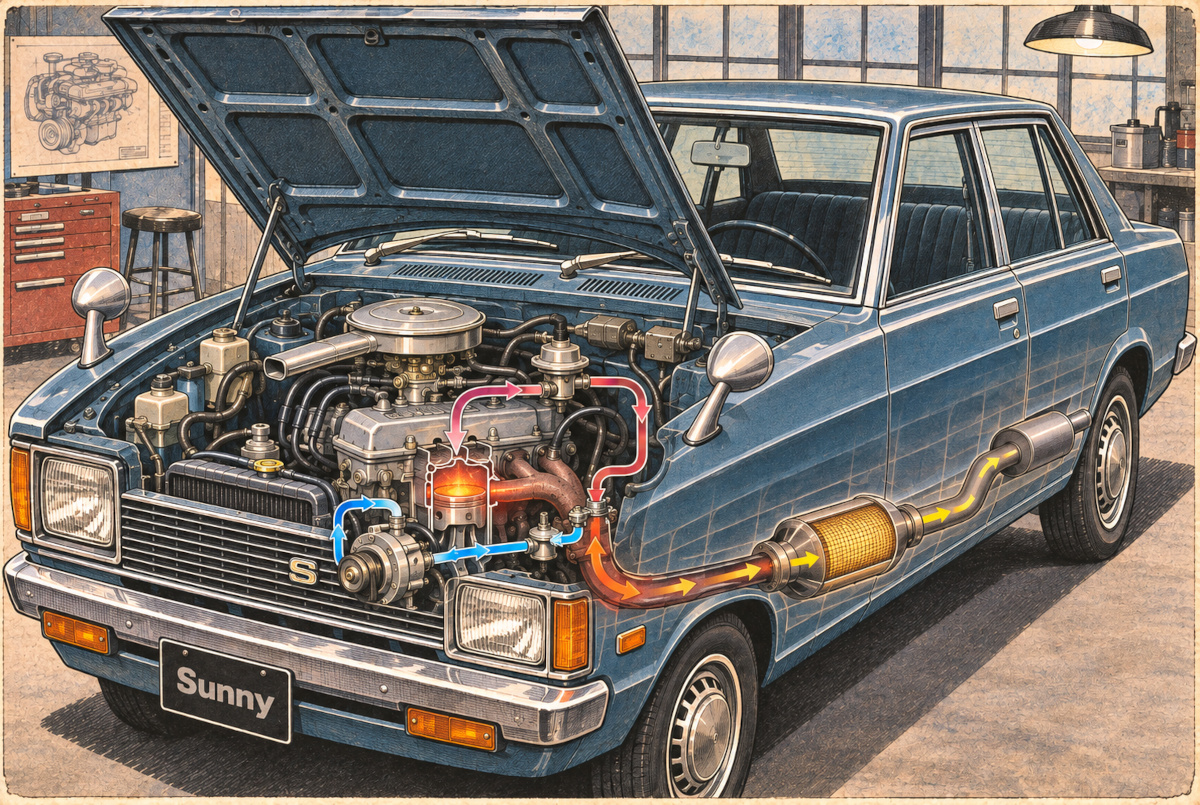
AI-generated conceptual illustration of Nissan’s 1970s NAPS emissions-control technologies. Red arrows schematically represent EGR, blue arrows secondary-air injection, and yellow arrows the exhaust-treatment path. Catalyst internals, component locations, and pipe routing are simplified and do not reproduce a verified B310 service diagram or a configuration shared by every variant. The car’s exterior is based on the post-1979 rectangular-headlamp B310.
What Does 15.5km/L Actually Mean in Fuel Consumption?
The 15.5km/L figure sounds respectable for a small family car of the period. But fuel consumption can be easier to visualize when expressed as the amount of gasoline needed to cover a fixed distance.
Using Nissan’s published 10-mode figure, we calculated the following theoretical consumption values.
| Distance traveled | Calculated gasoline consumption |
|---|---|
| 100km | Approximately 6.45 liters |
| 500km | Approximately 32.3 liters |
| 1,000km | Approximately 64.5 liters |
Calculated by dividing the distance by Nissan’s published 15.5km/L Japanese 10-mode figure for the 1.2-liter-class model. This assumes a constant test-cycle fuel-economy value and does not predict actual road consumption.
For international readers, the measurement method matters as much as the number itself.
Japan’s old 10-mode test was a standardized fuel-economy measurement procedure of its time. It is not directly comparable with today’s WLTC test cycle, nor does it represent an owner’s guaranteed city-driving fuel economy.
We also could not confirm a directly comparable B210 fuel-economy figure measured under equivalent conditions. It would therefore be misleading to claim that the B310 achieved a particular percentage improvement over its predecessor.
What Nissan’s record does establish is that fuel economy had become a major selling point alongside compliance with strict emissions requirements.
The B310 kept evolving. In 1978, an electronic fuel-injection version was added to the 1.4-liter range. In 1979, Nissan introduced the five-door Sunny California wagon, expanding the family’s appeal beyond conventional sedans and coupes.
It may not have looked like a technical revolution, but the B310 was adapting to a very different automotive market from the one the original Sunny had entered in 1966.
The Passenger Car Went Front-Wheel Drive. The Sunny Truck Did Not.
In October 1981, Nissan launched the fifth-generation B11 Sunny and switched its passenger-car range to front-wheel drive (FWD).
That made the B310 the last rear-wheel-drive Sunny passenger-car generation sold in Japan.
But the Sunny family had an unusual survivor.
The second-generation Sunny Truck, known by its B120 model code, had appeared back in 1971. It was based on the earlier B110 Sunny, and it retained the traditional front-engine, rear-wheel-drive layout.
As the passenger cars progressed through the B210, B310, and B11 generations, the little pickup continued with essentially the same basic architecture.
It was not completely frozen in time. Nissan revised the grille in 1978, updated the truck for Japan’s 1979 and 1981 emissions regulations, and introduced rectangular headlights and other changes in 1989.
In Japan, the Sunny Truck remained on sale until 1994. In South Africa, its descendant continued under the name “1400 Bakkie” until 2008. “Bakkie” is a South African term for a pickup truck.
The rear-wheel-drive Sunny passenger car ended in 1981, but the B110-derived pickup survived for another 13 years in Japan and remained part of the South African market until 2008.
Why such different lifespans?
Passenger-car buyers increasingly valued interior packaging, modern driving characteristics, and other improvements that encouraged manufacturers to adopt FWD.
A small commercial pickup had different priorities: affordability, carrying capacity, serviceability, and the usefulness of a proven design.
That is an interpretation of the contrasting product histories, rather than proof of one single corporate decision. Still, the long life of the Sunny Truck makes a persuasive point: the newest mechanical layout was not necessarily the most useful answer for every kind of vehicle.
Editor’s Note
When I first came across the claim that the Sunny had been the world’s No. 2 car in 1975, my reaction was simple: not bad at all, Nissan!
Then I checked the numbers. Suddenly the Corolla’s production total was more than 100,000 units different depending on which source I read. That rather spoils the fun of celebrating a ranking without asking what was actually counted.
That’s the trouble with impressive historical statistics. The headline is easy to remember. The small print is where the real story hides.
I also have some sympathy for the engineers who worked on the B210. They had just given the Sunny a rounder, more substantial appearance when the oil crisis arrived. Imagine putting all that effort into making a family car more sophisticated, only to find everyone increasingly worried about gasoline prices and exhaust emissions.
Personally, I’ve always preferred the sharper lines of the B310. And there’s something satisfying about discovering that underneath its rather ordinary appearance, Nissan had replaced the old rear leaf springs with a coil-sprung four-link arrangement. Someone had clearly bothered to improve the fundamentals.
But the Sunny Truck may be the strangest part of the story. The passenger cars kept changing, eventually abandoning rear-wheel drive altogether, while the old pickup just carried on.
Maybe that says more about automotive progress than another horsepower contest ever could. Newer is not automatically better for every job. Sometimes the old, uncomplicated machine is still exactly what its buyers need.
Terms That May Need a Quick Explanation
- EGR (Exhaust Gas Recirculation)
- An emissions-control method that routes some exhaust gas back into the engine’s intake. By reducing peak combustion temperatures, it helps limit the formation of nitrogen oxides (NOx). It became an important part of vehicle emissions-control strategies in the 1970s.
Nissan Sunny: 60 Years of History - Eight-Part Series
Born in 1966, the Nissan Sunny challenged the Toyota Corolla and helped shape Japan's mass-market car industry. Across eight articles, we examine its development, engineering, performance, sales, motorsport history, and why the Sunny name disappeared from Japan while surviving in overseas markets.
- Part 1: Did Toyota’s “Extra 100cc” Really Beat the Datsun Sunny? The 89cc Battle (Part 1)
- Part 2: Did the Datsun Sunny Really Make the Corolla Look Small? The B110 and GX-5 (Part 2)
- Part 3: Was the Datsun Sunny Really No. 2 in World Production? The B210 and B310 (Part 3)
- Part 4: English edition Coming soon
- Part 5: English edition Coming soon
- Part 6: English edition Coming soon
- Part 7: English edition Coming soon
- Final Part: English edition Coming soon
References
- Nissan Heritage Collection: Datsun Sunny Excellent 1400GL (Japanese) — Official account of the B210’s styling, safety equipment, and engine specifications.
- Nissan Heritage Collection: Datsun Sunny Sedan 1400SGL (Japanese) — Official history of the B310, NAPS compliance, published 10-mode fuel economy, rear-wheel drive, and Sunny California.
- Nissan Motor Corporation: Launch of the New Sunny B310 Series, October 24, 1977 (Japanese) — Original manufacturer announcement and archived press materials.
- GAZOO: Fourth-Generation Nissan Sunny B310 (Japanese) — Historical specifications, the A12A engine, suspension changes, and later facelift details.
- Meisha Bunka Kenkyujo: 1974 Toyota Corolla vs. 1973 Nissan Sunny (Japanese) — Published model-by-model world production rankings and production figures for 1974–1977. The original statistical methodology has not been independently verified.
- Toyota 75-Year History: Japanese Production Volumes by Main Vehicle Model (English) — Official record identifying 757,265 Corollas produced in Japan in 1975.
- Toyota Motor Corporation: Two Million Corollas Exported, August 6, 1976 (English) — Contemporary Toyota announcement explaining the scope of its world production-ranking claim.
- Japan Environment Agency: Revision of Permissible Motor Vehicle Exhaust Emissions, December 18, 1976 (Japanese) — Original regulatory document explaining the 1978 NOx requirements, including average targets and permissible limits.
- Japan Environment Agency: 1976 White Paper on the Environment, Motor Vehicle Emissions (Japanese) — Background on earlier Japanese emissions standards and the relevant vehicle categories.
- Society of Automotive Engineers of Japan: The History of Nissan Engines, Part Two (Japanese) — Technical historical account of Nissan’s EGR, catalyst, and emissions-control development.
- Agency for Natural Resources and Energy: Japan’s Energy History and the Two Oil Crises (Japanese) — Official explanation of the 1973 oil crisis and the rapid increase in crude oil prices.
- Nissan Heritage Collection: Sunny Truck Standard Body Deluxe (Japanese) — Official B120 history, production continuity, and successive emissions and design updates.
- JAF Mate Online: Driving the Second-Generation Nissan Sunny Truck B120 (Japanese) — Supplementary history of the Sunny Truck and its long production life, including the South African version.