

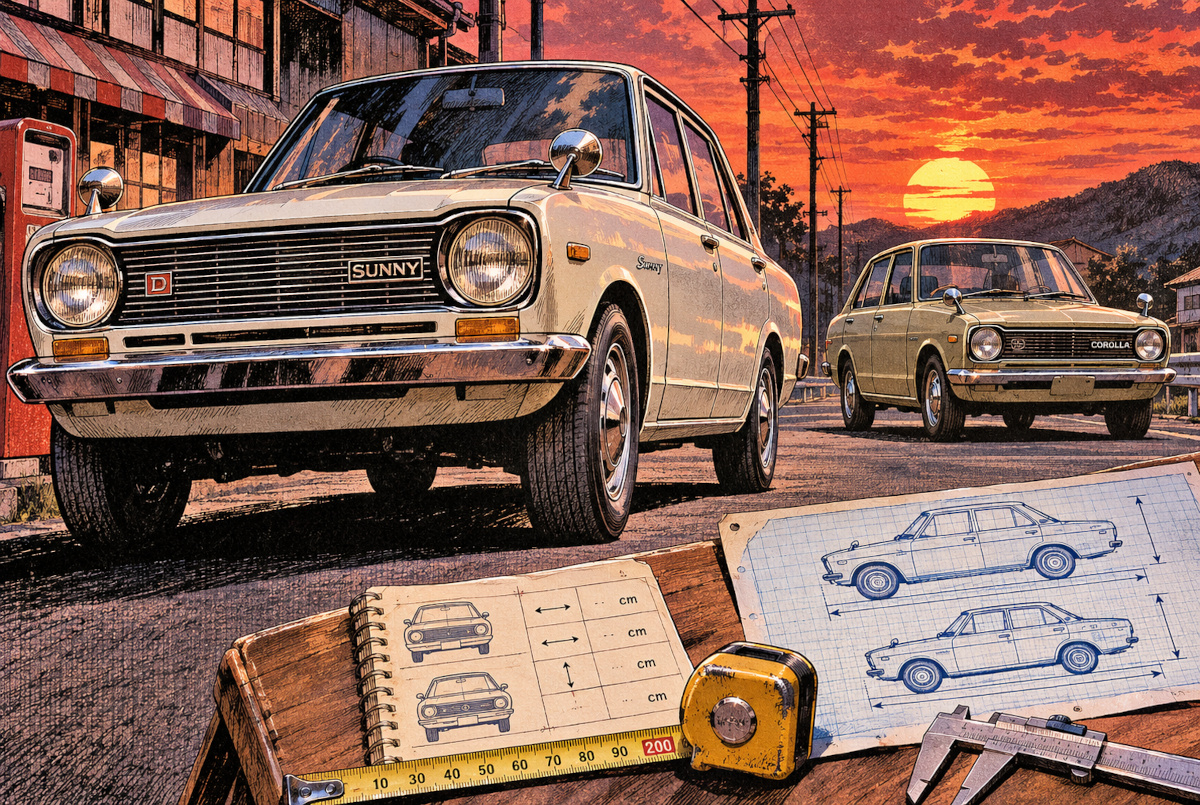
“The car next door looks small.” With this remarkably cheeky advertising line, Nissan introduced the second-generation Datsun Sunny (B110) in Japan in January 1970.
The original Sunny had a 988cc engine, while its Toyota Corolla rival offered 1,077cc. Nissan’s response was the new A12 engine, displacing 1,171cc. The battle for Japan’s family-car buyers had entered its second round.
But a closer look at the manufacturers’ specifications reveals something unexpected. Compared with the second-generation Corolla introduced in May 1970, the Sunny was actually smaller on the outside. The difference in engine displacement was just 5cc.
Then, in 1972, the 83 PS Sunny 1200GX-5 and the 115 PS Corolla Levin brought a different kind of competition. How much of the Sunny’s appeal came from size, horsepower, weight, or clever engineering? We went back to the historical specifications to find out.
Did the Car Next Door Really Look Smaller?
Introduced in January 1970, the B110 Sunny was larger than its predecessor. From the outset, Nissan offered two-door and four-door sedans, a coupe, and commercial van versions.
According to Nissan, the four-door sedan offered the largest passenger compartment in its class at the time. Equipment had also improved, including an automatic ventilation system that allowed fresh air to circulate without opening the windows.
The message was clear: this was no longer merely an inexpensive little car. Nissan wanted buyers to feel they were getting something more spacious and substantial.
There is an interesting wrinkle in the advertising history. Nissan associates the slogan with the B110’s January 1970 debut, while the Tokyo Copywriters Club records a newspaper advertisement using the line under the publication year 1971. These are not necessarily contradictory dates: the car’s introduction and the recorded advertisement are separate events.
But what happens when we set the advertising aside and measure the cars?
We compared Nissan’s published specifications for the 1970 Sunny B110 with Toyota’s historical records for the Corolla KE20, introduced on May 6 of the same year.
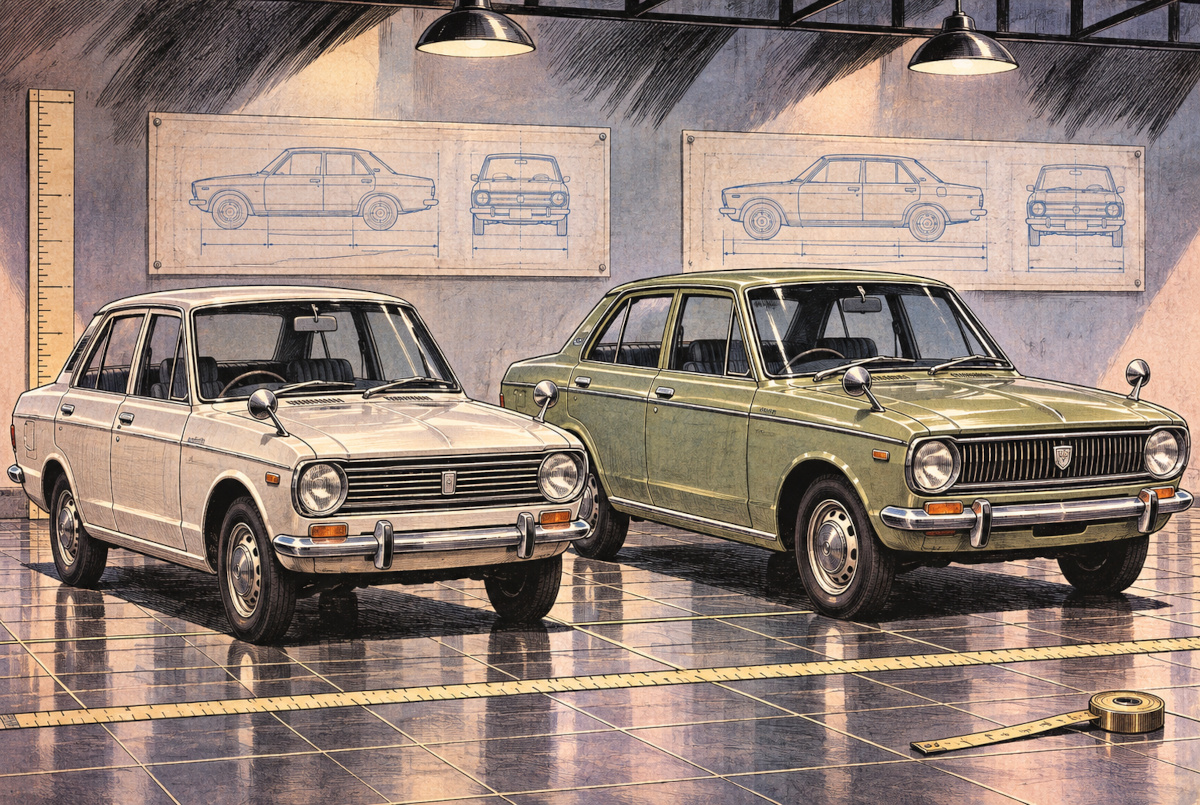
Editorial illustration based on the 1970 Datsun Sunny B110 and Toyota Corolla KE20. Some exterior details have been simplified, and the vehicles are not drawn to an exact common scale. Refer to the table below for the published dimensions.
| Specification | Sunny B110 | Corolla KE20 |
|---|---|---|
| Japanese launch | January 1970 | May 1970 |
| Overall length | 3,830mm | 3,945mm |
| Overall width | 1,495mm | 1,505mm |
| Wheelbase | 2,300mm | 2,335mm |
| Engine displacement | 1,171cc | 1,166cc |
| Maximum output (Deluxe) | 68 PS | 68 PS |
| Curb weight (Deluxe) | 700kg | 750kg |
Sources: Nissan Heritage Collection and Toyota’s 75-Year History. Figures refer to the manufacturers’ published specifications for the 1970 sedans. Output and curb weight are compared using the Deluxe models. PS denotes metric horsepower.
The Corolla was 115mm longer and 10mm wider. It also had a wheelbase 35mm longer than the Sunny’s.
As for the engines, Nissan’s 1,171cc A12 was just 5cc larger than Toyota’s 1,166cc unit. Both Deluxe models were rated at 68 PS.
There is one essential chronological detail. The second-generation Corolla did not exist when the B110 Sunny debuted in January 1970. At that point, the relevant Corolla rival was still the first-generation car. The table above is a comparison of the two new-generation models available from May 1970 onward, not a reconstruction of the choices available in January.
The striking point is that the impression created by Nissan’s advertisement did not necessarily correspond to the cars’ exterior dimensions.
That does not establish that the advertisement was false. Exterior dimensions alone cannot tell us which car had the roomier cabin, and Nissan specifically emphasized interior space. The claim appears to have been about perceived spaciousness and value, not simply which vehicle occupied more road space.
Same 68 PS, but the Sunny Had a Weight Advantage
The specifications reveal another difference: the Sunny Deluxe was 50kg lighter than the Corolla Deluxe.
That raises a more useful question than which car had the bigger engine. What happened when the same 68 PS was divided by each vehicle’s weight?
We calculated the power-to-weight ratio using the two manufacturers’ published figures.
| Deluxe model comparison | Sunny B110 | Corolla KE20 |
|---|---|---|
| Calculation | 68 ÷ 0.700 | 68 ÷ 0.750 |
| Power-to-weight ratio | 97.1 PS/t | 90.7 PS/t |
The Sunny’s result was approximately 7.1% higher.
Both engines were rated at the same maximum output, yet the lighter Nissan had more published horsepower available per metric ton of vehicle weight.
That does not prove the Sunny accelerated faster. We could not fully establish identical historical power-measurement conditions between the manufacturers, and the calculation does not account for gearing, torque characteristics, or actual road-test results.
Nevertheless, it reveals something that the engine-displacement figures alone do not: the B110’s relative lightness was a meaningful part of its appeal.
From 68 to 83 PS: The Twin-Carburetor Sunny 1200GX
In April 1970, Nissan added the sportier Sunny 1200GX. Its A12 engine retained the same 1,171cc displacement but gained twin SU carburetors and a higher compression ratio, raising maximum output to 83 PS.
That was an increase of 15 PS over the regular 68 PS version, or approximately 22.1%, without increasing engine capacity.
The underlying engineering remained relatively conventional. The front suspension used struts, while the rear employed a live axle located by leaf springs.
Yet that simple layout, combined with a lightweight body and an eager overhead-valve engine, made the GX an appealing small sporting car.
Nissan broadened the range again in April 1971 with the more upmarket Sunny Excellent, powered by a 1.4-liter L14 engine. By then, the Sunny family was developing in two directions: practical transport and increasingly ambitious performance models.
Why the GX-5’s Five-Speed Gearbox Was Special
In August 1972, Nissan introduced the 1200GX-5, adding a five-speed manual gearbox to the GX formula. It was offered in both sedan and coupe form, although the KB110 coupe is the version most closely associated with the name today.
What made the transmission interesting was not simply the presence of a fifth gear.
Its fifth-gear ratio was 1.000:1, a direct drive rather than a fuel-saving overdrive. The intermediate ratios were closely spaced to help the driver keep the engine working in a useful rev range.
The shift layout was unusual, too. First gear sat down to the left, leaving second through fifth in a conventional H-shaped arrangement. This is commonly known as a dogleg or racing-pattern gearbox.
Rather than treating fifth gear as a relaxed cruising ratio, Nissan designed the gearbox with sporting use in mind.
A fifth gear did not increase the A12 engine’s horsepower. It changed how effectively a driver could use the power already available.
That distinction matters. The GX-5’s appeal was as much about its mechanical character as its headline specifications.
83 PS Versus 115 PS: Could the Sunny Challenge the Corolla Levin?
Toyota had taken a different approach. In March 1972, it introduced the first Corolla Levin, the TE27.
The Levin featured a 1,588cc 2T-G twin-cam engine producing 115 PS, paired with a five-speed manual transmission. It was a considerably more powerful performance model than the Sunny GX-5.
But it was also equipped with a substantially larger engine.
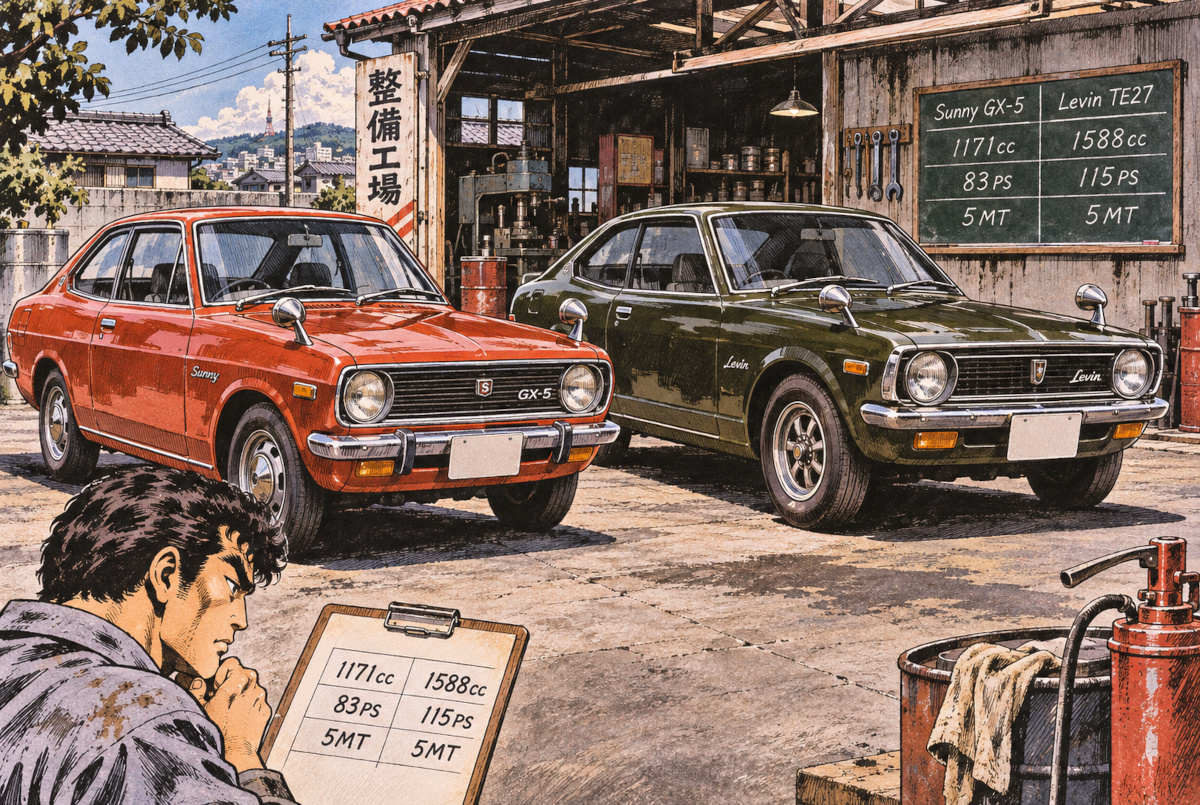
Editorial illustration comparing the production Sunny 1200GX-5 and Corolla Levin TE27. Engine displacement, maximum output, and transmission specifications follow period published figures. Certain badges, fender details, and wheels have been artistically simplified and do not precisely reproduce the original vehicles.
| Specification | Sunny 1200GX-5 | Corolla Levin TE27 |
|---|---|---|
| Introduction | August 1972 | March 1972 |
| Engine displacement | 1,171cc | 1,588cc |
| Engine | A12 OHV, twin carburetors | 2T-G DOHC |
| Maximum output | 83 PS | 115 PS |
| Transmission | 5-speed manual, direct fifth | 5-speed manual |
| Reported period price | Approximately ¥670,000 | ¥813,000 |
Production-car comparison. The Sunny price is the GX-5 coupe figure reported by Motor-Fan. The Levin price is the 1972 Tokyo-area figure reproduced from period catalog material by Monthly My Car magazine. The price conditions and exact GX-5 curb-weight specification have not been fully standardized, so no definitive value-for-money or power-to-weight ranking is calculated for these two sporting models.
The Levin produced 32 PS more than the Sunny, an advantage of approximately 38.6% relative to the GX-5’s output. Its engine also displaced 417cc more.
In other words, these were not two identically sized engines competing on equal terms.
Toyota’s Levin pursued higher absolute output with a 1.6-liter twin-cam engine. Nissan’s GX-5 relied on a compact, lightweight package and a closely spaced five-speed gearbox.
That does not establish that the Sunny was faster than the Levin. In fact, using maximum horsepower alone to declare either car the better sporting machine would ignore differences in capacity, weight, gearing, and intended use.
The more revealing comparison is not simply 83 PS against 115 PS, but two different engineering approaches to making an affordable Japanese car enjoyable to drive.
The 130 PS Sunny Was Not the GX-5 You Could Buy at a Dealership
Here is where Sunny specifications can become especially confusing.
Nissan’s Heritage Collection includes a GX-5-based TS racing car exhibited at the 1972 Tokyo Motor Show.
On the Japanese-language Heritage Collection page, that competition vehicle is listed with a 1,270cc engine producing 130 PS and a curb weight of 650kg.
Compared with the production GX-5’s 83 PS, 130 PS represents an increase of approximately 56.6%. But the race car was not simply a standard GX-5 with a different badge. Its displacement had been increased, and it used extensive competition modifications, including wider tires and enlarged wheel arches.
There is another detail worth checking before quoting specifications from an official source.
Nissan’s English-language Heritage Collection page describes the same historic competition car but lists a 1975-specification racing engine of 1,298cc producing 145 PS.
These figures should not be collapsed into a single specification.
There are three distinct references here: the 83 PS production GX-5, the 130 PS competition specification described on Nissan’s Japanese page, and the later 145 PS racing-engine specification listed on its English page.
According to Nissan, B110-series Sunnys won TS racing series titles at Fuji Speedway in 1971–1974, 1977, 1979, 1980, and 1982.
The chronology deserves attention. Since the GX-5 did not arrive until August 1972, it would be incorrect to attribute every earlier B110 racing title specifically to the GX-5 production grade.
What the record demonstrates is the remarkable longevity of the B110 platform in competition. An inexpensive mass-market car had become the basis for a serious racing machine.
1973: The Road Car Moves On, but the B110 Keeps Racing
In May 1973, Nissan replaced the B110 passenger-car range with the third-generation B210 Sunny.
The new car adopted a rounder, more contemporary body design, moving away from the B110’s crisp, straightforward appearance.
The B110’s Japanese passenger-car production life had lasted roughly three years and four months. But its competitive career continued for years afterward.
That contrast says a great deal about why the B110 remains special to enthusiasts. The showroom model came and went relatively quickly. The racing platform refused to disappear.
Editor’s Note
“The car next door looks small.” You’ve got to admire the nerve of that slogan. It’s hard to imagine a mainstream family-car advertisement taking quite the same swipe at its rivals today.
Then you open the specifications and discover that the Corolla introduced a few months later was actually longer. That is exactly the sort of detail that makes me want to keep digging.
But what really gets me is the GX-5. Only 83 PS, yet Nissan went to the trouble of fitting a five-speed gearbox with a racing-style shift pattern. It wasn’t chasing a spectacular horsepower figure. It was giving the driver a more involved machine.
And those 130 PS and 145 PS figures scattered through Sunny racing histories? They are a fine reminder that even official museum specifications need to be read carefully. You have to distinguish the original production car, a modified racing exhibit, and the later engine specification.
Of course, Toyota’s 115 PS twin-cam Levin was an impressive machine. I wouldn’t pretend otherwise. But there’s something appealingly stubborn about taking a humble 1.2-liter OHV engine, developing it relentlessly, and keeping the B110 competitive long after its showroom replacement arrived.
Maybe that’s the part of the Sunny story I like most. Nothing particularly glamorous—just a small car that turned out to have a lot more fight in it than anyone might have expected.
Terms That May Need a Quick Explanation
- Power-to-weight ratio (PS/t)
- Maximum engine output divided by vehicle weight in metric tons. PS means metric horsepower. A higher figure indicates more output relative to weight, but it does not directly establish acceleration, handling, or overall performance.
- Dogleg or racing-pattern gearbox
- A manual transmission layout that places first gear down to the left, leaving the frequently used second-through-fifth shifts in an H pattern. It is a shift-layout feature, not a direct measure of engine output or transmission performance.
Nissan Sunny: 60 Years of History - Eight-Part Series
Born in 1966, the Nissan Sunny challenged the Toyota Corolla and helped shape Japan's mass-market car industry. Across eight articles, we examine its development, engineering, performance, sales, motorsport history, and why the Sunny name disappeared from Japan while surviving in overseas markets.
- Part 1: Did Toyota’s “Extra 100cc” Really Beat the Datsun Sunny? The 89cc Battle (Part 1)
- Part 2: Did the Datsun Sunny Really Make the Corolla Look Small? The B110 and GX-5 (Part 2)
- Part 3: English edition Coming soon
- Part 4: English edition Coming soon
- Part 5: English edition Coming soon
- Part 6: English edition Coming soon
- Part 7: English edition Coming soon
- Final Part: English edition Coming soon
References
- Nissan Heritage Collection: Datsun Sunny 1200 Deluxe (Japanese) — Official 1970 B110 dimensions, engine specifications, launch background, and advertising.
- Toyota 75-Year History: Second-Generation Corolla (Japanese) — Official KE20 dimensions, displacement, curb weights, and engine output.
- Tokyo Copywriters Club: “The Car Next Door Looks Small” (Japanese) — Archival record of the Sunny newspaper advertisement, its copywriter, and publication year.
- Nissan Heritage Collection: Datsun Sunny 1200 Coupe GX-5 (Japanese) — Direct-drive five-speed transmission, TS racing history, and the 130 PS competition-car specifications.
- Nissan Heritage Collection: Datsun Sunny Coupe 1200GX-5 (English) — Official competition-car record, including the 1975-specification 1,298cc, 145 PS racing engine.
- Toyota Motor Corporation: Corolla and Motorsport (Japanese) — Official historical account of the Corolla Levin and the 2T-G twin-cam engine.
- GAZOO: Datsun Sunny 1200 Coupe GX (Japanese) — Production-car output and the distinctive GX-5 five-speed transmission.
- Monthly My Car: Original Toyota Corolla Coupe and Levin (Japanese) — Reproduced period catalog information on the TE27, its 115 PS engine, and the ¥813,000 Tokyo price.
- Motor-Fan: Toyota Corolla Levin TE27 vs. Datsun Sunny 1200GX-5 (Japanese) — Supplementary comparison of the production cars and reported original GX-5 prices.