

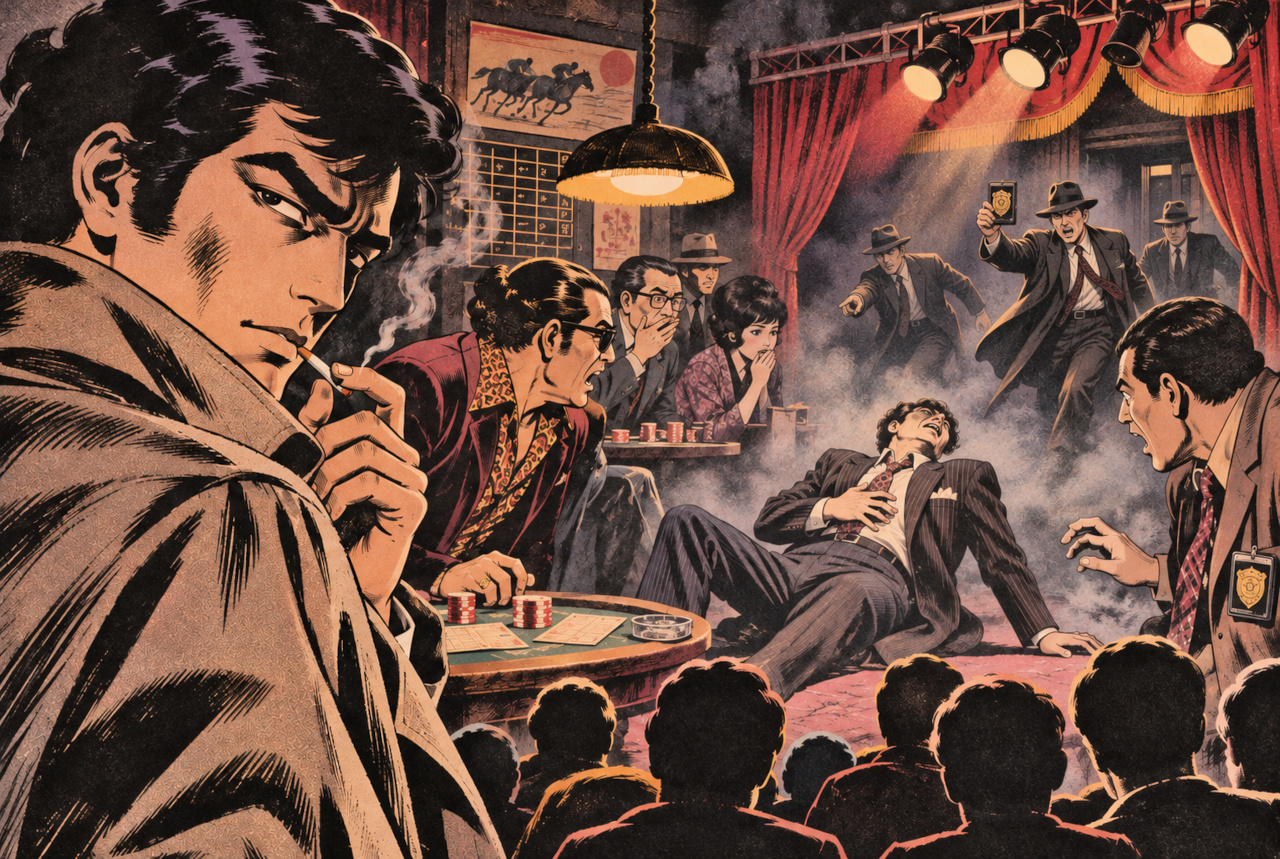
Spoiler warning: This article discusses the ending of The Sting (1973) and the November 8, 2026 season finale of VIVANT.
In the final episode of the Japanese television thriller VIVANT, Mamoru Nozaki (Hiroshi Abe) gets up after apparently being shot by Liu Mingxuan (Masato Sakai). The shooting was staged. The two men had secretly worked together to draw a hidden intelligence operative into revealing himself.
Nozaki calls the operation “Sting,” an explicit reference to the 1973 American film The Sting.
But pretending to die is hardly a new trick in movies or television. What bothered me was a more specific question: What makes someone believe a staged event is real in the first place?
Looking into the American Film Institute’s records and the filmmakers’ own recollections revealed something considerably more elaborate than a fake shooting. The final deception was only the last step in a carefully constructed trap.
From $2,000 to $500,000: How a 250-Fold Bet Begins with Trust
Directed by George Roy Hill and starring Paul Newman and Robert Redford, The Sting is a 1973 crime comedy that won seven Academy Awards in 1974, including Best Picture.
Set in 1936, the story follows Johnny Hooker, a young con artist seeking revenge against Doyle Lonnegan, a powerful gangster responsible for his partner’s death. Hooker joins forces with the experienced Henry Gondorff, and together they assemble an elaborate fake horse-race betting operation.
The supposed opportunity is simple: Lonnegan is led to believe that someone can delay the transmission of horse-racing results, allowing him to place a winning bet after the race has already been decided but before the bookmaker receives the result.
The technical details are less important than the way the conspirators build Lonnegan’s confidence. Based on the American Film Institute’s detailed synopsis, the process can be divided into three stages.
- First, demonstrate success with $2,000. Hooker supplies the money for Lonnegan’s initial wager. It wins, making the supposed advantage appear genuine.
- Then deliberately refuse a bet. Lonnegan is shut out at the betting window. When the race result arrives, he realizes that the information would have produced another winning bet. The missed opportunity makes the scheme seem even more convincing.
- Finally, secure a $500,000 wager. Now persuaded that the system works, Lonnegan commits an enormous sum of his own money.
Comparing the initial $2,000 test with the final $500,000 bet gives a striking result:
$500,000 ÷ $2,000 = 250.
The final wager is 250 times the size of the first test. This is a comparison of wager amounts, not a 250-fold profit or a numerical measure of trust.
What interests me most is the second stage. Why would a con artist refuse money from someone eager to hand it over?
Because the refusal helps make the entire operation look real. Lonnegan believes he has been denied a profitable opportunity rather than being invited into a trap. The film considers this move important enough to give it a chapter of its own: “The Shut-Out.”
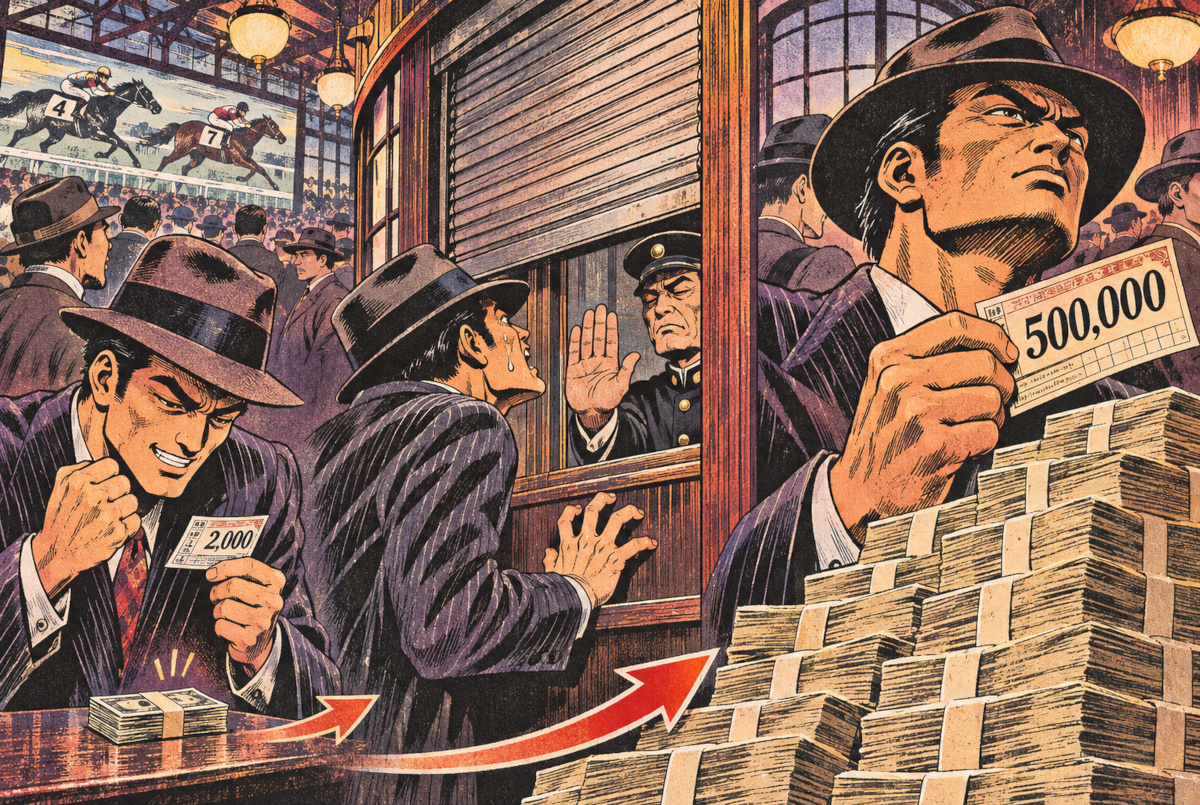
AI-generated conceptual illustration based on the film’s plot. Hooker supplies the initial $2,000. The characters, betting window and exaggerated stacks of cash are illustrative details, not reproductions of actual film scenes.
But how much was $500,000 worth in 1936?
Using the annual average U.S. Consumer Price Index (CPI), the index rises from 13.9 in 1936 to 321.943 in 2025. That is an increase of approximately 23.16 times.
$500,000 × 321.943 ÷ 13.9 = approximately $11.58 million.
In other words, Lonnegan’s final wager was equivalent to roughly $11.58 million in 2025 U.S. purchasing power.
This is an inflation-adjusted comparison based on U.S. consumer prices, not a currency conversion or an estimate of what the money would be worth as an investment. Still, it gives a sense of the extraordinary sum Lonnegan was persuaded to risk voluntarily.
Three Different Marks: The Gangster, the Policeman and the Audience
The climax of The Sting involves a raid on the fake betting parlor by men claiming to be FBI agents.
Gondorff appears to shoot Hooker. Then an FBI agent shoots Gondorff. Both men fall, and the bewildered Lonnegan is escorted away by police lieutenant William Snyder, leaving his $500,000 behind.
Except neither man has been killed. The raid and shootings were staged. Once Lonnegan and Snyder have gone, the supposedly dead men get back up.
The remarkable thing is that the scheme has not deceived just one person. Looking at the information each participant was given reveals three distinct layers of deception.
| Who was deceived? | What they believed | What was actually staged |
|---|---|---|
| Doyle Lonnegan | The racing advantage was real, and the federal raid was genuine. | A fake betting operation followed by a staged raid. |
| Lt. William Snyder | He was assisting legitimate FBI investigators. | The supposed federal agents were part of the con. |
| The film audience | Hooker had betrayed Gondorff, and the apparent shootings were real. | A final deception deliberately concealed from the viewer. |
Original comparative analysis based on the AFI Catalog’s detailed synopsis of The Sting.
Snyder is particularly important. He is a genuine police officer, yet he believes he is cooperating with the FBI. The supposed agent Polk is actually another con artist, Hickey.
Meanwhile, Lonnegan accepts that a real investigation is underway. The fake authorities provide a convincing reason for him to leave the premises without recovering his money.
And then there is the audience. Viewers have already been allowed to see much of the elaborate con being assembled. They may reasonably believe they understand what is happening.
But one crucial piece of information has been withheld from them: the final shooting is also part of the performance.
The brilliance of the scheme lies not simply in telling one convincing lie, but in making different people believe different lies at the same time.
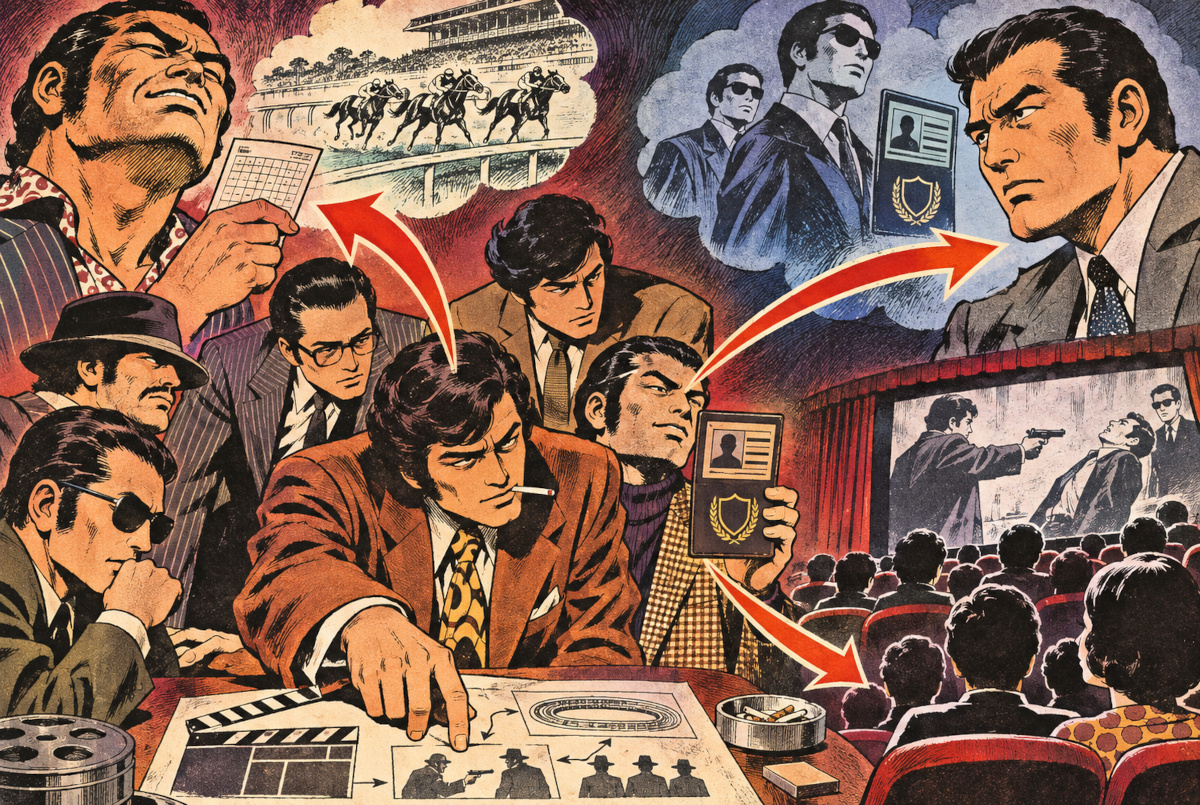
AI-generated conceptual diagram of the film’s three layers of deception. The characters and identification cards are fictional illustrations. This is an editorial analysis, not a reproduction of the film’s actual scenes.
What Nozaki Borrowed from The Sting Was More Than a Fake Death
Now return to VIVANT.
In the 2026 finale, Liu’s apparent shooting of Nozaki helps convince their opponents that Nozaki has been eliminated. Once a concealed operative seeking nuclear-fusion information reveals himself, Nozaki reappears and intervenes.
The resemblance to The Sting is clear, but the two schemes serve different purposes.
In The Sting, the staged raid and shootings persuade Lonnegan to leave the room. In VIVANT, the staged shooting helps draw a hidden enemy out into the open.
One scheme removes its target from the scene. The other encourages its target to reveal himself.
That is an important difference. The underlying logic, however, is remarkably similar: create a false situation that the target accepts as genuine, then allow the target’s own decisions to advance your plan.
This comparison is our editorial reading of the two stories. It does not mean that Nozaki recreated every element of the original film’s con, nor does it establish that VIVANT’s creators intended every parallel discussed here.
The Filmmakers Intended to Con the Audience from the Beginning
There is another revealing piece of evidence.
In a June 4, 2012 interview with The Guardian, producer Michael Phillips recalled how the project began in 1971. Screenwriter David S. Ward had an idea for a film about con artists but deliberately withheld the ending when presenting the story.
According to Phillips, Ward wanted the ending itself to deceive the audience.
So the audience’s mistaken interpretation of the climax was not merely an accidental by-product of clever plotting. It was part of the original creative intention.
Phillips also offered an explanation of the film’s title. In the con artists’ vocabulary, the “sting” refers to the moment when the target is separated from his money. That is somewhat different from the modern association of a “sting operation” with undercover law enforcement.
There is even a curious dispute in the film’s production history.
Similarities to David W. Maurer’s 1940 book The Big Con led to a controversy over the screenplay. According to the AFI Catalog, Universal reached a financial settlement reportedly worth about $350,000, although some accounts gave a figure of $300,000.
However, a review panel organized by the Writers Branch of the Academy concluded that Ward had not plagiarized Maurer’s work. That was an Academy review, not a court ruling establishing copyright infringement.
It would be tempting to turn a dispute surrounding a movie about fraud into a scandalous headline. But a financial settlement is not, by itself, proof of plagiarism. Even this story about deception deserves a little resistance to an easy conclusion.
Editor’s Note
When Nozaki got up in VIVANT, my first reaction was pretty straightforward: “So he was pretending to be dead. Nice trick.”
But the more I looked into The Sting, the less important the fake death seemed. By the time anyone hits the floor, the real work is already done. The target has been given a reason to trust the setup, a reason to risk the money, and finally a reason to walk away.
And somehow even a genuine police officer ends up trusting a fake FBI agent. Apparently, an official-looking badge and a convincing performance can be a dangerous combination.
The part that really got me, though, was the audience. I thought I was watching the con from the inside. I knew who the schemers were. I knew there was a trick.
Except I didn’t know the most important trick.
Perhaps the easiest moment to fool someone is the moment they decide they have already figured everything out.
I started with a fake shooting in a Japanese television drama and ended up back in a 53-year-old movie, wondering about that rather uncomfortable possibility.
References
- TBS Television, VIVANT Official Episode Guide (in Japanese; 2026 finale and plot information).
- Cinema Today, November 9, 2026 (in Japanese; reporting on Liu, Nozaki and the reference to The Sting in VIVANT’s finale).
- Nikkan Sports, November 8, 2026 (in Japanese; contemporary reporting on VIVANT’s “Sting” operation).
- American Film Institute, AFI Catalog: The Sting (1973) (detailed synopsis, chapter structure, production history and screenplay dispute).
- The Guardian, “How We Made … Michael Phillips and David S Ward on The Sting” (June 4, 2012; interviews with the producer and screenwriter).
- Academy of Motion Picture Arts and Sciences, The 46th Academy Awards (1974) (official award records).
- Federal Reserve Bank of Minneapolis, Consumer Price Index, 1913– (1936 annual average CPI of 13.9).
- U.S. Bureau of Labor Statistics, Consumer Price Index Annual Averages (2025 annual average CPI of 321.943).