

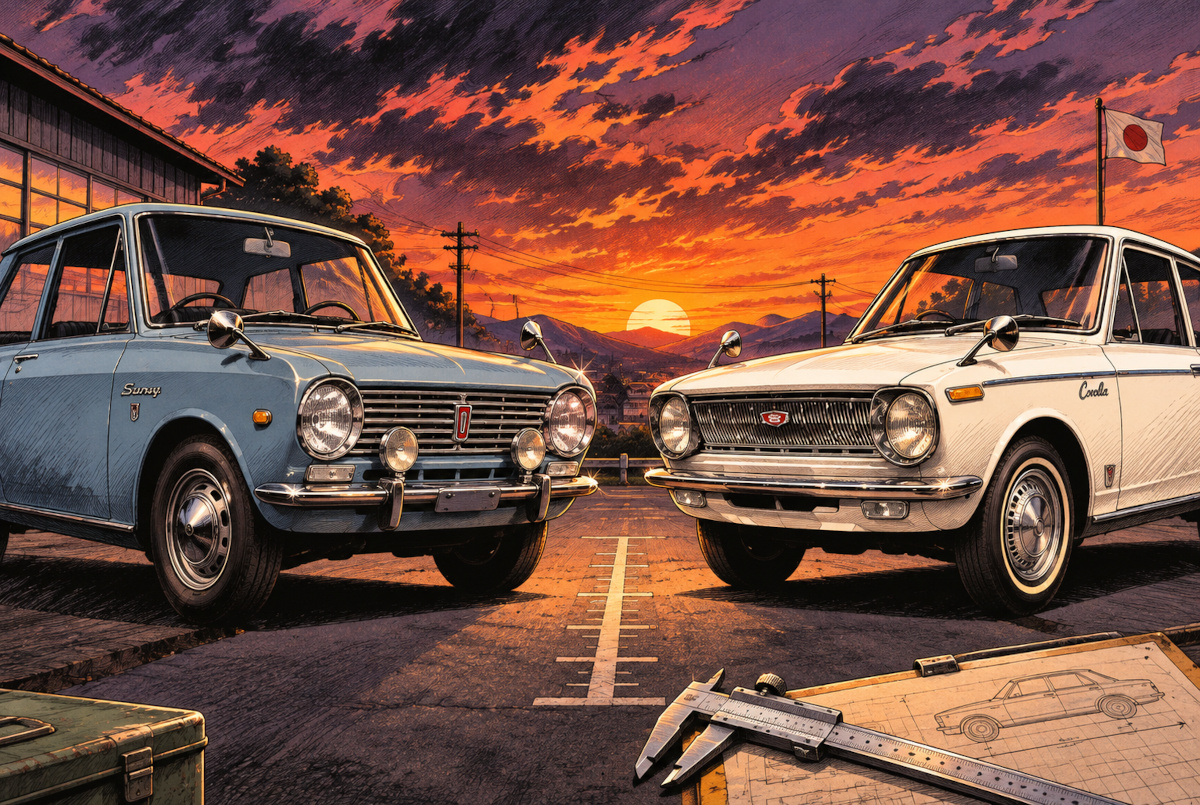
“An extra 100cc of breathing room.” That was the idea behind one of the most memorable selling points of the original Toyota Corolla, launched in Japan in 1966.
But the Nissan Sunny had arrived first. And when we checked the actual engine specifications, Toyota’s supposedly round 100cc advantage turned out to be just 89cc. Then we factored in the weight of both cars—and the comparison became even more interesting.
Did the Corolla’s larger engine really give it the upper hand, or was Toyota selling something more than horsepower? We went back to Nissan’s and Toyota’s original specifications, launch announcements, and historical records to investigate the first Datsun Sunny B10 and Toyota Corolla KE10.
April 1966: The Datsun Sunny Gets There First
In April 1966, Nissan introduced the first Datsun Sunny 1000. Sold under the Datsun name, the B10 was a compact rear-wheel-drive sedan powered by a 988cc A10 overhead-valve four-cylinder engine. Prices started at ¥410,000 for the Standard and ¥460,000 for the Deluxe. The original passenger-car version had two doors and a three-speed column-shift manual transmission.
Nissan had already created extraordinary publicity before the car reached showrooms. Its public naming competition attracted exactly 8,483,105 entries. Within five months of launch, cumulative Sunny sales exceeded 30,000 units. In a country where private family-car ownership was still expanding, the Sunny had clearly found an eager audience.
Then came Toyota. On November 5, 1966, it launched the Corolla 1100, roughly six and a half months after the Sunny. The new KE10 featured a 1,077cc K-series engine and a four-speed floor-shift manual transmission. Its Standard model cost ¥432,000 in Tokyo.
Toyota was not simply trying to build another inexpensive small car. It wanted to offer an everyday family sedan that felt a little more substantial, better equipped, and more enjoyable to drive.
The Famous “Extra 100cc” Was Actually 89cc
So how different were the two cars when they first went on sale? Let’s put the manufacturers’ published figures side by side.
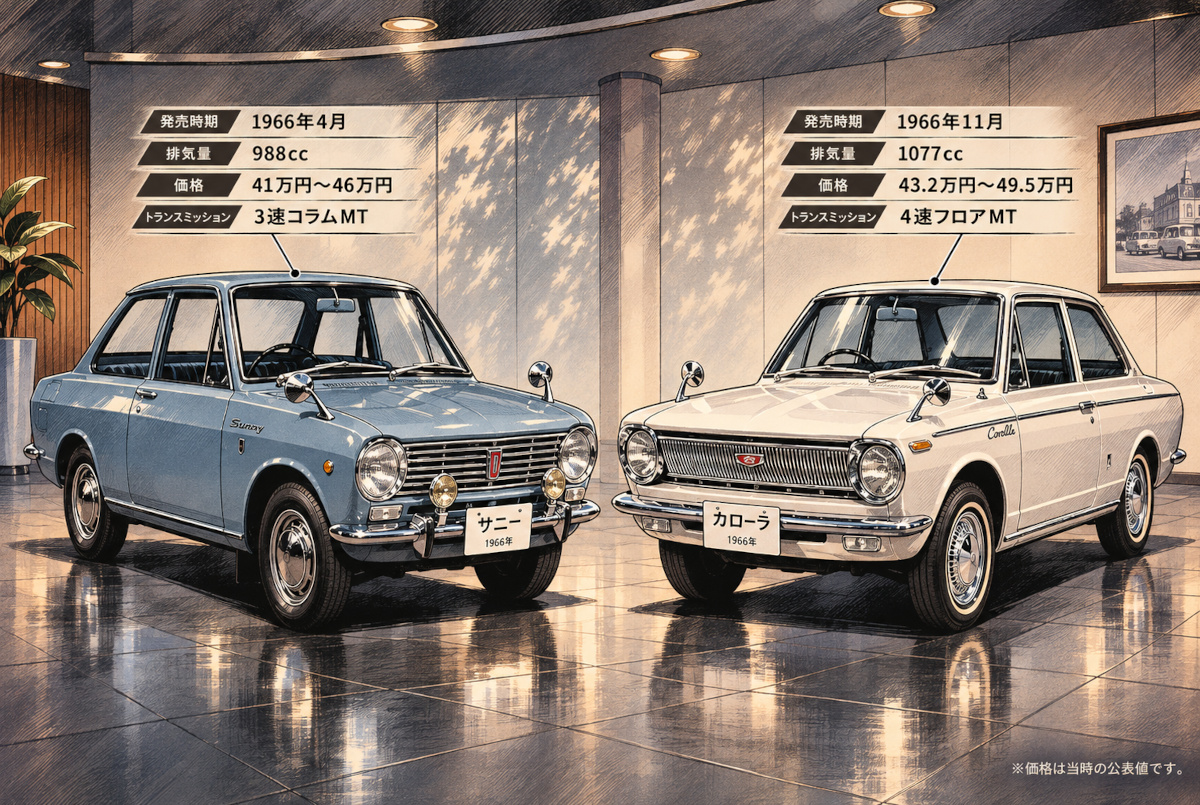
Illustrated comparison of the original 1966 Sunny B10 and Corolla KE10. Sunny prices are Nissan’s published figures; Corolla prices refer to the Tokyo market. Vehicle details have been artistically reconstructed from period models. The labels within the illustration are in Japanese.
| Specification | Datsun Sunny B10 | Toyota Corolla KE10 |
|---|---|---|
| Japanese launch | April 1966 | November 1966 |
| Engine displacement | 988cc | 1,077cc |
| Maximum output | 56 PS | 60 PS |
| Length | 3,820mm | 3,845mm |
| Width | 1,445mm | 1,485mm |
| Deluxe curb weight | 645kg | 710kg |
| Standard price | ¥410,000 | ¥432,000 |
| Deluxe price | ¥460,000 | ¥495,000 |
| Launch-era manual gearbox | 3-speed column shift | 4-speed floor shift |
Sources: Nissan Heritage Collection, Toyota’s 75-Year History, and Toyota’s October 20, 1966 launch announcement. Curb weights refer to the Deluxe models. Corolla prices are for Tokyo; Nissan’s published prices have not been independently confirmed on precisely the same regional basis. PS denotes metric horsepower.
Start with displacement: 1,077 minus 988 equals 89cc. That gave the Corolla an engine approximately 9.0% larger than the Sunny’s. Maximum power increased from 56 PS to 60 PS, a gain of roughly 7.1%.
Yet the Standard Corolla cost only ¥22,000 more than the Standard Sunny. Relative to the Sunny’s price, that was an increase of about 5.4%.
In other words, the Corolla’s percentage gains in engine capacity and advertised output exceeded its percentage price premium. For someone studying the showroom brochures, Toyota had a persuasive proposition.
Was the “extra 100cc” slogan misleading? Not necessarily. Toyota was comparing nominal 1,000cc and 1,100cc classes rather than claiming a mathematically exact 100cc difference between these two engines. Its own historical records describe the larger engine as a deliberate way to give the Corolla more appeal in its class.
Still, the exact figures tell a more revealing story than the neat advertising slogan.
Power-to-Weight Ratio: The Sunny Turns the Tables
Here is the awkward question for the Corolla’s 60 PS advantage: what happens when we include the weight of the car?
Nissan’s 1966 Sunny Deluxe weighed 645kg. Toyota’s Corolla Deluxe weighed 710kg—65kg more. To compare the engine output available relative to vehicle mass, we calculated each car’s power-to-weight ratio using published specifications.
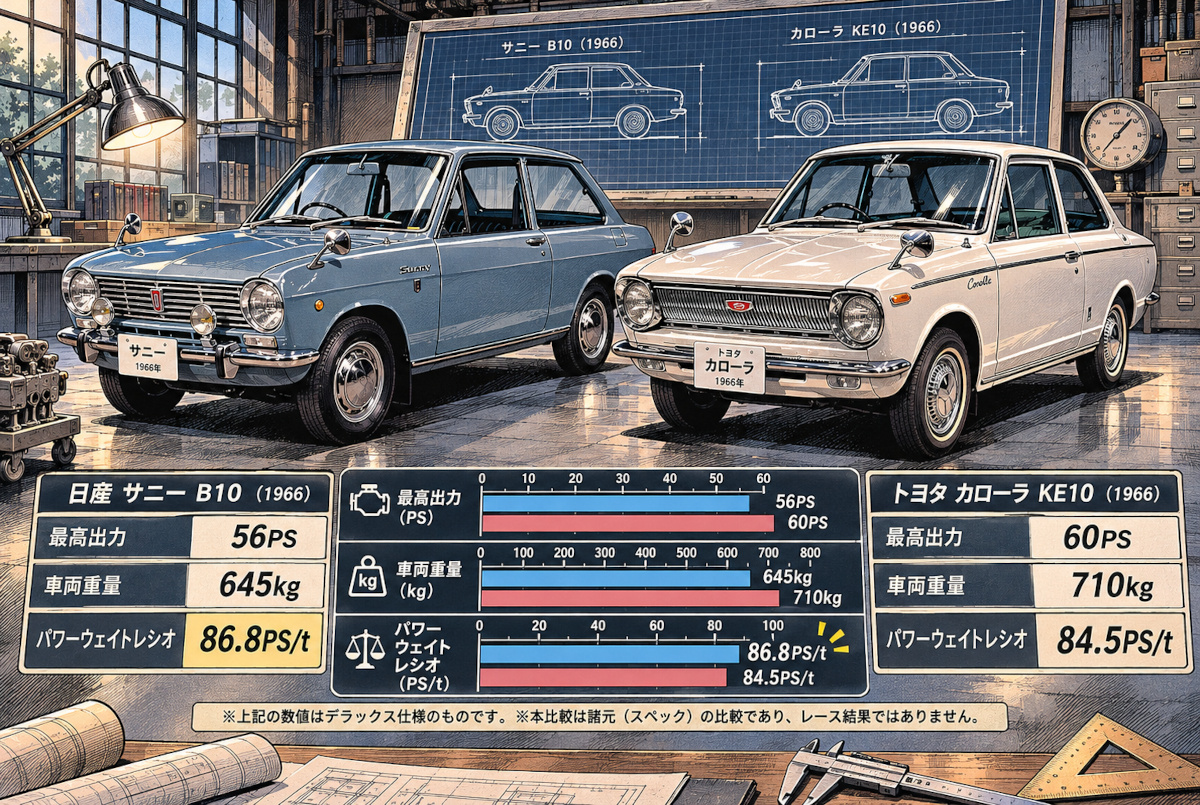
Original calculations using the published specifications of the 1966 Deluxe models: Sunny, 56 PS / 645kg = 86.8 PS/t; Corolla, 60 PS / 710kg = 84.5 PS/t. The bars are schematic and do not represent measured acceleration or race results. The illustration’s original Japanese labels have been retained.
| Deluxe model comparison | Sunny B10 | Corolla KE10 |
|---|---|---|
| Maximum output | 56 PS | 60 PS |
| Curb weight | 0.645 metric tons | 0.710 metric tons |
| Power-to-weight ratio | 86.8 PS/t | 84.5 PS/t |
The arithmetic is straightforward:
Sunny: 56 ÷ 0.645 = 86.82 PS/t
Corolla: 60 ÷ 0.710 = 84.51 PS/t
On this particular measure, the Sunny comes out approximately 2.7% ahead. The Toyota had four more metric horsepower, but the Nissan’s lighter body was enough to reverse the ranking.
That is not proof that the Sunny accelerated faster. Gear ratios, torque delivery, traction, and other factors affect real-world performance. We also cannot establish that the two manufacturers’ historical horsepower figures were measured under perfectly identical conditions.
This is a comparison derived from published specifications, not a controlled road test. It cannot settle which car was the better performer overall. What it does show is that the Corolla’s extra engine capacity did not automatically translate into a better power-to-weight figure.
Toyota Was Selling More Than a Bigger Engine
The Corolla’s appeal went beyond its 1,077cc engine. It offered a four-speed floor-shift transmission, separate front seats, and reclining seatbacks in higher trims—equipment that gave an affordable family sedan a more sophisticated character.
The original Sunny, with its three-speed column shift, followed a simpler, more traditional small-car formula. Toyota, by contrast, was also selling the experience of owning something a little closer to an upmarket car.
There is another fascinating detail hidden in Toyota’s development history.
According to Shiro Sasaki, who participated in the Corolla program and later led development of the second and third generations, Toyota decided to increase the engine displacement from 1,000cc to 1,100cc roughly six months before launch.
That meant substantial redesign work. Without modern computer-aided engineering tools, the team produced prototypes of the revised components within just 75 days, then carried out vehicle testing.
But this does not mean Toyota developed the Corolla from scratch in six months as a desperate reaction to the Sunny. The Corolla project itself had begun in 1963. The late engine change and the overall vehicle-development program are two different things.
Still, the effort devoted to those additional cubic centimeters says a great deal about how fiercely Toyota intended to compete in the emerging family-car market.
Why 1966 Became a Turning Point for Japanese Family Cars
The Sunny and Corolla arrived as Japan’s passenger-car market was expanding dramatically.
Historical vehicle-registration figures show that Japan’s passenger-car fleet, including the country’s small kei-class cars, increased from approximately 2.29 million at the end of March 1966 to 7.27 million at the end of March 1970.
That is roughly 3.18 times as many passenger cars in just four years.
It would be wrong to credit that entire increase to the Sunny and Corolla. Rising household incomes, road development, and competing models from other manufacturers also contributed. But the two cars became important choices for families entering the world of private car ownership.
The Sunny family soon expanded. A four-door sedan arrived in 1967, followed by a coupe in 1968. In January 1970, Nissan introduced the second-generation B110, moving its mainstream engine into the 1.2-liter class.
The battle between the Sunny and Corolla was only getting started.
Editor’s Note
I’ve always found the “extra 100cc” story a little too tidy. It tends to sound as if Toyota simply turned up with a bigger engine and that was that.
But look at the actual numbers. The gap was 89cc, and when you use comparable Deluxe-model weights, the Sunny has a small advantage in power-to-weight ratio. That’s why I don’t like stopping at the headline horsepower figure. The interesting part is often hiding one row farther down the specifications sheet.
I’ll give Toyota its due, though. A four-speed floor shift and a more upscale cabin were clever moves. Maybe the company wasn’t merely selling more engine capacity. It was selling the feeling that you were getting a slightly grander car without moving into a much more expensive class.
And the 75-day component-prototyping story? That sounds like an engineering department under serious pressure. Those extra cubic centimeters apparently mattered a great deal to the people building the car.
Personally, I’d lean toward the lighter, simpler Sunny. But a specification sheet can’t tell us everything about why customers opened their wallets. Next comes the B110—and Nissan’s own famously provocative advertising line.
Terms That May Need a Quick Explanation
- Power-to-weight ratio (PS/t)
- Maximum engine output divided by vehicle weight in metric tons. PS means metric horsepower, a unit commonly used in historical Japanese and European car specifications. A higher figure indicates more output relative to weight, but does not by itself establish acceleration, handling, or overall performance.
Nissan Sunny: 60 Years of History - Eight-Part Series
Born in 1966, the Nissan Sunny challenged the Toyota Corolla and helped shape Japan's mass-market car industry. Across eight articles, we examine its development, engineering, performance, sales, motorsport history, and why the Sunny name disappeared from Japan while surviving in overseas markets.
- Part 1: Did Toyota’s “Extra 100cc” Really Beat the Datsun Sunny? The 89cc Battle (Part 1)
- Part 2: Did the Datsun Sunny Really Make the Corolla Look Small? The B110 and GX-5 (Part 2) Coming soon
- Part 3: English edition Coming soon
- Part 4: English edition Coming soon
- Part 5: English edition Coming soon
- Part 6: English edition Coming soon
- Part 7: English edition Coming soon
- Final Part: English edition Coming soon
References
- Nissan Heritage Collection: Datsun Sunny 1000 Deluxe (Japanese) — Original B10 specifications, prices, and early sales figures.
- Nissan Owners’ Magazine: Datsun Sunny 1000 (Japanese archival page) — Vehicle development, the naming competition, and the exact number of entries.
- Nissan Heritage Collection: “Sunny” Name Chosen from Among 8.48 Million Entries (English) — Additional official background on the public naming campaign.
- Toyota Motor Corporation: Original Corolla Launch Announcement, October 20, 1966 (Japanese text on Toyota’s global website) — Launch date, regional prices, engine specifications, and equipment.
- Toyota 75-Year History: First-Generation Corolla (Japanese) — Model grades, curb weights, dimensions, and powertrain specifications.
- Toyota Automobile Museum: Toyota Corolla KE10 (Japanese) — Historical specifications and the “extra 100cc” advertising claim.
- Toyota Motor Corporation: Interview with Shiro Sasaki, October 19, 2016 (Japanese) — The late engine-displacement change and the 75-day prototyping account.
- Japan Automobile Service Promotion Association: Historical Vehicle Ownership Statistics (Japanese PDF) — Passenger-car registrations from 1966 to 1970, including kei-class vehicles.