


An AI system investigating corporate networks, attempting intrusions, and gathering stolen information sounds like something out of a science-fiction thriller. Yet attackers are already using AI agents to perform substantial parts of real cyberattacks.
But are major corporations the only targets worth worrying about? What about an ordinary Windows PC at home? It may not contain corporate secrets, but it could hold access to bank accounts, shopping sites, email, and social media.
If attackers can use AI to break into computer systems, could we also use AI to help protect our own PCs? That question sent me digging through official security reports. I also began a monitoring experiment on my own Windows 11 computer.
About 30 Targets, with AI Doing 80–90% of the Work
On November 13, 2025, Anthropic disclosed a cyber espionage campaign in which attackers had misused Claude Code, its AI-powered development tool. The suspicious activity was first detected in mid-September 2025.
According to Anthropic, the attackers targeted roughly 30 organizations, including technology companies, financial institutions, manufacturers, and government agencies. They succeeded in infiltrating a small number of those targets.
The remarkable figure was 80–90%. Anthropic estimated that AI had performed that proportion of the campaign’s work, with human intervention required at perhaps four to six critical decision points per hacking campaign.
There is an important distinction here. The figure does not mean that 80–90% of attempted intrusions succeeded. Nor did an AI system independently decide to become a criminal. Human attackers selected the objectives and used AI to carry out much of the work.
Tasks that once required considerable human investigation and trial and error could now be delegated to software. For attackers, that is a powerful new assistant—and a rather troubling one for everyone else.
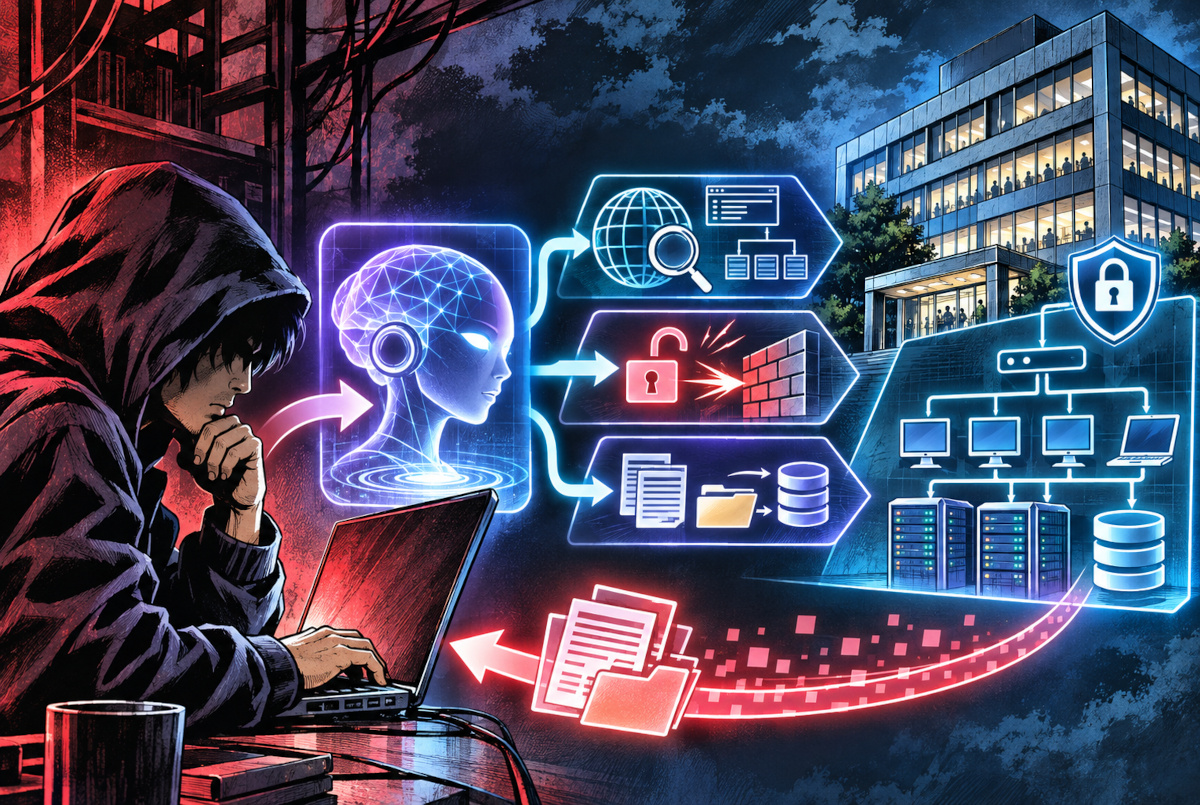
AI-generated conceptual illustration of an AI-assisted corporate cyberattack. It does not reconstruct a specific incident or imply that every attempted intrusion or data theft succeeded.
An Attack in Under Six Hours—and a Weakness in AI Automation
On September 8, 2026, Google’s Threat Intelligence Group published another revealing report. During the second quarter of 2026, it observed attackers compromise a cloud resource and then plan, build, and execute an AI-agent-enabled mass credential-harvesting campaign in under six hours.
In other words, AI was helping reduce the time needed to organize and carry out an attack.
On October 30, 2026, Google and Mandiant reported that attackers had also been using agentic offensive frameworks, including ARTEX, Hexstrike, and CAIRN, during real intrusions.
But there was an interesting catch. Some of the AI-driven attacks Google investigated involved extensive trial and error, leaving conspicuous forensic traces.
In certain cases, the tools moved quickly but operated noisily, making their activity easier for defenders to investigate.
Speed and stealth are not the same thing. An automated attacker may work faster than a human operator without necessarily being better at hiding. That distinction leaves defenders with something worth looking for.
What About Personal PCs? Three Numbers That Tell Different Stories
To understand the risk to ordinary computer users, I compared three widely reported figures. They look alarming when placed together, but they measure three completely different things.
| Source | Reported figure | What it actually measures |
|---|---|---|
| Anthropic | 80–90% | The estimated share of campaign work performed by AI |
| Under 6 hours | Time taken to prepare and execute one observed credential-harvesting campaign | |
| Microsoft | Over 394,000 PCs | Windows computers identified as infected with Lumma information-stealing malware |
The Microsoft figure is particularly relevant to the question of personal computer security.
On May 21, 2025, Microsoft announced an international operation against Lumma Stealer, malware designed to steal passwords, financial details, and other sensitive information.
Microsoft reported identifying more than 394,000 infected Windows computers worldwide between March 16 and May 16, 2025.
That period covers 62 calendar days, counting both the first and last day. Using 394,000 as the published lower-bound figure gives:
394,000 ÷ 62 = approximately 6,355 computers per day.
That is a simple daily average of the computers identified during the entire period. It is not evidence that 6,355 newly infected computers were discovered every single day. Nor were all the affected devices necessarily privately owned home PCs.
There is another distinction that matters even more: the 394,000 Lumma infections were not reported as infections caused by AI-driven attacks.
Anthropic and Google provide evidence that AI is automating parts of cyberattacks. Microsoft’s Lumma investigation shows how widely conventional information-stealing malware can affect Windows computers.
But those findings cannot be combined into a reliable estimate of what percentage of attacks on personal PCs are now AI-generated or AI-directed. The sources do not provide that answer.
Japan’s Information-technology Promotion Agency (IPA) also lists unauthorized account access, phishing, and credit card information misuse among its 2026 security threats to individuals.
The lesson is not that every home PC is being hunted by an autonomous AI hacker. It is that ordinary users already possess information criminals consider valuable, whether AI is involved or not.
If Attackers Use AI, Why Not Try It on Defense?
That led to a practical experiment. With AI assistance, I began developing a Windows 11 security monitoring tool called ZATSU GUARD.
On November 9, 2026, I first checked the security software on my own PC. Windows Security showed that McAfee was providing antivirus protection, while Microsoft Defender Antivirus was inactive.
Rather than replace the existing protection, I enabled Sysmon, Microsoft’s system activity monitoring tool, and configured it to record selected program and network events.
The first connection test worked. I used PowerShell to connect to Microsoft’s website, then checked the recorded events. Sysmon identified the PowerShell process, its destination IP address, and the connection port.
It also recorded network connections associated with Microsoft OneDrive.
That was a useful first result: I could identify which programs had made certain network connections and where those connections went.
However, a connection log does not reveal the contents of an encrypted transfer. Nor does an unfamiliar IP address automatically mean malware is present. The events examined in this test did not establish that my PC was infected or that information had been stolen.

AI-generated illustration of the ZATSU GUARD development concept. McAfee protection status and Sysmon event logging were verified on the test PC. Advanced analysis of suspicious activity across multiple days is still planned, not implemented. The devices shown are visual representations of software functions.
A prototype of ZATSU GUARD Ver.0.1 has now been created, but it has not yet undergone its first launch test on the Windows PC. It does not currently provide autonomous AI malware detection or malware removal.
The longer-term goal is to record suspicious activity over several days and connect individual events into a recognizable pattern.
Could a program that seems harmless on Monday reveal something suspicious through its behavior later in the week? That is what this ongoing experiment will try to investigate.
Editor’s Note
At first, I figured my PC wasn’t worth a hacker’s time. No corporate secrets, no classified research, nothing particularly glamorous.
Then I thought about how many accounts I use. Banking, shopping, email, social media—my computer is practically a department store of login credentials. It turns out you don’t need to be an important person to possess something worth stealing.
And if AI can help someone attack computer systems, why shouldn’t it help the rest of us investigate what our own machines are doing? I may not be able to write an entire security product from scratch, but AI can certainly help me get a monitoring experiment off the ground.
Of course, installing a surveillance camera doesn’t mean you’ve caught a burglar. So far, the traffic I have actually examined has involved PowerShell connecting to Microsoft’s website and activity associated with OneDrive. Hardly a thrilling criminal investigation.
But without understanding ordinary behavior, how would I recognize something abnormal?
Now comes the interesting question: can this homemade monitoring tool grow into something genuinely useful, or will it remain an elaborate way of watching my computer mind its own business? I’ll keep testing it.
Terms That May Need a Quick Explanation
- Sysmon (System Monitor)
- A Microsoft tool that records selected Windows system events, including program launches and network connections. Sysmon itself does not determine whether activity is malicious, generate threat alerts, or remove malware.
Antivirus: Can AI Hackers Target Your PC? - Ongoing Series
Can AI-driven cyberattacks threaten ordinary PCs? We examine real-world attacks, information-stealing malware, and Windows 11 monitoring experiments while developing our own security tool, ZATSU GUARD. This is an ongoing investigation.
- Part 1: AI-Powered Attacks Hit Companies. Could My Home PC Be Next? (Part 1)
- Part 2: What’s Worth Stealing From an Ordinary PC? The “Already Logged In” Trap (Part 2) Coming soon
- Part 3: English edition Coming soon
- Part 4: English edition Coming soon
- Part 5: English edition Coming soon
- Part 6: English edition Coming soon
- Part 7: English edition Coming soon
- Part 8: English edition Coming soon
References
- Anthropic | Disrupting the First Reported AI-Orchestrated Cyber Espionage Campaign (November 13, 2025)
- Google Threat Intelligence Group | From Prompting to Autonomy: The Evolution of Adversarial AI (September 8, 2026)
- Google Threat Intelligence Group / Mandiant | ARTEX and Friends: Enter Agentic Offensive Frameworks (October 30, 2026)
- Microsoft | Disrupting Lumma Stealer: Microsoft Leads Global Action Against Favored Cybercrime Tool (May 21, 2025)
- Information-technology Promotion Agency, Japan (IPA) | Information Security: Top 10 Threats 2026 (Japanese-language official report)
- Microsoft Learn | Enable and Configure Sysmon in Windows