

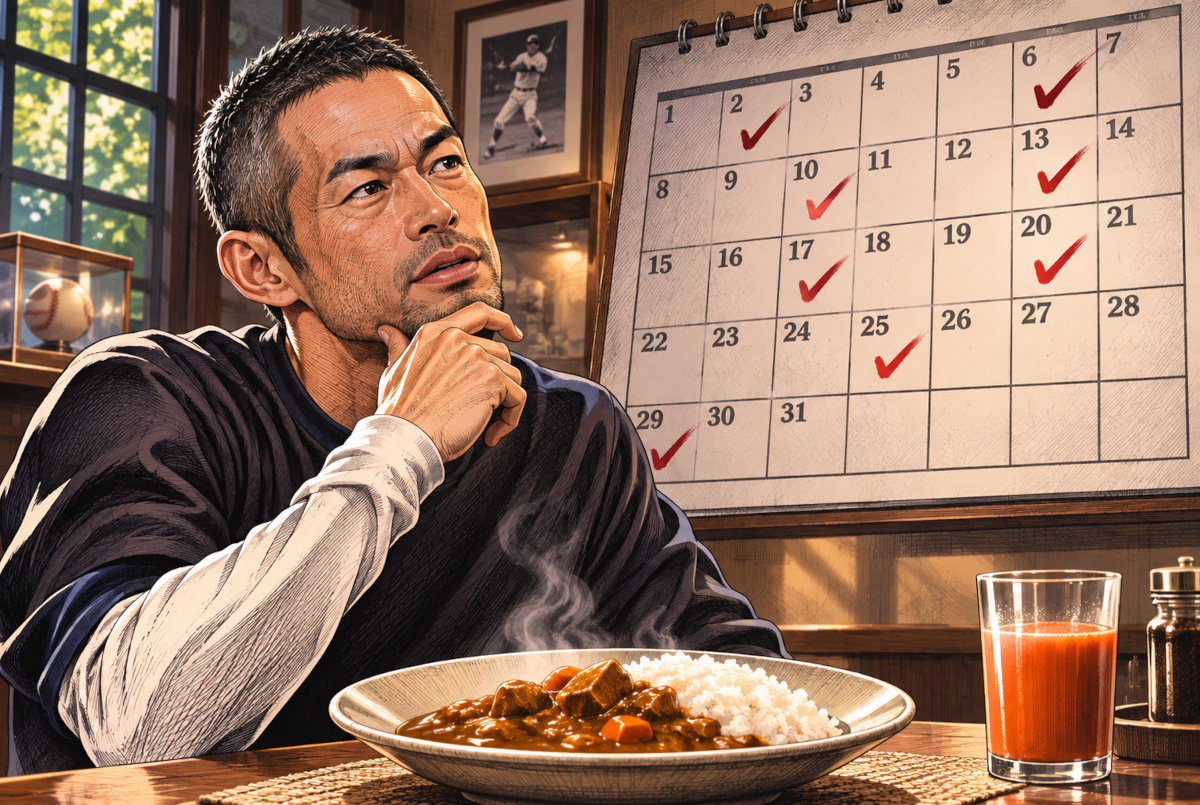
One of baseball’s most enduring food legends says that Ichiro Suzuki ate curry for breakfast every single day. All 365 of them. But in a February 2025 interview with Japan’s Number magazine, Ichiro gave a rather different account: he ate curry on home-game days only, at most 81 days a year, and the habit lasted roughly two years. That’s less than a quarter of the year. So where did the daily-curry legend come from? And does eating curry in the morning actually offer any health benefits? We checked Ichiro’s own words, Japan’s official food data, and a clinical study.
AI-generated illustration inspired by Ichiro Suzuki’s former breakfast habit. It does not reproduce his actual home, clothing, or a documented meal.
How 365 Days Became a Maximum of 81
A Major League Baseball regular season normally consists of 162 games, with 81 played at home. That’s where the number comes from. Back in November 2022, Ichiro explained that he had eaten curry only when he was at home during the season, and that he hadn’t even reached 81 curry breakfasts. In other words, 81 was an upper limit, not a recorded number of meals.
We ran the numbers ourselves:
81 ÷ 365 × 100 = approximately 22.2%.
Reverse the comparison, and 365 ÷ 81 gives approximately 4.5. The popular image of 365 curry breakfasts was therefore at least about 4.5 times the maximum suggested by his account. Because the actual number was lower than 81, we cannot calculate the exact degree of exaggeration. But the gap is already substantial.
There’s another detail the legend tends to leave out: the routine lasted only about two years. Ichiro later switched to meals such as udon and somen noodles. In a December 2024 television documentary, he revealed that his breakfast-and-lunch routine had become toast and corn soup.
Ichiro has also spoken about the value of repetition. Eating the same food repeatedly, he explained in 2022, can make small differences easier to notice. That tells us something about his approach to consistency. It does not establish that curry improved his batting performance.
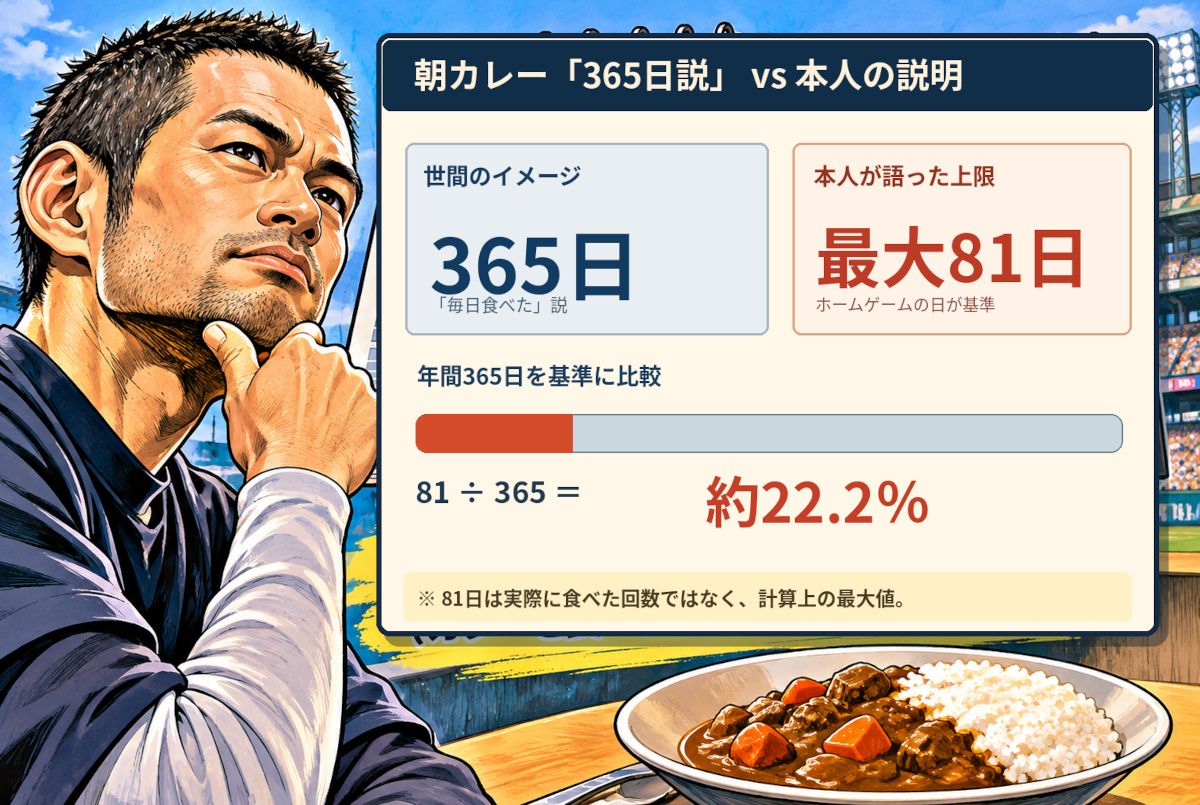
Our calculation compares the 365-day legend with Ichiro’s stated maximum of 81 home-game days: 81 ÷ 365 ≈ 22.2%. The 81 days represent an upper limit, not the number of times he actually ate curry.
Is Curry Actually a Healthy Breakfast?
Breakfast can provide energy and nutrients after an overnight fast. Japan’s Ministry of Agriculture, Forestry and Fisheries also promotes breakfast as part of maintaining a regular daily routine. But those are benefits associated with breakfast, not benefits unique to curry. A balanced breakfast based on bread, rice, or other foods can serve the same basic purpose.
Japanese curry rice typically combines cooked white rice with a thick, seasoned sauce containing ingredients such as meat and vegetables. That makes it a convenient way to combine carbohydrates, protein, and vegetables, depending on the recipe. It also means portion size matters.
According to Japan’s official food composition database, 100 g of cooked white rice contains 156 kcal. Using that figure, a 150 g serving provides 234 kcal, while 200 g provides 312 kcal. That’s a difference of 78 kcal from the rice alone, without changing the curry sauce.
The curry itself deserves a closer look. S&B Foods’ medium-hot Golden Curry, a Japanese solid curry-roux product, lists 87 kcal, 5.3 g of fat, and 2.3 g of salt equivalent for an 18 g portion of roux.
Japan’s 2025 dietary reference intakes set a daily salt-equivalent target of less than 7.5 g for adult men. The 2.3 g in that small portion of roux alone represents approximately 31% of that Japanese daily target. This comparison does not include the rice, meat, vegetables, or other seasonings. It is also a Japan-specific dietary benchmark, not a universal recommendation for every country.
So curry can certainly be part of breakfast. But eating it in the morning does not make calories, fat, or salt disappear.
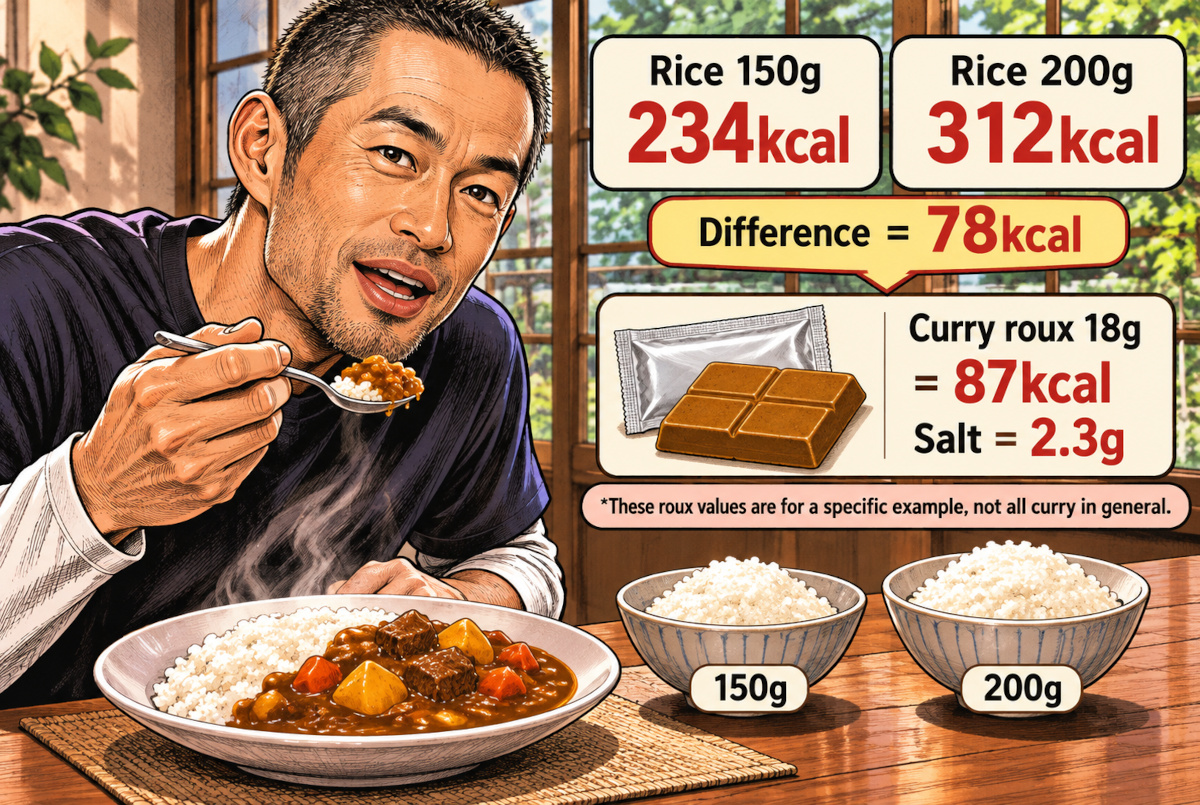
Rice calculations use Japan’s official food composition data. The roux figures refer specifically to an 18 g portion of S&B Golden Curry Medium Hot: 87 kcal and 2.3 g of salt equivalent. They are not nutritional values for a complete curry meal, nor do they represent Ichiro’s actual portion sizes.
A Clinical Trial Actually Tested Curry
Here’s where the story becomes more interesting. In 2014, a paper published in Nutrition Journal reported a randomized, controlled crossover trial involving 14 healthy Japanese men.
Each participant ate two different test meals on separate days: Japanese curry containing a blend of spices, and a comparable meal prepared without those spices. Researchers measured flow-mediated dilation (FMD), an indicator of how well blood vessels respond to increased blood flow, before eating and again one hour afterward.
The results were striking enough to deserve attention.
After the spice-free control meal, average FMD fell from 5.8% to 5.1%, a decrease of 0.7 percentage points. After the curry meal, it rose from 5.2% to 6.6%, an increase of 1.4 percentage points.
Subtracting those two changes gives a difference of 2.1 percentage points. This is our straightforward calculation from the rounded averages reported in the paper, not a separately estimated clinical effect size. The researchers also reported a statistically significant difference in the post-meal FMD responses.
The participants had fasted for at least 12 hours overnight. Each test meal consisted of 180 g of curry sauce or its control equivalent plus 200 g of cooked rice, totaling approximately 500 kcal. Measurements were conducted in the morning, making the experiment particularly relevant to a discussion of breakfast. However, it did not compare morning curry with eating the same meal at lunch or dinner.
Before celebrating curry as a medical breakthrough, consider what was actually tested. The study involved 14 men, one serving of each test meal on separate days, and a measurement taken one hour after eating. The experimental curry included a substantial spice blend, with 4.5 g of turmeric per serving. It was not identical to an ordinary serving of commercial Japanese curry.
There is also a disclosure worth reading in the original paper: the study was supported by House Foods Corporation, and several of its authors were employees of House Foods or its corporate group. That does not invalidate the findings, but it belongs in any careful assessment of the evidence.
Other biochemical measurements, including the oxidative-stress markers studied, did not show a significant curry-specific effect. Nor did this experiment establish that eating curry every morning prevents cardiovascular disease or increases life expectancy.
A short-term change in blood-vessel function after a curry meal is not the same as proof that a daily curry breakfast improves long-term health. The distinction matters far more than any catchy claim about a miracle spice.
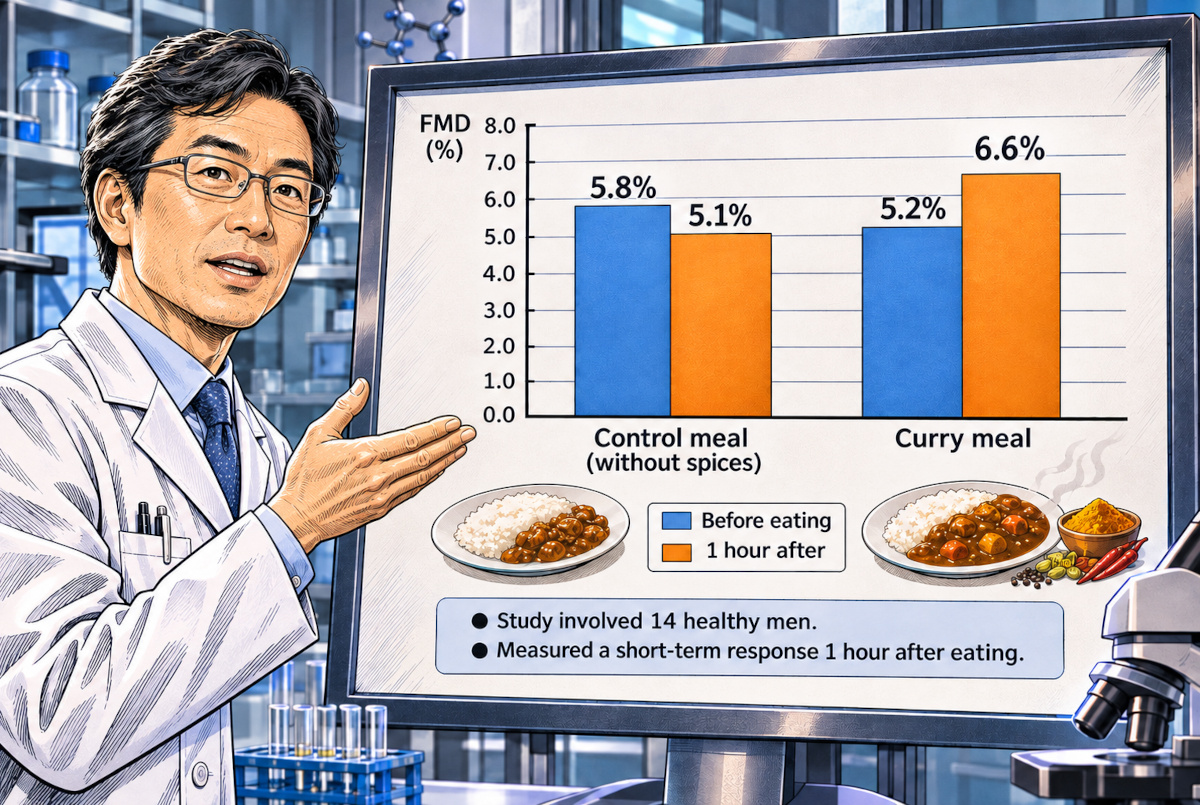
Based on Nakayama et al. (2014), which measured FMD before and one hour after meals in 14 healthy men. These findings do not demonstrate long-term disease prevention. The researcher and laboratory are AI-generated fictional representations, not depictions of the actual study personnel or facilities.
Terms That May Need a Quick Explanation
- Flow-Mediated Dilation (FMD)
- A test of how much an artery widens in response to increased blood flow. A higher reading after a meal does not, by itself, prove that cardiovascular disease has been prevented or that the person will live longer.
Editor’s Note
Would anyone seriously expect to become Ichiro just by eating curry every morning? Probably not. Still, I hadn’t expected the legendary 365 days to shrink to fewer than 81, and only for about two years. The numbers make the story look rather generously seasoned. What bothers me more is that the breakfast changed, yet the legend stayed exactly where it was. Ichiro moved on to noodles, toast, and soup; the rest of us kept serving him curry. Perhaps the first thing we should have questioned wasn’t the health value of the meal, but the seasoning added to the story itself.
Curry: A Five-Part Series
Was Ichiro really eating curry every morning? From the science of spices and nutritional comparisons to Indian food culture and the risks of reheating curry, this five-part series examines the facts, figures, and surprising truths behind a familiar dish.
- Part 1: Ichiro’s Morning Curry Legend: 365 Days, or 81 at Most?
- Part 2: 35 Spices and Herbs, but Flour Comes First? Is Japanese Curry Healthy or Fattening?
- Part 3: English edition Coming soon
- Part 4: English edition Coming soon
- Final Part: English edition Coming soon
References
- Number Web (February 13, 2025), “Ichiro: Staying True to His Japanese Identity,” Part 1. Interview with Ichiro Suzuki. In Japanese.
- Full-Count (November 4, 2022), report on Ichiro’s comments about his morning curry habit and the value of repetition. In Japanese.
- Nikkan Sports (December 22, 2024), report on Ichiro’s appearance on the television documentary Jonetsu Tairiku and his toast-and-corn-soup breakfast. In Japanese.
- Ministry of Agriculture, Forestry and Fisheries of Japan, “Are You Eating Breakfast?” Official dietary education material. In Japanese.
- Ministry of Education, Culture, Sports, Science and Technology of Japan, Standard Tables of Food Composition in Japan: Cooked White Rice, 100 g.
- S&B Foods, Golden Curry Medium Hot, 198 g package: Official nutritional information per 18 g serving of curry roux. In Japanese.
- Ministry of Agriculture, Forestry and Fisheries of Japan, “Be Careful About Excessive Salt Intake.” In Japanese.
- Ministry of Health, Labour and Welfare of Japan, e-Health Net: Sodium and Japan’s Dietary Reference Intakes (2025). Official salt-equivalent targets. In Japanese.
- Nakayama, H., et al. (2014). “A single consumption of curry improved postprandial endothelial function in healthy male subjects: a randomized, controlled crossover trial.” Nutrition Journal, 13, Article 67. Original research paper in English.