
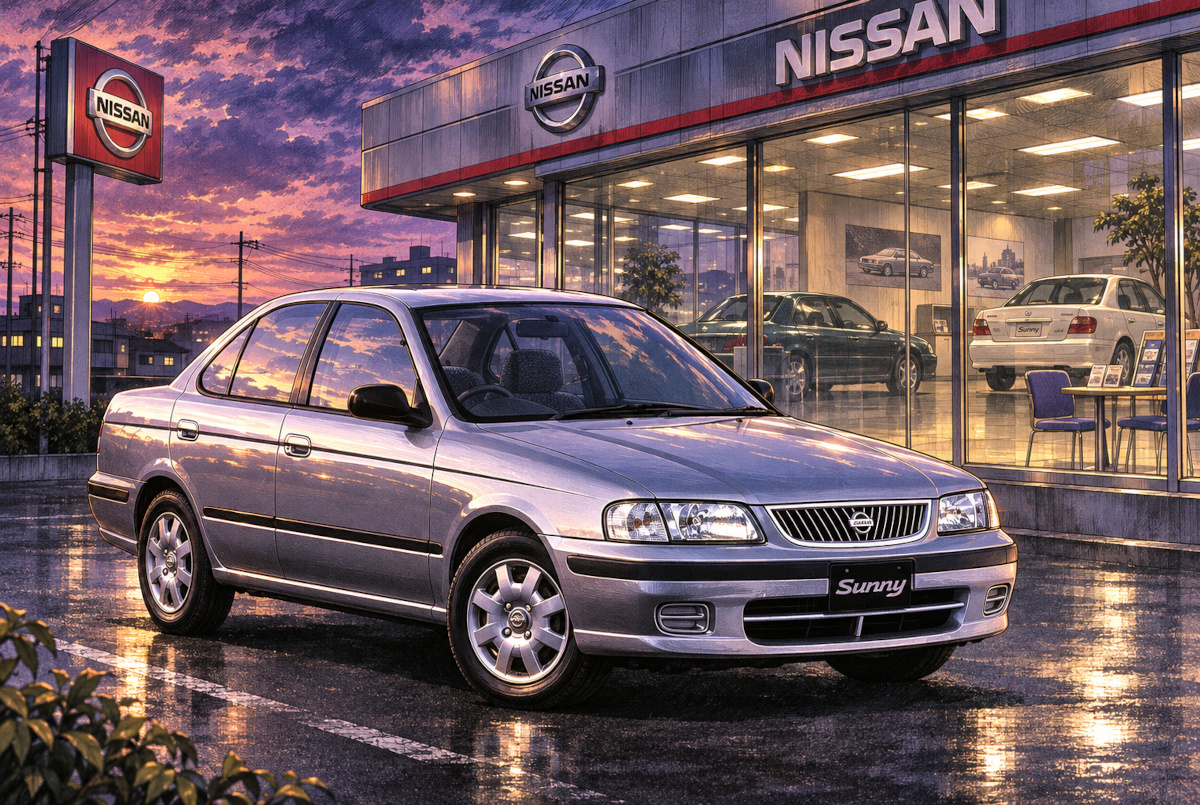
In October 1998, Nissan introduced the ninth-generation Sunny, known as the B15. Marketed in Japan as a “New World-Standard Sedan,” it would become the last Sunny sold under that name in the Japanese domestic market.
On paper, this was a sensible compact sedan with improved crash protection and a more refined interior. But hidden in the Japanese price list was something rather less sensible: the 1600 VZ-R, a 1.6-liter, 175-PS, five-speed manual sports sedan costing ¥1,871,000. That was a remarkably serious engine for such an ordinary-looking car.
Yet in 2004, Nissan retired the Sunny name in Japan after 38 years.
Was the last Sunny really inferior to the Toyota Corolla? Or did Nissan abandon the name for reasons that had little to do with the car’s actual performance?
To find out, I compared period specifications, equipment lists, prices, and Japanese sales records from Nissan, Toyota, and historical catalog archives.
1998: What Was So New About the “World-Standard” Sunny?
Launched in October 1998, the B15 moved away from the rounded appearance of the previous B14 and returned to a more conservative, angular design. Nissan developed it around a newer platform, emphasizing structural rigidity, crash safety, and cabin quality.
The main gasoline engines were the 1.3-liter QG13DE and 1.5-liter QG15DE. The 1500 EX Saloon, producing 105 PS, came with dual front airbags, ABS, and seat belts with pretensioners as standard equipment.
Nissan continued improving the car after its introduction. A September 2000 update brought equipment and interior changes. In May 2002, revised bumpers and a new grille accompanied further improvements. The 1.5-liter engine’s output increased to 109 PS, emissions performance improved, and active front head restraints became standard across the range.
The B15, in other words, was not simply an ageing budget sedan left to fade away. Nissan kept investing in its safety, environmental performance, and everyday usability.
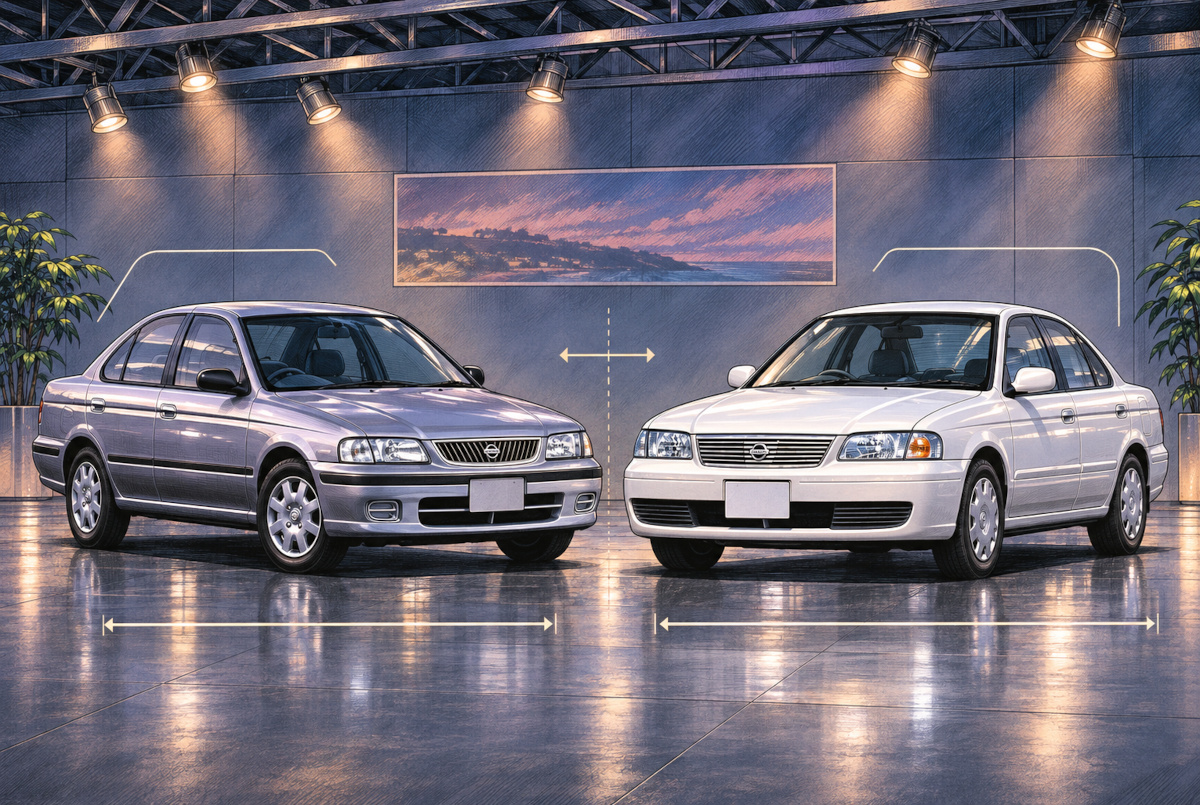
AI-generated comparison illustration based on the 1998 Nissan Sunny B15 and its 2002 facelift. It highlights changes to the grille and bumpers rather than reproducing exact vehicle dimensions or equipment specifications.
175 PS in an Ordinary Sunny? Meet the VZ-R
The most unlikely member of the B15 family was the 1600 VZ-R, chassis designation JB15. Its naturally aspirated 1,596cc SR16VE DOHC engine produced 175 PS at 7,800 rpm. No turbocharger was involved.
The secret was Nissan’s NEO VVL variable valve lift and timing system. By switching between low-speed and high-speed cam profiles, the engine could change valve timing and lift to suit different operating conditions. The VZ-R also came with a five-speed manual gearbox, a limited-slip differential, and disc brakes at both ends.
But how much extra performance did buyers actually get for their money? I compared two Japanese-market models introduced in October 1998: the regular 1500 EX Saloon and the 1600 VZ-R. Both were front-wheel-drive sedans with five-speed manual transmissions.
| Specification | 1500 EX Saloon | 1600 VZ-R |
|---|---|---|
| Engine displacement | 1,497cc | 1,596cc |
| Maximum output | 105 PS | 175 PS |
| Curb weight | 1,080kg | 1,180kg |
| 10-15 mode fuel economy | 18.8km/L | 11.8km/L |
| Required fuel | Regular gasoline | Premium gasoline |
| Listed new-car price | ¥1,349,000 | ¥1,871,000 |
Sources: GAZOO historical vehicle catalogs, October 1998 specifications. Both vehicles are front-wheel drive with five-speed manual transmissions. Prices are the historical manufacturer-listed figures and exclude additional ownership and registration costs. PS refers to metric horsepower, as used in the original Japanese specifications.
The engines differed in displacement by just 99cc, yet their maximum outputs were separated by 70 PS. Dividing output by displacement gives approximately 70.1 PS per liter for the EX Saloon and 109.6 PS per liter for the VZ-R.
That is a substantial difference for two engines fitted to the same basic family sedan.
The VZ-R also cost ¥522,000 more, a premium of approximately 38.7% over the EX Saloon. And the price was only part of the story.
Using their official 10-15 mode fuel-economy figures, I calculated how much fuel each car would theoretically consume over the same 100km distance:
EX Saloon: 100 ÷ 18.8 = approximately 5.32 liters.
VZ-R: 100 ÷ 11.8 = approximately 8.47 liters.
Under those test-based assumptions, the VZ-R would consume roughly 59% more gasoline over the same distance. And unlike the EX Saloon, it required premium fuel.
These are calculations based on historical Japanese fuel-economy test figures, not measured real-world consumption. Actual results depend on driving conditions, and the old 10-15 mode is not directly comparable with today’s WLTC figures.
Nissan was selling two remarkably different propositions under one Sunny badge: an economical everyday sedan and a high-revving 175-PS sports sedan.
There was a catch. The VZ-R disappeared from the lineup with the September 2000 update, so 175 PS was never a standard B15 feature throughout its production life. Nor should it be confused with the 200-PS VZ-R N1 versions offered in the Pulsar family.
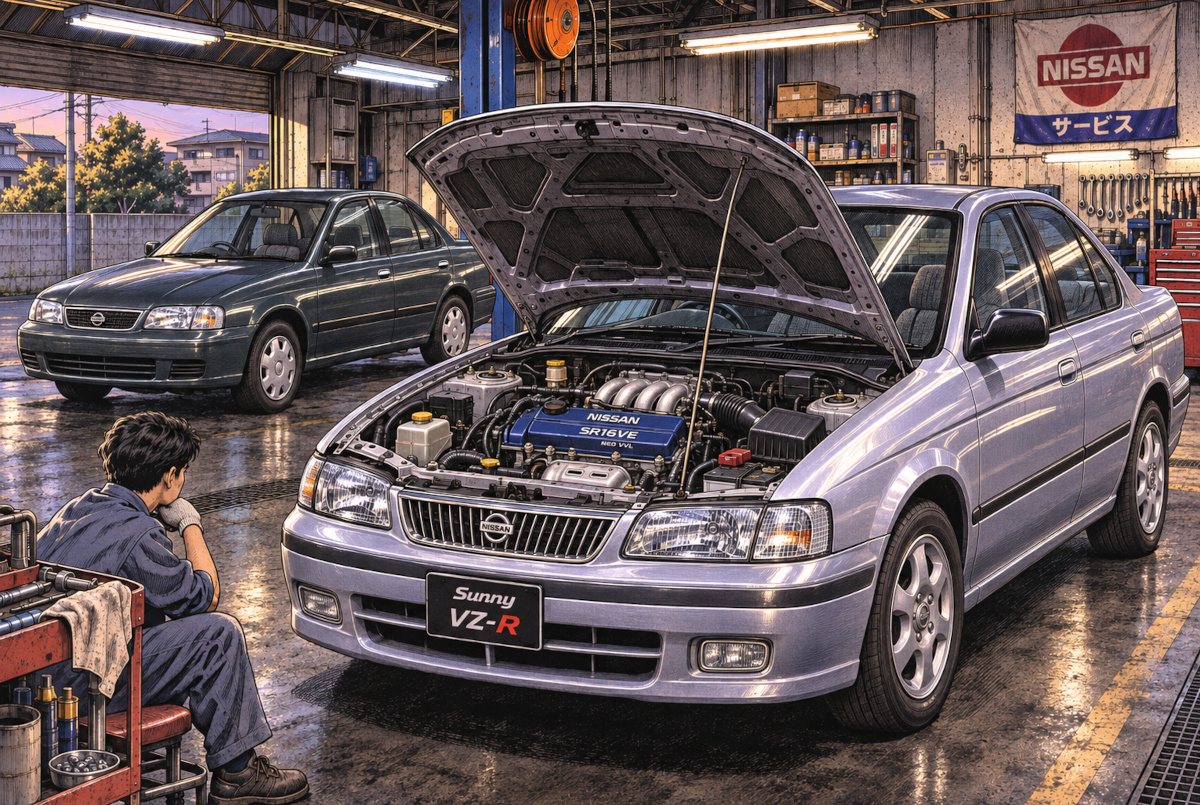
AI-generated technical illustration comparing the 1998 Sunny 1600 VZ-R with a regular B15 sedan. The VZ-R used the 1.6-liter SR16VE engine producing 175 PS. The vehicles and engine are illustrative interpretations; details such as the grille, lettering on the valve cover, and auxiliary components may differ from the production cars.
Sunny vs Corolla: What Happens When We Compare Like for Like?
The obvious rival was the Toyota Corolla. But comparing random versions from different years would tell us very little, especially when equipment levels and transmissions could change the figures.
So I narrowed the comparison to Japanese-market 1998 four-door sedans with approximately 1.5-liter engines, front-wheel drive, and five-speed manual gearboxes. The candidates were the Sunny B15 EX Saloon and two E110-generation Corollas: the XE Saloon and SE Saloon.
| Specification | Sunny B15 EX | Corolla XE | Corolla SE |
|---|---|---|---|
| Overall length | 4,345mm | 4,315mm | 4,315mm |
| Wheelbase | 2,535mm | 2,465mm | 2,465mm |
| Interior length | 1,880mm | 1,830mm | 1,830mm |
| Maximum output | 105 PS | 100 PS | 100 PS |
| 10-15 mode fuel economy | 18.8km/L | 18.8km/L | 17.6km/L |
| Listed price | ¥1,349,000 | ¥1,223,000 | ¥1,457,000 |
Sources: GAZOO historical Nissan Sunny and Toyota Corolla catalogs. Sunny figures are from October 1998 and Corolla figures from April 1998. Body type, drivetrain, transmission, and engine class have been aligned, but equipment levels and the tax-inclusive or tax-exclusive basis of the listed prices have not been completely standardized. All dimensions are Japanese catalog specifications.
On the published figures, the Sunny was 30mm longer overall than the Corolla, with a wheelbase 70mm longer. Its listed interior length was also 50mm greater.
That does not automatically mean the Sunny had better rear-seat legroom or a more comfortable cabin. Interior length is only one measurement, and seating geometry matters too. Still, the figures hardly suggest that Nissan had fallen hopelessly behind.
The price comparison gets even more interesting. Against the cheaper Corolla XE Saloon, the Sunny was more expensive. Against the better-equipped SE Saloon, it was cheaper.
Which car represented better value? Without matching their entire equipment lists and tax treatment, claiming a clear winner would be premature.
Fuel economy offers an equally awkward result for anyone expecting a straightforward Corolla victory. The Sunny EX Saloon and Corolla XE Saloon both recorded 18.8km/L in the same Japanese test cycle.
At least within this controlled specification comparison, there is no evidence that the B15 Sunny was inferior to the Corolla across the board.
That does not prove the Sunny was the better car overall. But it does give us a reason to question the idea that Nissan simply lost because its product was worse.
A New Sunny, but Falling Sales: What Do the Numbers Say?
Specifications are one thing. Actual buyers are another.
A Motor-Fan compilation based on Japanese Automobile Dealers Association data and related sources records 66,894 Sunny sales in Japan for 1998, placing the nameplate tenth in the passenger-car sales ranking.
One important qualification: the B15 did not arrive until October. That annual figure therefore includes sales of its B14 predecessor. It is not a full-year B15 total.
A separate historical sales-ranking source reports 54,290 Sunnys sold in 2001 and 49,121 in 2002.
That is a fall of 5,169 vehicles in one year, or approximately 9.5%.
The 1998 figures and the 2001-2002 figures come from different published compilations. Their underlying statistical coverage has not been fully reconciled, so I have not calculated a precise overall decline across the entire period.
Nevertheless, the later figures show that by the early 2000s, Japanese Sunny sales were running at roughly 50,000 vehicles a year.
There is another revealing comparison. When Nissan announced Sunny updates in September 2000 and May 2002, it set monthly sales targets of 5,000 vehicles on both occasions.
Divide the reported 2002 annual sales total of 49,121 by 12, and the monthly average comes to approximately 4,093 vehicles.
That is around 18% below a hypothetical full year at the 5,000-unit monthly target.
Of course, the May 2002 target cannot be applied directly to every month of that calendar year. This is a scale comparison, not proof that Nissan missed its post-facelift target by exactly 18%.
Even with that limitation, the numbers suggest that maintaining the Sunny’s domestic sales volume was becoming difficult.
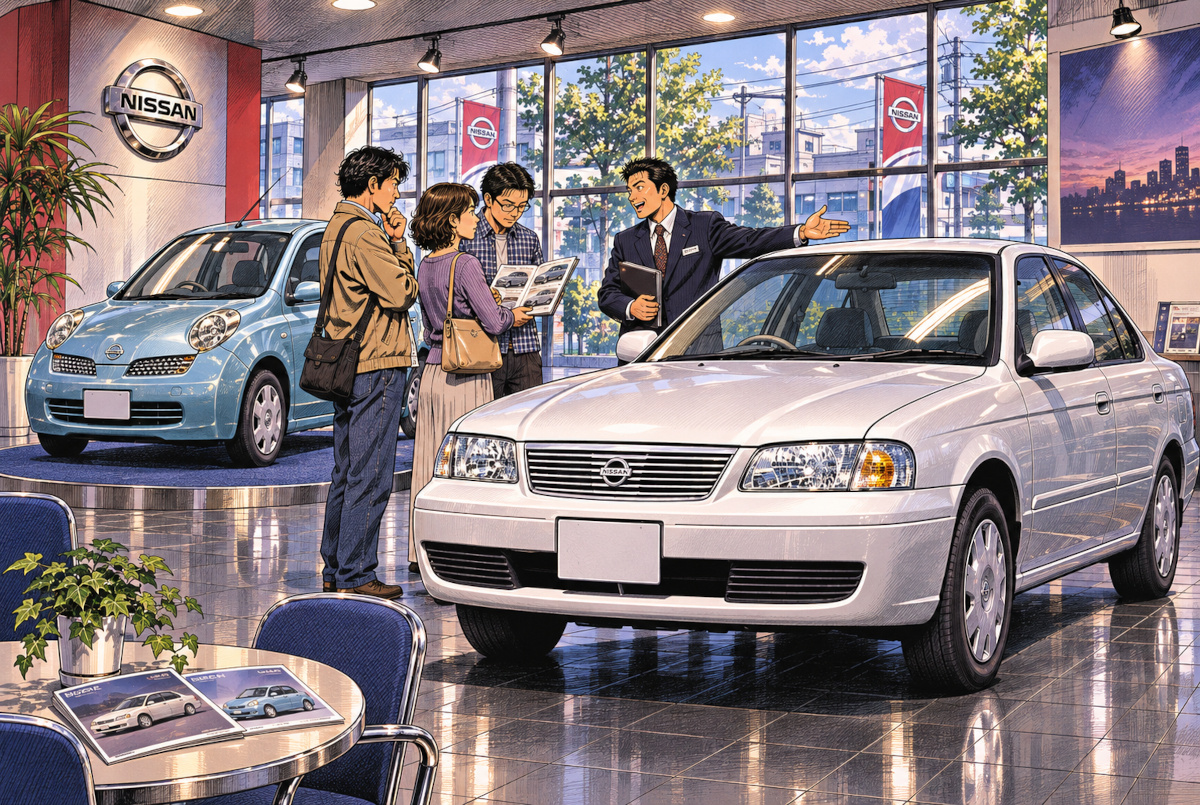
AI-generated illustration imagining a Nissan dealership in Japan around 2002. Customers are shown considering a B15 Sunny alongside a contemporary compact car. This is a fictional showroom scene, not a reconstruction of an actual dealership or sales discussion.
2004: The Sunny Name Died, but the Small Sedan Survived
Nissan was still refining the B15 in May 2002, updating its grille and bumpers while improving safety and emissions performance. Yet the Sunny’s Japanese domestic-market run ended in October 2004.
On October 29 that year, Nissan launched the Tiida Latio, a new compact sedan with a newly developed 1.5-liter engine, a spacious cabin, and an emphasis on interior quality.
Its monthly sales target was 3,000 vehicles.
Compare that with the Sunny’s 5,000-unit monthly target announced during its 2002 update, and the Latio’s target was 40% lower.
That does not establish that demand for compact sedans had fallen by 40%. We are comparing sales plans for different models, rather than directly measured market demand.
But it does show something about Nissan’s approach. The company did not abandon the compact sedan altogether. It introduced a different product with a different name and a different sales plan.
The available evidence does not support a neat story in which the Sunny disappeared because it was fundamentally underpowered or technically inferior.
The B15 offered a 175-PS performance variant, continued safety and efficiency improvements, and competitive figures against contemporary Corollas. Yet the nameplate’s domestic sales were declining, and Nissan eventually chose to move on.
The car kept improving. That simply was not enough to keep the Sunny name alive in Japan.
Editor’s Note
The first thing that caught my attention was the VZ-R. Who looks at an ordinary four-door Sunny and decides it needs a naturally aspirated engine making 175 PS at 7,800 rpm?
It needed premium fuel, used considerably more gasoline than the regular 1.5-liter model, and cost an extra ¥522,000. Who exactly was Nissan trying to sell this thing to?
Still, that is precisely the sort of oddball engineering decision I miss. Take a completely respectable family sedan, give it an engine that belongs in a different conversation, and put it in the price list anyway. You have to admire a company willing to do that. Today, I suspect the profitability spreadsheet would arrive before the prototype.
The Corolla comparison bothers me in a different way. When you line up the actual specifications, the Sunny was hardly a hopeless contender. Its interior length and engine output were competitive, while the apparent price advantage changed depending on which Corolla grade you picked.
Yet the Sunny name disappeared. Being good at building a car and being good at selling it are clearly not the same thing. A familiar badge, years of customer loyalty, and the relationship between buyers and dealerships can matter just as much as a specification sheet.
Personally, I wish Nissan had kept the Sunny name. Retiring a badge with 38 years of history cannot have been a trivial decision. Then again, without the internal planning documents, I cannot pretend to know exactly what the executives were thinking.
Perhaps that is the strangest part of the story: the last Japanese Sunny was by no means the weakest one. It was simply the last one.
Terms That May Need a Quick Explanation
- NEO VVL (Nissan Ecology Oriented Variable Valve Lift and Timing)
- Nissan’s variable valve lift and timing system. It switches between different cam profiles according to engine operating conditions, changing when the intake and exhaust valves open and how far they lift. The SR16VE engine in the B15 VZ-R used this technology.
Nissan Sunny: 60 Years of History - Eight-Part Series
Born in 1966, the Nissan Sunny challenged the Toyota Corolla and helped shape Japan's mass-market car industry. Across eight articles, we examine its development, engineering, performance, sales, motorsport history, and why the Sunny name disappeared from Japan while surviving in overseas markets.
- Part 1: Did Toyota’s “Extra 100cc” Really Beat the Datsun Sunny? The 89cc Battle (Part 1)
- Part 2: Did the Datsun Sunny Really Make the Corolla Look Small? The B110 and GX-5 (Part 2)
- Part 3: Was the Datsun Sunny Really No. 2 in World Production? The B210 and B310 (Part 3)
- Part 4: The Sunny Went FWD 19 Months Before the Corolla—Was the B12 Really That Good? (Part 4)
- Part 5: The Nissan Sunny Got Better. So Why Did Sales Fall? B13, B14 and the 300-PS Race Car
- Part 6: Nissan Gave Its Last Sunny 175 PS. Why Did the Name Disappear?
- Part 7: Why Did Nissan Drop the Sunny Name—Only to Target Older Buyers Again? (Part 7) Coming soon
- Final Part: English edition Coming soon
References
- Nissan Motor Co., “Launch of the All-New Sunny” (October 1998, Japanese) — Original manufacturer announcement for the B15, including a linked detailed press-release PDF.
- Nissan, “NEO VVL SR16VE” (Japanese) — Official explanation of the variable valve system and its 175 PS at 7,800 rpm output.
- GAZOO, “1998 Nissan Sunny VZ-R” (Japanese) — Historical specifications covering the SR16VE engine, curb weight, equipment, fuel economy, and price.
- GAZOO, “1998 Nissan Sunny EX Saloon, 5-Speed Manual” (Japanese) — Original specifications and pricing for the 1.5-liter sedan used in the VZ-R comparison.
- GAZOO, “1998 Toyota Corolla XE Saloon, 5-Speed Manual” (Japanese) — Dimensions, engine output, fuel economy, and listed price for the Japanese-market 1.5-liter front-wheel-drive Corolla.
- GAZOO, “Toyota Corolla E110 Historical Model and Grade Listings” (Japanese) — Period catalog entries used to identify the 1998 Corolla SE Saloon’s 1.5-liter manual-transmission specifications and price.
- Nissan Motor Co., “Sunny Partial Update” (September 2000, Japanese) — Changes to equipment and grades, listed prices, and monthly sales targets.
- Nissan Motor Co., “Sunny Minor Model Change” (May 2002, Japanese) — Exterior revisions, emissions improvements, safety equipment, and monthly sales targets.
- GAZOO, “2002 Nissan Sunny EX Saloon” (Japanese) — Specifications for the revised model, including the 109-PS QG15DE engine.
- Motor-Fan, “Japanese New-Car Sales Rankings in the 1990s” (Japanese) — Historical sales compilation based on Japanese Automobile Dealers Association and related data, including the Sunny’s 1998 sales.
- Car Stadium, “2002 Annual Vehicle Sales Rankings” (Japanese) — Published Sunny sales figures for 2001 and 2002. Complete reconciliation with the underlying statistical series has not been performed.
- Nissan Motor Co., “Launch of the New Tiida Latio Compact Sedan” (October 29, 2004, Japanese) — Official details of the successor-era compact sedan, its equipment, positioning, and monthly sales target.