
In January 1990, Nissan introduced the seventh-generation Sunny, the B13. Japan’s asset-price bubble was nearing its end, but even an ordinary family sedan was expected to feel a little more luxurious. Nissan responded with an unusually ambitious engine lineup: every gasoline-powered B13 Sunny featured a DOHC, 16-valve engine.
Then Japan’s bubble economy collapsed. When the eighth-generation B14 arrived in January 1994, priorities had shifted toward fuel economy, cabin space, and everyday practicality.
Yet the Sunny was also living a very different life on the racetrack. The showroom sedan offered 105 PS from a 1.5-liter engine, while its JTCC racing counterpart produced more than 300 PS from a specially prepared 2.0-liter engine.
Did the Nissan Sunny actually improve after the bubble burst? Or was Nissan building a better sedan just as Japanese buyers were beginning to look elsewhere?
To find out, I compared the original B13 and B14 specifications, Nissan’s racing records, and Japanese sales figures from the 1990s. The results reveal more than a simple story of economic decline.
1990: Even the Ordinary Sunny Had a DOHC Engine
The B13 was a direct evolution of the B12, better known in Japan as the “Trad Sunny.” It retained the previous generation’s restrained, angular styling while improving interior materials, equipment, and refinement.
According to the Nissan Heritage Collection, the gasoline engine lineup included the 1.3-liter GA13DS, 1.5-liter GA15DS, 1.6-liter GA16DE, and 1.8-liter SR18DE. All four used twin overhead camshafts and four valves per cylinder.
There is an important distinction here. The B13 was not the first Sunny to offer a DOHC engine. The preceding B12 already had twin-cam variants. What made the B13 unusual was that Nissan extended DOHC technology throughout the gasoline range, rather than reserving it for sporting models.
For example, the 1990 Sunny 1500 Super Saloon used the GA15DS engine with an electronically controlled carburetor. It produced 94 PS and had a curb weight of 990 kg. PS refers to metric horsepower, the unit used in the original Japanese specifications.
For a nameplate that had begun life as an inexpensive 1,000cc car, this was quite a transformation. Nissan was giving its everyday sedan engineering that once would have sounded more appropriate for a performance model.
B13 vs B14: Just 40 mm Longer, but 110 mm More Cabin Length
Nissan announced the eighth-generation B14 in December 1993 and launched it in January 1994. Its styling became rounder, and the emphasis shifted toward space efficiency and fuel economy.
But how much had actually changed beneath the styling?
I compared the original 1990 B13 Sunny 1500 Super Saloon with the 1994 B14 1500 Super Saloon. Both were front-wheel-drive, 1.5-liter sedans, using specifications published for their respective launch-period versions.
| Specification | 1990 Sunny B13 | 1994 Sunny B14 |
|---|---|---|
| Overall length | 4,210 mm | 4,250 mm |
| Overall width | 1,670 mm | 1,690 mm |
| Wheelbase | 2,430 mm | 2,535 mm |
| Catalog interior length | 1,740 mm | 1,850 mm |
| Engine | GA15DS, DOHC | GA15DE, DOHC |
| Maximum output | 94 PS | 105 PS |
Sources: GAZOO historical vehicle specifications and Nissan Heritage Collection. The figures compare launch-period models, not every version produced during each generation. Nissan’s preserved 1993 B13, for example, is listed at 4,250 mm overall length, rather than the 4,210 mm of the original 1990 model.
The B14 grew by only 40 mm in overall length, or approximately 0.95%. Its catalog interior length, however, increased by 110 mm, or about 6.3%.
The wheelbase grew by 105 mm. That is already a clue to what Nissan’s engineers were doing.
There is another way to examine the packaging. Subtract the wheelbase from the overall length, and the result is the combined front and rear overhang.
For the B13, that calculation gives 4,210 – 2,430 = 1,780 mm. For the B14, it gives 4,250 – 2,535 = 1,715 mm. In other words, the combined overhang decreased by 65 mm.
The B14 was not simply a larger car. Nissan extended the wheelbase and reduced the combined overhang, making room for a longer cabin within a body that had grown only slightly.
That does not mean the additional 110 mm can be attributed entirely to the wheelbase change. Seat placement, interior design, and the manufacturer’s measurement conventions also matter. Catalog interior length is not identical to usable rear-seat legroom.
Still, the comparison reveals a genuine change in engineering priorities. Where the B13 emphasized refinement, the B14 made more efficient use of its exterior dimensions.
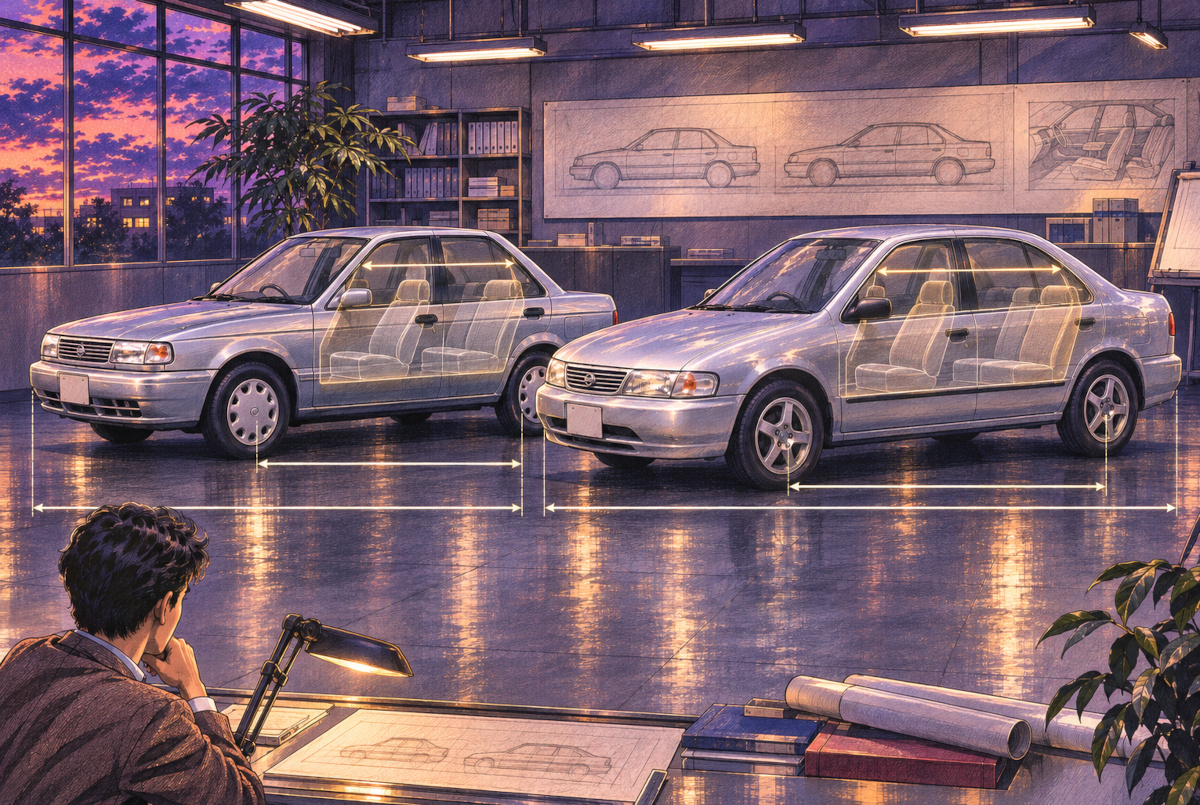
AI-generated comparison of the 1990 B13 and 1994 B14 Sunny. Overall length increased by 40 mm, wheelbase by 105 mm, and catalog interior length by 110 mm. Vehicle proportions, transparent body sections, and exterior details are schematic, not a scale-accurate engineering drawing.
105 PS and 19.6 km/L: The B14 Was Not Just About Cutting Costs
The B14’s 1.5-liter engine evolved into the GA15DE, replacing the earlier electronically controlled carburetor with electronic fuel injection. Maximum output increased from 94 PS to 105 PS, an improvement of approximately 11.7%.
There was also a notable fuel-economy figure. The 1994 Sunny 1500 Super Saloon with front-wheel drive and a five-speed manual transmission achieved a published 19.6 km/L under Japan’s 10-15 mode test procedure.
That equals approximately 12.2 miles per liter and helps explain Nissan’s contemporary advertising phrase, “12miles SUNNY.” For readers outside Japan, the figure means miles per liter, not miles per US gallon.
It was not a figure achieved by every B14. Fuel consumption varied with transmission, drivetrain, and specification. Nor is the historical 10-15 mode directly interchangeable with modern fuel-economy test cycles.
The changes went beyond the engine. Nissan adopted a multilink-beam rear suspension arrangement for front-wheel-drive B14 models, while a September 1995 revision made the driver’s airbag standard equipment throughout the Japanese range.
The point is that the B14 was not merely a stripped-down product of an economic downturn. Nissan was redirecting its investment toward fuel efficiency, interior packaging, safety, and practical refinement rather than the more conspicuous luxury associated with the bubble years.
105 PS on the Road, More Than 300 PS on the Track
The B14 also had an unexpected second career. In 1994, Nissan entered the Sunny in the All Japan Touring Car Championship, better known as the JTCC.
The championship followed a Super Touring format based on production cars with at least four doors and naturally aspirated engines of no more than 2.0 liters. Events were short sprint races rather than the endurance format of the earlier Group A era.
Nissan initially raced the Primera before adding the Sunny during the 1994 season.
In 1995, Akira Iida drove the No. 31 Xanavi Sunny to the model’s first JTCC victory at Mine. The Nissan Heritage Collection preserves the No. 32 Xanavi Sunny driven by Satoshi Motoyama during the 1996 season.
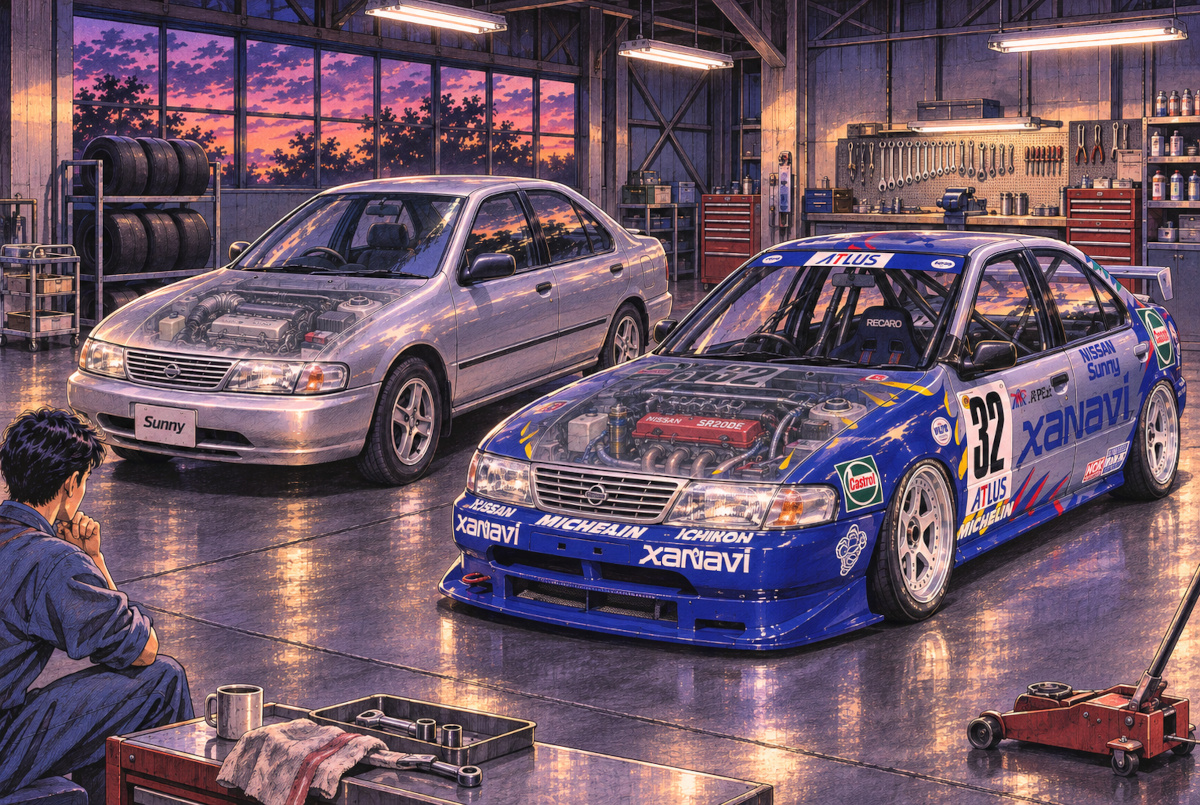
AI-generated comparison of a road-going B14 Sunny and the 1996 No. 32 Xanavi Sunny JTCC car. The standard 1.5-liter GA15DE produced 105 PS, while the competition-prepared 2.0-liter SR20DE produced more than 300 PS. Engine internals, component placement, and sponsor markings are simplified for illustration and are not exact reproductions of the original cars.
The competition car used a heavily modified SR20DE-based DOHC four-cylinder engine displacing 1,997cc. Despite being naturally aspirated, it produced more than 300 PS at 8,500 rpm. Its listed weight was at least 975 kg, and it used a six-speed racing transmission.
Now compare it with the ordinary B14 1500 Super Saloon.
Taking 300 PS as the minimum racing output, 300 / 105 gives a power ratio of approximately 2.86. The competition car had at least 2.86 times the maximum engine output of the standard sedan.
But that comparison is incomplete because the two engines have different displacements. Output per liter offers another perspective.
| Calculation | Road-going B14 | 1996 JTCC Sunny |
|---|---|---|
| Engine displacement | 1,497cc | 1,997cc |
| Maximum output | 105 PS | More than 300 PS |
| Output per liter | 105 / 1.497 = 70.1 PS/L | 300 / 1.997 = 150.2 PS/L or more |
The race engine therefore delivered at least about 2.14 times as much power per liter.
This was not a 300-PS Sunny sold to the public. It was a purpose-built competition machine using a different, extensively developed engine and racing hardware, while retaining the identity of the production sedan on which it was based.
There is even a small trap in Nissan’s own archive. The Japanese Heritage Collection page labels the car “1966 JTCC” in its heading, but the body text, specifications, and official English page identify it as a 1996 car. Since the JTCC series itself began in 1994, the heading appears to contain a typographical error.
Even original manufacturer records deserve a second look when the numbers do not agree.
Better Engineering, Fewer Buyers: Where Did the Sedan Market Go?
During the B13 years, Nissan also offered the separately styled NX Coupe, which shared the basic mechanical platform. After the B14 arrived, Nissan introduced the two-door Lucino coupe in May 1994, broadening its appeal beyond the conventional family sedan.
But the Japanese passenger-car market was changing. Minivans, SUVs, and other recreational or multipurpose vehicles were becoming increasingly attractive alternatives to traditional sedans.
How did the Sunny fare while these new choices were spreading?
Motor-Fan’s compilation of Japanese new-car registration figures, based on industry data, gives the following annual Sunny sales:
| Year | Sunny registrations |
|---|---|
| 1994 | 113,302 |
| 1995 | 101,995 |
| 1996 | 93,722 |
Subtracting 93,722 from 113,302 gives a decline of 19,580 cars. Dividing that decline by the 1994 total produces approximately 17.3%.
That was a substantial drop over just two years, especially considering the B14’s improved cabin space, engine output, and equipment.
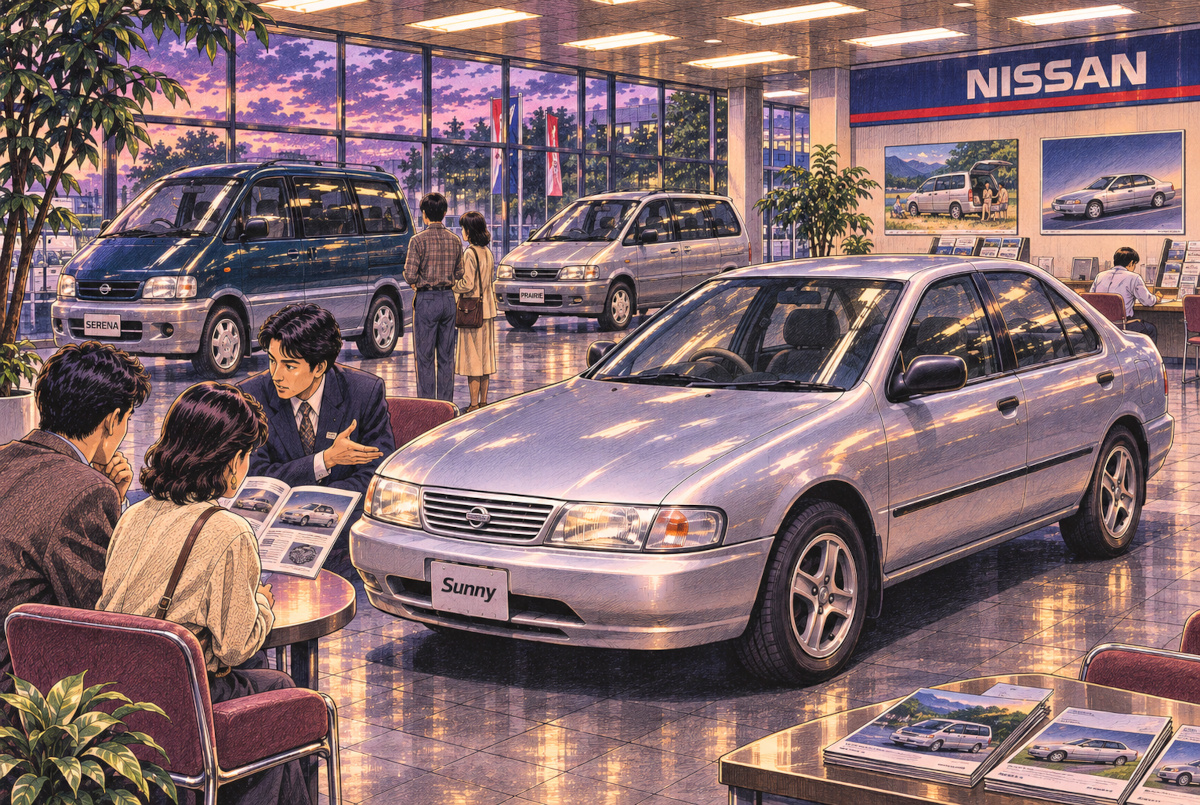
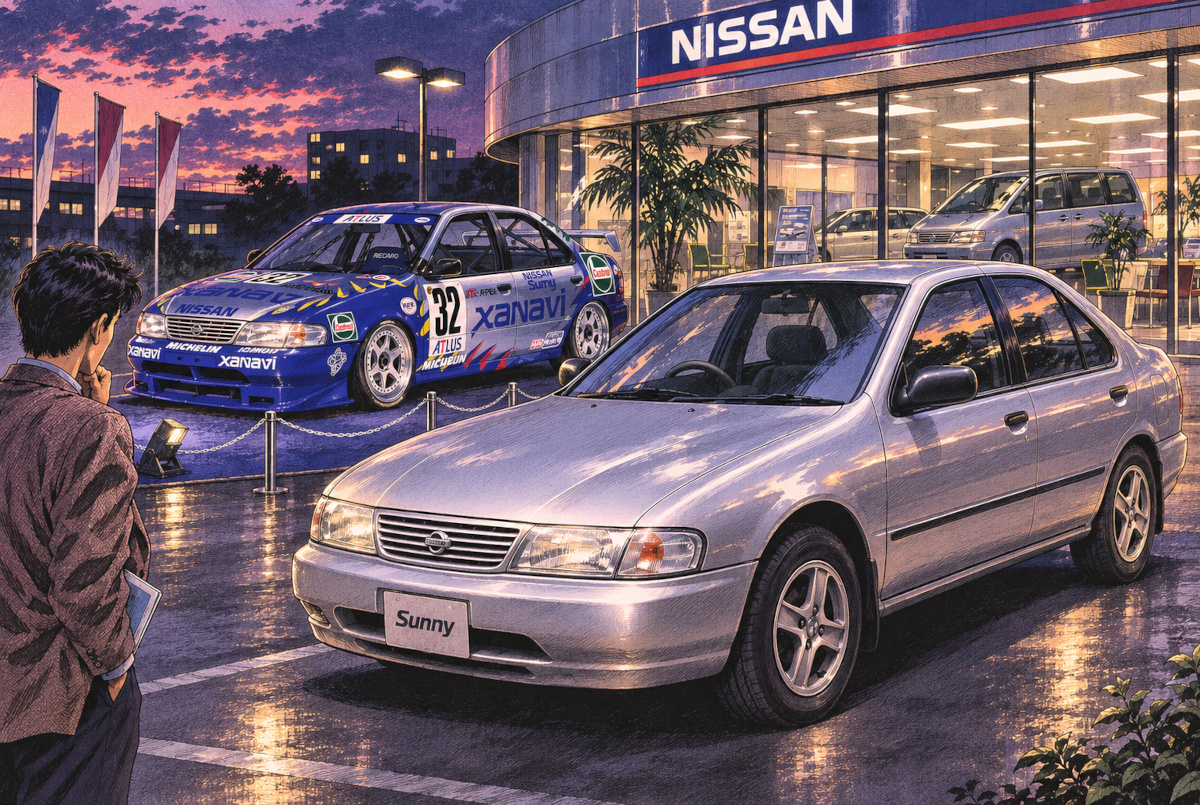
AI-generated illustration of a fictional Japanese dealership in the mid-1990s. It represents a period when buyers could choose between conventional sedans and a growing range of minivans and multipurpose vehicles. Vehicle model details and dealership surroundings are not exact historical reproductions.
Even so, the Sunny was still Japan’s ninth-best-selling passenger-car nameplate in 1996. It had not disappeared from the market.
Nor can these figures tell us precisely how many younger customers abandoned the Sunny. Comparable age-specific buyer statistics were not available in the sources examined, so it would be misleading to claim that only older buyers remained.
The figures also do not prove that the minivan and SUV boom caused the entire 17.3% decline. They show that Sunny registrations fell during a period when Japanese consumers had more alternatives to the traditional sedan. Separating the effects of competition, demographics, prices, and vehicle preferences would require additional evidence.
The B14 received exterior revisions in May 1997, and the ninth-generation B15 succeeded it in October 1998.
By that point, the Sunny faced a difficult challenge: it had to remain a dependable and affordable sedan in a market where the very definition of a practical family car was changing.
Editor’s Note
One thing still strikes me about the B13. In 1990, even the ordinary 1.3-liter Sunny had a DOHC engine. Today, somebody in an accounting department would probably start asking awkward questions about the cost. But Nissan was serious enough about its small sedan to give the entire gasoline range twin-cam engines.
The B14’s dimensions are even more intriguing. Just 40 mm of extra body length, yet 110 mm more catalog interior length. Numbers like that make me wonder what sort of arguments went on between the body engineers, interior designers, and people responsible for keeping costs down.
Then there is the JTCC Sunny. I have always liked the absurdity of touring-car racing: take something with the face of an ordinary family sedan, fit a highly developed racing engine, and send it into a serious championship. More than 300 PS under a Sunny badge? That is exactly the sort of unlikely machinery worth digging into.
But here is the uncomfortable part. The road car was improving, while sales were slipping. Nissan offered a youth-oriented coupe, made the sedan roomier, improved fuel economy, and added safety equipment. Yet buyers were increasingly considering vehicles that had little in common with the traditional three-box sedan.
Personally, I prefer the square-edged B13. But the B14 deserves more credit than it usually gets. It was not merely a B13 with the corners rounded off. Nissan was working hard to rethink what an affordable family sedan should offer.
And that may be the strangest lesson of the bubble’s aftermath: an automaker can make a genuinely better car and still find that the market has started asking for something else.
Terms That May Need a Quick Explanation
- Overhang
- The portion of a vehicle extending beyond the front or rear axle. Adding the front and rear overhangs gives the overall vehicle length minus its wheelbase. A reduction in overhang does not automatically translate into an equal increase in usable interior space.
Nissan Sunny: 60 Years of History - Eight-Part Series
Born in 1966, the Nissan Sunny challenged the Toyota Corolla and helped shape Japan's mass-market car industry. Across eight articles, we examine its development, engineering, performance, sales, motorsport history, and why the Sunny name disappeared from Japan while surviving in overseas markets.
- Part 1: Did Toyota’s “Extra 100cc” Really Beat the Datsun Sunny? The 89cc Battle (Part 1)
- Part 2: Did the Datsun Sunny Really Make the Corolla Look Small? The B110 and GX-5 (Part 2)
- Part 3: Was the Datsun Sunny Really No. 2 in World Production? The B210 and B310 (Part 3)
- Part 4: The Sunny Went FWD 19 Months Before the Corolla—Was the B12 Really That Good? (Part 4)
- Part 5: The Nissan Sunny Got Better. So Why Did Sales Fall? B13, B14 and the 300-PS Race Car
- Part 6: Nissan Gave Its Last Sunny 175 PS. Why Did the Name Disappear?
- Part 7: Why Did Nissan Drop the Sunny Name—Only to Target Older Buyers Again? (Part 7) Coming soon
- Final Part: English edition Coming soon
References
- Nissan Heritage Collection — Sunny 1500 Super Saloon (Japanese). Nissan’s official account of the B13 engine range, model development, and specifications for its preserved 1993 example.
- GAZOO — January 1990 Nissan Sunny Super Saloon Specifications (Japanese). Original-generation B13 dimensions, interior measurements, 94-PS engine, and curb weight.
- Response.jp — 1994 Nissan Sunny 1.5 Super Saloon, Five-Speed Manual (Japanese). B14 wheelbase, cabin measurements, 105-PS output, and 19.6 km/L fuel-economy rating.
- Meisha Bunka Kenkyujo — Nissan Sunny, 1994–1998 (Japanese). Historical discussion of the B14’s packaging, development priorities, and “12miles SUNNY” advertising.
- Nissan Heritage Collection — Xanavi Sunny JTCC No. 32 (Japanese). Official technical specifications and competition history of the 1996 car. The page heading contains an apparent year typo.
- Nissan Heritage Collection — Sunny (1996: HB14) (English). Official confirmation of the 1996 No. 32 Xanavi Sunny, Satoshi Motoyama, engine output, and six-speed racing transmission.
- NISMO — History of Japanese Motorsport, Vol. 06: The New JTCC (Japanese). Nissan’s account of Super Touring regulations and the Primera and Sunny competition programs.
- GAZOO — Nissan Lucino Model History (Japanese). The B14-based coupe range introduced in May 1994.
- Motor-Fan — Thirty Years of Japan’s Best-Selling Passenger Cars, Page 4 (Japanese). Historical nameplate registration figures compiled from Japanese automobile industry data, including the Sunny’s 1994–1996 totals.
- CarSensor — Nissan Sunny B14 Model and Revision History (Japanese). Documentation of the 1995 safety-equipment changes and subsequent styling revisions.