


Jensen Huang is out as NVIDIA’s CEO. His departure followed an infidelity scandal and reports of possible foreign intelligence targeting, although the national security allegations remain unresolved.
But for a PC hardware enthusiast, there’s another question worth asking. What happens to the GPUs? A CEO’s private life doesn’t determine how many TFLOPS the next GeForce will deliver. And what if the United States actually stopped using NVIDIA hardware? Could its AI industry carry on with chips from AMD, Google, and Amazon?
The alternatives exist. Yet a closer look at NVIDIA’s financial reports, competing AI accelerators, and the software behind them reveals a problem that can’t be solved simply by swapping graphics cards.
92.5% of NVIDIA’s Revenue Came From Data Centers!
NVIDIA’s financial results, released on August 26, 2026, reported total revenue of $96.221 billion for the quarter ended July 26. Data Center revenue alone reached $89.0 billion.
Let’s calculate the share:
$89.0 billion ÷ $96.221 billion × 100 = approximately 92.5%.
That leaves approximately 7.5% for all other business segments combined. On the same basis, Data Center revenue was about 12.3 times the rest of NVIDIA’s revenue.
Roughly 92.5% of NVIDIA’s quarterly revenue came from its Data Center business.
That’s not the same as the roughly 90% share of desktop graphics card shipments we examined in Part 1. That figure described a market dominated by NVIDIA. This one describes how NVIDIA itself makes its money.
There’s another catch. Data Center revenue includes more than AI GPUs. Networking equipment and related infrastructure also contribute. Likewise, the remaining 7.5% doesn’t consist entirely of GeForce gaming cards.
NVIDIA is no longer a company you can understand just by looking at its latest gaming GPU.
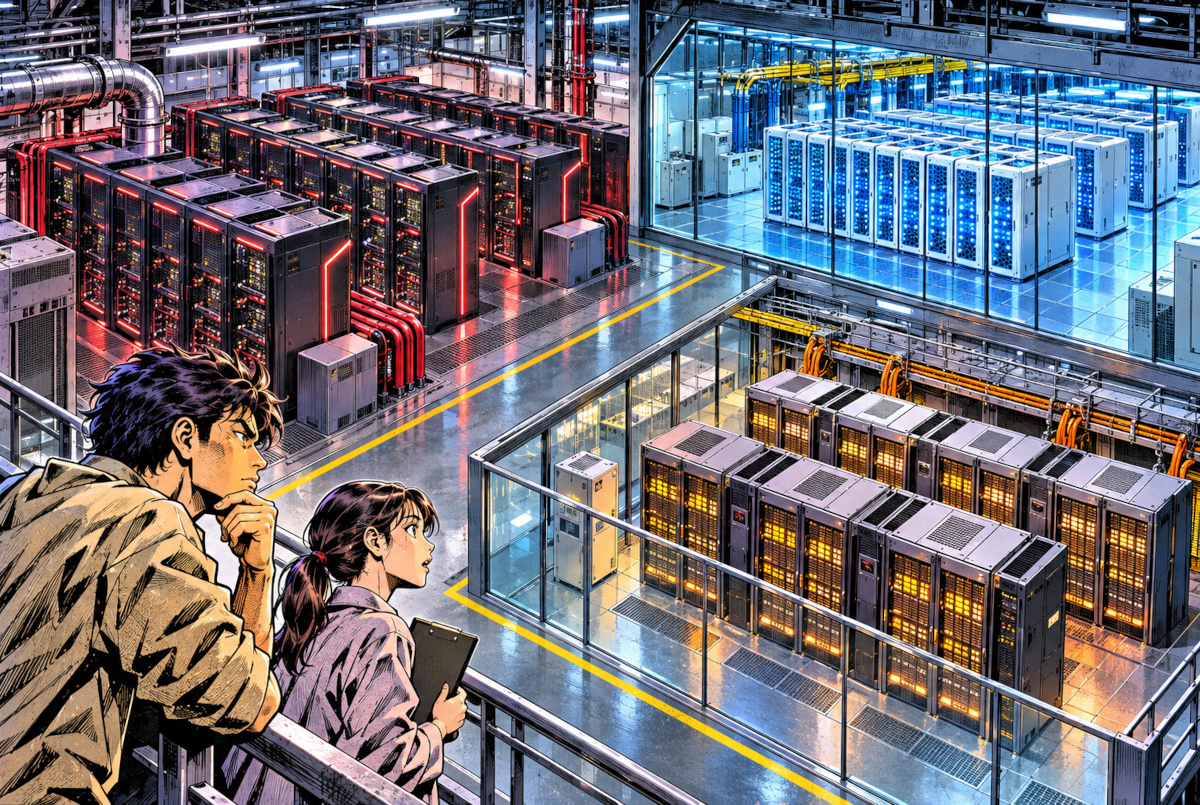
In NVIDIA’s quarter ended July 2026, Data Center accounted for approximately 92.5% of total revenue. AI-generated conceptual illustration; it does not depict an actual NVIDIA facility or its equipment configuration. The colors of the server racks do not represent revenue shares or particular companies.
Could AMD, Google, or Amazon Take NVIDIA’s Place?
NVIDIA isn’t the only company capable of building chips for AI. AMD has its Instinct GPUs, while Google and Amazon have developed specialized processors for their own cloud computing platforms.
Here’s how the main alternatives compared as of November 14, 2026, based on their official product announcements.
| Company | Competing Technology | Primary Deployment |
|---|---|---|
| AMD | Instinct MI400 Series | AI GPUs and server systems |
| Ironwood TPU | Google Cloud and related AI infrastructure | |
| Amazon AWS | Trainium3 | AWS cloud infrastructure |
On November 12, 2026, AMD announced further details of its Instinct MI400 Series and introduced the MI450X.
Google’s TPU7x, the first processor in its Ironwood family, became generally available on March 31, 2026. Amazon’s Trainium3-powered EC2 Trn3 UltraServers became generally available in December 2025.
So the claim that AI simply cannot run without NVIDIA is wrong. These are real alternatives, not imaginary future technologies.
But they don’t all serve the same purpose. AMD Instinct products are GPUs designed for AI and high-performance computing. Google’s TPUs and AWS Trainium chips are specialized AI accelerators, generally accessed through their respective cloud ecosystems.
They aren’t ordinary consumer graphics cards that you can buy, insert into a desktop PC, and expect to behave like a GeForce.
Having an alternative AI chip is not the same as having a drop-in replacement for NVIDIA’s entire computing platform.

AI-generated conceptual illustration of alternative AI computing platforms, including AMD Instinct, Google TPU, and AWS Trainium. It is not a real data center or an accurate wiring diagram. The green and orange paths do not identify particular manufacturers or indicate performance differences.
Change the GPU, and CUDA Is Still a Problem
Then there’s CUDA, NVIDIA’s platform for running parallel computing workloads on GPUs.
CUDA is widely used in AI development, scientific computing, and other demanding applications. Over the years, developers have built software around its programming tools, libraries, and associated computing environment.
AMD offers a competing software platform called ROCm, which supports AI frameworks including PyTorch. Google TPUs and AWS Trainium have their own software tools and supported frameworks as well.
That means moving away from NVIDIA is possible. But applications relying on CUDA-specific code or libraries may require modifications, compatibility checks, and performance testing.
Some workloads can move with relatively little effort. Others may involve substantial engineering work. The exact difficulty depends on the software, not just which GPU looks faster on a specification sheet.
Replacing the hardware is one job. Making sure the software still works properly is another.
That’s what makes NVIDIA’s position unusually strong. Its competitive advantage isn’t limited to semiconductor performance. It also includes the development ecosystem built around those chips.

AI-generated conceptual diagram of GPU hardware and software development environments. Moving CUDA-dependent applications to AMD ROCm or another platform may require code changes and compatibility testing, depending on the libraries and workloads involved. The floating code and illuminated cables are artistic devices, not actual hardware connections.
What If the United States Banned NVIDIA at Home?
Before imagining an American AI industry without NVIDIA, we need to separate two very different policies.
On January 13, 2026, the US Department of Commerce’s Bureau of Industry and Security (BIS) announced changes to its licensing policy for certain advanced semiconductor exports to China.
The policy covers chips including NVIDIA’s H200 and AMD’s MI325X. Export license applications can receive case-by-case review when specified security and supply conditions are met.
That is not an automatic authorization to export every advanced AI chip to China. More importantly, it is not a ban on using NVIDIA products inside the United States.
As of November 14, 2026, we could not establish that the United States had adopted a blanket domestic ban on NVIDIA hardware.
Now consider a hypothetical policy that removed NVIDIA equipment from US AI data centers.
Companies using NVIDIA-based systems could face hardware replacement costs, software migration work, and additional testing. AMD, Google, and AWS technologies might replace some workloads, but the available evidence doesn’t establish how quickly or completely they could replace the entire installed NVIDIA infrastructure.
Restricting semiconductor exports to another country and banning those same chips at home are fundamentally different things.
We also cannot reliably calculate the total financial damage or migration time from the published information examined here.
The existence of competing chips means that American AI would not necessarily stop overnight without NVIDIA. But there is equally little basis for assuming that a nationwide transition would be quick or painless.

AI-generated policy illustration. In January 2026, the US Commerce Department announced case-by-case review of certain semiconductor export license applications to China, subject to conditions. The check mark shown in the illustration does not mean automatic export approval. No blanket US domestic ban on NVIDIA products had been announced as of November 14, 2026.
Terms That May Need a Quick Explanation
- CUDA
- A parallel computing platform and programming model developed by NVIDIA. It enables developers to use GPUs for workloads such as AI and scientific computing, with supporting libraries and development tools.
Editor’s Note
There’s an old saying that great men have a weakness for romance. That’s hardly an excuse for infidelity. Still, as a PC hardware obsessive, I find myself wondering how many TFLOPS NVIDIA’s next GPU will deliver rather than dwelling on its former CEO’s private life.
A scandal doesn’t suddenly break CUDA or make a GeForce card run slower. If trouble at the top starts affecting product development or supplies, though, that’s a different story.
What really caught me off guard was the revenue breakdown. I used to think of NVIDIA as a graphics card company. Now its Data Center business accounts for more than nine-tenths of revenue.
The man in the leather jacket may be gone, but the engineers, chips, and software remain. And the more I looked into the alternatives, the clearer it became that another company can’t simply inherit that whole ecosystem.
In the end, that’s the part I care about. Not the gossip, but what would actually happen to the technology.
NVIDIA: Three-Part Series
From the resignation of NVIDIA's founder and CEO to the global GPU market, AMD and Intel competition, and the dependence of AI infrastructure on NVIDIA. Three articles examine the technology, market data, and the challenges of replacing NVIDIA hardware.
- Part 1: NVIDIA’s CEO Is Out. Why Does Intel Lead the PC GPU Market? (Part 1)
- Part 2: Could AMD and Intel Replace NVIDIA? The 10× Graphics Card Problem (Part 2)
- Final Part: The Leather Jacket Is Gone. Could U.S. AI Run Without NVIDIA? (Final Part)
References
- NVIDIA, “NVIDIA Announces CEO Transition” (November 12, 2026) — Official announcement of Jensen Huang’s resignation and the company’s plans for business continuity.
- NVIDIA, “NVIDIA Announces Financial Results for Second Quarter Fiscal 2027” (August 26, 2026) — Official total revenue and Data Center revenue used to calculate the 92.5% share.
- AMD, “AMD Advances the Instinct MI400 Series for AI and Scientific Computing” (November 12, 2026) — MI400 Series developments and announcement of MI450X.
- Google Cloud, “Cloud TPU Release Notes” — March 31, 2026 general availability of TPU7x, the first processor in the Ironwood family.
- Amazon Web Services, “Announcing Amazon EC2 Trn3 UltraServers” (December 2, 2025) — General availability of Trainium3-powered infrastructure.
- NVIDIA, “CUDA Programming Guide” — Official explanation of the CUDA platform and programming model.
- AMD, “ROCm PyTorch Compatibility” — Documentation of PyTorch support and compatibility considerations within the ROCm ecosystem.
- US Department of Commerce, Bureau of Industry and Security, “Department of Commerce Revises License Review Policy for Semiconductors Exported to China” (January 13, 2026) — Official explanation of case-by-case export license review and applicable conditions.