


NVIDIA co-founder Jensen Huang resigned as CEO in November 2026. A leadership scandal doesn’t suddenly make a GeForce graphics card slower. But it raises an oddly practical question: what if NVIDIA graphics cards stopped reaching the market altogether?
AMD has Radeon. Intel has Arc. Both companies make discrete GPUs, but could they actually replace NVIDIA? We examined gaming benchmarks, US retail prices, and worldwide graphics card shipments. As it turns out, making a competitive GPU and supplying an entire market are two very different problems.
Can’t Radeon Compete With GeForce? The Benchmarks Say Otherwise
Let’s start with AMD. In a graphics card comparison published by Tom’s Hardware in October 2026, the Radeon RX 9070 XT came surprisingly close to NVIDIA’s GeForce RTX 5070 Ti.
| Comparison | RX 9070 XT | RTX 5070 Ti |
|---|---|---|
| Average FPS at 1440p | 85.3 | 92.0 |
| Median US street price | $759 | $1,099 |
| Price per FPS | $8.90 | $11.95 |
| Video memory | 16GB GDDR6 | 16GB GDDR7 |
Source: Tom’s Hardware, October 2026 comparison. Performance figures are based on testing through June 2026, using a 19-game suite at 1440p, including conventional rasterization and ray tracing. Upscaling and frame generation were disabled. Prices are median US street prices at the time of the October survey, not current prices or Japanese retail prices. Price per FPS is calculated independently from the published figures.
The Radeon delivered approximately 92.7% of the GeForce’s average frame rate, but cost only about 69.1% as much.
Now divide the frame rate by the price of each card:
Radeon RX 9070 XT: 85.3 ÷ $759 = approximately 0.1124 FPS per dollar.
GeForce RTX 5070 Ti: 92.0 ÷ $1,099 = approximately 0.0837 FPS per dollar.
Using the GeForce as a baseline of 100%, the Radeon reaches approximately 134.3%.
Under these particular test and price conditions, the Radeon offered roughly 34% more gaming performance per dollar.
That is hardly the result you’d expect from a manufacturer supposedly unable to challenge NVIDIA. Of course, it doesn’t mean AMD wins every game. Ray tracing performance, DLSS, CUDA compatibility, and other software features can change the value of a card depending on what you use it for.
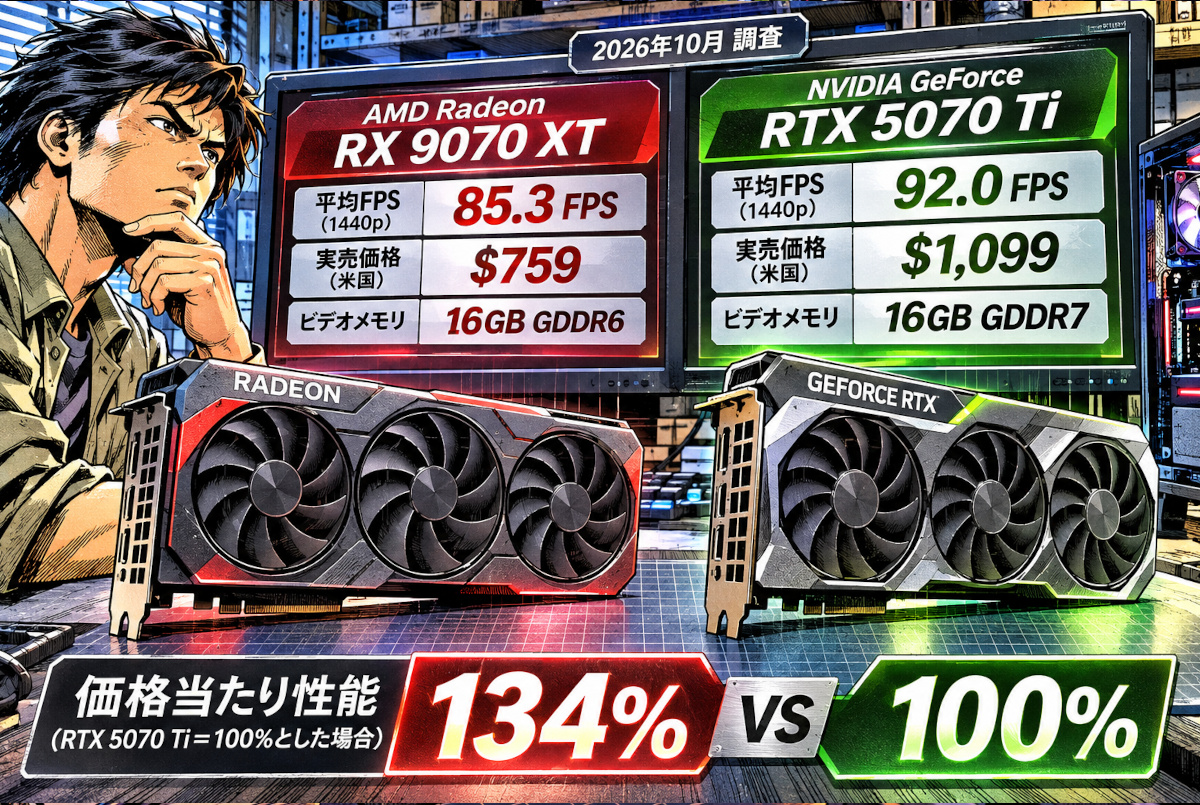
AI-generated editorial illustration based on Tom’s Hardware data. FPS results come from a 19-game 1440p test suite, while prices reflect the October 2026 US survey. The 134% relative performance-per-dollar figure is our calculation, with RTX 5070 Ti set to 100%. The illustration retains Japanese labels; GPU appearances and the person are fictionalized.
What About Intel Arc? More Memory, but Less Speed
Intel is no longer limited to the integrated graphics found in many of its processors. The Arc B580, launched in December 2024, entered the discrete graphics card market with 12GB of GDDR6 memory and a suggested launch price of $249.
In Tom’s Hardware’s June 2026 rasterization benchmark, the Intel Arc B580 averaged 50.7 FPS at 1440p, compared with 59.8 FPS for the GeForce RTX 5060.
That puts the Arc at approximately 84.8% of the RTX 5060’s performance in this test: 50.7 ÷ 59.8 × 100.
These figures are from a rasterization-only benchmark, not the combined 19-game results used for the Radeon comparison above. They should not be mixed as though they came from the same performance ranking.
The Arc B580’s 12GB of memory is attractive next to the RTX 5060’s 8GB. But more VRAM doesn’t automatically produce higher frame rates. Intel offers a genuine alternative in the lower-cost segment, though it is not yet a substitute for NVIDIA’s fastest gaming GPUs.
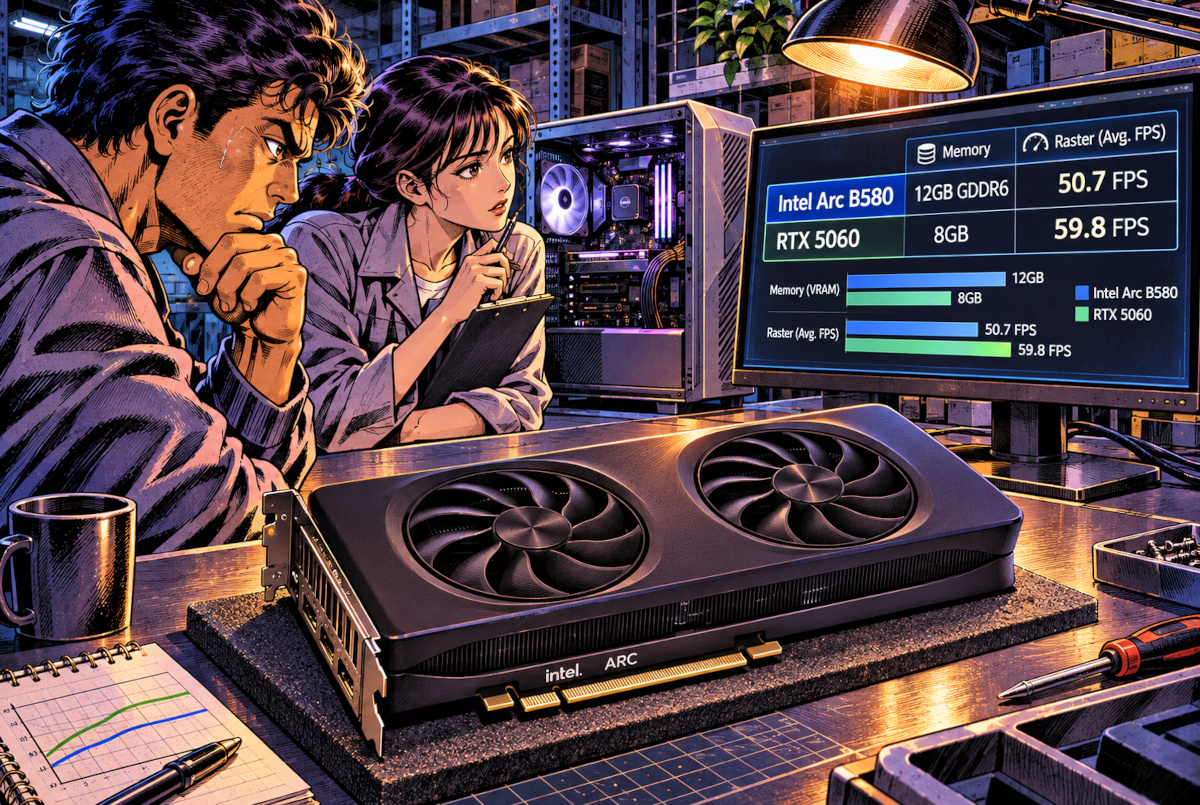
AI-generated hardware comparison. FPS figures are from Tom’s Hardware’s June 2026 native-resolution rasterization benchmarks, without upscaling or frame generation. They do not represent ray tracing results. The graphics card and people are illustrative, not photographs of a specific test.
If NVIDIA Disappeared, Would AMD and Intel Need to Ship Ten Times as Many Cards?
Here’s where the problem gets much bigger than a benchmark chart.
According to Jon Peddie Research (JPR), worldwide desktop graphics add-in board shipments reached approximately 12.5 million units in the second quarter of 2026. NVIDIA accounted for roughly 90% of the market, AMD for 8%, and Intel for 2%.
Converting those rounded market shares into actual shipment estimates gives us:
| Manufacturer | Estimated Q2 2026 Shipments |
|---|---|
| NVIDIA | 11.25 million |
| AMD | 1.00 million |
| Intel | 0.25 million |
Independent estimates derived from JPR’s total shipment volume and rounded market shares. These are not exact manufacturer-reported unit counts.
AMD and Intel together accounted for approximately 1.25 million cards per quarter.
Now imagine NVIDIA stopped supplying new desktop graphics cards worldwide. Assume total demand stayed at 12.5 million cards per quarter, and every NVIDIA card had to be replaced by a discrete GPU from AMD or Intel.
The required combined shipment volume would be:
12.5 million ÷ 1.25 million = 10.
AMD and Intel would need to ship roughly ten times their existing combined volume to cover the entire market.
This is a hypothetical replacement requirement, not a measurement of factory capacity. It does not prove that either company is incapable of expanding production tenfold. The publicly available shipment figures alone cannot establish how much additional manufacturing capacity they could obtain or how quickly.

AI-generated conceptual illustration based on JPR’s Q2 2026 market data and our calculations. The tenfold figure assumes unchanged worldwide demand and complete replacement with AMD and Intel discrete graphics cards. It does not measure actual production capacity. Factory equipment, packaging, and shipment stacks are fictionalized and not drawn to a precise physical scale.
What If Only the United States Stopped Buying NVIDIA?
A worldwide shutdown is an extreme scenario. What if only the US stopped adopting new NVIDIA graphics cards?
No such blanket US restriction had been announced as of November 14, 2026. This is a hypothetical calculation, not a description of government policy.
We could not establish a reliable public figure for exactly how many NVIDIA desktop graphics cards were shipped to the US. So instead, let’s assume that 20% of NVIDIA’s worldwide shipments went to the American market.
That gives us:
11.25 million × 20% = 2.25 million cards.
Suppose AMD and Intel must continue supplying their existing worldwide customers while also filling this additional 2.25-million-card gap.
Their required combined shipments would rise to 1.25 million + 2.25 million = 3.5 million cards per quarter.
3.5 million ÷ 1.25 million = 2.8 times their existing volume.
The 20% US allocation is an illustrative assumption, not a verified regional market share. The result changes if that assumption changes or if demand shifts to other products.
There’s also a manufacturing complication. AMD relies on Taiwan Semiconductor Manufacturing Company (TSMC) for advanced GPU fabrication, according to its annual filing. Intel’s official specifications also identify TSMC’s N5 process for the Arc B580.
In other words, having a competitive chip design doesn’t automatically mean having the manufacturing capacity to supply millions more cards. Production slots, memory, packaging, assembly, and distribution all matter.
Editor’s Note
A CEO can leave under a cloud of scandal, but that won’t magically overclock a Radeon or turn an Intel Arc into an RTX 5090 overnight.
What surprised me was how competitive AMD already looks when you calculate performance per dollar. Intel isn’t just making the graphics built into office PCs anymore, either.
Yet when I tried to work out what replacing NVIDIA would actually involve, the number ten suddenly appeared. Ten times the combined shipment volume. That’s quite a different problem from winning a few benchmark charts.
PC enthusiasts can spend hours arguing over a five-FPS difference. But a card that performs beautifully is no use to a buyer if nobody can manufacture and deliver enough of them.
And the biggest NVIDIA dependency isn’t necessarily on the gaming side anymore. The final part of this series will look at AI accelerators, data centers, and the software ecosystem that makes replacing NVIDIA even more complicated.
NVIDIA: Three-Part Series
From the resignation of NVIDIA's founder and CEO to the global GPU market, AMD and Intel competition, and the dependence of AI infrastructure on NVIDIA. Three articles examine the technology, market data, and the challenges of replacing NVIDIA hardware.
- Part 1: NVIDIA’s CEO Is Out. Why Does Intel Lead the PC GPU Market? (Part 1)
- Part 2: Could AMD and Intel Replace NVIDIA? The 10× Graphics Card Problem (Part 2)
- Final Part: The Leather Jacket Is Gone. Could U.S. AI Run Without NVIDIA? (Final Part)
References
- NVIDIA, “NVIDIA Announces CEO Transition” (November 12, 2026) — Official announcement of Jensen Huang’s resignation and the company’s business continuity plans.
- Tom’s Hardware, “Best Graphics Cards for Gaming in 2026” — October 2026 US median street prices and the 1440p gaming performance figures used in our price-to-performance calculations.
- Tom’s Hardware, “GPU Benchmarks Hierarchy 2026” — June 2026 rasterization results for Intel Arc B580 and GeForce RTX 5060.
- AMD, “AMD Unveils Next-Generation RDNA 4 Architecture with Radeon RX 9000 Series” (February 28, 2025) — Official specifications of Radeon RX 9070 XT, including its 16GB GDDR6 memory.
- NVIDIA, “GeForce RTX 5070 Family” — Official specifications for RTX 5070 Ti, including its 16GB GDDR7 memory.
- Intel, “Intel Launches Arc B-Series Graphics Cards” (December 3, 2024) — Arc B580 product launch and suggested starting price.
- Jon Peddie Research, “Q2’26 PC Graphics AIB Shipments” (September 9, 2026) — Worldwide graphics add-in board shipment volumes and manufacturer market shares used for our hypothetical supply-gap calculations.
- AMD, “2025 Form 10-K” (filed February 4, 2026) — Semiconductor manufacturing partners, TSMC dependence, and production supply risks.
- Intel, “Arc B580 Graphics Specifications” — Official video memory specifications and TSMC N5 manufacturing process.