
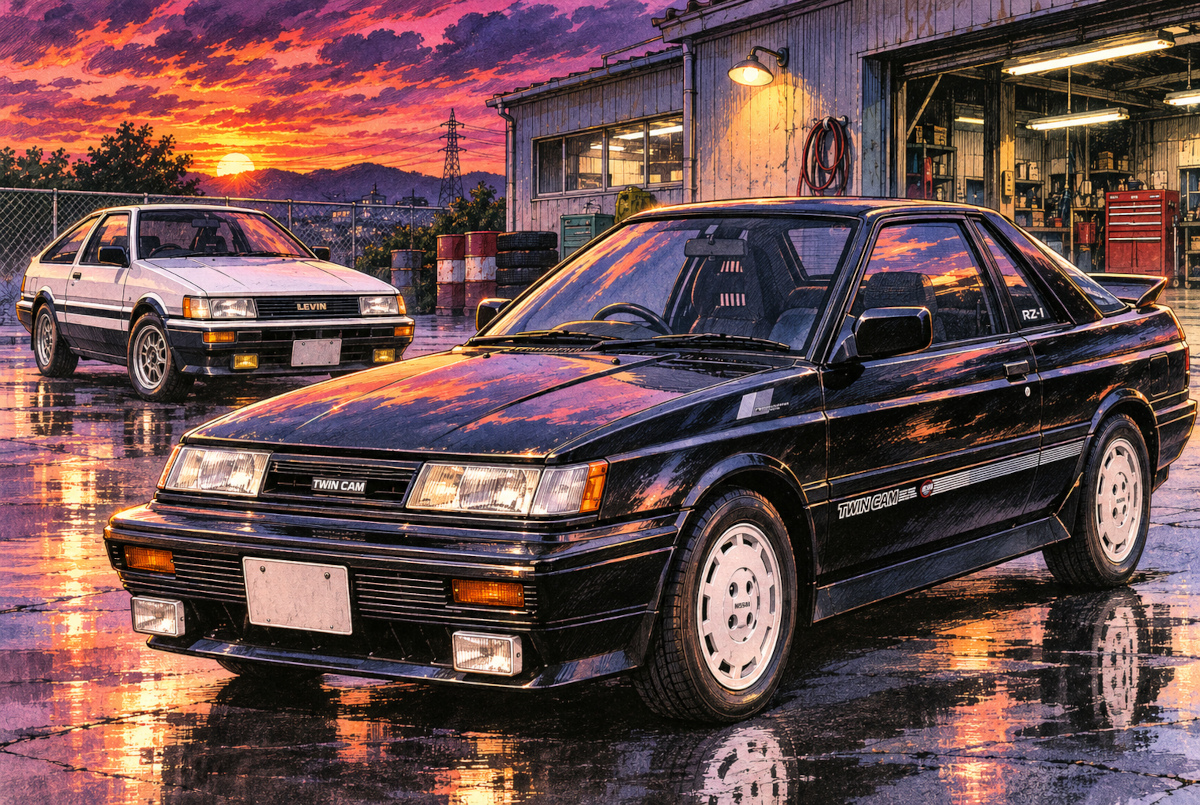
In the 1980s Japanese performance-car scene, Toyota’s AE86 Corolla Levin and Sprinter Trueno were rated at 130PS. Nissan’s Sunny RZ-1 Twin Cam, meanwhile, made 120PS.
On paper, Nissan appeared to be 10PS behind. End of argument?
Not quite. A closer look at Toyota’s and Nissan’s published specifications reveals a rather important detail: the AE86’s 130PS was a gross horsepower rating, while the RZ-1’s 120PS was a net rating. They weren’t measured under equivalent conditions.
So what happens when we find a more comparable Toyota? To investigate, we’ll examine Nissan’s CA16DE engine, introduced in August 1986, alongside the 4A-GE fitted to the front-wheel-drive AE92 Levin and Trueno in 1987.
AE86: 130PS. RZ-1: 120PS. Was Nissan Really 10PS Behind?
Launched in May 1983, the Toyota AE86 used the 1.6-liter 4A-GEU, a naturally aspirated, 16-valve DOHC engine rated at 130PS.
In August 1986, Nissan added a 1.6-liter 16-valve DOHC engine, the CA16DE, to the Sunny RZ-1 range. Its published output was 120PS.
For reference, PS stands for metric horsepower, the unit commonly used in Japanese performance specifications of the period.
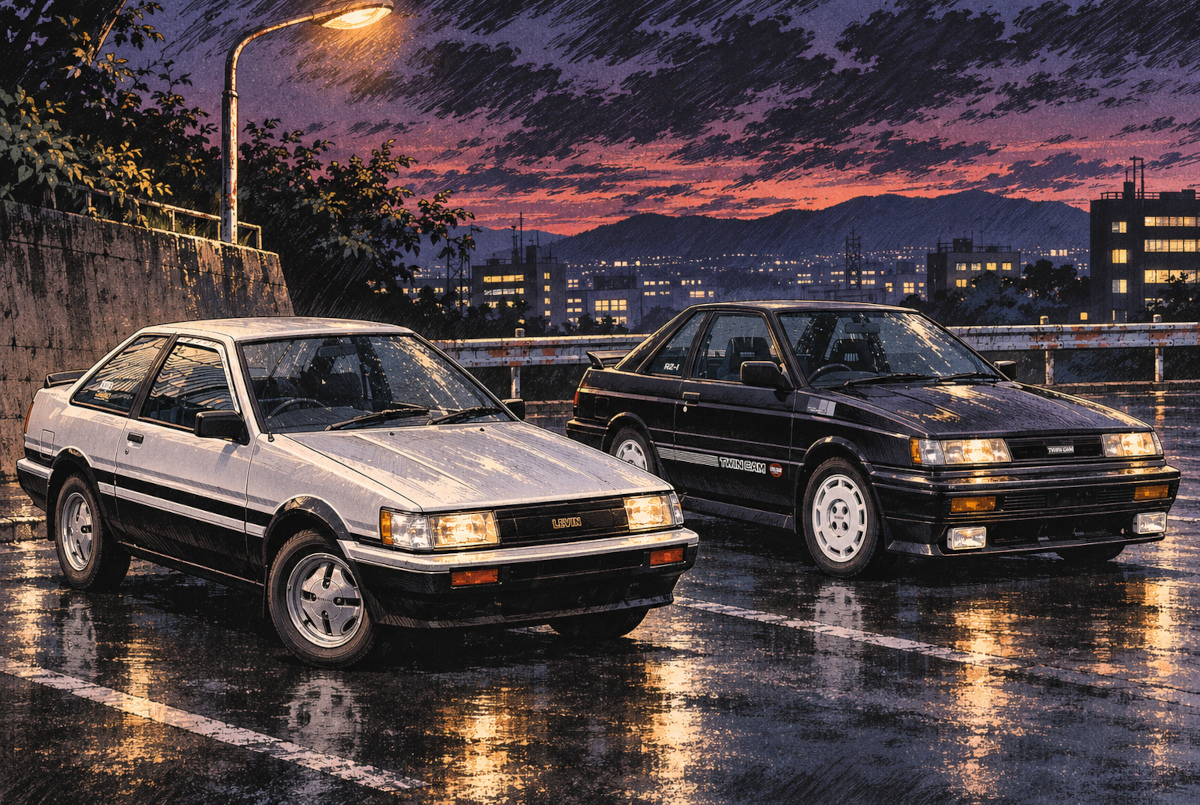
An original illustration imagining the AE86 Levin and Sunny RZ-1 Twin Cam in the same mid-1980s setting. The RZ-1 incorporates styling cues associated with the NISMO version. Some exterior details are stylized, and the Toyota shown is an AE86, not the later AE92 GTV discussed below.
The catch is that the Japanese industry was going through a transition in how engine power was reported.
Gross horsepower was measured with an engine in a relatively simplified test configuration. Net horsepower was measured under conditions closer to those of an engine installed in a vehicle, including specified accessories and intake and exhaust equipment.
Because of these differences, net output is generally lower than gross output for the same engine.
Toyota’s official 75-year vehicle history explicitly identifies the AE86’s 130PS figure as gross. Nissan’s CA16DE, however, was rated at 120PS net.
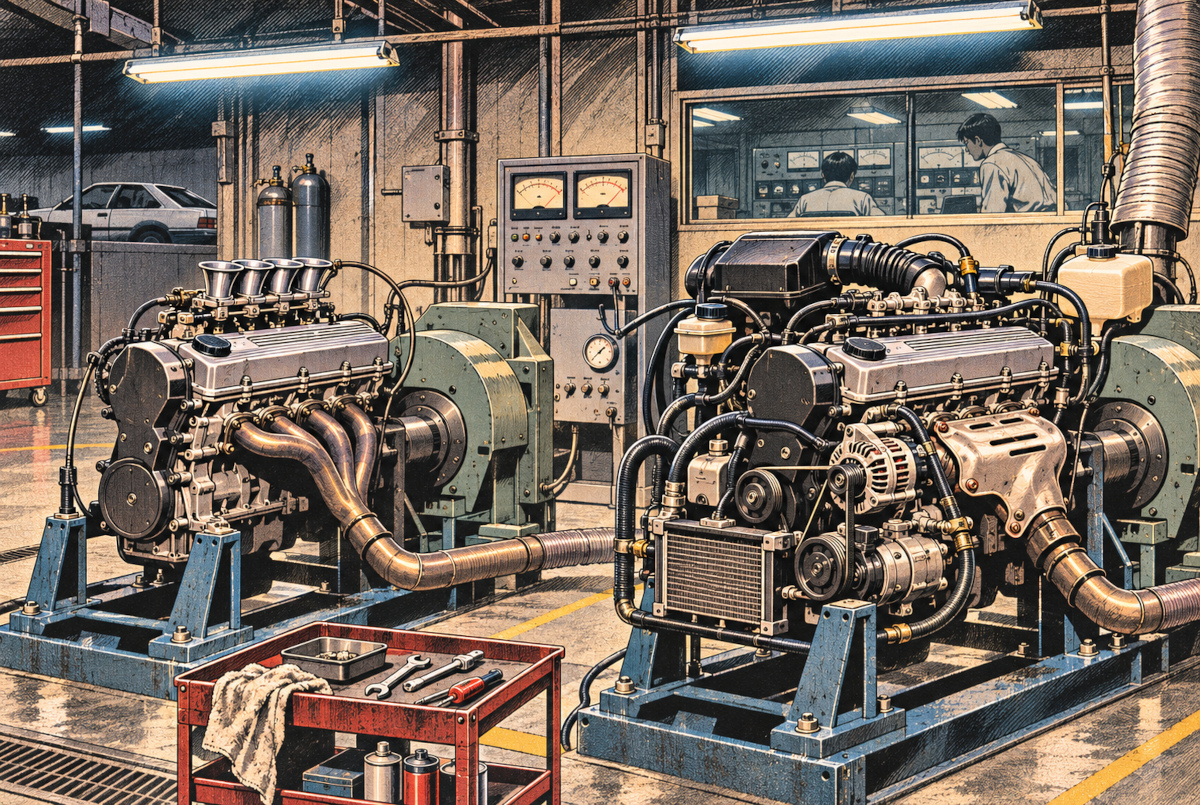
A conceptual illustration of gross power testing (left) and net power testing (right). Both concern engine output at the engine shaft, but equipment and accessory requirements differ. The engines and facilities do not reproduce actual AE86 or RZ-1 factory tests.
The numbers 130 and 120 alone cannot establish which engine actually produced more power under comparable test conditions.
Nor is there a universal conversion factor between gross and net horsepower. The difference depends on the engine, its accessories and the applicable testing procedure.
There’s another wrinkle. Specialist accounts describe the original RZ-1’s 1.5-liter turbo rating of 100PS as a gross figure. So simply subtracting that from the CA16DE’s 120PS net rating and declaring a precise 20PS improvement is questionable too.
This is where the old horsepower argument starts to fall apart.
CA16DE vs 4A-GE: Same 120PS, Different Engine Geometry
For a more meaningful comparison, we can turn to the AE92 Corolla Levin and Sprinter Trueno, introduced in May 1987.
Unlike the rear-wheel-drive AE86, the AE92 was front-wheel drive. Its naturally aspirated 4A-GE produced 120PS net, giving us a much more comparable published power rating.
And the results are interesting.
| Specification | Nissan CA16DE | Toyota 4A-GE |
|---|---|---|
| Displacement | 1,598cc | 1,587cc |
| Peak power (net) | 120PS at 6,400rpm | 120PS at 6,600rpm |
| Peak torque | 14.0kgm at 5,200rpm | 14.5kgm at 5,200rpm |
| Bore × stroke | 78.0 × 83.6mm | 81.0 × 77.0mm |
| Compression ratio | 10.0:1 | 9.4:1 |
| Variable intake system | NICS | T-VIS |
Representative Japanese-market specifications for the 1986 Sunny RZ-1 Twin Cam and the early 1987 AE92 4A-GE. Both are naturally aspirated 1.6-liter DOHC 16-valve engines. Torque figures are expressed in kilogram-force meters.
Only 11cc separates their displacements, and both engines produce the same published peak power.
But look at the cylinder dimensions.
The CA16DE has a 78.0mm bore and an 83.6mm stroke, making it a long-stroke design. The 4A-GE uses an 81.0mm bore and a shorter 77.0mm stroke.
In other words, Nissan chose a narrower cylinder with a longer piston travel, while Toyota chose a wider cylinder with a shorter travel.
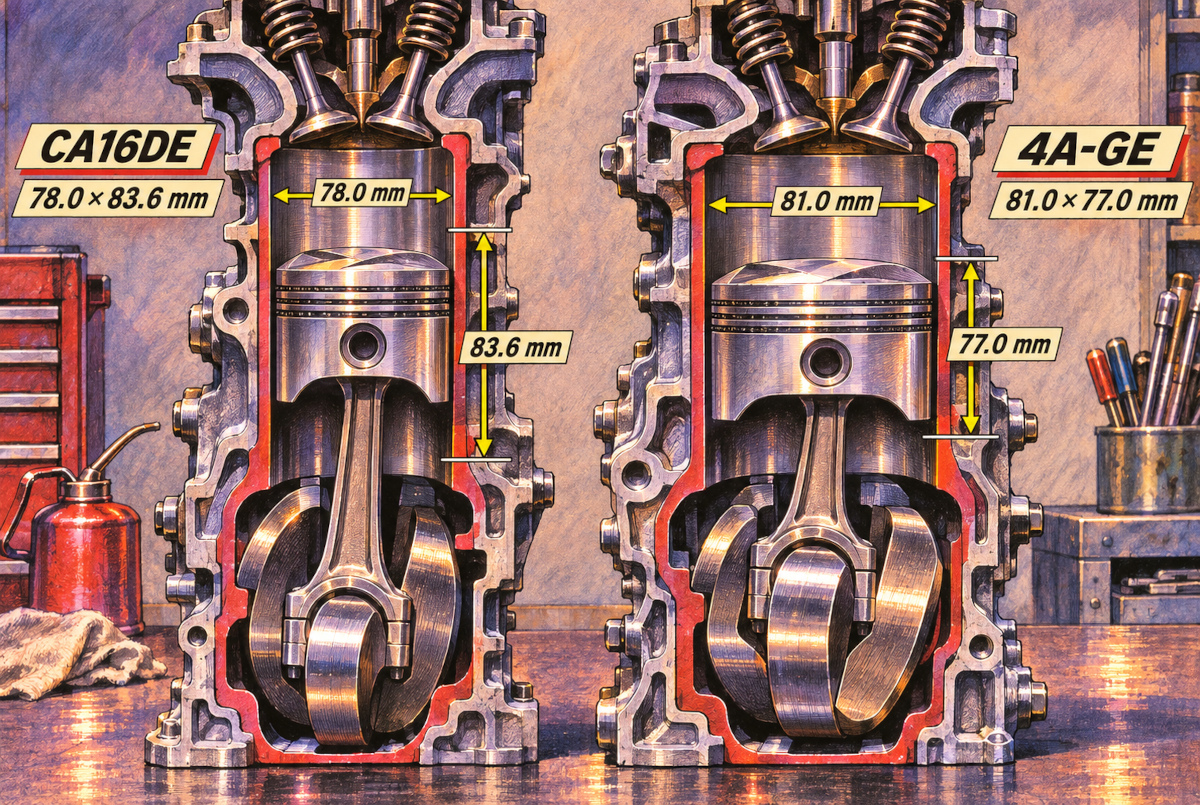
Bore and stroke comparison based on published engine specifications. Internal components and piston movement are shown schematically; this is not a scale engineering drawing or an exact reproduction of either engine’s internal construction.
That raises a question worth calculating: how fast were the pistons moving at the respective peak-power engine speeds?
The formula for mean piston speed is:
Mean piston speed = stroke (m) × 2 × engine speed (rpm) ÷ 60
Using the published dimensions and peak-power engine speeds:
- CA16DE: 0.0836 × 2 × 6,400 ÷ 60 = approximately 17.8m/s
- 4A-GE: 0.0770 × 2 × 6,600 ÷ 60 = approximately 16.9m/s
Despite reaching peak power at a slightly lower engine speed, the CA16DE has the higher calculated mean piston speed because of its longer stroke.
That does not automatically make it less durable, slower to rev or inferior at high rpm. Piston speed is just one characteristic of engine design, not a complete performance verdict.
There is another temptation to avoid: assuming that a long-stroke engine must produce stronger low-rpm torque.
Toyota’s published maximum torque is actually 0.5kgm higher, and both engines reach their quoted torque peaks at 5,200rpm.
To establish which engine delivers more torque at lower speeds, we would need comparable torque curves, not just two peak figures.
NICS vs T-VIS: The Variable-Intake Battle of the 1980s
Nissan and Toyota were not relying on cylinder geometry alone. Both companies also explored ways to improve engine breathing across different operating speeds.
Nissan equipped the CA16DE with NICS, a variable-induction system designed to alter intake behavior according to engine operating conditions.
The CA16DE also incorporated electronic fuel injection and electronically controlled direct ignition. Together with its 16-valve cylinder head and 10.0:1 compression ratio, these were important elements of Nissan’s approach.
Toyota’s T-VIS took a different approach to intake management. Its basic principle involved two intake passages per cylinder, with one passage closed at lower engine speeds and opened at higher speeds.
This was intended to help maintain intake-air velocity at lower speeds while allowing greater airflow at higher speeds.
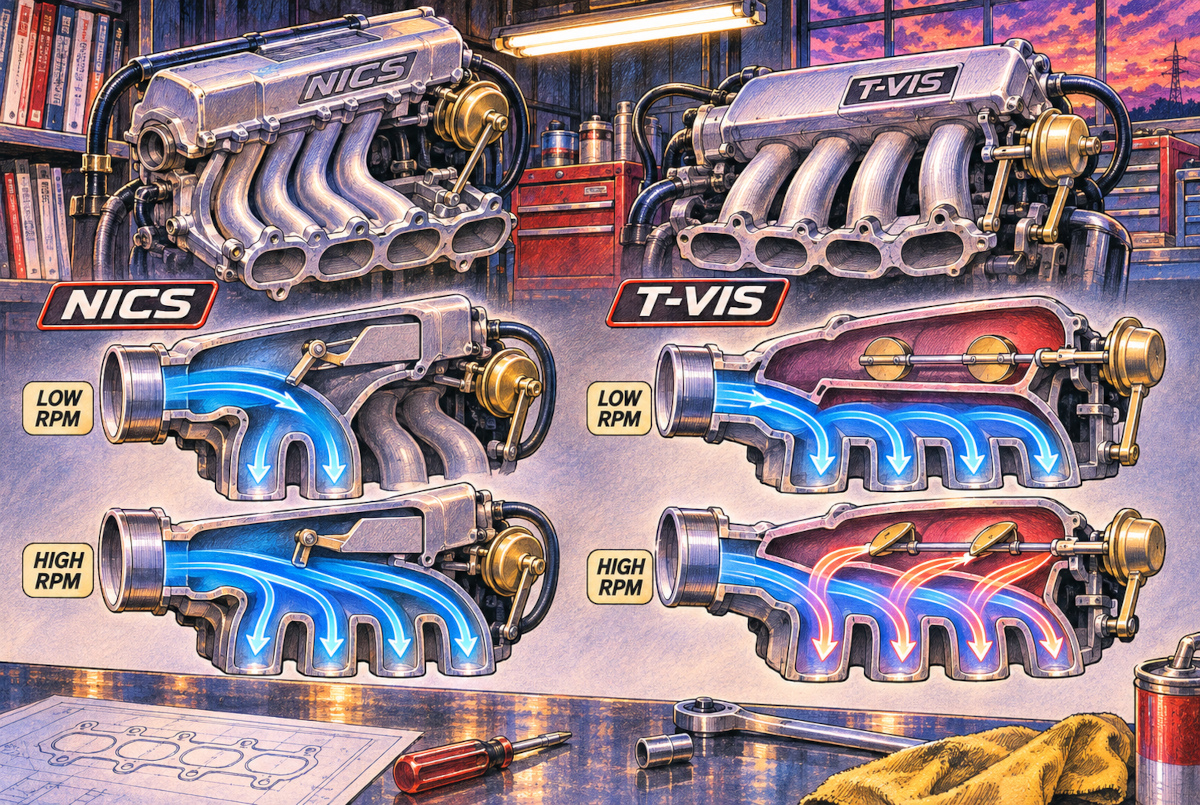
A simplified conceptual comparison of NICS and T-VIS. The illustration does not reproduce the actual intake manifolds, valve locations or internal plumbing. Omitted airflow arrows do not indicate that any cylinders stop taking in air.
Both systems sought to improve the engine’s usefulness over a broad rpm range. But that does not mean their manifold structures, valve arrangements or control strategies were identical.
In particular, the illustration should not be treated as a factory diagram of the CA16DE’s NICS hardware. Exact internal layouts and switching conditions require model-specific engineering documentation.
The point is that Nissan’s 120PS engine was more than a response to Toyota’s horsepower figure. It reflected a different package of mechanical dimensions and engine-control technologies.
Equal Power, but the Sunny RZ-1 Carried an Extra 40kg
Once the two engines are compared on the same published power-rating basis, another question presents itself: what happens when we include vehicle weight?
According to the published specifications, the 1986 Sunny RZ-1 Twin Cam Type A with a five-speed manual transmission weighed 1,040kg.
The representative 1987 AE92 Corolla Levin GTV weighed 1,000kg.
Both cars were front-wheel-drive, naturally aspirated 1.6-liter DOHC models rated at 120PS net.
| Specification | RZ-1 Type A | AE92 Levin GTV |
|---|---|---|
| Peak power | 120PS | 120PS |
| Curb weight | 1,040kg | 1,000kg |
| Power-to-weight ratio | 115.4PS/t | 120.0PS/t |
| Drivetrain | FWD | FWD |
Comparison of the 1986 RZ-1 Twin Cam Type A five-speed manual and the representative 1987 AE92 Levin GTV specifications. Power-to-weight ratios were independently calculated from published peak power and curb weight, using metric tons.
Here is the arithmetic:
RZ-1: 120 ÷ 1.040 = 115.4PS per metric ton.
AE92 GTV: 120 ÷ 1.000 = 120.0PS per metric ton.
Using the RZ-1 as the baseline:
(120.0 ÷ 115.38 − 1) × 100 = approximately 4.0%.
With both engines rated at 120PS net, the AE92 GTV had a roughly 4.0% higher power-to-weight ratio than the RZ-1 Type A.
That’s a slightly uncomfortable result for Nissan enthusiasts.
But it is not proof that the Toyota accelerated 4% faster. Gear ratios, drivetrain losses, tires, suspension and many other factors influence real-world performance. No equivalent acceleration test has been established here.
What the published specifications do show is a more nuanced picture. The CA16DE was not simply outclassed on rated peak power. Against the AE92’s naturally aspirated 4A-GE, it matched that 120PS figure. The Nissan’s disadvantage was its greater curb weight.
And the story doesn’t end there. Nissan also offered the RZ-1 Twin Cam NISMO, with special suspension, aerodynamic equipment and distinctive interior details.
In Part 3, we’ll investigate what the NISMO treatment actually delivered—and whether it offered anything meaningful against Toyota’s increasingly formidable front-wheel-drive Levin and Trueno.
Terms That May Need a Quick Explanation
- Gross horsepower
- Engine power measured under specified test conditions with a relatively simplified accessory and equipment configuration. Historical gross and net ratings should not be directly compared without accounting for their different standards.
- Net horsepower
- Power measured under conditions closer to those of an engine installed in a vehicle, with specified intake, exhaust and accessory equipment. Net power cannot be calculated from gross power using one universal conversion percentage.
- Mean piston speed
- The average speed at which a piston travels up and down its cylinder, calculated from stroke length and engine rpm. It is useful for examining engine geometry but does not independently establish performance or durability.
- NICS — Nissan Induction Control System
- Nissan’s variable-induction technology, designed to control intake behavior according to engine operating conditions. The exact hardware arrangement depends on the application.
- T-VIS — Toyota Variable Induction System
- Toyota’s variable-induction system that closes one of two intake passages per cylinder at lower engine speeds and opens it at higher speeds to manage airflow characteristics.
Editor’s Note
I’ll admit it: when I first saw 130PS for the AE86 and 120PS for the RZ-1, I figured Nissan had simply come up 10PS short.
Then I checked the measurement standards. Gross versus net. Two different sets of rules. So much for that easy verdict.
Next, I compared the RZ-1 with the AE92. Both engines made 120PS net, which finally gave Nissan a fairer comparison. Except now the RZ-1 was carrying an extra 40kg. This little investigation was not going particularly well for the Nissan side.
Still, the CA16DE deserves more credit than being dismissed as a copy of Toyota’s 4A-GE. Nissan went with a longer stroke, variable induction and electronic ignition control. It clearly had its own engineering ideas about how a 1.6-liter twin-cam should work.
What really gets me, though, is how much a simple horsepower figure can distort the story. Imagine spending an afternoon arguing that your favorite car has 10 more horses, only to discover that the two manufacturers weren’t even using the same measuring stick.
That’s the sort of small print that can ruin a perfectly good argument in an old car magazine.
Nissan Sunny RZ-1: Four-Part Series
From its unusual 1986 debut as a personal coupe to the CA16DE twin-cam engine, NISMO models, and rivalry with the Toyota Levin and Trueno. Across four articles, we examine the RZ-1, its engineering, and why it disappeared.
- Part 1: A Date Car With a Scowl: The Nissan Sunny RZ-1’s Curious 1986 Debut
- Part 2: The 10-PS Trap: Was Nissan’s Sunny RZ-1 Really Outgunned by the AE86?
- Part 3: Same 120 PS, ¥240,000 More: What Was Nissan Selling with the Sunny RZ-1 NISMO? Coming soon
- Final Part: English edition Coming soon
References
- Nissan Heritage Collection — Sunny RZ-1 Twin Cam NISMO. Official Japanese-language source for the CA16DE engine’s output, torque and vehicle specifications.
- GAZOO — Nissan Sunny RZ-1 Twin Cam Type B. Japanese vehicle catalog listing the CA16DE’s net horsepower rating, bore and stroke.
- CarSensor Japan — Nissan Sunny RZ-1 Twin Cam Type A. Original specifications for the five-speed manual model, including curb weight and engine output.
- Toyota Motor Corporation, 75 Years of Toyota — Fifth-Generation Corolla Levin (AE86). Official specifications identifying the 130PS rating as gross.
- Toyota Motor Corporation, 75 Years of Toyota — Sixth-Generation Corolla Levin (AE92). Official specifications for the 120PS net GTV and its 1,000kg curb weight.
- Web Motor Magazine — 1980s Boys’ Racers, Part 17: Nissan Sunny RZ-1 Twin Cam NISMO (2019). Japanese-language specialist article discussing the CA16DE, NICS and electronic engine-management technology.
- Web Motor Magazine — Classic Japanese Engines, Part 8: Toyota 4A-GE (2020). Japanese-language technical history covering the 4A-GE’s development, specifications and induction technology.