

Ask whether aliens exist, and the discussion tends to slide almost immediately toward UFO sightings, strange lights, blurry photographs, and eyewitness stories. That may be entertaining, but it also adds a lot of noise. So this article sets all of that aside. The only question here is how far astronomy, planetary science, and the science of life have actually taken us as of 2026.
That leads to a more interesting situation than either side of the usual argument suggests. Science has not confirmed extraterrestrial life. At the same time, it has become increasingly difficult to insist that Earth must be the one extraordinary place where everything happened and nowhere else did. Planets are common. Environments where liquid water may be possible are not obviously rare. And the raw materials associated with life are not exclusive to Earth. In other words, the universe is beginning to look rather more crowded with possibilities than it once did.
The Universe Turned Out to Be Full of Planets
There was a time when we did not even know whether planetary systems like our own were common. Until the mid-1990s, no planet had been confirmed around a Sun-like star. Today, that uncertainty is gone. NASA now lists more than 6,200 confirmed exoplanets—planets outside our solar system—and thousands of additional candidates still await confirmation.
That does not mean only 6,200 planets exist. It means those are the worlds we have managed to confirm with current instruments and observation methods. The bigger change is conceptual: having planets now appears to be a normal feature of stars rather than some bizarre exception. That changes the starting point of the alien-life argument. The old assumption that Earth-like environments must be almost impossibly rare has become harder to defend simply by pointing to a lack of planets.
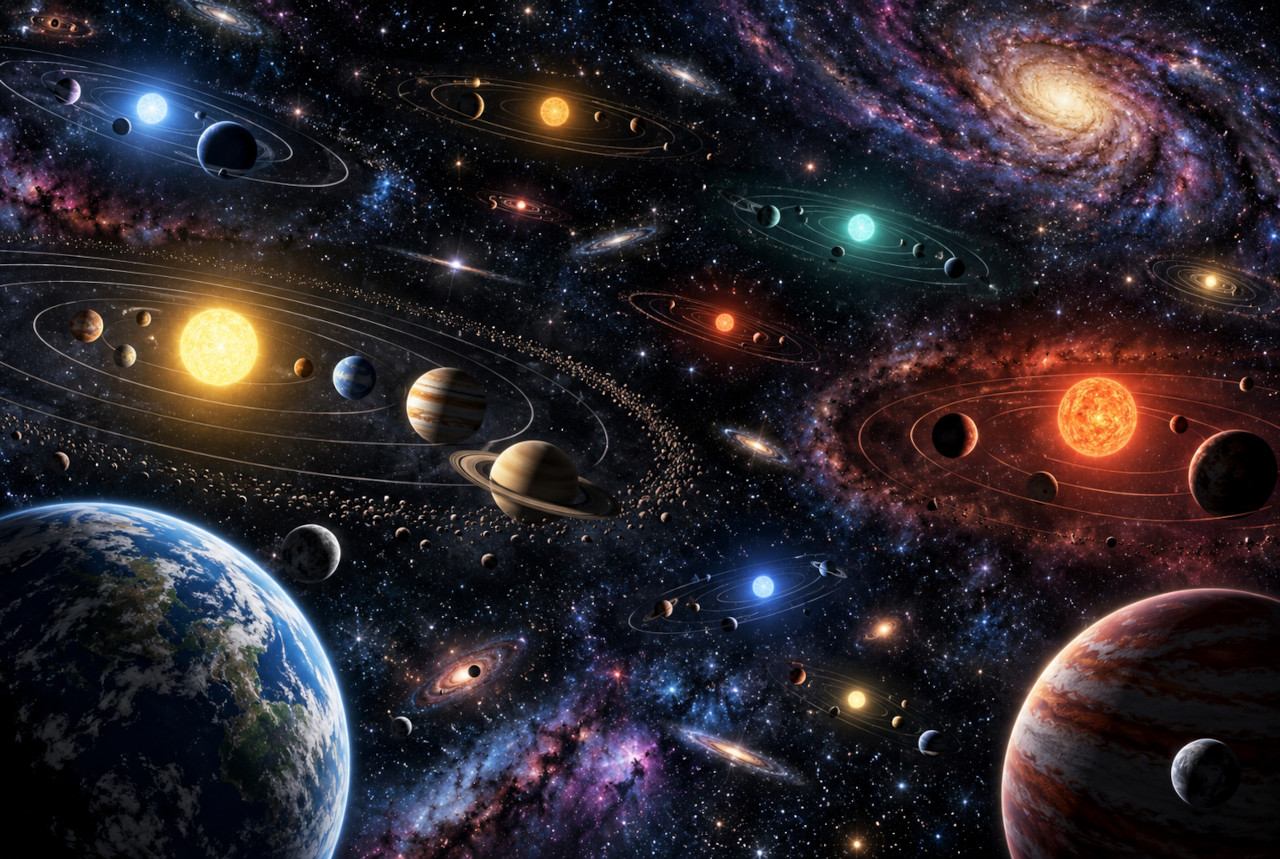 AI-generated conceptual illustration showing planetary systems throughout space. Planet sizes, orbital distances, and arrangements are not shown to scale.
There May Be Hundreds of Millions of Potentially Habitable Worlds
The next step is the so-called habitable zone: the range of distances from a star where conditions could allow liquid water to remain on a planet’s surface. A planet inside that zone is not automatically another Earth, but the number of potentially interesting worlds is no longer trivial.
An analysis using data from NASA’s Kepler mission estimated that, among stars similar in temperature to the Sun, the Milky Way could contain at least about 300 million rocky worlds capable, under the right conditions, of supporting liquid water on their surfaces. That is not 300 million inhabited planets. It is a rough estimate of worlds where one important condition for habitability might be satisfied.
And that distinction matters. A planet can sit in the habitable zone and still be a terrible place for life. Its atmosphere may be unsuitable or absent. Its star may be violently active. Its temperature, chemistry, or geological history may work against long-term habitability. “Potentially habitable” and “inhabited” are not the same claim. Lose that distinction, and science quickly turns into wishful thinking.
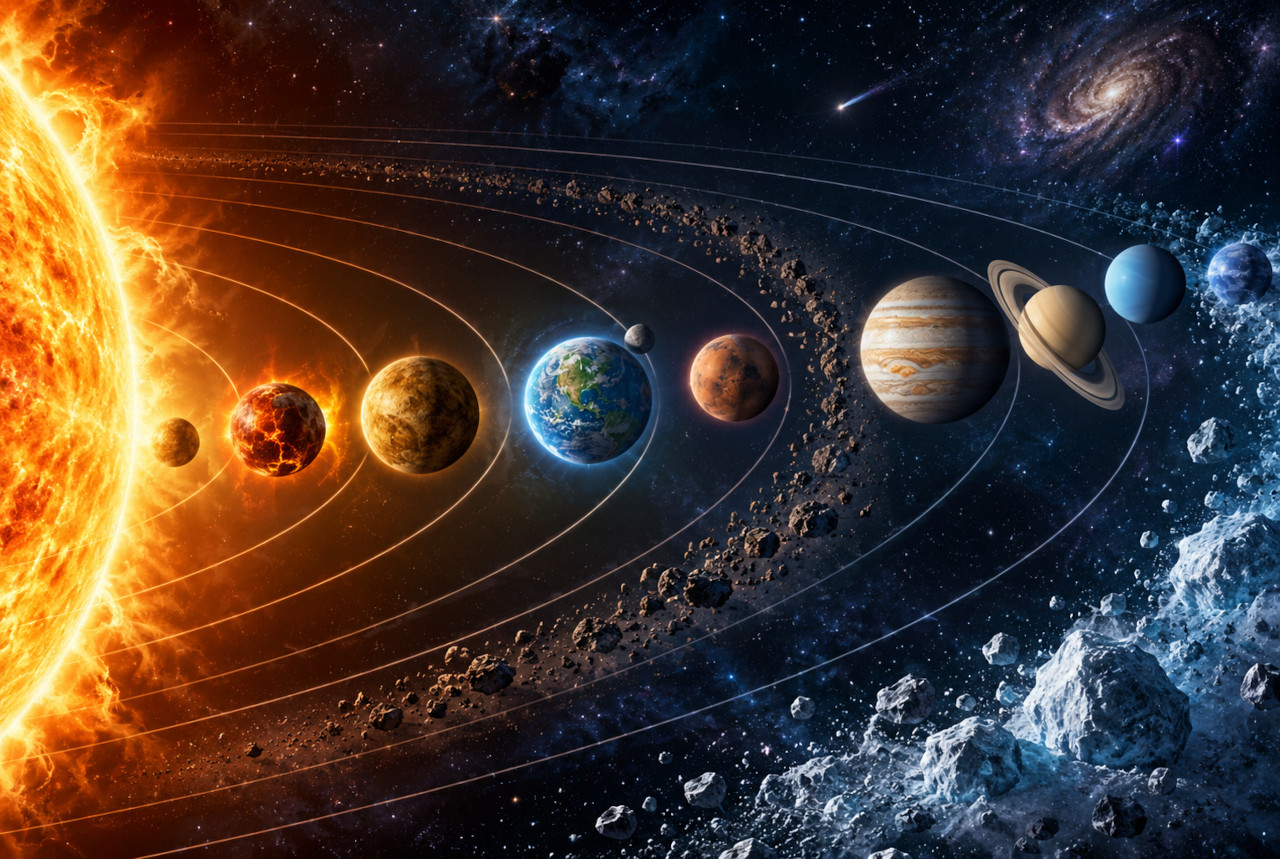 AI-generated concept illustration of a habitable zone. It does not reproduce a real planetary system or imply that life exists on the temperate planet shown.
The Ingredients for Life Are Not an Earth-Only Product
The raw materials are another part of the puzzle. Carbon, hydrogen, nitrogen, oxygen, phosphorus, and sulfur—the elements often grouped as CHNOPS because of their importance to life as we know it—exist well beyond Earth. Researchers have found amino acids and sugars in meteorites, while spacecraft and astronomical observations have detected organic or life-related chemical building blocks on asteroids, comets, and in material between the stars.
None of this is evidence that a meteorite, comet, or dust cloud is alive. Chemistry is not biology. But it does undermine the idea that Earth somehow received a unique box of ingredients unavailable anywhere else. The materials associated with life are not an exclusively terrestrial specialty.
Life on Earth also turns out to be annoyingly difficult to kill. Organisms survive around deep-sea hydrothermal vents, inside glaciers, in extremely salty environments, under high pressure, in highly acidic or alkaline conditions, and in places exposed to radiation levels that humans would find intolerable. These extremophiles do not prove that alien organisms exist, but they do show that the range of environments compatible with life is broader than human comfort would suggest.
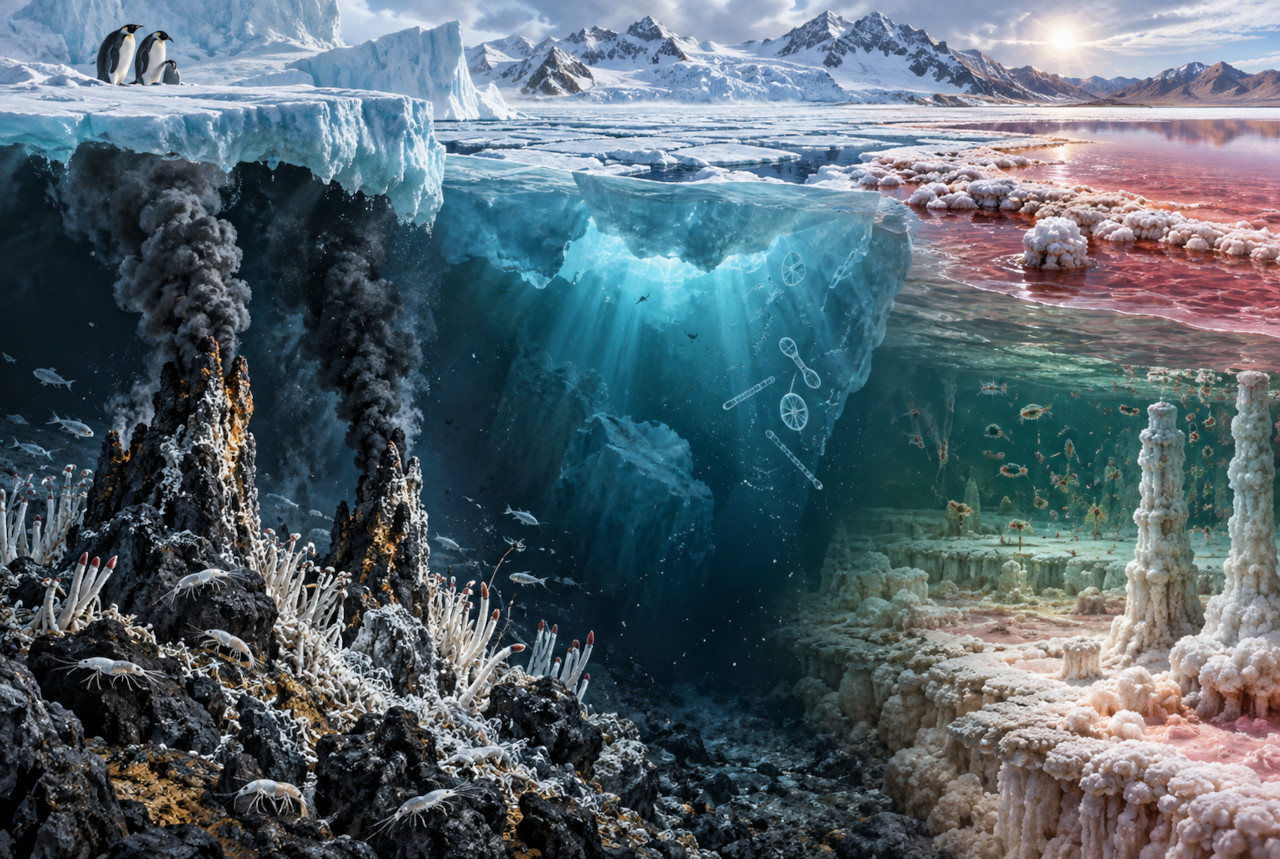 AI-generated conceptual illustration combining several extreme environments on Earth. Not every organism shown should be interpreted as an extremophile in the same biological sense.
The Hard Part Is Not Finding Planets—It Is Explaining How Life Starts
At this point, it becomes tempting to say, “Fine, then the universe must be full of life.” That is understandable. But this is exactly where the argument hits its biggest missing number. We still do not know how probable it is for non-living chemistry to cross the line into life.
Life appeared relatively early in Earth’s history. Evidence indicates that life existed at least around 3.5 billion years ago, which has encouraged the idea that once the right conditions exist, biology may emerge fairly quickly. In 2020, Columbia University astronomer David Kipping examined the timing of life’s appearance using Bayesian statistics. In his model, the available evidence favored a typically rapid origin of life over a slow one by at least a factor of 2.8.
That sounds encouraging until one remembers the awkward part: Earth is a sample size of one. Worse, we are observers who could only have appeared on a planet where life began early enough for intelligence eventually to evolve. In other words, we are holding the winning ticket while trying to calculate the odds of the lottery. This observer-selection effect means that Earth’s early life cannot simply be translated into “life starts easily everywhere.”
This is where the alien question becomes much stranger than the UFO version. We have vast numbers of stars. Planets are common. Some worlds may have liquid water. The necessary chemistry exists throughout space. And yet, at the final step, we still do not know how difficult it is for chemistry to become biology. The deepest uncertainty in the alien-life problem may no longer be astronomical at all. It may be the origin of life itself.
“Alien” Is Too Broad a Word
There is another problem hidden inside the question: the word “alien” bundles completely different things together. A bacterium beneath the ice of another world would be extraterrestrial life. So would something comparable to a fish, an insect, or an entire ecosystem. A species capable of building radio telescopes, spacecraft, or an industrial civilization is another matter entirely.
Earth’s history makes the distinction obvious. Life may have appeared relatively early, but technological civilization arrived astonishingly late. For most of the planet’s history, Earth was alive without anything remotely resembling a human technological society. The origin of life and the origin of technological intelligence are not the same problem and need not have the same probability.
That is why “there may be microbes elsewhere” and “there may be civilizations transmitting signals across the galaxy” are scientifically very different statements, even though both are casually squeezed into the word “aliens.”
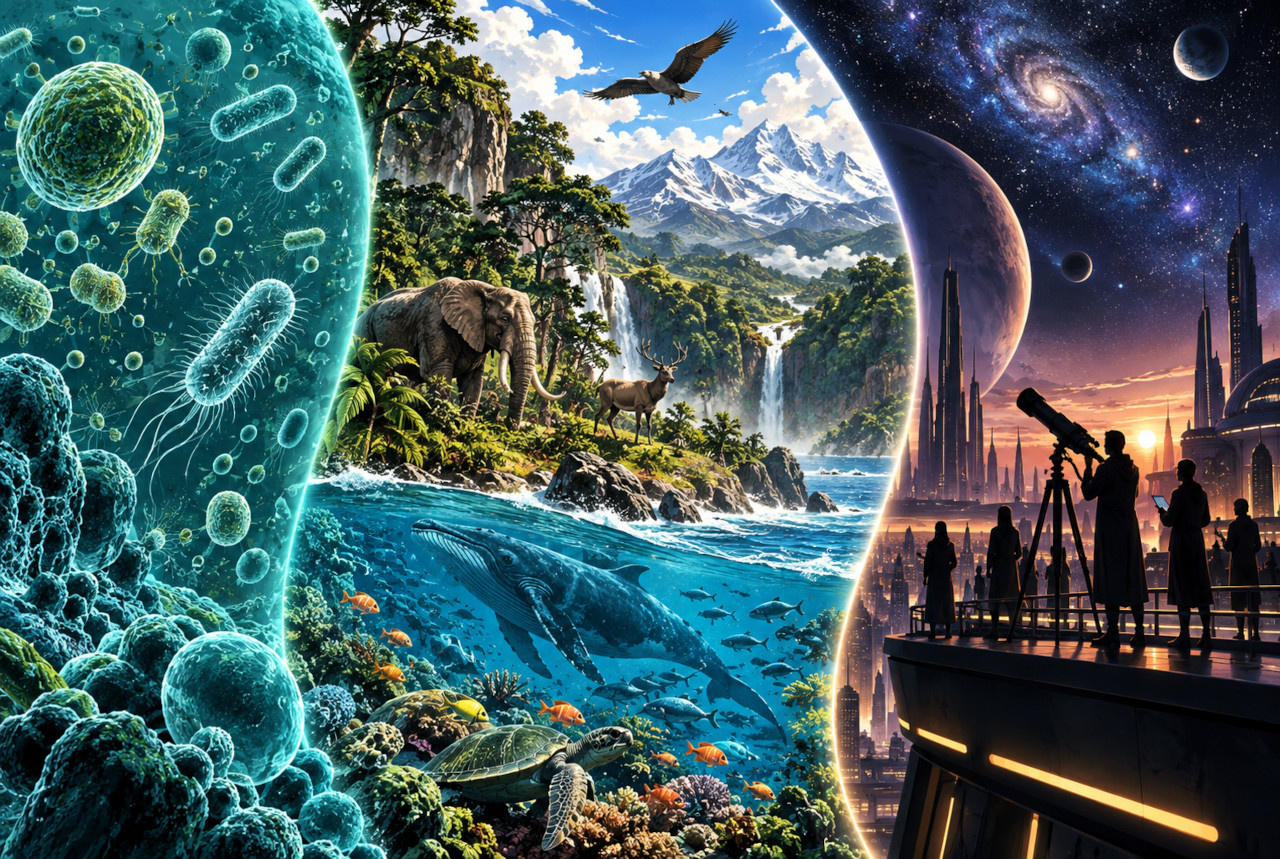 AI-generated conceptual illustration separating microbial life, complex life, and technological civilization. It does not imply that evolution must follow a single predetermined path or inevitably produce intelligence.
“We Still Don’t Know” Is More Interesting Than It Sounds
The discussion is often forced into two dramatic positions: either aliens definitely exist, or there is no evidence and therefore there is nothing out there. Science currently sits in the much less theatrical space between them. The universe appears to contain a very large number of places where some ingredients and conditions associated with life could exist. At the same time, Earth remains the only world where life has actually been confirmed.
So the sensible position is not certainty but estimation. The universe is enormous. Planets are plentiful. The chemistry is available. Habitable environments may be numerous. That makes extraterrestrial life entirely plausible. But plausibility is not discovery.
The reverse claim deserves just as much caution. Saying that Earth is the only living world in the galaxy is also a surprisingly bold statement when hundreds of millions of potentially habitable worlds may exist. UFO stories can be removed from the discussion completely, and the alien-life question does not disappear. If anything, it becomes more interesting.
Editor’s Note
I think the old version of this debate has become a little stale. Someone sees a UFO, someone calls it a fake, and everyone goes home convinced they were right from the beginning. I have a soft spot for that old TV-special and pulp-magazine atmosphere, but treating the existence of extraterrestrial life as if it depends on blurry objects in the sky now feels like missing the better story.
Astronomy has moved on. We can no longer casually say, “There probably aren’t many planets like that anyway.” At the same time, science has not handed us a neat answer. Having the ingredients is not the same as producing life. Producing microbes is not the same as producing intelligence. And producing intelligence is certainly not the same as building a civilization that crosses interstellar space.
That gap between what we know and what we still cannot calculate is exactly what makes this more interesting than the old paranormal version. Is Earth absurdly special, or is life simply one of the things matter occasionally does when the conditions are right? I don’t know. Neither does anyone else yet. But that is a far better mystery than arguing over another fuzzy light in the night sky.
References
- NASA Science — “How Many Exoplanets Are There?”
- NASA — “About Half of Sun-Like Stars Could Host Rocky, Potentially Habitable Planets”
- NASA Science — “The Habitable Zone”
- NASA Astrobiology — “What Are the Sources of Life’s Building Blocks Outside the Earth?”
- NASA Science — “What Types of Conditions Can Life Survive In?”
- Kipping, David — “An Objective Bayesian Analysis of Life’s Early Start and Our Late Arrival,” Proceedings of the National Academy of Sciences, 2020