

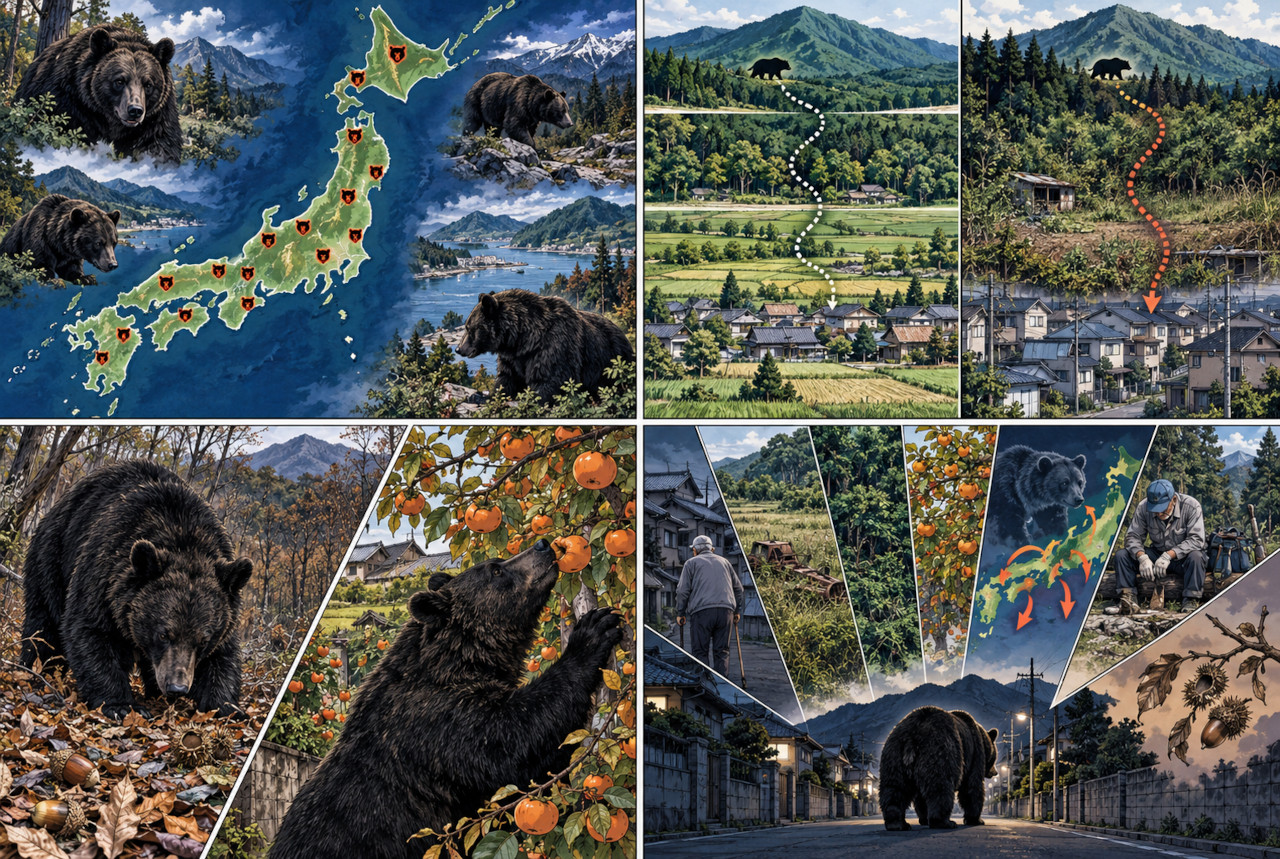
Akita, Iwate, Nagano, Toyama, Hyogo—communities separated by hundreds of kilometers have all reported bears appearing near homes, roads and other places used in everyday life.
That raises an obvious but strangely unsettling question. Bears in northern Japan are not exchanging information with bears in central or western Japan. Yet similar behavior appears in distant regions at roughly the same time.
Perhaps the biggest change is not simply the bears themselves. Across many parts of Japan, the landscape surrounding them has been changing in remarkably similar ways.
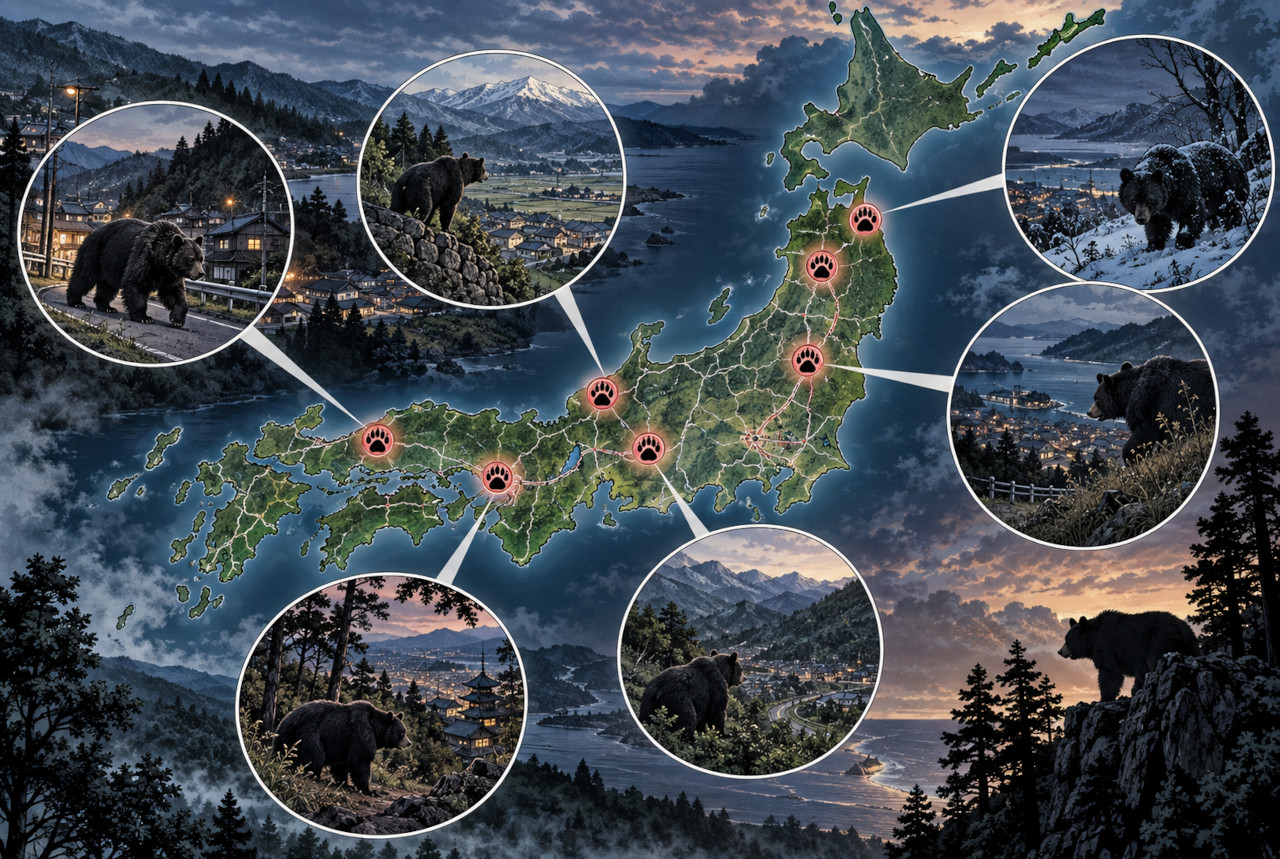 This illustration is a conceptual representation of bear appearances in different parts of Japan. It does not show actual sighting locations or the precise distribution of bear populations.
Acorn shortages alone cannot explain what is happening
One commonly cited explanation for bear appearances near human settlements is a poor crop of acorns and other tree nuts. Japanese black bears rely heavily on foods such as beech and oak nuts in autumn, when they need to build up energy before winter.
When those foods become scarce, bears may travel farther and move toward lower elevations in search of alternatives.
That explanation is real—but it is not new. Japan has experienced poor nut crops and large bear appearances before.
What has changed is what a bear now finds after leaving the deeper mountains.
In many areas, the boundary that once separated bear habitat from human settlements has become much less distinct.
Historically, much of rural Japan contained a transitional landscape known as satoyama. These were not untouched forests. They were woodlands, grasslands, fields and irrigation areas regularly used and maintained by local people for farming, firewood and other everyday needs.
Human activity itself helped create a buffer between deeper forest and village life.
As rural populations have declined and aged, however, farmland has been abandoned, woodland management has decreased, and some former agricultural areas have become covered with tall grass, shrubs and trees.
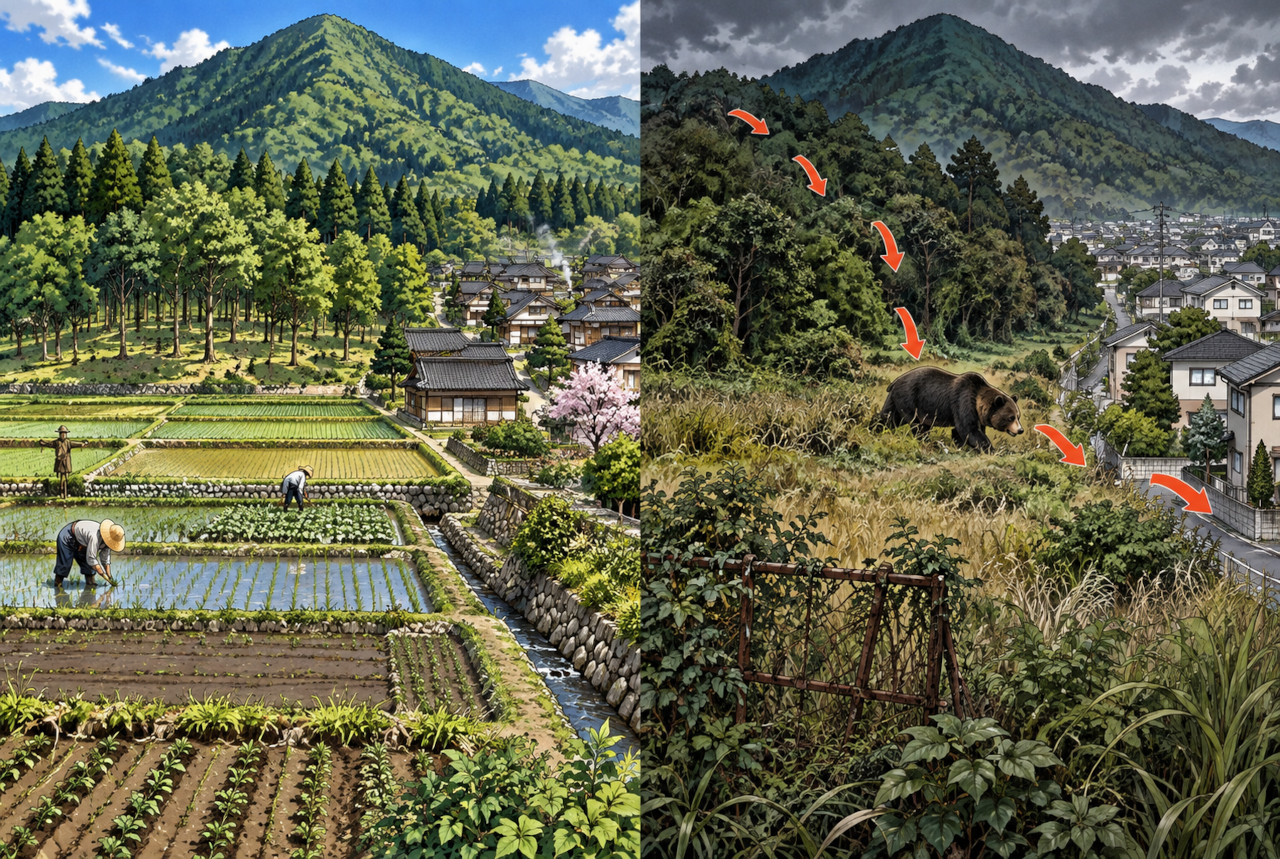 Conceptual comparison of a managed rural landscape and an overgrown one. Reduced human activity can make the transition between forest and residential areas less distinct.
What looks abandoned to humans may look like new habitat to a bear
There is a certain irony here.
To people, an abandoned field covered in weeds may look neglected. An unmanaged woodland may look like land that has simply been left behind.
To a bear, however, dense vegetation can provide cover, food and a relatively quiet route through an area where fewer people are present.
Land that humans regard as deteriorating can, under some conditions, become increasingly usable wildlife habitat.
Then there is food.
Persimmon and chestnut trees are common around older rural homes in Japan. As houses become vacant or their owners grow too old to harvest them, fruit may simply remain on the trees.
Vegetable gardens, compost, garbage and other human-related food sources may also attract wildlife.
For a bear, spending hours searching a forest floor for scattered nuts may be less efficient than returning to a place where a persimmon tree produces a large crop every autumn.
Once a bear learns that food can reliably be found near people, a settlement is no longer merely somewhere it wandered into by accident. It can become part of its foraging options.
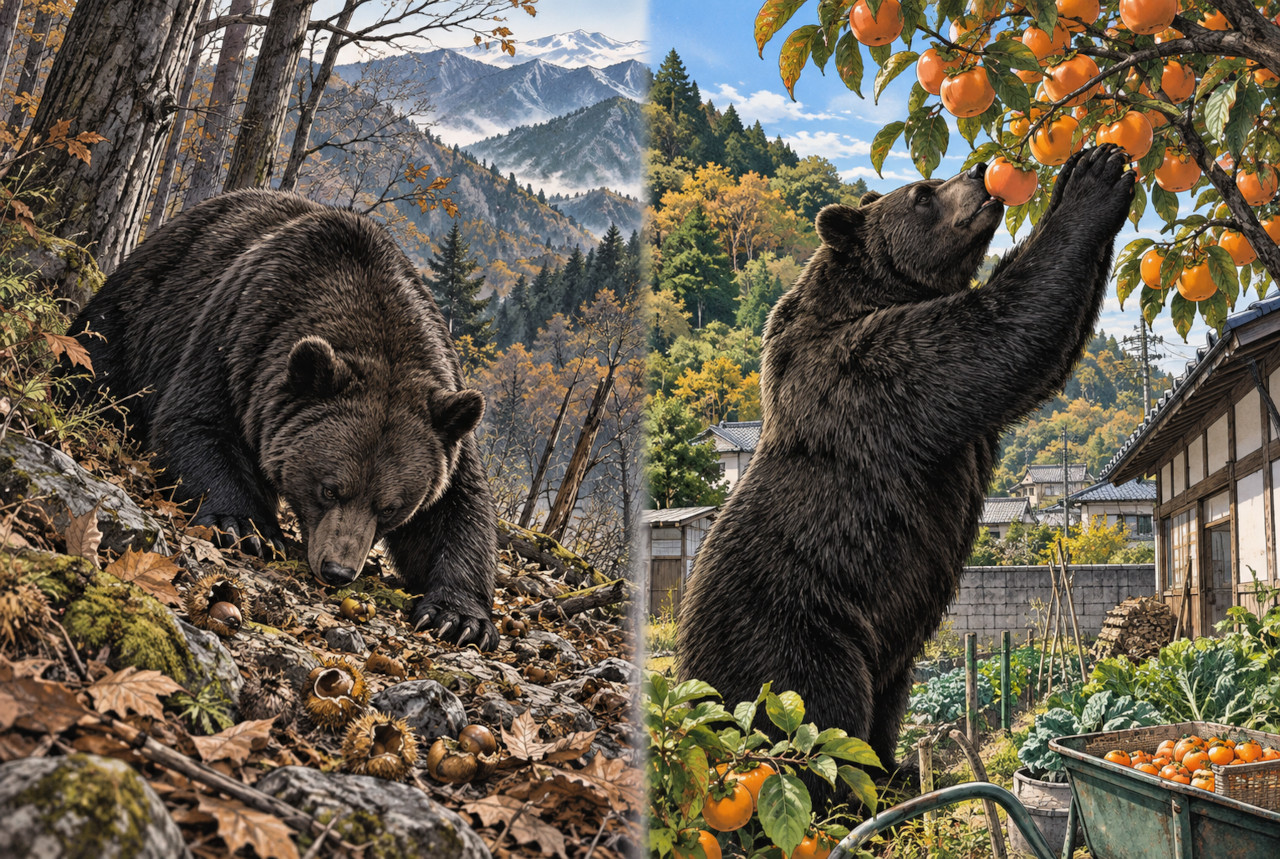 Conceptual illustration showing how unattended fruit around settlements can become an attractive food source for bears.
Rivers can become invisible corridors into towns
A road, a row of houses or a suburban district may look like a clear boundary to us. A bear does not necessarily see the landscape the same way.
Riverbanks, strips of woodland, tall grass, parks and other connected green spaces can provide cover and movement routes extending from mountainous areas toward developed land.
In other words, what residents see as “a river running through town” may function for wildlife as a narrow extension of the surrounding natural landscape.
And at the end of that corridor may be a residential neighborhood.
This helps explain why bear appearances cannot always be understood simply as an animal making one extraordinary journey from a remote mountain into a city. In some places, a chain of usable habitat still connects the two.
A poor acorn crop may be the trigger, not the whole cause
The current bear issue makes more sense when it is viewed as several conditions overlapping rather than a single cause.
Bear ranges have expanded in many parts of Japan. Rural populations have declined. Farmland has been abandoned. Some satoyama landscapes receive far less maintenance. Fruit is left unharvested. Wildlife-management work is increasingly dependent on an aging pool of experienced personnel. In some regions, changing snow and climate conditions may also affect the environment in which large mammals live.
Then a poor year for acorns and other forest foods arrives.
The route toward human settlements already exists. Food becomes scarce, and the bear crosses a boundary that has gradually become easier to cross.
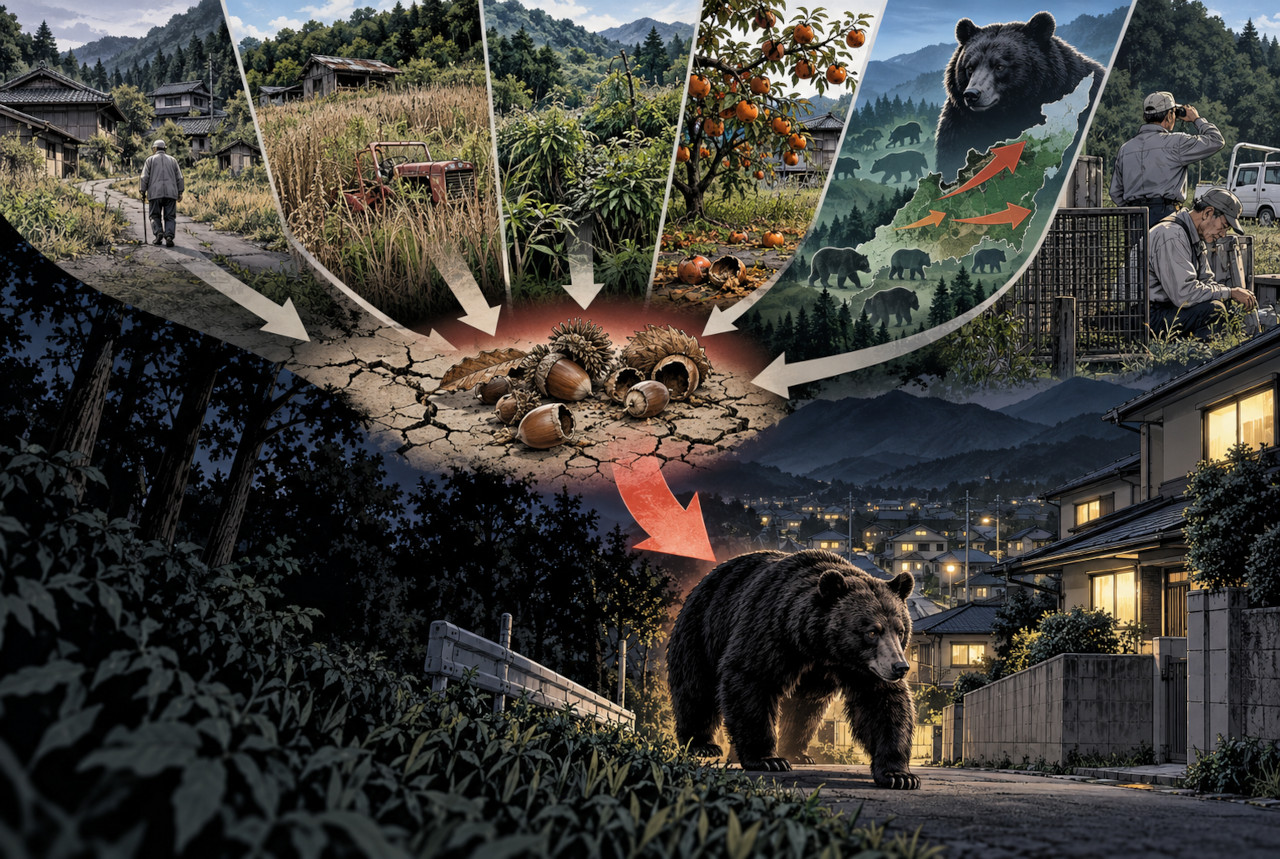 Conceptual illustration of several long-term factors combining with food shortages to increase the likelihood of bears entering human living areas.
The bears did not coordinate—the country changed around them
A bear in Akita does not know what a bear in Nagano is doing.
Yet both can respond in similar ways when they encounter similar environmental conditions.
Fewer people work the land. Fields disappear. Fewer residents regularly enter the surrounding woods. Vegetation becomes denser. Fruit remains unharvested. At the same time, bear distribution has expanded in many regions.
That is why describing the situation only as “bears invading human territory” risks missing something important.
In some parts of Japan, humans have gradually stopped maintaining territory they once used intensively, and wildlife is beginning to use that space again.
This does not mean every rural community is being reclaimed by bears, nor does it mean bear populations are increasing everywhere. Japan also has vulnerable regional populations; the small population on Shikoku, for example, is very different from expanding populations elsewhere, while the Japanese black bear is considered extinct on Kyushu.
But in regions where bear habitat and declining human activity increasingly overlap, the boundary is moving.
And sometimes that boundary is no longer deep in the mountains. It may be beyond a field, along a riverbank, or only a short distance from someone’s home.
The frightening part is not that bears suddenly became different animals.
It is that the landscape separating their world from ours has been changing quietly enough that many of us noticed only when a bear appeared at the other end of the street.
Editor’s Note
A bear appearing near someone’s home is frightening enough. But what unsettles me more is the larger pattern behind it: warming conditions, rural depopulation, neglected land and changing ecosystems all moving at the same time. Saying “the planet is ending” may sound too dramatic. Maybe it is. Still, I cannot shake the feeling that nature is telling us something simpler and harder to ignore: the old normal may already be disappearing.
References
- Ministry of the Environment, Japan — Guidelines for Conservation and Management Plans for Bears, FY2026
- Ministry of the Environment, Japan — Results of the National Distribution Survey of Bears and Japanese Serow
- Ministry of the Environment, Japan — National Mammal Distribution Survey
- Ministry of the Environment, Japan — Report on Mass Appearances of Japanese Black Bears
- Government of Japan — Bear Damage Countermeasure Roadmap, March 2026