
There is a strangely long gap in the history of the Skyline GT-R. After the Kenmeri GT-R disappeared in 1973, the GT-R name did not return until the R32 arrived in 1989 — roughly 16 years later.
But the Skyline itself was anything but dormant during that period. Nissan fought through the emissions-regulation era, adopted turbocharging, and even moved away from the Skyline’s long-established straight-six tradition by making a four-cylinder DOHC “RS” the most powerful version of the car. Later, the straight-six DOHC engine returned, followed by the race-oriented GTS-R.
Those 16 years without a GT-R were not an empty period. They were the years in which Nissan gradually rebuilt the ingredients that would eventually make the R32 GT-R possible.
Tracing the Skyline GT-R — 5-Part Series
The GT-R did not evolve in a straight line. Across five articles, we examine its birth, disappearance, revival, transformation into a legend, and eventual independence from the Skyline name.
- Part 1: Why the Nissan Skyline GT-R Became a Legend — Defeat, Disappearance and a 16-Year Comeback
- Part 2: How the R32 Skyline GT-R Was Engineered to Win Group A — and Became a Legend
- Part 3: Was the R33 GT-R Really the Weak Link? Why the R34 Became a Legend
- Final Part: Is the R35 Really a GT-R? Why Nissan Made It a Standalone Model
- Special: What Happened to the Skyline During the GT-R’s 16-Year Absence? From the Four-Cylinder R30 RS to the R32 Revival
The “Skyline Japan” made a GT-R-less Skyline feel normal
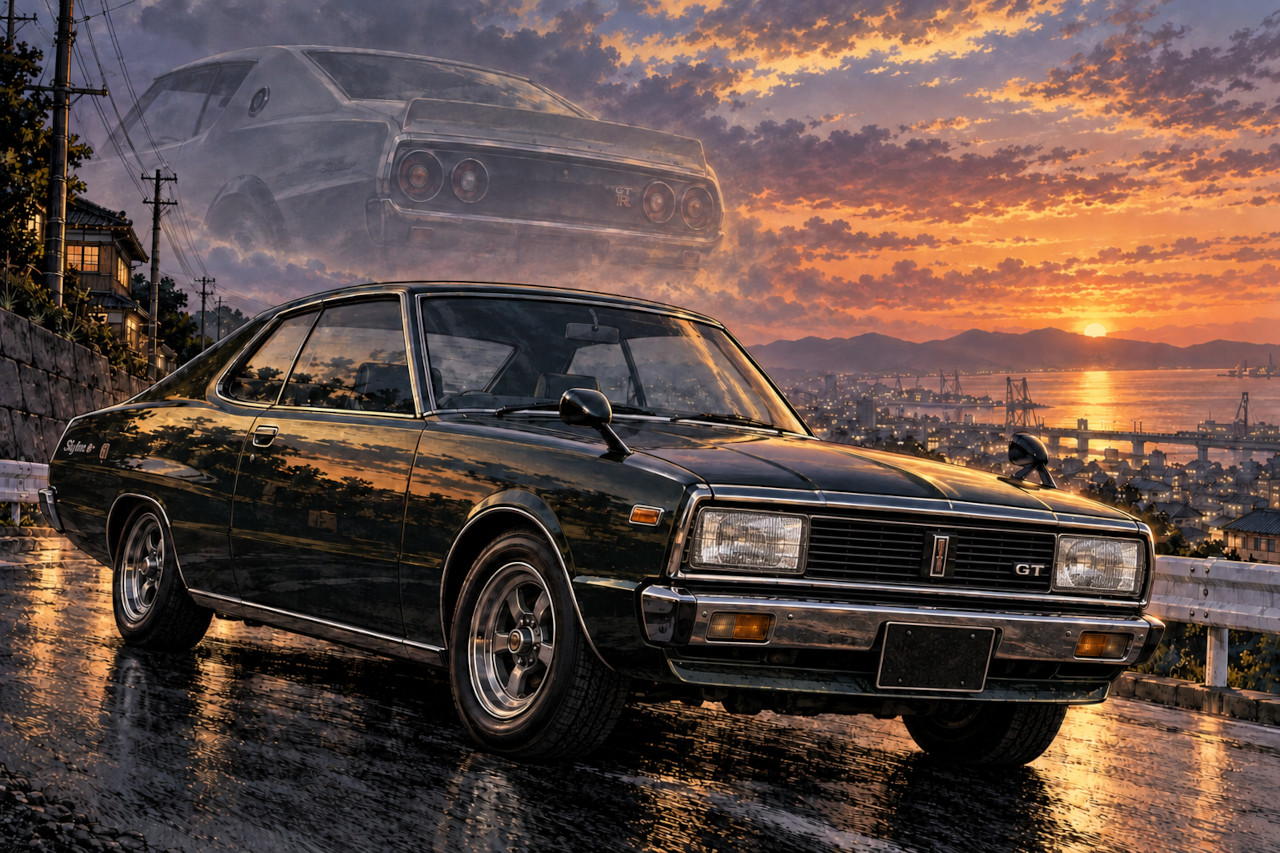 AI-generated image representing the transition from the Kenmeri GT-R era to the C210 Skyline. It is intended as a historical illustration rather than a precise factory reference image.
The C210 Skyline, introduced in 1977 and commonly nicknamed the “Skyline Japan” in its home market, had no GT-R version. After production of the Kenmeri GT-R ended, Nissan was forced to focus on increasingly strict emissions regulations, and the era of building high-performance Skylines around motorsport ambitions temporarily faded.
Even so, the Skyline never completely abandoned performance. In 1980, Nissan introduced the 2000GT Turbo with the L20ET 2.0-liter turbocharged straight-six. It produced 145 PS, and its Japanese advertising famously asked, “Who can chase the Skyline now?” The return of the GT-R was still years away, but the Skyline was clearly beginning to move beyond the emissions-control years and back toward outright performance.
With the R30, the most powerful Skyline became a four-cylinder
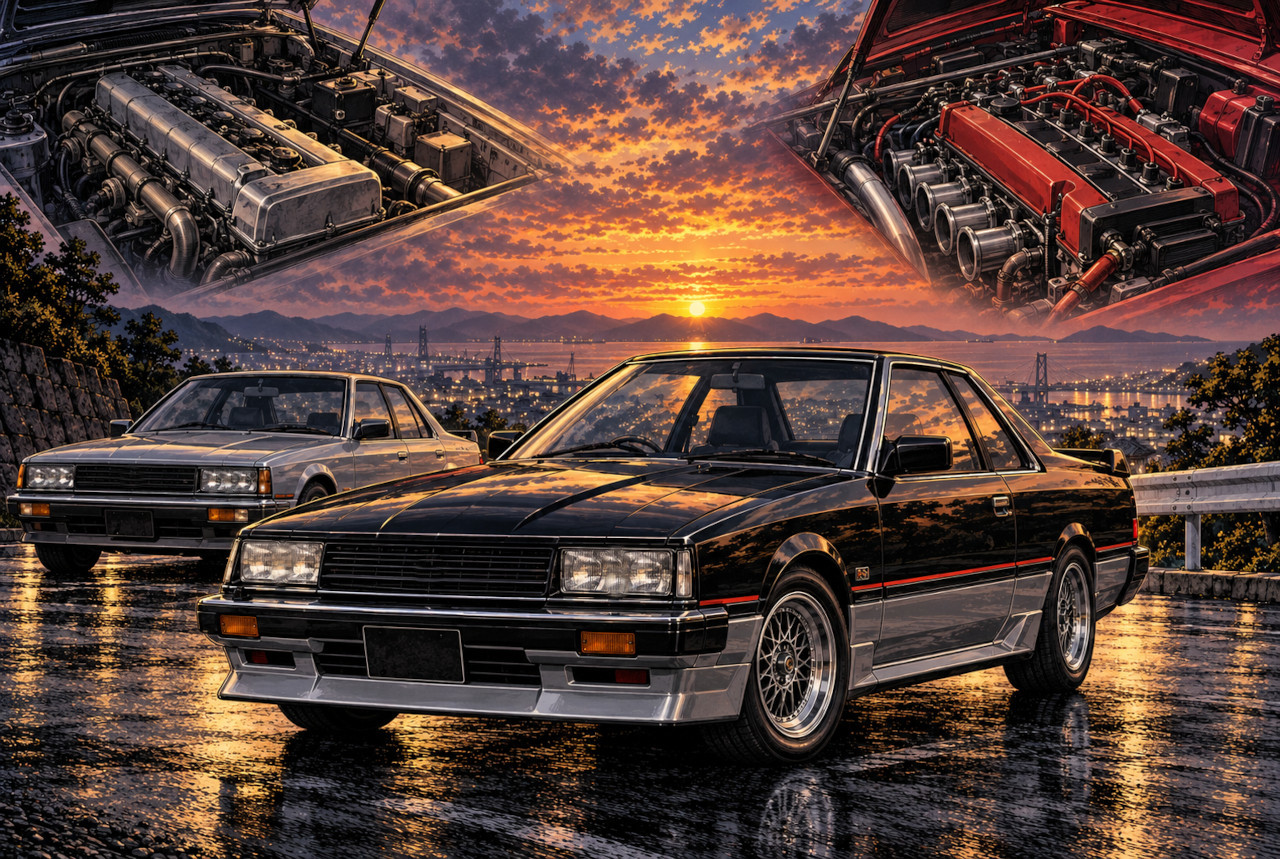 AI-generated image illustrating the difference between the R30’s straight-six GT line and the four-cylinder DOHC RS line.
The R30 Skyline arrived in 1981, and the 2000GT models still used Nissan’s L-series straight-six. So it would be inaccurate to say that the Skyline itself had suddenly become a four-cylinder car.
The real change came with the 2000RS, which was added above the regular GT range. Its FJ20E was a 2.0-liter inline-four with four-valve DOHC heads, producing 150 PS. DOHC technology had returned to the Skyline for the first time since the GT-R era — but now with four cylinders instead of six.
In other words, Nissan retained the straight-six “GT” models while introducing a separate, more performance-focused line called RS, for Racing Sport. The position of the most powerful Skyline had shifted from the straight-six GT to the four-cylinder RS. That is one of the most interesting aspects of the R30 generation.
It was called the “most powerful Skyline ever” — but it still was not a GT-R
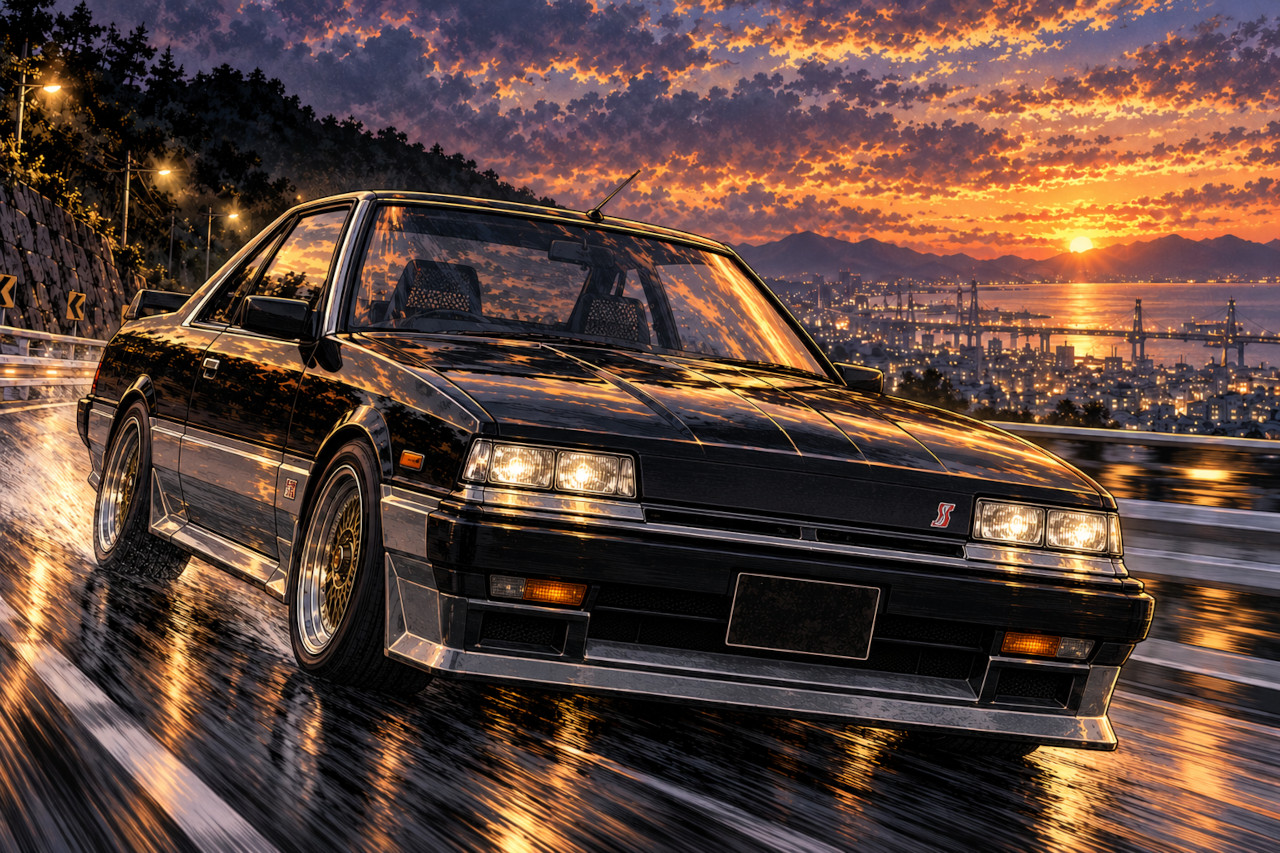 AI-generated illustration of the R30 Turbo RS-X era. The image is symbolic and does not reproduce every factory detail exactly.
In 1983, Nissan introduced the turbocharged FJ20ET-powered Turbo RS with 190 PS and promoted it in Japan as the “most powerful Skyline ever.” An intercooled version followed in 1984, raising output to 205 PS.
And yet, Nissan still did not call it a GT-R. Nissan’s own heritage material also notes the curious fact that, despite being promoted as the most powerful Skyline of its time, it did not receive the GT-R badge.
It would be too simplistic, however, to say that a four-cylinder Skyline was somehow “unqualified” to be a GT-R. The GT-R name had never meant merely “the model with the most horsepower.” Historically, it had been closely associated with racing and with the idea of building a Skyline capable of winning in serious competition.
The R30 RS therefore makes more sense as a car that restored the Skyline’s identity as a fighting performance car without actually reviving the GT-R name.
The spectacular wide-body R30 Super Silhouette racing car also became an icon of this era. But it should not be confused with the production Turbo RS. The race car used the purpose-built LZ20B four-cylinder DOHC turbo engine rather than the road car’s FJ20ET, producing more than 570 PS.
The R31 finally reunited the straight-six DOHC engine with serious racing
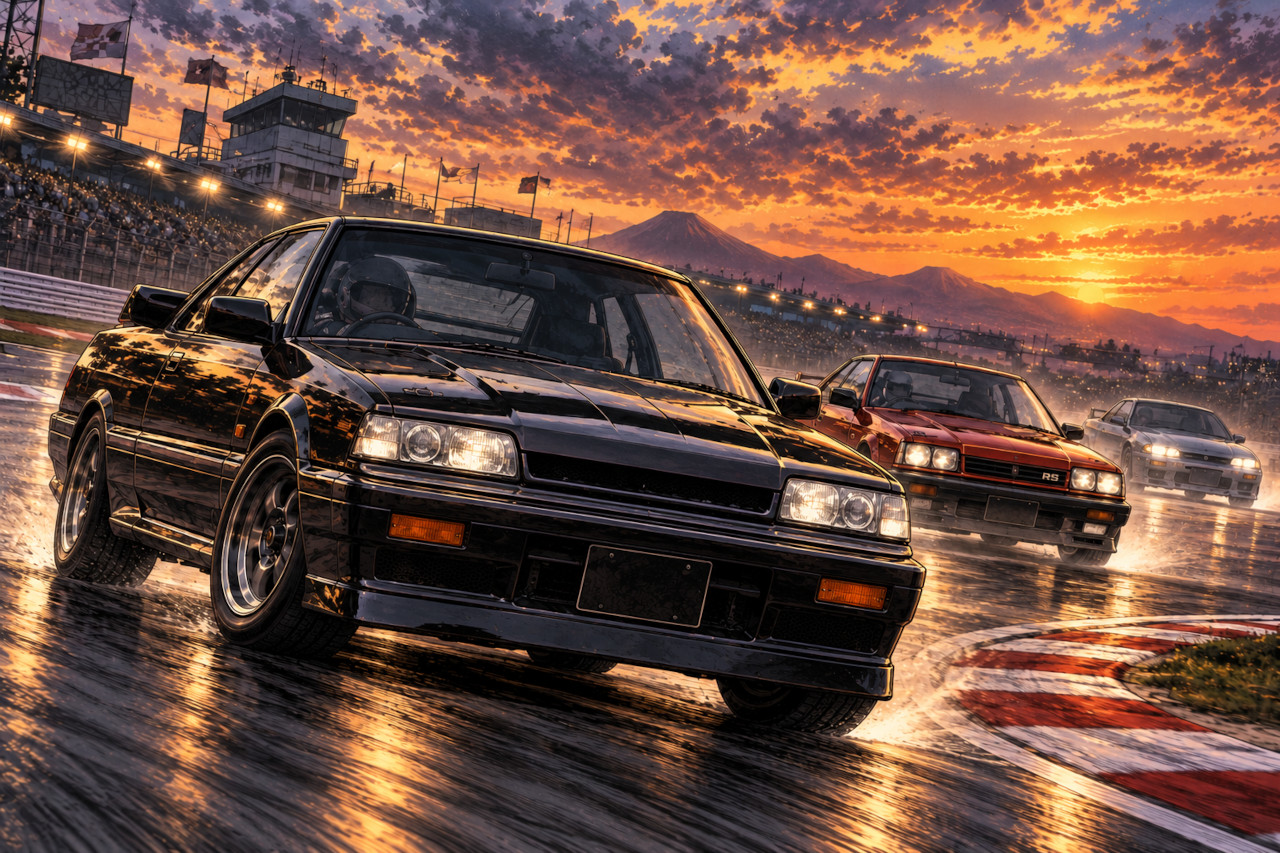 AI-generated illustration connecting the R30 RS, R31 GTS-R and the later R32 GT-R as successive steps in Skyline performance development.
With the R31 Skyline, introduced in 1985, Nissan adopted the new RB-series straight-six engine, bringing a straight-six DOHC powerplant back into the Skyline family. Then, in 1987, Nissan released the GTS-R, a limited-production model built with Group A touring-car competition in mind.
The GTS-R used the RB20DET-R, a turbocharged straight-six DOHC engine rated at 210 PS in road-going form. Its larger turbocharger and stainless-steel equal-length exhaust manifold were among the features developed with competition use in mind. In 1989, the R31 GTS-R won the Japanese Touring Car Championship series title.
But at the InterTEC endurance races in Japan, the R31 still struggled to defeat the formidable Ford Sierra RS500. The GTS-R was competitive, but it was not yet dominant enough to overwhelm the best international opposition.
The R32 was not a monster that appeared from nowhere
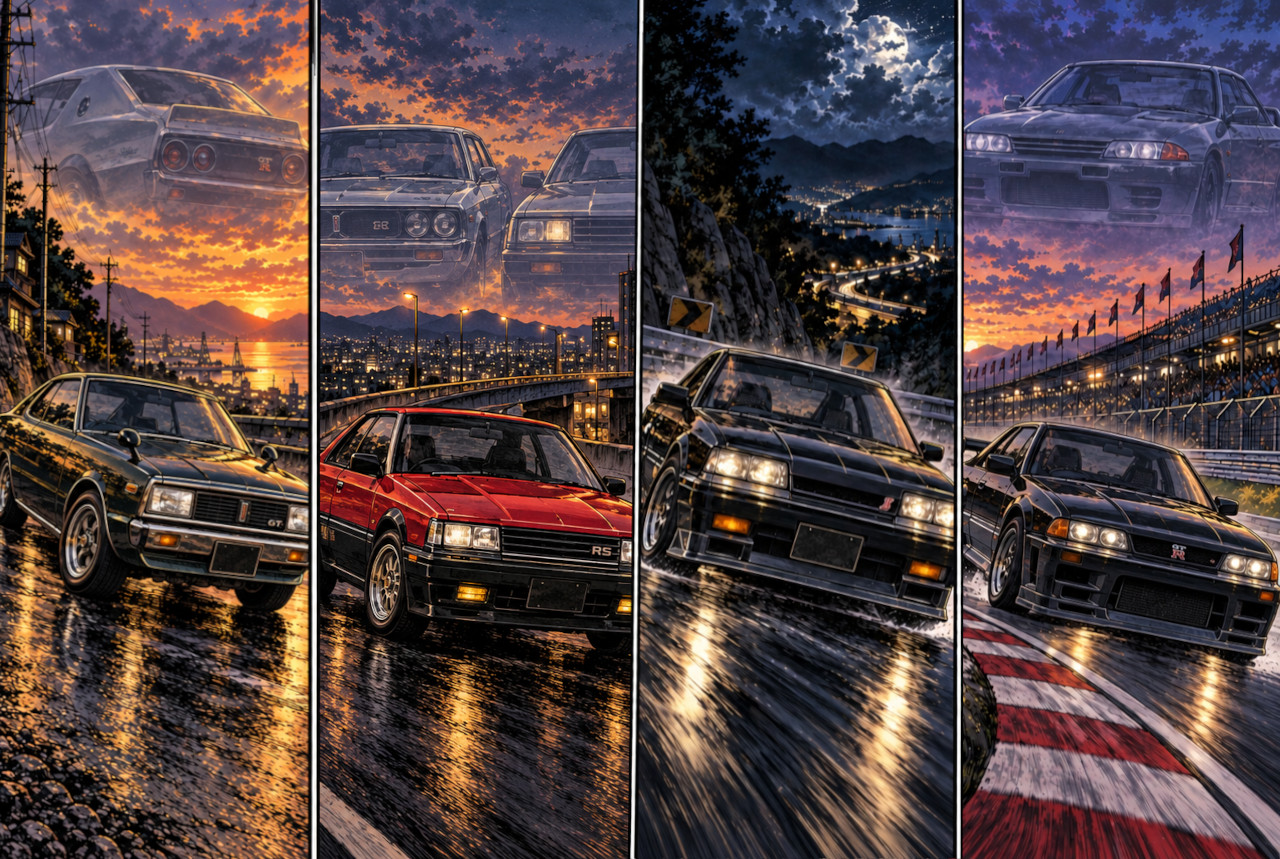 AI-generated illustration showing the C210, R30, R31 and R32 as an evolutionary sequence rather than as an exact scale comparison.
By the time the GTS-R was fighting in touring-car competition, Nissan was already developing the next GT-R. Lessons learned from the R31’s racing program fed directly into the next project: this time, Nissan would build a road car from the outset with the clear goal of winning under Group A regulations.
The result was the R32 GT-R, powered by the RB26DETT and equipped with the electronically controlled ATTESA E-TS torque-split all-wheel-drive system.
In 1989, the GT-R name returned after an absence of roughly 16 years. From 1990 onward, the R32 GT-R went on to win all 29 Japanese Touring Car Championship races it entered during its Group A era.
If you look only at the R32’s results, it can seem like a monster that suddenly appeared out of nowhere. But behind it were the C210 turbo, the four-cylinder R30 RS, and the race-developed R31 GTS-R.
During those 16 years without a GT-R, the Skyline was not standing still. Nissan was willing to set aside even the straight-six tradition for a time, while gradually rebuilding turbocharging, DOHC performance, racing experience, and the link between road-car development and competition.
Once all of those elements finally came together, the GT-R name was ready to return.
Editor’s Note
I used to look at the R30 RS and think, “Why is the hottest Skyline using a four-cylinder?” For a Skyline, that always felt slightly wrong to me.
But once I started looking at the history in order, that four-cylinder choice became one of the most interesting parts of the story. Nissan could have stayed conservative and insisted on a straight-six simply because that was the Skyline tradition. Instead, if the FJ20 was the engine that gave them the performance they wanted, they used it and went after the title of the most powerful Skyline anyway.
What I like even more is that Nissan could call it the “most powerful Skyline ever” without casually bringing back the GT-R badge. There is something almost stubborn about that. The name still seemed to carry a special weight.
Then the R31 GTS-R appears, straight-six DOHC performance and serious touring-car racing come together again, and only after that do we arrive at the R32. If you look at the R32 alone, it seems almost unreal. If you look at the 16 years before it, however, it starts to feel less like a miracle and more like the car Nissan had been working toward all along.
References
- Nissan Heritage Collection: Skyline 2000GT-E·L (C210/C211)
- Nissan Heritage Collection: Skyline 2000 Turbo Intercooler RS-X
- Nissan Heritage Collection: Skyline Super Silhouette Group 5
- Nissan Heritage Collection: Skyline 2000 GTS-R
- NISMO: Domestic Motorsport History — R31 GTS-R
- NISMO: Domestic Motorsport History — R32 GT-R and the 29-race Group A winning streak