

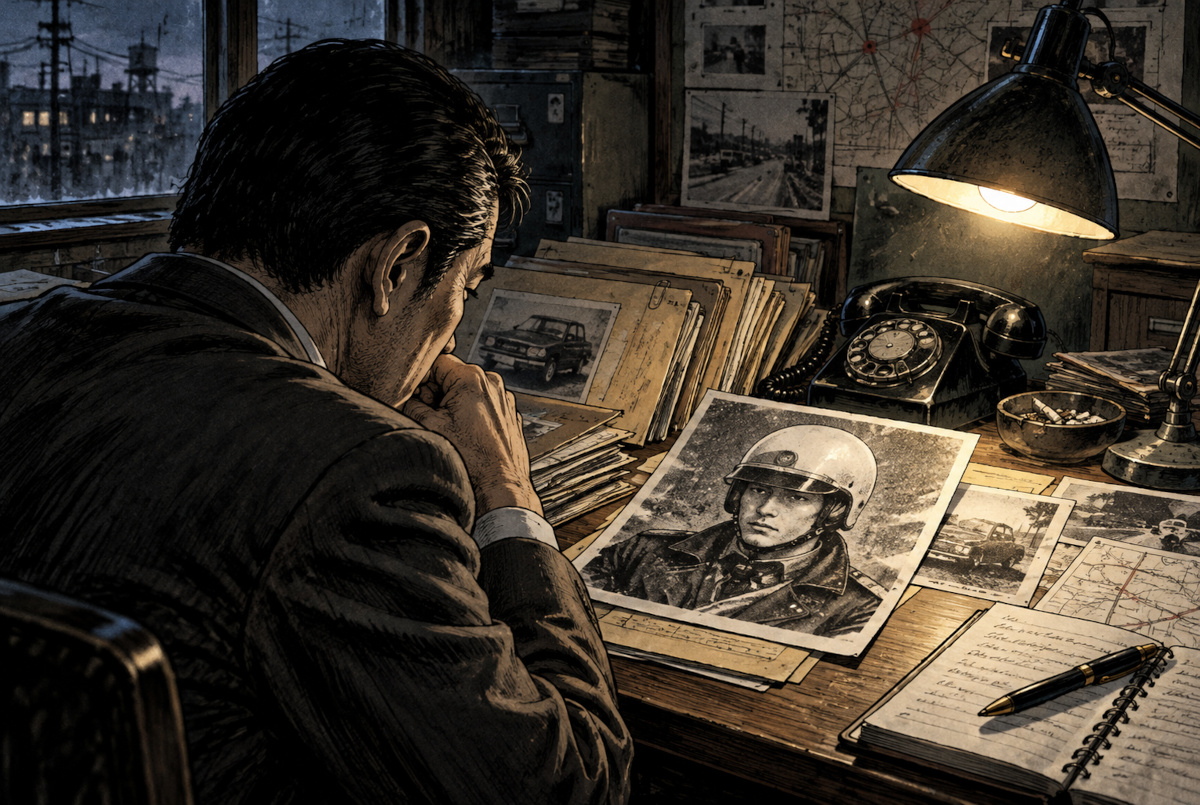
What if the police knew who committed Japan’s most infamous unsolved robbery almost from the beginning?
Years ago, I heard precisely that claim from a man who said he had worked on the original investigation.
On December 10, 1968, nearly ¥300 million was stolen in Fuchu, western Tokyo. Five days later, a 19-year-old young man who had come under police suspicion died. His father was a serving motorcycle police officer.
There is even a theory that the father burned the stolen money and used his position within the police to keep the truth buried.
But did the police really know who the robber was and then keep that knowledge hidden for more than 57 years?
Comparing a parliamentary inquiry from 1975 with a major investigation broadcast by NHK in 2026 reveals a problem more complicated than a straightforward conspiracy story.
Why Was Japan’s Most Famous Suspect Photograph Discarded?
Ask anyone familiar with the ¥300 million robbery what the culprit looked like, and they will probably picture the same face: a young man wearing a white motorcycle helmet.
The image became one of the most recognizable suspect photographs in Japanese criminal history.
It was released on December 21, 1968, just 11 days after the robbery.
But there was a serious problem.
According to later investigative reporting, the face used in the widely circulated composite image came from a photograph of another man who had already died before the robbery.
Investigative journalist Shoji Kondo, who spent decades pursuing the case, advanced an even more troubling explanation. He suggested that police used a photograph resembling the 19-year-old suspect, whom this article calls Suspect S, because the young man’s father was a police officer and investigators did not want to expose that connection publicly.
That is an allegation about the photograph’s purpose, not an independently established account of the police decision.
No official record examined for this article establishes that protecting S was the reason for choosing the image.
What is documented in later reporting is that the photograph’s reliability came under serious doubt. It was reportedly formally discarded as an investigative image in December 1974.
A face considered unreliable for the investigation nevertheless remained the public face of the crime for decades.
That is quite a contradiction.
The photograph was supposed to help identify the culprit. Instead, its enormous publicity may have helped fix a questionable image of the offender in the public imagination.
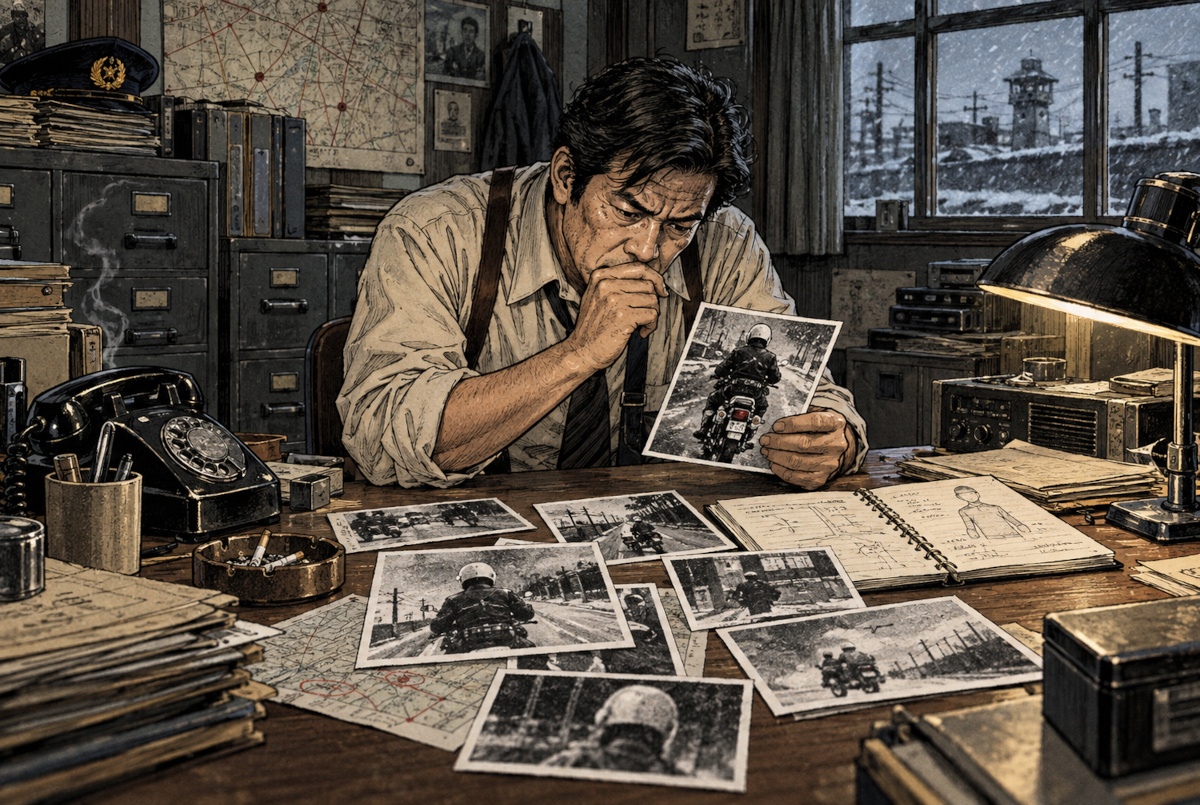
AI-generated illustration symbolizing the investigation around 1974. The detective, motorcycle, photographs and documents are fictional. This is not a reconstruction of actual investigators, police premises or evidence photographs from the ¥300 million robbery.
By 1975, Parliament Was Already Questioning the Police Investigation
One of the most revealing things I found is that the investigation’s shortcomings were not first discovered by modern journalists.
They were being discussed in Japan’s parliament half a century ago.
On December 11, 1975, the day after the statute of limitations expired, lawmaker Seiichi Kataoka questioned the police investigation during a meeting of the House of Representatives’ Local Administration Committee.
His concerns included the initial response, inconsistencies in the command structure and a traditional investigative practice known in Japanese as mikomi sosa.
In simple terms, that meant concentrating on someone investigators already believed was responsible, potentially at the expense of alternative leads.
Kataoka also referred to the Metropolitan Police Superintendent General, Kuniyasu Tsuchida, having acknowledged the investigation’s failure and apologized to the public.
There is an important distinction here: Kataoka was raising questions about what had gone wrong. His parliamentary statements do not by themselves prove that every alleged investigative mistake occurred exactly as described.
Nevertheless, the possibility that investigative methods had contributed to the failure was already being debated openly in 1975, just seven years after the robbery.
That matters when discussing a supposed decades-long silence.
Japan’s police did not simply announce that nothing had gone wrong and close the subject forever.
But neither does a public discussion of investigative failure establish that senior officers deliberately concealed a known culprit.
And the parliamentary record examined here does not establish that Suspect S’s father ordered the investigation to be stopped.
In 2026, a Witness Account About 20 Kilometers Away Raised New Questions
Fast-forward roughly half a century.
On January 10, 2026, Japan’s public broadcaster NHK aired Unsolved Cases: File 10 — The ¥300 Million Robbery.
According to NHK, the production obtained extensive investigation-related materials and attempted to reach more than 180 people connected with the case.
Among those interviewed was a woman who had been a high school student at the time and witnessed events at the crime scene. Her account brought renewed attention to details of the fake motorcycle police officer.
Another finding was particularly striking.
As described in reporting about the documentary, investigators had received multiple potentially significant accounts concerning a motorcycle believed to be connected with the crime, from an area roughly 20 kilometers (12 miles) away.
Those accounts were not adequately pursued or incorporated into the investigation, according to the program’s findings.
That raises a rather uncomfortable question.
Did investigators know who the robber was and intentionally suppress the information?
Or did they already possess leads that might have brought them closer to the answer, without recognizing their importance at the time?
The second possibility would still represent a serious investigative failure. But it is not the same as proving a deliberate effort to protect a particular suspect.
A neglected lead can result from bad judgment, poor coordination or a preconceived theory. Demonstrating intentional suppression requires evidence of something more: who intervened, what they knew and what action they deliberately took.
Could the Suspect’s Father Really Have Controlled the Investigation?
The father’s police career remains one of the most provocative details in the case.
In a 2021 TV Tokyo report, journalist Shoji Kondo described Suspect S’s father as a commander in a motorcycle traffic police unit who also had experience in public security policing.
Kondo also recounted an angry response when he approached the father for an interview.
But there is a leap in reasoning that deserves closer inspection.
Holding a command position in a traffic police unit does not automatically give someone authority over the headquarters investigating a nationally significant robbery.
Nor does an angry reaction to questions about a deceased family member establish involvement in a crime.
To understand exactly where the evidence stands, I separated four frequently repeated claims.
| Claim or concern | What the available sources establish | What remains unproven |
|---|---|---|
| Suspect S committed the robbery | Retrospective reports identify him as a person who attracted investigative attention and died five days after the crime. | Physical evidence directly establishing his participation in the robbery. |
| His father burned the stolen money | Accounts and allegations about the destruction of the money have circulated. | An original, verifiable eyewitness account or forensic examination of the alleged burned material. |
| Police promoted an unreliable image of the culprit | Later reporting describes serious doubts about the famous suspect image and its formal rejection in 1974. | A complete documentary record of how the image was selected and why investigators made those decisions. |
| Senior police officers orchestrated a cover-up | Parliament questioned investigative failures. Journalists later documented claims and suspicions surrounding the case, but the sources examined do not directly substantiate a cover-up. | Reliable evidence identifying who ordered or carried out a deliberate suppression of evidence or investigative action. |
This comparison is not intended to dismiss every suspicious detail.
Its purpose is to distinguish circumstances that make a theory worth investigating from evidence that can actually establish guilt or deliberate concealment.
That distinction is essential if the question is not merely whether the story sounds convincing, but whether it can be demonstrated.
AI-generated illustration of a present-day editor reexamining historical material. The person, room, photographs and documents are fictional. It does not depict an actual NHK newsroom, police archive or authentic investigative records.
Was the Money Hidden on Battleship Island? When Fiction Overtakes a Real Crime
The ¥300 million robbery has inspired so many theories that the stolen money has even found its way into stories set on an abandoned island.
One example is
Kodansha’s official description of its nineteenth and final volume connects the fictional story to the real robbery and to Gunkanjima, or Hashima Island, an abandoned former coal-mining island popularly known as Battleship Island.
But the manga is fiction. Its plot is not evidence that the real stolen money was ever hidden there.
Could stories like this have been deliberately created to distract people from the real perpetrator?
I found no evidence establishing such a purpose.
What fiction can do, however, is make an imagined explanation more memorable than the actual investigative record. After enough films, books, dramas and manga, it becomes surprisingly easy to remember the dramatized story while forgetting where the established facts end.
What Was Really Silent for 57 Years?
By 1975, the investigation was already being challenged in parliament.
Investigators and reporters subsequently published their recollections. In January 2026, NHK returned to the case with newly examined materials and interviews.
So the story was never literally buried in 57 years of complete silence.
The silence is of another kind.
Despite the testimony, public debate and competing theories, there has been no conclusive official determination of who carried out the robbery, who might have assisted, or what ultimately happened to the money.
The evidence examined for this article does not allow me to rule out every possibility that Suspect S’s father exerted improper influence.
But it certainly does not allow me to state that he did.
If there is a way to move beyond the endless cycle of new suspects and dramatic theories, it lies in examining specific inconsistencies between witness accounts, investigation records and the decisions investigators made.
Another colorful theory may attract attention. A documented explanation of why a crucial lead was ignored would tell us something much more useful.
Terms That May Need a Quick Explanation
- Mikomi sosa (見込み捜査)
- A Japanese term for an investigative approach focused on a person or theory already considered likely. When applied too rigidly, it can lead investigators to overlook competing explanations or evidence.
Editor’s Note
I still remember what I was told years ago by someone who said he had worked on the original robbery investigation. The police, he suggested, had identified a likely culprit almost immediately.
That kind of story stays with you. It certainly makes me wonder whether something happened behind the scenes.
But digging into the records produced a more complicated picture. Parliament was already discussing investigative failures in 1975. Decades later, journalists were still finding witnesses and examining what went wrong. The police and the press had not been entirely silent.
And yet that famous suspect photograph survived in the public imagination long after its reliability had been questioned. New testimony continued to emerge, but no culprit was conclusively identified.
It is an exasperatingly unfinished story.
Did the father protect his son? Or did the police spend years struggling with the consequences of their own investigative mistakes?
I cannot give either theory a clean bill of certainty.
What I keep coming back to is something slightly different.
If someone inside the investigation really knew what had happened, why was that knowledge never preserved in a form that could prove it?
That’s the question I cannot shake.
And with that, this four-part series on the ¥300 million robbery comes to an end. The real case remains unsolved. I am not going to invent a solution simply to give the story a more satisfying ending.
The 300 Million Yen Robbery $2014 Four-Part Series
The police officer's son, the missing money, the fake police motorcycle, and questions about the investigation. Four articles examine the evidence, competing theories, and what remains unproven.
- Part 1: Did the Robber Die Five Days Later? Japan’s ¥300 Million Mystery and a Police Officer’s Son
- Part 2: Did the Suspect’s Father Burn ¥300 Million? The Chimney Smoke Mystery
- Final Part: Did Police Already Know the Culprit? Japan’s ¥300 Million Robbery, 57 Years On
- Special: A Yamaha 350 R1 Disguised as a Police Bike? Japan’s ¥300 Million Heist Coming soon
References
- Fuji Television — Timeline from New Testimony: The ¥300 Million Robbery (Japanese) — Provides dates for the robbery, the publication of the suspect image, detective Hachibei Hiratsuka’s involvement, and the expiration of the statute of limitations.
- Bunshun Online — Excerpt from Showa Unsolved Cases: Seicho Matsumoto’s Theory and the Mysterious Suspect X (December 10, 2025; Japanese) — Discusses the 19-year-old Suspect S, his father’s police career, and reporting on the suspect photograph’s formal rejection.
- TV Tokyo — Investigative Journalist Shoji Kondo Discusses His Theory of the ¥300 Million Robbery (July 2, 2021; Japanese) — Kondo’s account of Suspect S, his interview with the father, and the theory concerning the photograph.
- House of Representatives — Local Administration Committee, Remarks by Seiichi Kataoka (December 11, 1975; Japanese) — Questions concerning the initial police response, investigative leadership and suspect-focused investigative practices, including a reference to the Metropolitan Police Superintendent General’s acknowledgment of failure. The proceedings can also be located through the National Diet Library’s official Diet Proceedings Search System.
- NHK — Unsolved Cases, File 10: The ¥300 Million Robbery (Broadcast January 10, 2026; Japanese) — Official program information describing its extensive documentary research and attempts to contact more than 180 people connected with the case.
- MANTANWEB — NHK Revisits the ¥300 Million Robbery and Its Troubled Initial Investigation (January 10, 2026; Japanese) — Reports the former high school witness’s account and the overlooked motorcycle-related testimony from approximately 20 kilometers away.
- Kodansha — Montage, Volume 19: Final Volume, by Jun Watanabe (Official Manga Listing; Japanese) — Confirms the fictional story’s connection to the 1968 robbery and Gunkanjima (Battleship Island).