
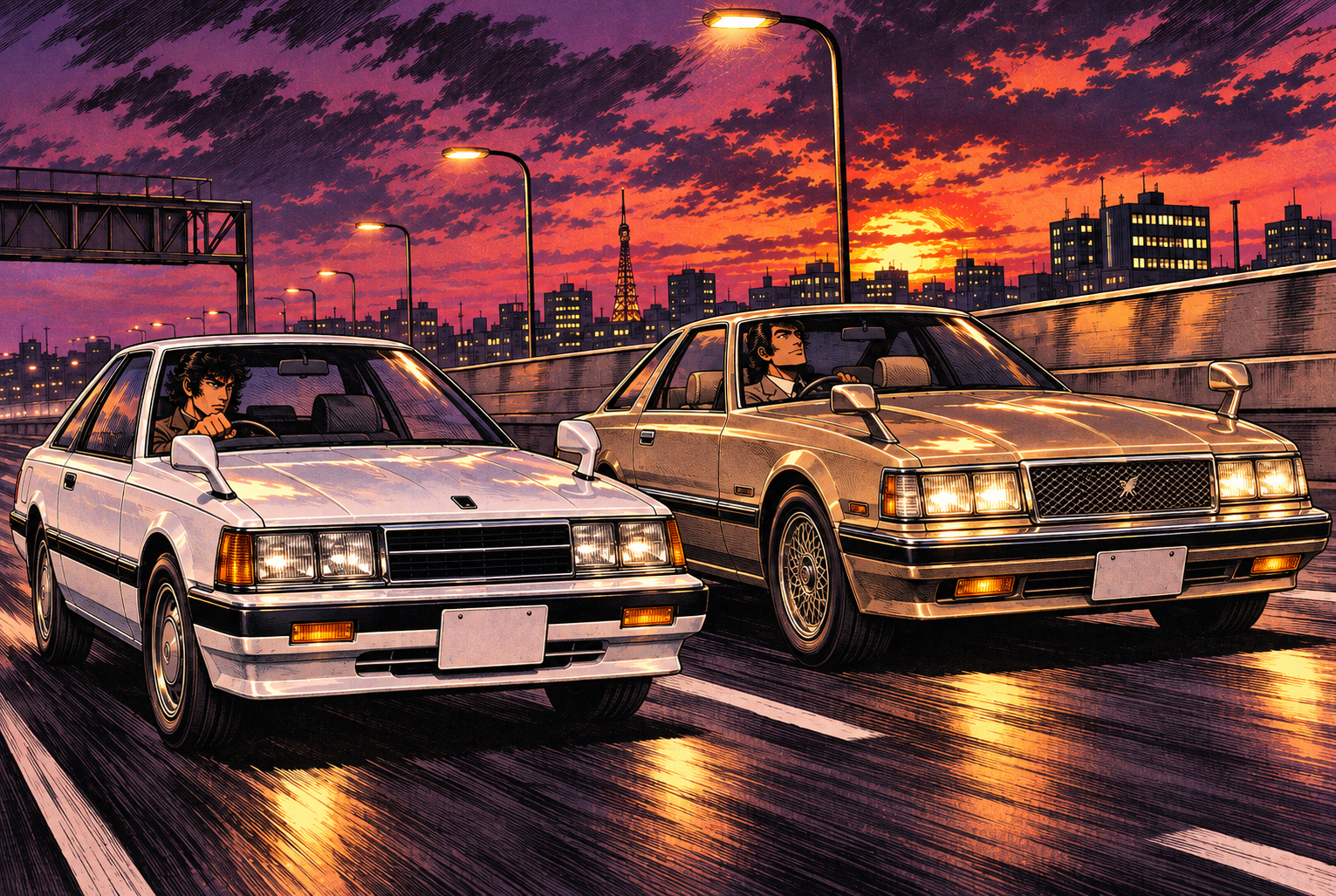
The Nissan Leopard lost to the Toyota Soarer. That is the familiar verdict when enthusiasts discuss Japan’s luxury coupes of the 1980s. But there is one rather inconvenient number: in 1982, the Leopard recorded 3,961 more registrations than the Soarer in Japan’s 5-number vehicle class.
So how did the Leopard lose the overall sales contest? And why did the gap grow wider in the following years?
To investigate, we went back to period specifications, original manufacturer documents, vehicle prices, dealer networks, and registration figures. The answer is more complicated than simply declaring the Soarer the better car.
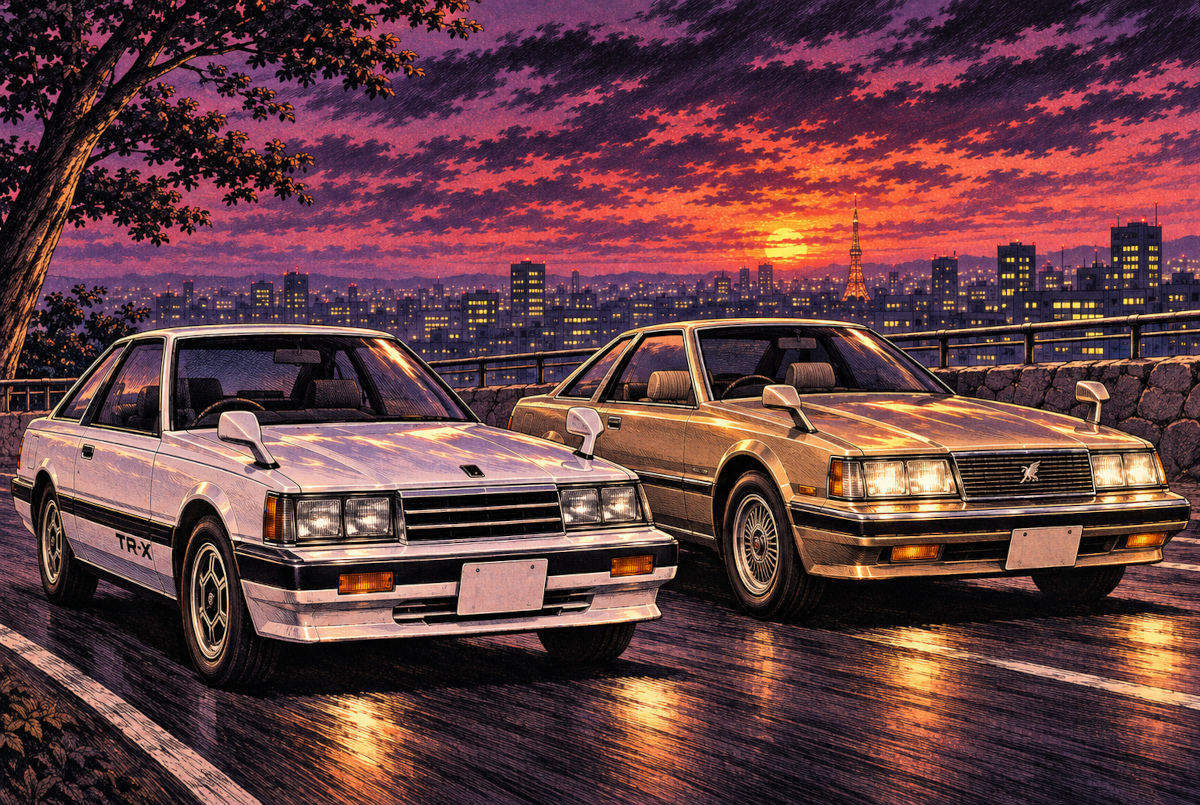
Artist’s interpretation of the first-generation Nissan Leopard and Toyota Soarer. The scene symbolizes Japan’s early-1980s luxury GT market; some vehicle details and background elements differ from the originals.
The Nissan Leopard Arrived Nearly Five Months Before the Toyota Soarer
Nissan launched the first-generation Leopard (F30) on September 30, 1980. Toyota introduced the first-generation Soarer (Z10 series) on February 27, 1981. In this particular rivalry, Nissan had a 150-day head start.
The Leopard was offered as both a two-door and four-door hardtop, with 1.8-liter, 2.0-liter, and 2.8-liter engines. Its aerodynamic body achieved a drag coefficient (Cd) of 0.37.
For 1980, the equipment list was remarkably ambitious. Depending on the grade, buyers could get an electronic multi-function instrument display, a trip computer, and even fender-mounted mirrors with built-in wipers. Nissan was not exactly short of ideas.
There was another unusual twist. Nissan sold the Leopard through its Nissan dealer network, while the closely related Leopard TR-X went through Nissan Cherry dealers. The two versions even had different front-end designs: integrated, irregularly shaped headlamp units on the regular Leopard and four rectangular lamps on the TR-X. Nissan’s own corporate history confirms the separate sales channels.
Toyota took a more focused approach. The Soarer was a two-door luxury coupe from the beginning. Its Cd figure was 0.36, and features such as digital instrumentation and microcomputer-controlled air conditioning made it equally futuristic.
Both cars looked toward the next decade. The difference was that Toyota presented a particularly clear proposition: a prestigious, technically sophisticated grand touring coupe.
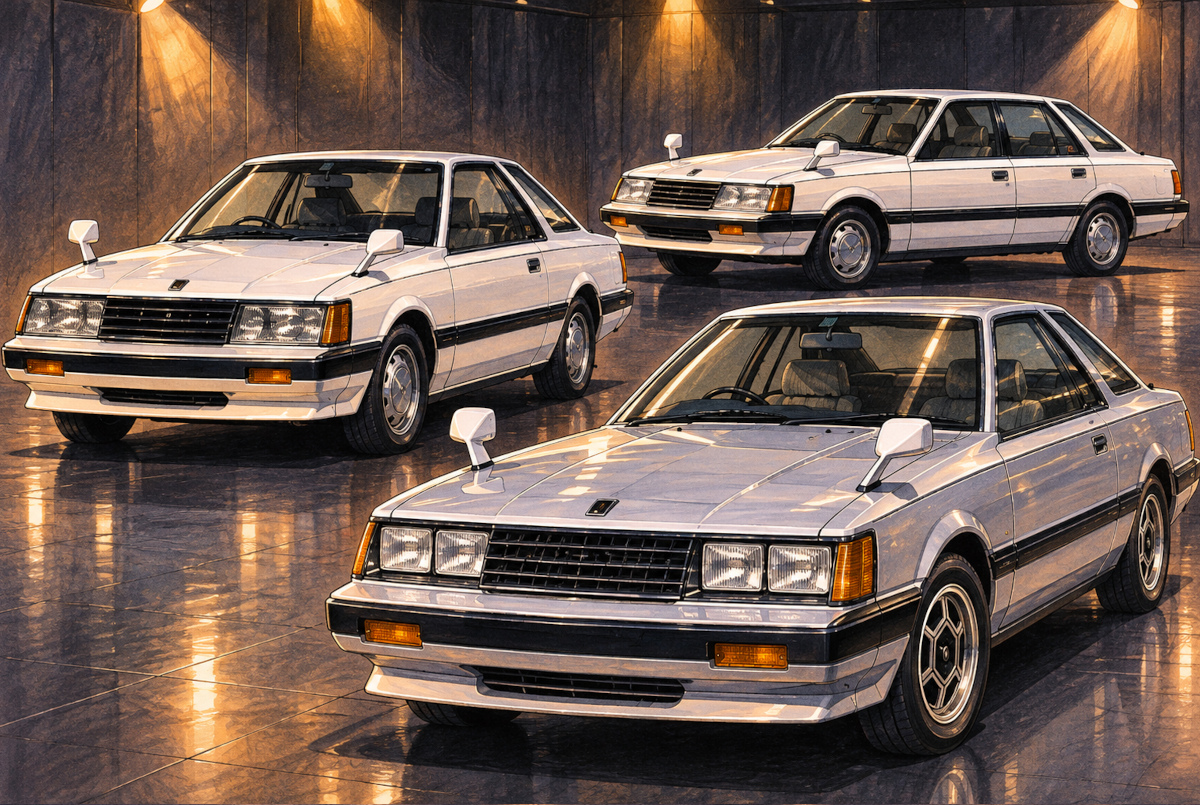
Illustration of the first-generation Leopard family: regular two-door model at left, four-door model at rear, and two-door TR-X in the foreground. The original Leopard used integrated headlamp units, while the TR-X featured four rectangular lamps. Some grille, window, and trim details have been simplified.
Same 2.8-Liter Displacement, but a 25-PS Difference
For anyone raised on Japanese performance-car magazines, the engine comparison is impossible to ignore.
Nissan’s L28E was a 2.8-liter straight-six with a single overhead camshaft (SOHC). Toyota answered with the 5M-GEU, a 2.8-liter straight-six using dual overhead camshafts (DOHC).
| Original 2.8L Models | Nissan Leopard | Toyota Soarer |
|---|---|---|
| Representative grade | 280X SF-L | 2800GT |
| Engine | Inline-six SOHC | Inline-six DOHC |
| Maximum power | 145 PS | 170 PS |
| Maximum torque | 23.0 kgm | 24.0 kgm |
| Vehicle weight | 1,290 kg | 1,300 kg |
| Weight per horsepower | 8.90 kg/PS | 7.65 kg/PS |
| Original reference price | ¥2,620,000 | ¥2,667,000 |
Comparison of representative two-door models with five-speed manual transmissions. Power figures use the period gross rating system. Weight per horsepower was independently calculated by dividing vehicle weight by maximum engine output. The Leopard price dates from 1980 and the Soarer price from 1981; specifications and equipment were not identical.
The price difference was only ¥47,000, yet the Soarer offered another 25 PS. Its weight-per-horsepower figure was approximately 14% lower, an advantage on paper.
That does not automatically translate into a 14% improvement in acceleration. Transmission ratios, torque delivery, and other factors matter. Still, a buyer comparing the two specification sheets had an obvious reason to take the Soarer’s DOHC engine seriously.
Then came an awkward development for Nissan.
In July 1981, the Leopard gained a 2.0-liter turbocharged engine producing 145 PS—the same maximum output as its naturally aspirated 2.8-liter six.
The larger engine still produced more torque: 23.0 kgm versus 21.0 kgm. But the smaller turbo offered the same headline horsepower without moving into Japan’s more expensive 3-number tax class.
Suddenly, the 2.8-liter Leopard had to justify both its price and its higher annual tax bill.
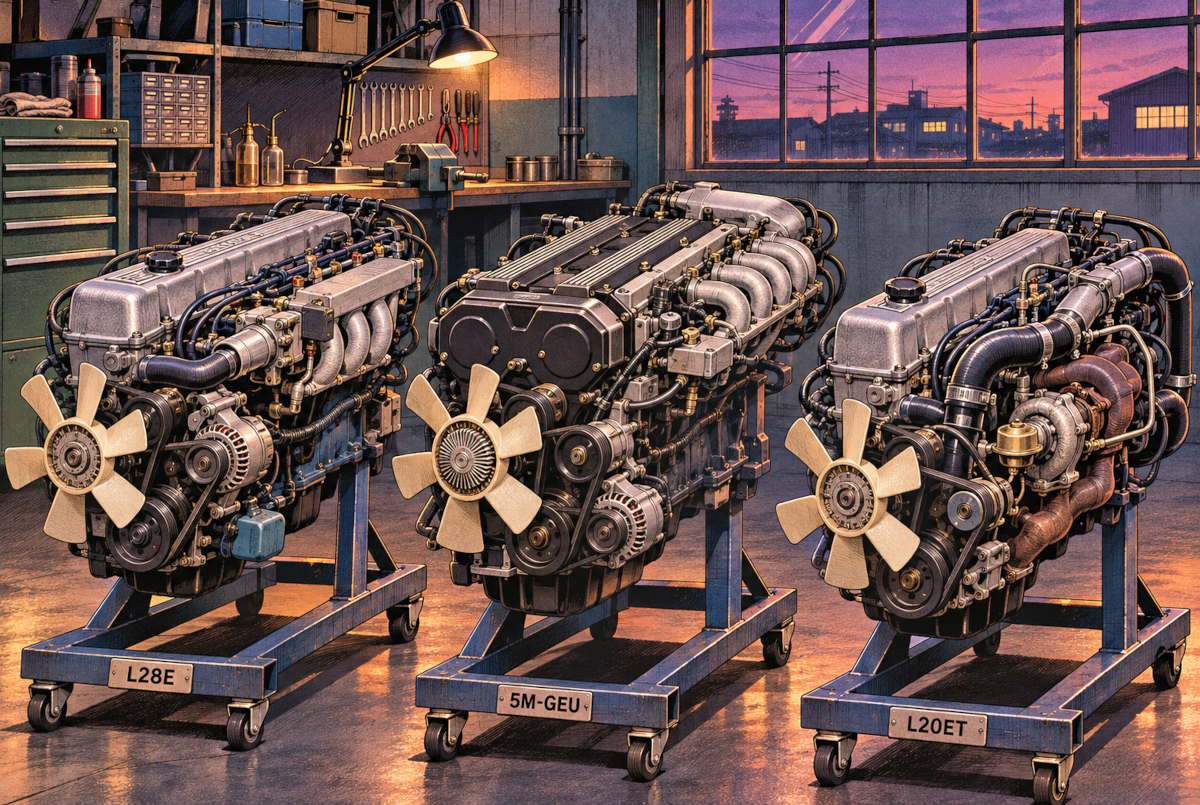
From left: Nissan L28E (2.8L SOHC, 145 PS), Toyota 5M-GEU (2.8L DOHC, 170 PS), and Nissan L20ET (2.0L SOHC turbo, 145 PS). Figures are period gross ratings. The intake systems, turbo plumbing, and accessory layouts are illustrative rather than exact mechanical reproductions.
In 1982, the Leopard Actually Led the 5-Number Class
Here is where the story becomes more interesting than the usual “Toyota won, Nissan lost” summary.
A Japanese enthusiast’s archival study reproduces vehicle registration figures originally published in Monthly My Car and attributed to the Japan Automobile Dealers Association (JADA).
Using those secondary transcriptions, we recalculated the 1982 results by vehicle registration class.
| 1982 Registrations | Nissan Leopard | Toyota Soarer |
|---|---|---|
| 5-number class | 18,256 | 14,295 |
| 3-number class | 313 | 9,311 |
| Total | 18,569 | 23,606 |
Source: Secondary transcriptions of historical JADA registration statistics. We could not directly examine the original 1982 statistical tables or conclusively verify how the Leopard TR-X was categorized in the original records. Figures should therefore be treated as provisional. The Leopard also included both two-door and four-door models, whereas the Soarer was a two-door-only car; this is not a like-for-like body-style comparison.
In the 5-number class, Nissan led by 3,961 registrations. But in the 3-number class, Toyota led by a massive 8,998.
Put those two categories together and the Soarer finished 5,037 registrations ahead.
There is an important limitation. The Leopard’s total includes four-door models. These figures do not prove that its two-door coupe outsold the Soarer’s two-door coupe.
Even with that qualification, the registration pattern is striking.
The Leopard was competitive in the lower-displacement category, but the Soarer dominated registrations in the larger-engine class.
Our calculation reveals another difference. Only about 1.7% of Leopard registrations were in the 3-number class. For the Soarer, the figure was approximately 39.4%.
In other words, nearly four in ten registered Soarers belonged to the more heavily taxed category, compared with fewer than two in every hundred Leopards.
Those percentages describe registered vehicles, not a survey of what individual buyers preferred or why they made their decisions. Nevertheless, they show where the two model ranges were finding customers.
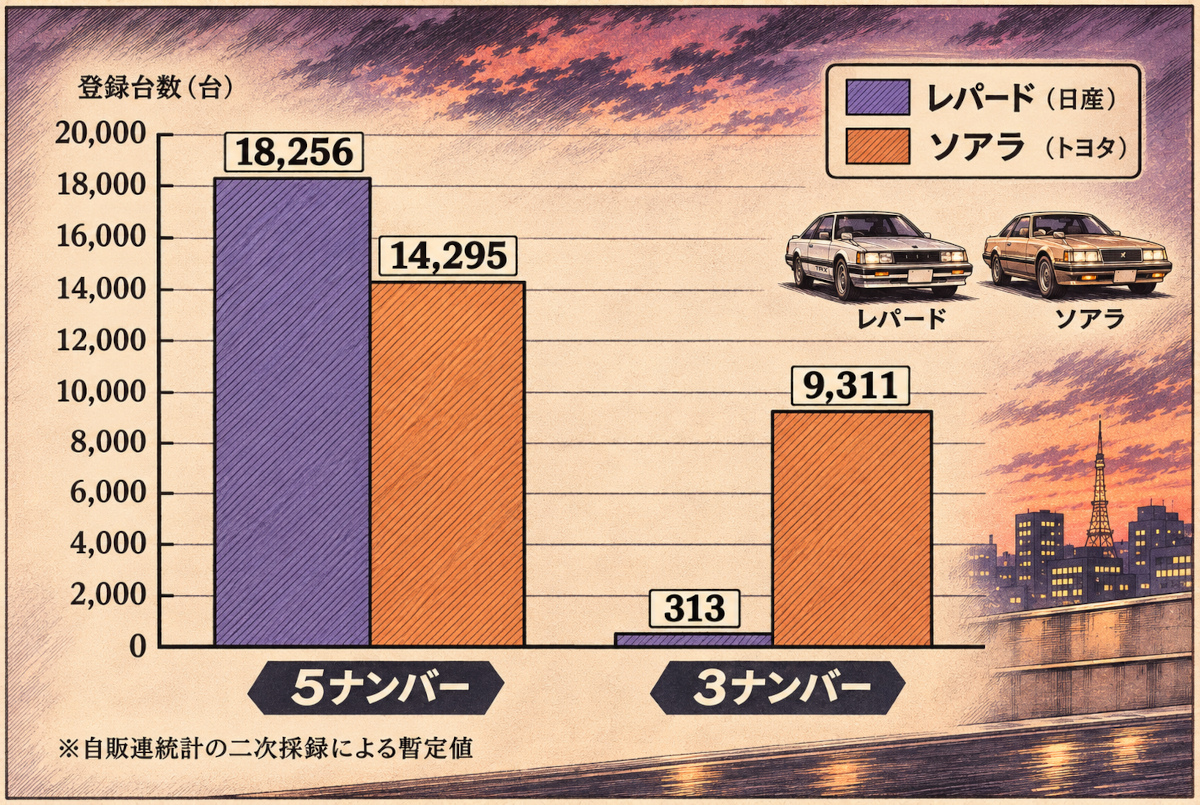
Our breakdown of 1982 registrations. The Leopard led the 5-number class by 3,961 vehicles, while the Soarer led the 3-number class by 8,998. Calculated from secondary transcriptions of JADA statistics; the original statistical tables have not been directly verified.
Japan’s Old 3-Number Road Tax Was a Different World
For readers unfamiliar with the Japanese system, 5-number and 3-number refer to registration classes historically distinguished by engine displacement and vehicle dimensions.
Before the automobile tax reform of April 1989, the distinction could have a substantial impact on ownership costs.
For privately owned passenger cars, the annual automobile tax was:
- 5-number car, over 1.5L and up to 2.0L: ¥39,500 per year.
- 3-number car, up to 3.0L: ¥81,500 per year.
That is an extra ¥42,000 every year—approximately 2.06 times the smaller car’s tax.
Now return to those registration figures.
Despite this tax penalty, Toyota recorded 9,311 Soarer registrations in the 3-number class during 1982. The Leopard managed just 313, and Nissan discontinued its 2.8-liter version in the September 1982 facelift.
The problem was not that Japanese buyers universally refused large engines. The Soarer demonstrated that a substantial market existed even under the old tax system.
Why did those buyers choose the Soarer? Engine performance, equipment, brand prestige, styling, and showroom experience may all have played a role.
The registration figures alone cannot establish their relative importance. But they do challenge the easy explanation that the Leopard’s 2.8-liter failure was simply a consequence of Japan’s tax rules.
Two Dealer Networks Each—So Why Such Different Results?
Nissan distributed the regular Leopard through Nissan dealers and the Leopard TR-X through Nissan Cherry dealers.
Toyota also used two networks: Toyota and Toyopet dealerships. Its February 1981 launch announcement listed a total of 102 sales companies and an initial monthly sales target of 3,000 vehicles.
That figure requires care. A sales company is not the same thing as an individual showroom, and we do not have directly comparable dealership-count data for Nissan. It would therefore be misleading to declare Toyota’s retail network the decisive advantage on this evidence alone.
The more intriguing difference is how the cars were positioned.
The Leopard attempted to cover both two-door personal luxury motoring and the four-door hardtop market. The Soarer concentrated on one identity: a premium two-door grand tourer.
Toyota also kept developing the range. In 1983, it added a 2.0-liter DOHC engine producing 160 PS.
By then, the 5-number registration comparison had already reversed:
| 5-Number Registrations | Nissan Leopard | Toyota Soarer |
|---|---|---|
| 1982 | 18,256 | 14,295 |
| 1983 | 12,815 | 20,831 |
| 1985 | 3,165 | 16,392 |
Historical registration figures transcribed from period JADA data. Original statistical tables have not been directly verified.
Even in the class where Nissan had initially held an advantage, the gap was growing rapidly.
Nissan responded with a 3.0-liter V6 turbo version in 1984, but the first-generation Leopard never regained the overall lead.
When the second-generation F31 arrived in 1986, Nissan abandoned the four-door body and made the Leopard a two-door-only model.
The next confrontation with the Soarer would be much more direct.
Editor’s Note
There is plenty about the original Leopard that still appeals to an old-school Nissan enthusiast. That sharp nose, the L-series straight-six, the almost excessive enthusiasm for electronic gadgets—Nissan was clearly trying.
Which makes the figure of just 313 registrations for the 2.8-liter model all the more painful.
But that is not what bothers me most.
What gets me is the split. Nissan was still holding its own in the 5-number class, yet Toyota was miles ahead among the larger-engine registrations.
Was the Leopard simply 25 PS short of what buyers wanted? Or had the Soarer already become the car people felt was worth paying extra money—and extra tax—to own?
The numbers do not prove either explanation. That uncertainty is part of what makes the story worth investigating.
Getting to the showroom first is not the same thing as winning. Neither is stuffing a car with the latest gadgets.
A car’s engineering merits and the amount someone is willing to pay for its badge are not necessarily the same thing. Funny how often that turns out to be the real battle.
Nissan Leopard: Five-Part Series
The Nissan Leopard arrived before the Toyota Soarer, yet struggled to match its rival in the Japanese market. Across five articles, we examine sales figures, engine performance, pricing, technology, the influence of Abunai Deka, and the Leopard's changing identity through 2000.
- Part 1: How Did the Nissan Leopard Outsell the Soarer in One Class—Yet Lose Overall?
- Part 2: Did a 2.0L Toyota Soarer Really Beat Nissan’s 3.0L Leopard? Coming soon
- Part 3: English edition Coming soon
- Part 4: English edition Coming soon
- Final Part: English edition Coming soon
Terms That May Need a Quick Explanation
- DOHC / SOHC
- DOHC means dual overhead camshaft, while SOHC means single overhead camshaft. The terms describe how the engine’s camshafts operate its valves. DOHC does not automatically make an engine faster; overall design and tuning also matter.
- Japan’s 5-Number and 3-Number Classes
- Japanese passenger vehicles have historically been classified partly by engine displacement and body dimensions. During the period discussed, cars with engines up to 2,000cc and within specified size limits qualified for the smaller 5-number category. Vehicles exceeding the displacement or dimensional limits were generally registered in the 3-number category. Before April 1989, this distinction produced a particularly large difference in annual automobile tax for privately owned vehicles.
References
- Nissan Heritage Collection: Leopard 4-Door Hardtop 200X ZGX (Japanese) — Official information on the original Leopard’s body styles, equipment, aerodynamics, and development.
- Nissan Heritage Collection: Leopard 2-Door Hardtop Turbo SGX (Japanese) — Official specifications for the 2.0-liter turbocharged model and the 1982 facelift.
- Nissan Motor Company History, 1974–1983: Corporate Chronology (Japanese; Shibusawa Company History Database) — Confirms the September 30, 1980 launch and the Nissan/Nissan Cherry sales arrangements.
- Toyota’s 75-Year History: First-Generation Soarer (Japanese) — Official model history, specifications, equipment, and sales channels.
- Toyota Motor Corporation: February 27, 1981 Soarer Launch Announcement (Japanese PDF) — Original manufacturer release covering the product concept, dealer companies, monthly sales target, specifications, and launch prices.
- Web Motor Magazine: Showa Classic Cars No. 73 — Nissan Leopard 280X SF-L (1980) (Japanese) — Period vehicle specifications, weight, pricing, and the original four-door concept.
- Web Motor Magazine: Revisiting the Impact of the MZ11 Soarer 2800GT (Japanese) — Contemporary specifications and pricing of Toyota’s original 2.8-liter luxury coupe.
- Kouichi Hayashi and Makoto Watanabe, “The Relationship of the Transition of Japanese Sedans’ Overall Width and Influencing Factors,” Bulletin of JSSD, Vol. 61, No. 2 (2014) (Japanese PDF with English abstract) — Includes historical automobile tax rates before and after Japan’s April 1989 reform.
- parl-siro: A Look at the 1983 Nissan Leopard TR-X Catalog (Japanese, 2016) — Includes registration figures transcribed from historical JADA statistics published in the magazine Monthly My Car. The original statistical tables have not been independently inspected.
- micgz: Historical Toyota Soarer Registration Research, March 2010 Archive (Japanese) — Supplementary enthusiast research based on historical registration records.