

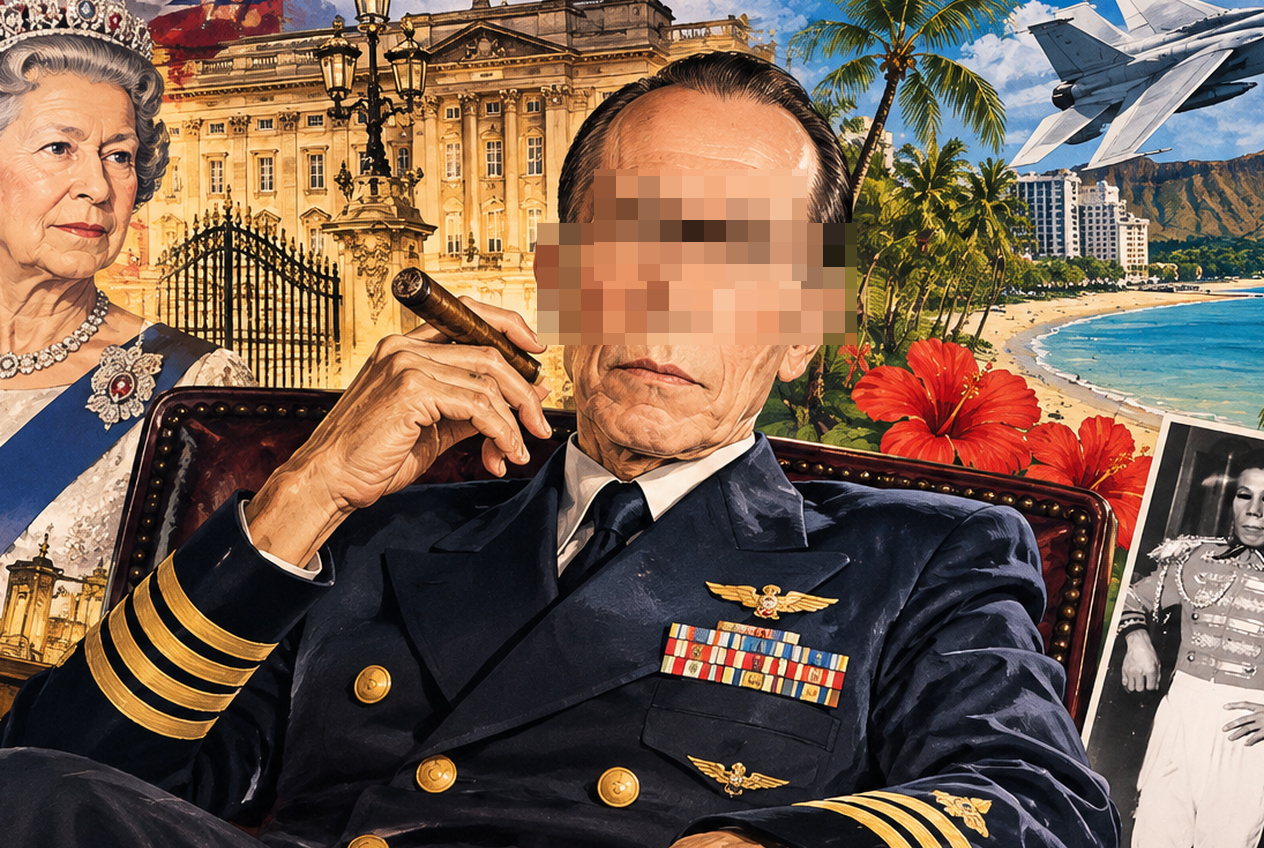
“My father is descended from King Kamehameha of Hawaii. My mother is Queen Elizabeth II’s twin sister. I’m a U.S. military fighter pilot. Oh, and I earned a doctorate at the University of Tokyo.”
Imagine receiving a résumé like that. Most employers would probably end the interview before it began. Yet a Japanese man who told women a similarly extraordinary story really did become the subject of a series of marriage fraud cases.
He called himself “Colonel Kuhio.” His arrest in 1984 was reported by the Japanese press, and he later became notorious as a marriage swindler whose alleged total takings were estimated at around 100 million yen.
British royalty, Hawaiian royalty and a U.S. military colonel. This wasn’t so much a résumé as an all-you-can-eat buffet of prestigious identities.
But when I started checking the claims, something unexpected emerged: the name “Kuhio” genuinely belonged to a Hawaiian prince.
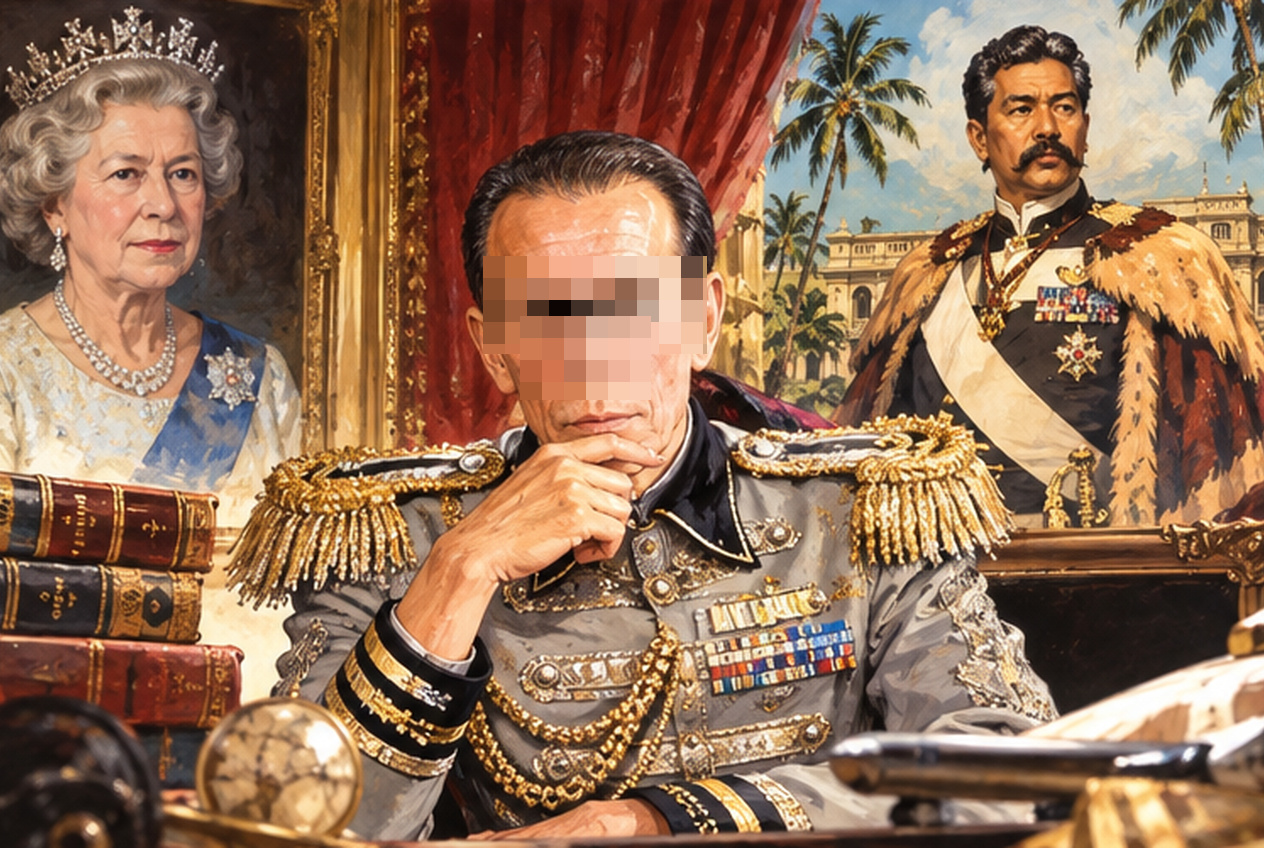 AI-generated illustration inspired by Colonel Kuhio’s claimed background. This is not a historical record of military service or a genuine connection to royalty.
Did Queen Elizabeth II Really Have a Twin Sister?
Let’s begin with the supposed mother. This is the easiest part of the story to check, because the British Royal Family keeps fairly good records of its own members.
According to the Royal Family’s official website, Elizabeth II was born on April 21, 1926. Her younger sister, Princess Margaret, was born on August 21, 1930.
That’s exactly four years and four months apart. They weren’t twins. They weren’t even born in the same year.
Nor is there an additional, previously unknown twin sister in the official family records. The claim about Queen Elizabeth’s twin sister, reported as part of Kuhio’s invented background, collapses under a simple check of birth dates.
But there is a curious twist. In promotional descriptions of the 2009 Japanese film Colonel Kuhio (Kuhio Taisa), the relationship becomes more distant: the man’s mother is described as a cousin of the husband of the Queen’s younger sister.
That’s quite a retreat from having the Queen’s twin sister as your mother.
And it matters. The account of his claims in the Japanese newspaper Nikkan Gendai and the film’s promotional materials do not give the same family relationship. Director Daihachi Yoshida also acknowledged in a 2009 interview that the source material contained fictionalized elements and that the film was a creative adaptation.
We cannot establish exactly why those versions differ. What we can establish is that a line from a movie or its advertising should not automatically be treated as a verbatim statement made by the real man.
There Really Was a Prince Kuhio. But the Dynasty Is Another Matter
Next comes the claim about his father’s royal ancestry. Here, the investigation takes a rather unexpected turn.
A real Hawaiian prince named Jonah Kūhiō Kalanianaʻole lived from 1871 to 1922. According to the Hawaiʻi State Archives, King Kalākaua granted him the title of prince in 1883. He later represented the Territory of Hawaii as a nonvoting Delegate in the United States House of Representatives.
And the story gets stranger.
According to the U.S. House of Representatives’ official historical biography, Prince Kūhiō traveled to Japan in 1888 at the invitation of the Japanese government. King Kalākaua had hoped to arrange a marriage between the prince and a member of Japan’s Imperial Family.
The marriage never took place. The prince spent nearly a year in Japan but made no attempt to secure such a match.
Still, consider the coincidence: the real Prince Kuhio was once associated with the prospect of an international royal marriage. Decades later, a Japanese marriage swindler was using the Kuhio name to support a story about his own supposed royal connections.
That is a remarkable historical overlap. It is not proof that the swindler knew this history or deliberately borrowed it.
Now for the catch.
The Kamehameha dynasty ruled Hawaii until 1872. Prince Kūhiō’s royal title, however, came through King Kalākaua, who became monarch in 1874, and the Kalākaua dynasty.
A genuine Prince Kūhiō and a claim of descent from King Kamehameha are not automatically the same genealogical claim.
Different royal dynasties do not necessarily mean that their members had no distant blood relationships. But they are not interchangeable labels, either.
More importantly, the official records examined for this article provide no evidence linking the Japanese man calling himself Colonel Kuhio to Hawaiian royalty.
Whether he knew the real prince’s history remains unanswered. An intriguing resemblance between two stories is not evidence of the storyteller’s intentions.
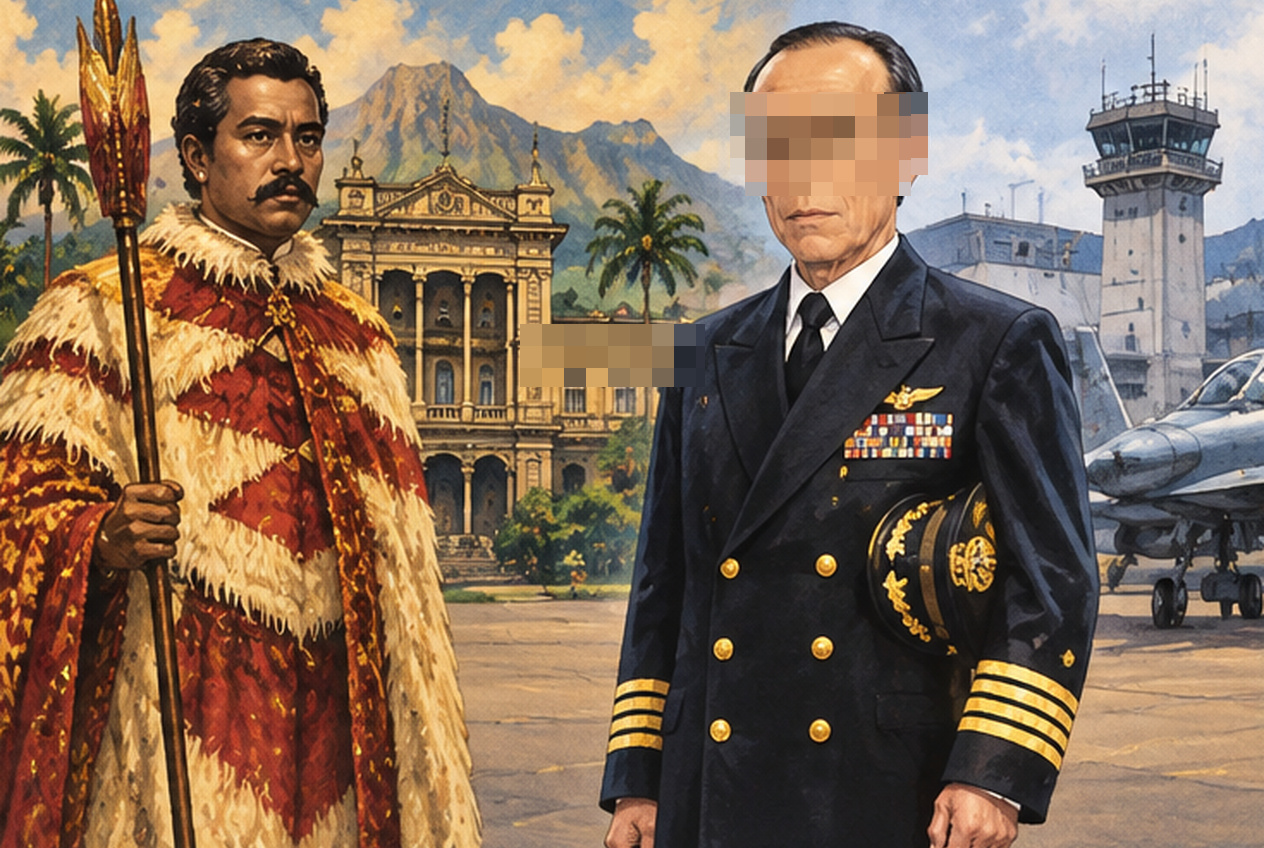 AI-generated illustration contrasting Hawaiian royal history with the colonel’s claims. The royal portrait, military uniform and aircraft are not accurate reconstructions of specific historical people or equipment.
A U.S. Colonel, a Tokyo Doctorate, and a ¥50 Million Wedding Payment
The royal ancestry was only one part of the package.
In a 2015 article, Nikkan Gendai described how Kuhio claimed to be a U.S. Air Force pilot with a doctorate from the University of Tokyo, one of Japan’s most prestigious universities. The paper reported that he was actually a Japanese man who had attended a vocational training school in Hokkaido.
Another Japanese publication, Shukan Shincho, reported an even more elaborate version of his supposed career: a colonel stationed at Yokota Air Base, assigned from British intelligence to the U.S. Navy as a fighter pilot.
British intelligence, the American Navy, an Air Force pilot, a colonel, and a doctorate from Tokyo. Quite a lot to fit onto one business card.
But what was the financial attraction of marrying such an extraordinary man?
Promotional materials for the 2009 film included a claim that the U.S. military would provide 50 million yen in marriage funds once he married.
That figure belongs to the story as presented in the film’s publicity. The available materials do not establish that the real man quoted precisely the same amount to every woman he approached.
Even so, ¥50 million is an extraordinary sum to promise as a wedding benefit.
So I checked the U.S. Department of Defense’s official guidance for people marrying service members.
Military spouses can qualify for benefits including health coverage, access to military shopping facilities, educational and career assistance, and certain housing-related support. Eligibility and the specific benefits depend on the applicable rules.
What the guidance explicitly does not offer is a salary or stipend simply for being a military spouse. Nor does it identify a standard, one-time ¥50 million marriage payment.
There is a distinction worth making here: the current rules alone cannot prove what every military benefit looked like in the 1970s or 1980s. But the official benefits we can verify provide no basis for believing in the enormous wedding payment described in the story.
Why Would Anyone Believe Such an Impossible Story?
Viewed from the outside, the whole thing looks ridiculous. A relative of the British monarch. Descended from Hawaiian royalty. A U.S. colonel. A University of Tokyo doctorate. And a fortune supposedly waiting for whoever married him.
Yet Gentosha, the Japanese publisher of the book that inspired the film, describes the estimated amount obtained from women as roughly 100 million yen.
That is a publisher’s estimate, not a court-certified total verified for this article. The original judgments have not been examined here.
Why did the women believe him? Did the appearance of wealth make him convincing? Was the prospect of marrying an international military officer part of the appeal? Or did trust develop gradually, until doubts that would have seemed obvious to an outsider became harder to confront?
The available evidence does not justify giving every woman the same motive.
And the fact that someone could produce a large sum of money tells us little about why she believed the story. Having savings, property or access to loans is one thing. Recognizing a fabricated identity in someone you trust is quite another.
Financial resources and good judgment about a romantic partner are not the same thing.
For anyone tempted to see Colonel Kuhio as a case study in becoming a more successful con artist, the lesson is not to invent a grander résumé.
A story being believed does not make it true. And emotional trust is no substitute for evidence.
Colonel Kuhio: Behind the False Identity $2014 Three-Part Series
Royal bloodlines, a military career, and an enormous wedding payment. Across three articles, we examine Colonel Kuhio's claims, the money behind the marriage scams, and later reports about the man.
- Part 1: The Queen’s Twin Sister? Colonel Kuhio’s Outrageous Royal and Military Claims — Part 1
- Part 2: English edition Coming soon
- Final Part: English edition Coming soon
Editor’s Note
The thing that first bothered me wasn’t merely the ridiculous résumé. It was the fact that, according to the reports, a story this outrageous could persuade people to part with serious money.
Fifty million yen from the U.S. military just for getting married? That sounds less like a wedding benefit and more like winning the lottery.
But the deeper I looked, the less satisfied I became with the easy response: “How could anyone fall for that?” The words of someone you have fallen in love with can sound much more plausible from inside the relationship than they do to strangers watching from a distance.
Love doesn’t always submit its paperwork to the logic department. If it did, human relationships would be considerably less chaotic.
Still, I’d have one question before worrying about whether Queen Elizabeth had a secret twin sister: if this fellow was such an important military colonel, why would the woman have to come up with the marriage money in the first place?
That’s where the next part of this series goes: the money. We’ll examine the supposed military wedding payment and how financial promises became connected to the real marriage fraud cases.
References
- Nikkan Gendai (October 1, 2015), article on Colonel Kuhio (2009, directed by Daihachi Yoshida) — Japanese-language reporting on the 1984 arrest and Kuhio’s claimed background. Part of the article requires a subscription.
- Daily Shincho (August 13, 2015), feature on the marriage swindler who posed as fighter pilot Colonel Kuhio — Japanese-language reporting on his military claims and public persona.
- The Royal Family, “Queen Elizabeth The Queen Mother” — Official birth dates and family history of Queen Elizabeth II and Princess Margaret.
- Hawaiʻi State Archives, “Jonah Kūhiō Kalanianaʻole Exhibition” — Primary historical records concerning Prince Kūhiō and his royal status.
- U.S. House of Representatives, History, Art & Archives, “KALANIANAʻOLE, Jonah Kuhio” — Prince Kūhiō’s visit to Japan in 1888, the proposed royal marriage, and his congressional career.
- U.S. National Park Service, “Kamehameha Begins His Bid for Power” — Historical background on the Kamehameha dynasty and the Hawaiian monarchy.
- U.S. Department of Defense, Military OneSource, “Getting Married in the Military” — Official information on marriage, military spouse benefits and the absence of a general spouse salary or stipend.
- Gentosha, Colonel Kuhio by Kazumasa Yoshida (Japanese-language book listing) — Publisher’s estimate of the amount obtained through the marriage scams and details of the book that inspired the film.
- INTRO (September 24, 2009), interview with director Daihachi Yoshida — Japanese-language interview discussing the film’s creative adaptation of the real-life case.
- CINEMA FACTORY (September 28, 2009), Colonel Kuhio film introduction — Contemporary Japanese-language promotional description containing the distant royal relationship and the ¥50 million marriage-payment claim.