
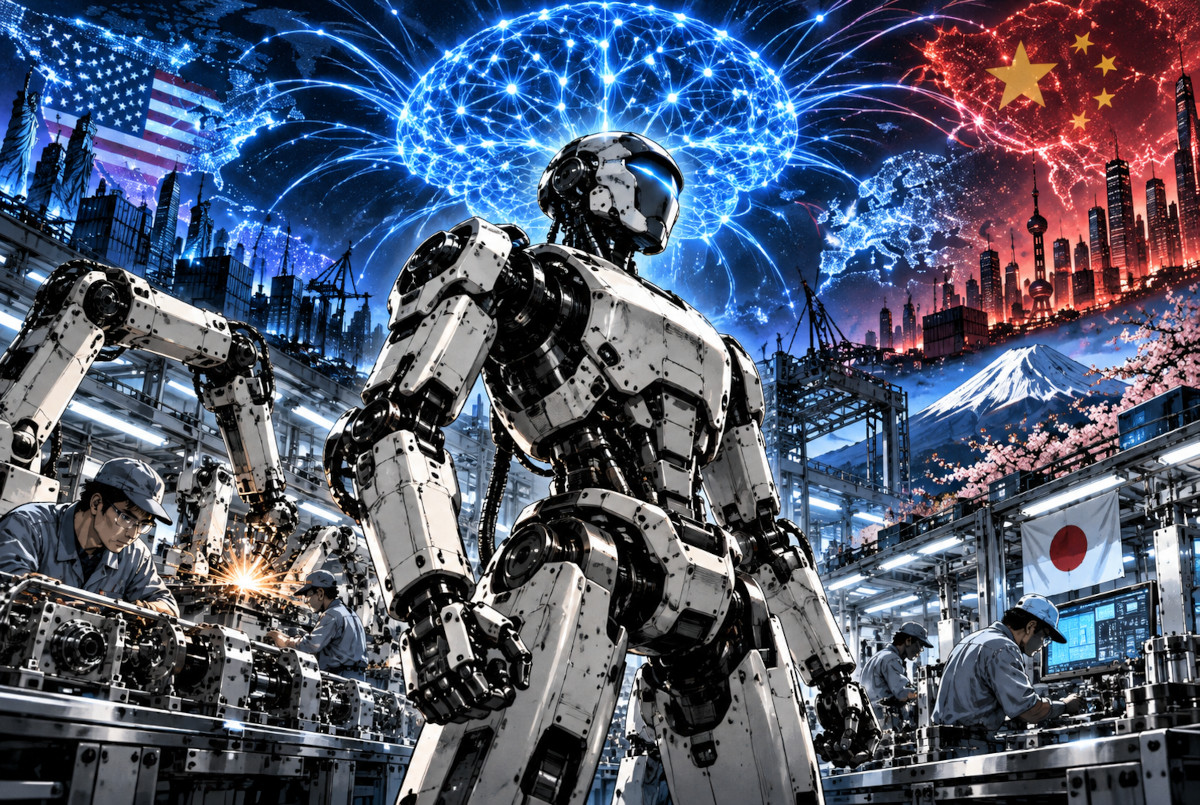
ChatGPT, Gemini, Claude, and China’s DeepSeek dominate the global conversation around generative AI. Look at the companies behind today’s most influential models, and one thing quickly becomes obvious: Japanese names are largely missing from the front of the pack.
That makes it easy to conclude that Japan has simply fallen behind in AI. And when it comes to frontier model development, there is some truth to that. According to Stanford University’s AI Index 2026, organizations in the United States produced 59 notable AI models in 2025, while China produced 35. At the cutting edge of AI model development, the race has increasingly become a U.S.-China contest.
But that does not mean Japan is incapable of building AI. Preferred Networks has developed its PLaMo family of foundation models, while Japanese telecom giant NTT has developed tsuzumi 2, a compact large language model designed especially for Japanese-language business applications. Japan has AI technology. What it has not yet achieved is leadership in the global race for the largest and most influential general-purpose models.
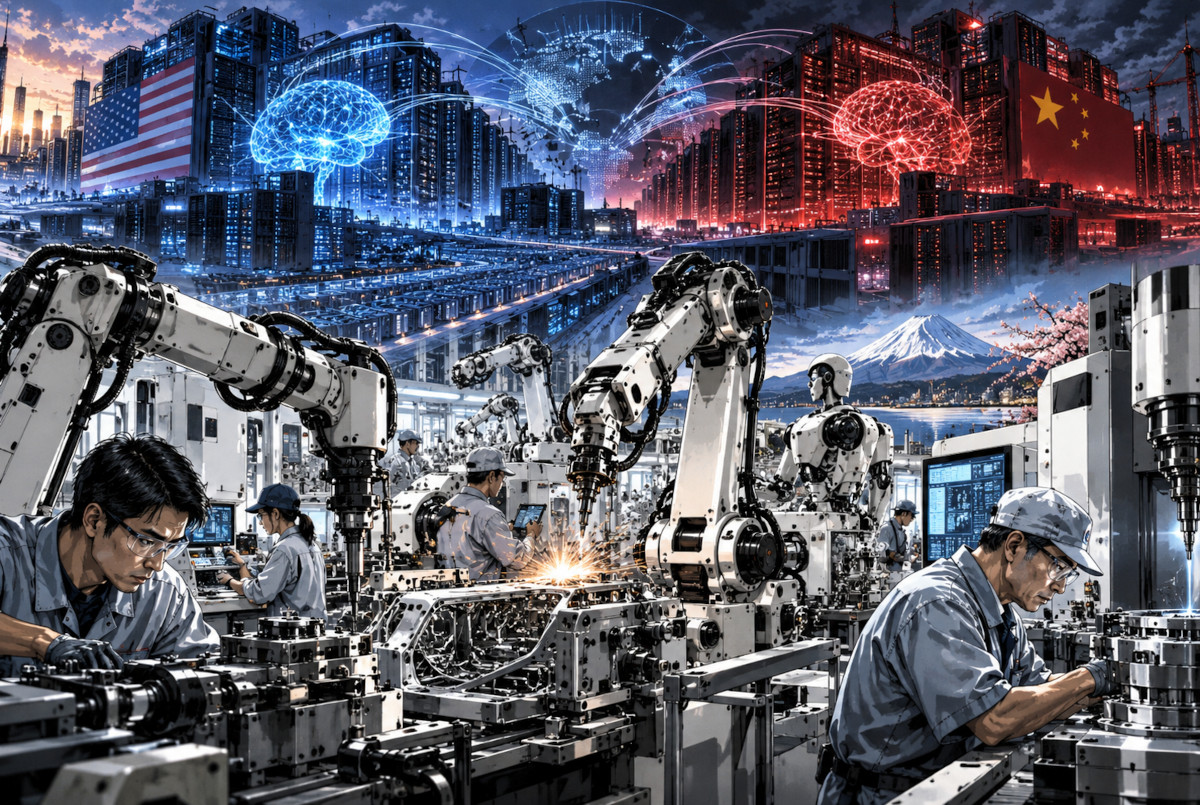 Concept image generated with AI. It does not depict any specific real-world data center, factory, company, or industrial facility.
Japan Still Has an Unusually Strong Set of “Hands and Feet”
The picture changes once AI leaves the computer screen and begins interacting with the physical world. This is where physical AI enters the discussion: systems that use cameras and sensors to perceive their surroundings, make decisions, and then control robots, vehicles, machines, or other physical equipment.
Suddenly, Japan looks much more relevant. According to the International Federation of Robotics (IFR), Japan accounts for about 38% of global industrial robot production, making it the world’s predominant robot manufacturing country.
The strength goes far beyond complete robots. Japanese industry has deep expertise in servo motors, precision reducers, sensors, machine tools, factory automation equipment, automotive production systems, and precision motion control. Companies such as FANUC and Yaskawa Electric are part of a much larger industrial ecosystem that has been refining the physical side of automation for decades.
Factories also contain something that cannot simply be scraped from the public internet: real-world operational knowledge. What angle allows a robot to grip a slippery component reliably? Which vibration pattern suggests that a motor is approaching failure? Which combination of heat, speed, and pressure is likely to produce a defective weld?
Much of this knowledge exists inside manufacturing plants, production equipment, maintenance records, and the experience of skilled workers. This is one reason Japan’s Ministry of Economy, Trade and Industry has identified physical AI as one of the areas where Japan could build a meaningful competitive advantage.
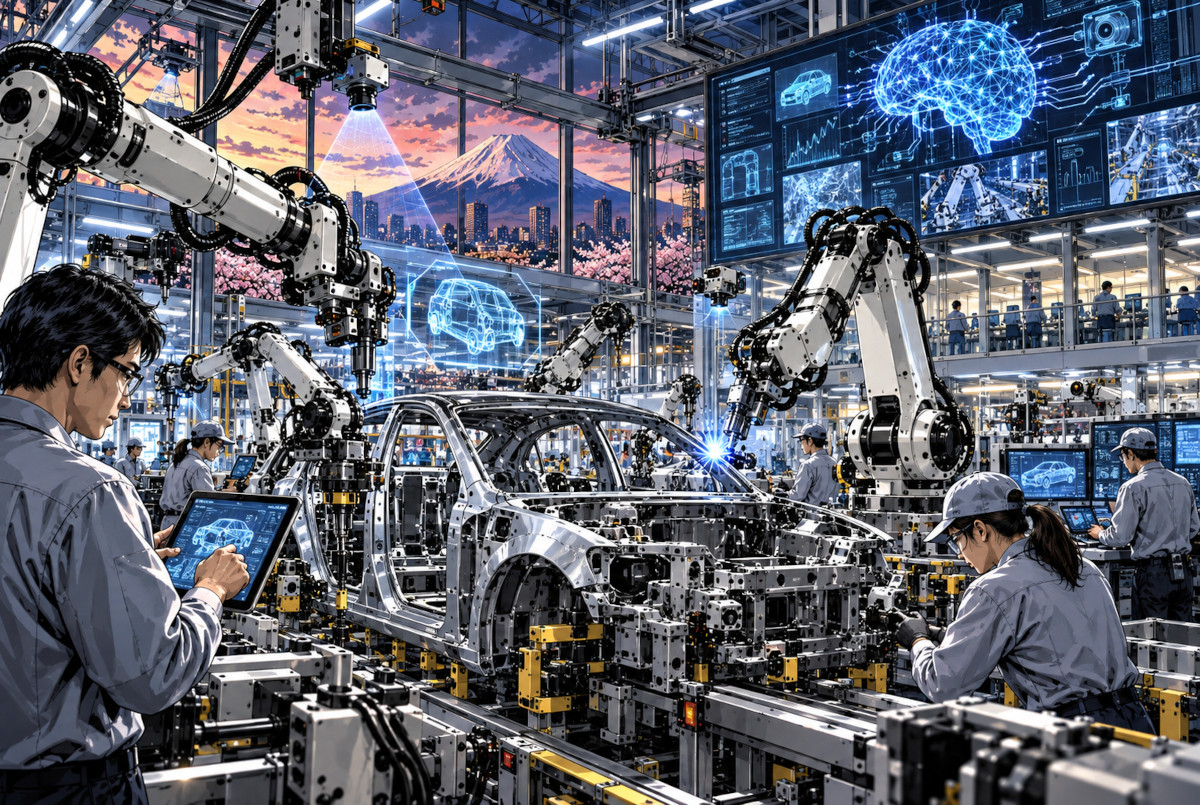 Concept image generated with AI. It does not reproduce any specific automotive factory, robot product, or company facility.
Then You Look at China—and the Comfortable Story Falls Apart
There is an appealing story Japan could tell itself: “We may have missed the first wave of generative AI, but robotics is our territory.” Unfortunately, the numbers from China make that argument much less comfortable.
China installed about 295,000 industrial robots in 2024. That single country accounted for 54% of all industrial robot installations worldwide. China’s operational stock reached roughly two million industrial robots, about 4.5 times Japan’s approximately 450,000 units. Chinese robot manufacturers also captured 57% of their own domestic market in 2024, surpassing foreign suppliers for the first time.
The important point is not simply that China buys a lot of robots. China also has an enormous manufacturing base in which those robots can operate, fail, improve, and generate data. That creates the possibility of a powerful feedback loop: more robots produce more real-world data; more data improves AI; better AI enables even more automation.
And China can run that loop across an industrial economy of extraordinary scale. So even in the field Japan considers one of its traditional strengths, the competition is already intense.
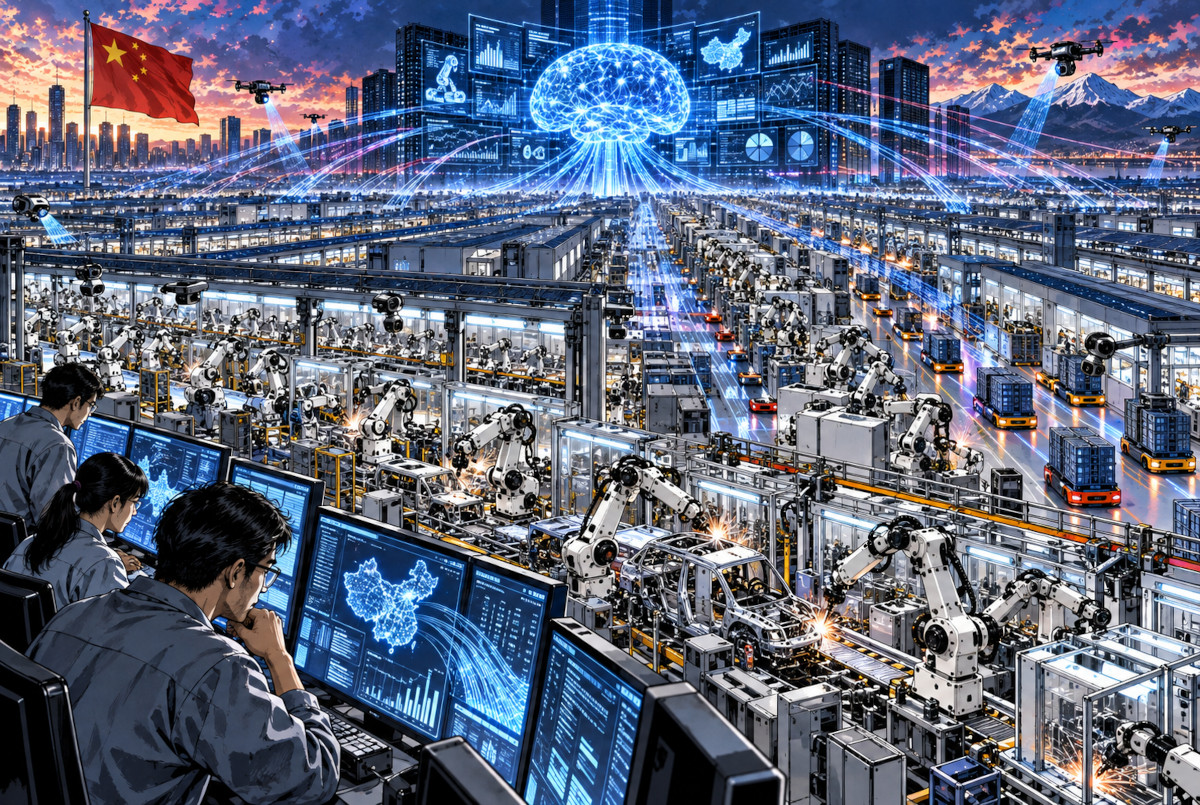 Concept image generated with AI. It symbolically represents the scale of China’s industrial robot deployment and does not depict any specific factory.
What If Japan Builds the Body—but America Supplies the Brain?
There is another development worth watching. FANUC, one of Japan’s most important industrial robot manufacturers, announced in 2026 that it was working with Google to advance robot control using AI agents. The company is also expanding its use of NVIDIA technologies for physical AI.
From a business perspective, this makes perfect sense. If Google and NVIDIA provide world-class AI, simulation, computing, and software platforms, using those technologies can help Japanese manufacturers deploy smarter robots faster.
But there is another way to look at the same arrangement.
Japan could end up building an excellent robotic “body” while relying on Google, NVIDIA, or other foreign platforms for the “brain.” In that scenario, Japan would remain an outstanding machinery manufacturer without necessarily controlling the most valuable intelligence layer above the machine.
There is an uncomfortable historical parallel. Japanese companies once held formidable positions in displays, electronic components, cameras, batteries, and other parts of the consumer electronics supply chain. But in smartphones, the dominant operating systems and software platforms ultimately became Apple’s iOS and Google’s Android.
Physical AI could produce a similar division of power. The company that manufactures the robot may not automatically be the company that controls the AI platform, training environment, data ecosystem, or developer network surrounding it.
The Japanese government appears to recognize this problem. It is supporting the development of domestic multimodal foundation models and programs that make manufacturing data “AI-Ready”—in other words, converting industrial data into forms that AI systems can actually use for development and training. FANUC has also begun discussions with Fujitsu about potential collaboration in physical AI, while continuing to make use of technologies from international partners.
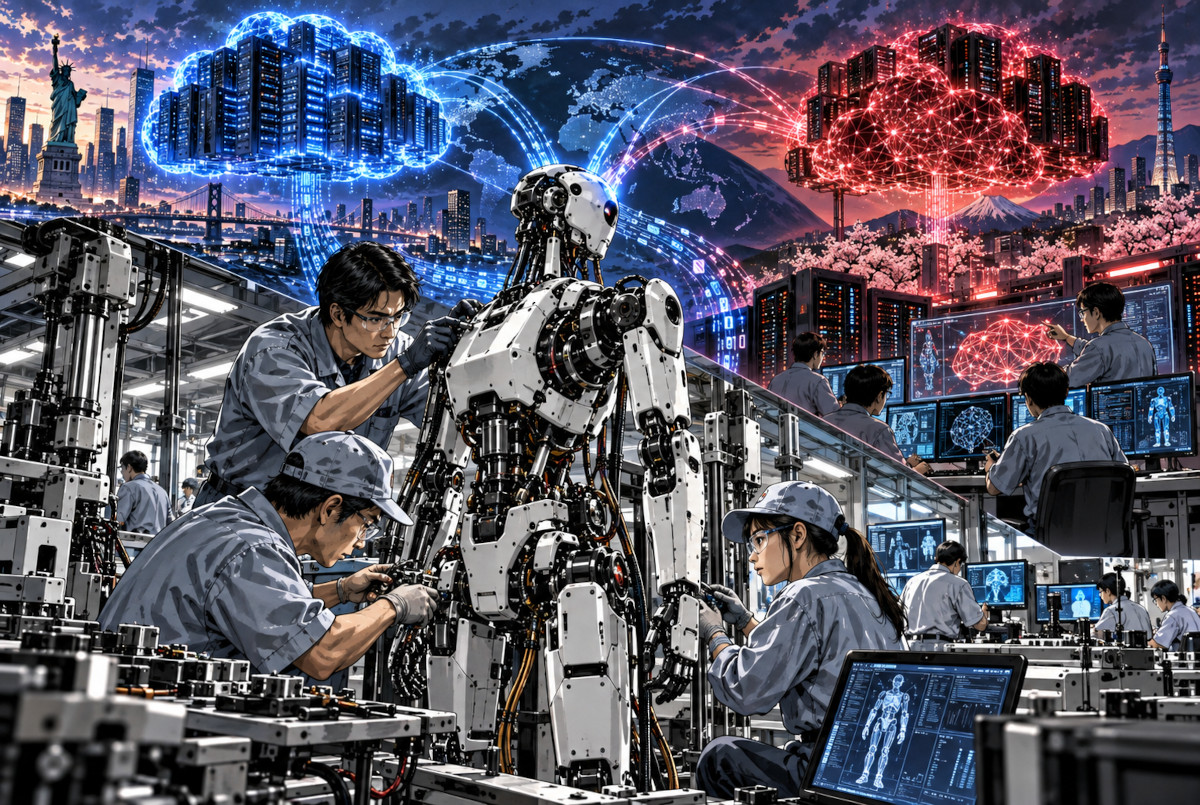 Concept image generated with AI. It is not a diagram of any real corporate system and is intended to illustrate dependence on external AI platforms as an industrial issue.
The Real Challenge Is Not Simply Building More Robots
Japan already has valuable assets: industrial robots, machine tools, sensors, precision control systems, manufacturing expertise, and decades of accumulated factory knowledge. But possessing those assets does not automatically guarantee leadership in physical AI.
The more important question is whether Japan can collect knowledge from the physical world, turn it into usable training data, improve AI with that data, and return that intelligence to factories and machines while retaining control of the overall system.
The United States is extraordinarily strong in foundation models, AI chips, cloud computing, simulation software, and developer platforms. China combines increasingly competitive AI with the world’s largest industrial robot market and an enormous manufacturing base.
Japan sits between those two powers. Assuming that decades of robotics expertise will automatically protect its position would be dangerous.
But there is also a genuine opportunity here. Competing directly to build an even larger general-purpose chatbot may not be Japan’s best game. Factories, automobiles, logistics centers, construction sites, infrastructure, and even care facilities generate forms of physical-world information that traditional internet-scale AI training does not automatically provide.
Japan’s old industrial strengths could therefore become something new: training resources for machines that need to understand and act in the real world.
Whether Japan is ultimately remembered as an AI laggard may depend less on how many robots it builds than on a more important question: whose AI gets to learn from everything those robots experience?
Editor’s Note
When I first started looking into this, my reaction was fairly simple: Japan may have lost ground in the ChatGPT-style AI race, but at least we still have robots. The deeper I went, the less comfortable that argument became. China is putting an astonishing number of robots into factories, while some of the intelligence that could make Japanese robots smarter is coming from companies such as Google and NVIDIA.
Still, I do not think that means Japan is finished. Japanese factories have spent decades running machines, breaking them, repairing them, modifying them, and figuring out why one process works while another fails. That experience is real industrial capital. The question is whether we turn it into usable AI data—or leave it buried in paper documents, isolated factory systems, and the heads of veteran engineers. If Japan gets that part wrong, we may once again become the country that builds excellent hardware while someone else owns the platform that makes it valuable.
References
- Stanford HAI — The 2026 AI Index Report: Research and Development
- Preferred Networks — Official Release of the PLaMo 3.0 Prime Japanese Generative AI Foundation Model
- NTT — Update to NTT’s LLM “tsuzumi 2”
- Ministry of Economy, Trade and Industry — Development Project for Multimodal Foundation Models for AI Robotics and Physical AI
- Ministry of Economy, Trade and Industry — GENIAC Projects for AI-Ready Manufacturing Data and Robotics Foundation Models
- International Federation of Robotics — Japan’s Car Industry Has Highest Robot Installations in Five Years
- International Federation of Robotics — World Robotics 2025
- FANUC — Collaboration with Google to Accelerate the Real-World Deployment of Physical AI
- FANUC — Further Strengthening Collaboration with NVIDIA
- FANUC and Fujitsu — Discussions on Business Collaboration for the Real-World Deployment of Physical AI