


Eight Hours to Leave Japan, Eight Years to Be Arrested: Inside Tokyo’s ¥47 Million Robbery Attempt
In November 2018, an attempted robbery targeting roughly ¥47 million in cash took place in Taito Ward, Tokyo. Nearly eight years later, the case suddenly moved again. On September 15, 2026, the Tokyo Metropolitan Police arrested two South Korean nationals who had left Japan after the incident and were later transferred to Japanese custody by South Korean authorities.
At first glance, it sounds like a simple story: an old robbery case finally produced arrests. But the details make it far more interesting. The two suspects reportedly left Japan only about eight hours after the crime, Japan’s statute-of-limitations rules did not simply run out while they were abroad, and even after these arrests, the full structure behind the crime is still not completely clear.
The Target Was Too Precise to Look Random
The incident occurred on November 12, 2018, on a street in Matsugaya, Taito Ward. People connected to a precious-metals purchasing business had just withdrawn a large amount of cash from a bank when they were attacked by a group believed to consist of five men. The attackers used an irritant spray and tried to take a bag containing the money, but the victims resisted and the robbery failed.
The first question is obvious: why were these particular people targeted at exactly that moment? This was not someone casually choosing a pedestrian who happened to look wealthy. The victims were carrying a large amount of cash immediately after leaving a bank. That makes a purely spontaneous street robbery difficult to explain. Contemporary reports indicated that police were also examining whether someone had supplied information about the victims’ movements or the cash withdrawal.
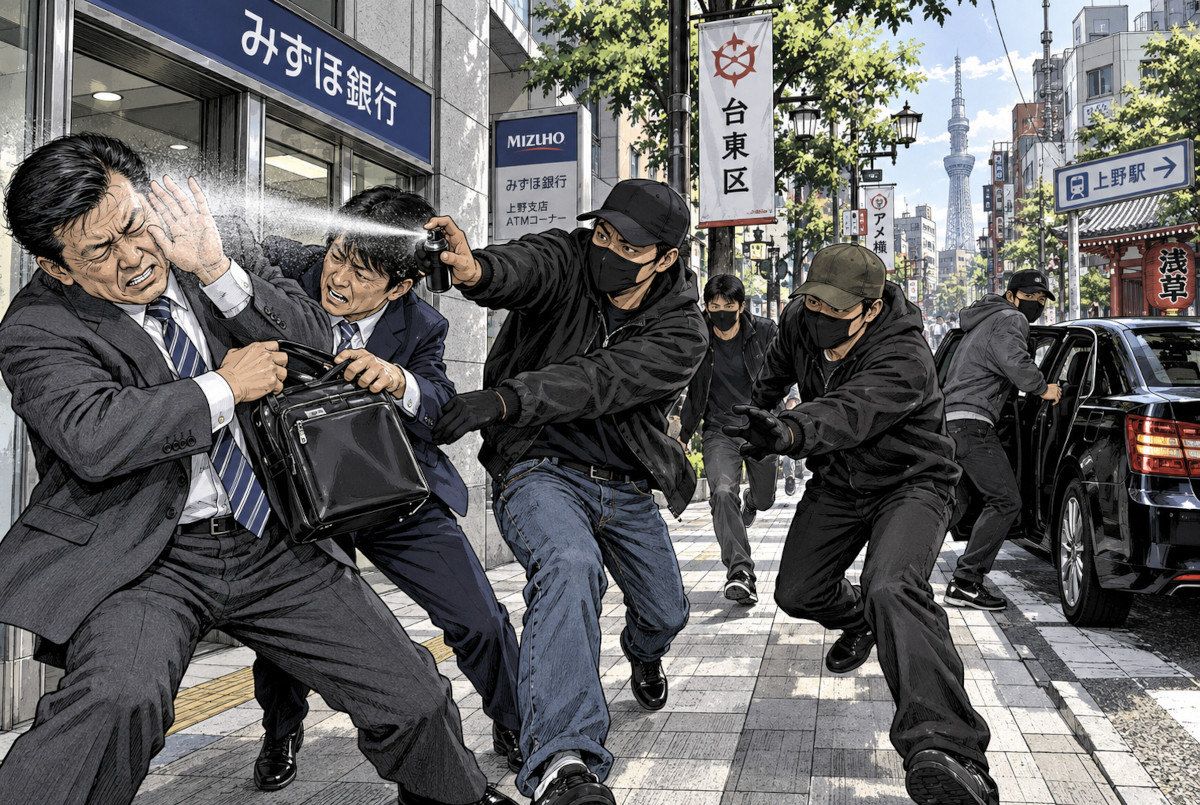 AI-generated illustration. It does not reproduce the actual crime scene, bank, business, victims, or suspects. The real incident occurred on a street near a precious-metals purchasing business.
The More Striking Number Is Not Eight Years, but Eight Hours
Two members of the suspected five-man group were arrested in Japan soon after the 2018 incident. The other three reportedly left for South Korea on the day of the crime. According to the latest reporting, the two men arrested in 2026 departed from Narita Airport for South Korea about eight hours after the attempted robbery.
That timing changes the way the case looks. The remarkable part is not only that arrests came eight years later. It is that the suspects were already outside Japan within hours of the attack. Reports at the time described police as viewing the incident as a possible “hit-and-run” style cross-border crime—commit the offense, leave the country quickly, and make the investigation far more complicated.
Another detail makes the case even stranger. Recent reporting says investigators believe the two suspects had been visiting Japan as tourists and were approached about the robbery by a foreign national they had met in a Tokyo park. If that account is accurate, it opens a much bigger question: Who was that person? Did he know about the ¥47 million cash withdrawal? Was he simply recruiting people, or was he connected to whoever planned the operation?
The arrests answer one part of the case, but they may also create a new line of investigation.
 AI-generated illustration. It does not depict the actual suspects or the interior of Narita Airport. The clock is a visual device representing the reported eight-hour interval between the crime and departure.
Why Were They Arrested Now?
Japanese investigators did not suddenly discover the suspects in 2026. Authorities had already obtained arrest warrants for the men who left Japan and had pursued them through international police channels. In other words, the identities of the wanted men were known relatively early; the difficult part was obtaining custody.
That finally changed in September 2026. According to Japanese media reports, South Korean authorities transferred the two men to Japan, where the Tokyo Metropolitan Police arrested them. Japan and South Korea have had a bilateral extradition treaty in force since 2002, providing a formal legal framework for surrendering wanted persons between the two countries.
For readers outside Japan, this distinction matters. An international police alert does not mean Japanese officers can simply travel overseas and arrest someone. The country where the wanted person is located must act under its own laws and applicable treaties. Extradition can involve identification, evidence, court procedures, government decisions and challenges by the person being sought.
We now know how the two men ultimately came into Japanese custody: they were transferred from South Korea. What remains less clear is why that process took almost eight years. Public reporting has not yet fully explained what happened during that period, when formal extradition procedures began, or what legal or investigative obstacles delayed the transfer.
Why Eight Years Abroad Did Not Automatically Mean the Case Expired
A common reaction to an old criminal case is: “Isn’t the statute of limitations almost over?” Under Japanese criminal procedure, however, the answer is not as simple as counting calendar years from the date of the offense.
Article 255 of Japan’s Code of Criminal Procedure provides that when an offender is outside Japan, the running of the limitation period for prosecution is suspended during the period abroad. In practical terms, leaving Japan does not allow the prosecution clock to continue running normally while the suspect remains overseas.
That is an important part of this case. The passage of eight calendar years did not mean eight full years had necessarily accumulated toward the prosecution deadline. The long investigation was supported not only by police persistence, but also by a legal system designed to prevent overseas flight from becoming an easy route to simply waiting out the clock.
 AI-generated illustration. It does not reproduce an actual Tokyo Metropolitan Police investigation room, case board, investigative documents, or suspect photographs.
The Arrests Move the Case Forward, but They Do Not Finish It
With the two latest arrests, four people from the suspected five-man group have now been arrested in Japan. Police are still seeking the remaining person.
But the bigger unanswered question may sit above the five alleged participants. From the beginning, investigators were interested in how the attackers knew that the victims would be carrying such a large amount of money immediately after a bank withdrawal. Now there is also the reported figure who allegedly approached the two suspects in a Tokyo park.
Those may turn out to be the same person. They may be entirely different people. At this point, the public evidence does not establish either scenario.
That is why this case is more interesting as “a door reopening after eight years” than as a neat eight-year-old mystery that has now been solved. For anyone interested in long-running investigations, the real question is not simply whether two wanted men were arrested. It is what those arrests may allow investigators to learn now that was impossible to establish in 2018.
Editor’s Note
Cases like this remind me that leaving the country does not necessarily mean a case disappears. Eight years is a long time. News stories fade, people forget names, and an incident that once made headlines turns into an old search result. Yet the investigation can still be sitting there, unfinished.
I also have to admit that I find it satisfying to see a long-running case move forward instead of simply fading away. If someone is suspected of taking part in a serious crime, crossing a border should not be treated as a magic reset button. At the same time, these arrests are not the end of the story. One suspected participant is still being sought, and we still do not know who knew about the cash, who organized the plan, or exactly how the people involved were connected. For someone who likes unresolved cases, that is the part I want to see investigators uncover next.
References
- TV Asahi News: Two South Korean nationals arrested in connection with the eight-year-old attempted robbery case
- NTV News NNN via Livedoor News: Arrests in the attempted robbery targeting approximately ¥47 million in cash
- Jiji Press via Excite News: Two South Korean suspects arrested after transfer of custody
- Taito City: Official 2018 public safety notice concerning the attempted robbery
- e-Gov Japan: Code of Criminal Procedure
- Ministry of Foreign Affairs of Japan: Treaty on Extradition between Japan and the Republic of Korea
- National Police Agency of Japan: Measures for suspects who flee overseas