
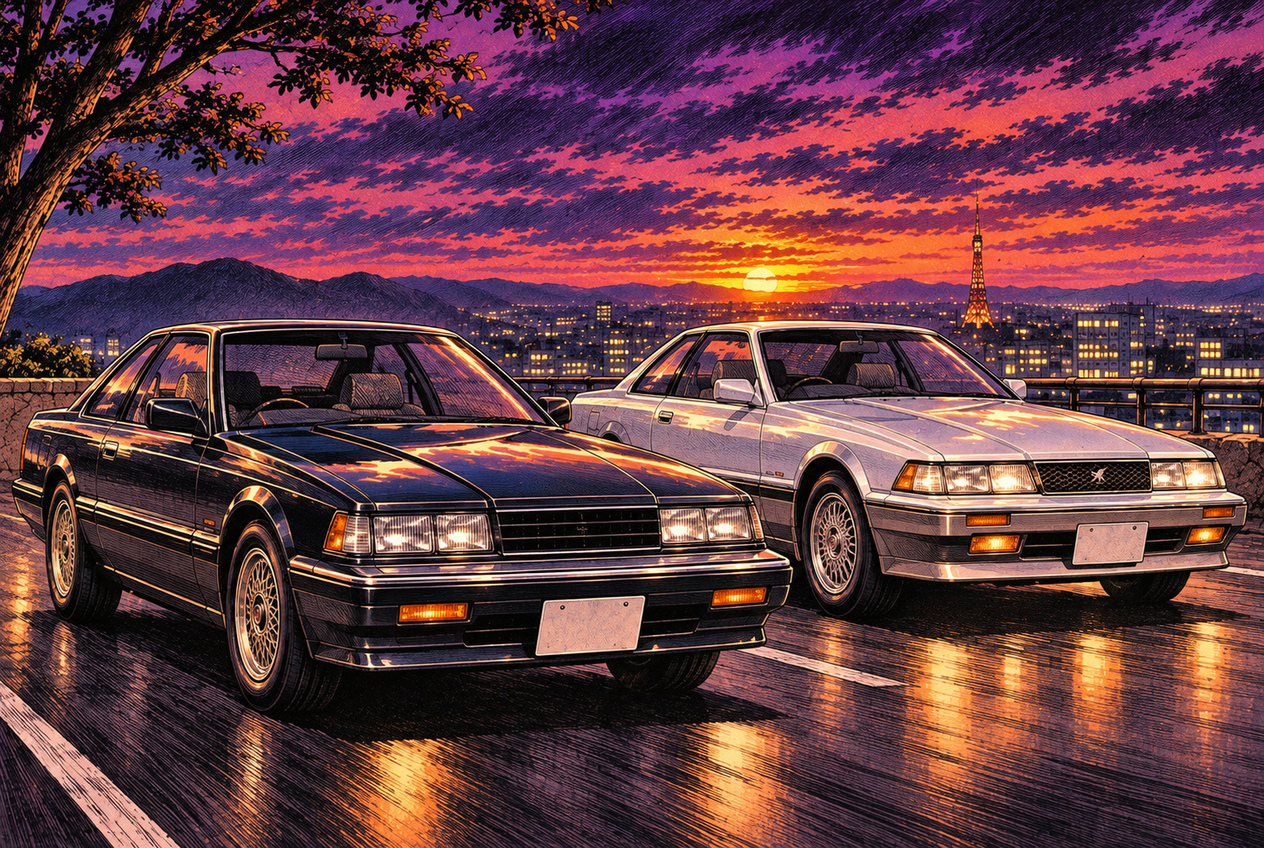
In 1986, Nissan brought out the second-generation Leopard F31, determined to take another shot at the Toyota Soarer. Its flagship Ultima came with a newly developed 3.0-liter V6 DOHC engine producing 185 PS.
Then I came across a remarkable set of acceleration figures. A retrospective article quoting a 1986 test in the Japanese magazine Best Car listed the Leopard 3.0L at 16.36 seconds over 400 meters. The Toyota Soarer 2.0GT? Just 15.37 seconds.
According to those figures, Nissan’s larger-engined car, with an extra liter of displacement and 45 more PS, was almost a full second slower over the standing quarter-mile.
Not exactly the result a Nissan enthusiast wants to see. But after checking the original vehicle specifications, something about that comparison began to bother me.
Let’s put the 1986 Leopard F31 and Soarer Z20 under the microscope: engines, prices, vehicle weights, transmissions, and the acceleration figures that still deserve a closer look.
1986: Toyota Got There 28 Days Ahead of Nissan
Toyota launched the second-generation Soarer Z20 series on January 21, 1986. Nissan followed with the second-generation Leopard F31 on February 18, just 28 days later.
The first Leopard had been available as both a two-door and four-door hardtop. Nissan dropped the four-door for the F31 and concentrated on a two-door luxury coupe, with V6 engines across the entire range. Much of its basic platform engineering was shared with the contemporary R31 Skyline.
Toyota retained the Soarer’s straight-six layout. Its range was led by a 3.0-liter turbo, supported by a 2.0-liter twin-turbo and naturally aspirated 2.0-liter models.
On the surface, these were two sophisticated Japanese grand tourers competing for much the same customer. Under their long hoods, however, Nissan and Toyota had taken rather different approaches.
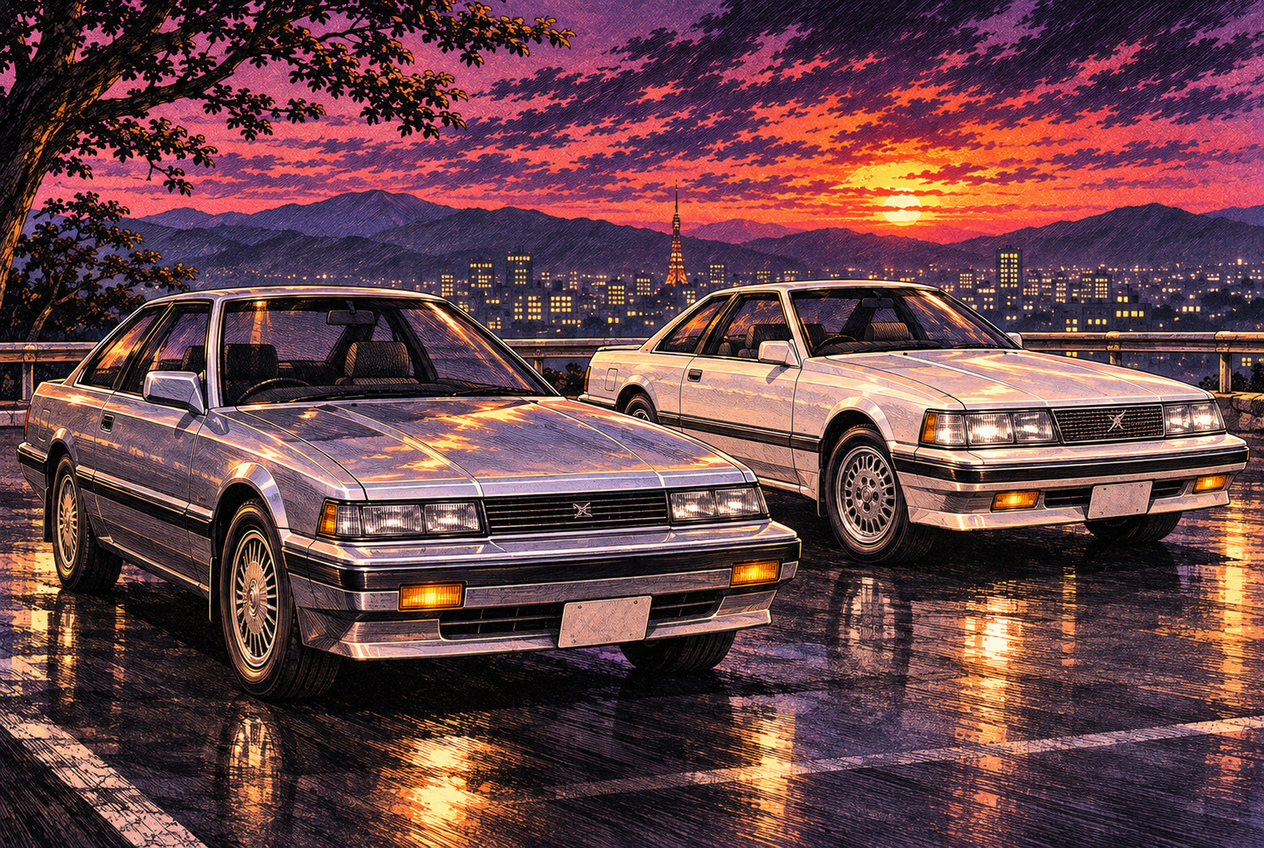
Illustration of the 1986 Nissan Leopard F31 and Toyota Soarer Z20. It conveys the general styling of the two coupes; certain headlamp, grille, emblem, wheel, and trim details differ from the original production cars.
The 3.0-Liter Showdown: Nissan Was 45 PS Short
Start with the flagship engines. Nissan’s Leopard Ultima and Toyota’s Soarer 3.0GT were both offered with four-speed automatic transmissions at launch, making them a useful starting point for comparison.
| 1986 Launch Specifications | Nissan Leopard Ultima | Toyota Soarer 3.0GT |
|---|---|---|
| Engine code | VG30DE | 7M-GTEU |
| Engine layout | 3.0L V6 DOHC, naturally aspirated | 3.0L inline-six DOHC turbo |
| Displacement | 2,960cc | 2,954cc |
| Maximum power | 185 PS | 230 PS |
| Maximum torque | 25.0 kgm | 33.0 kgm |
| Vehicle weight | 1,460 kg | 1,470 kg |
| Transmission | 4-speed automatic | 4-speed automatic |
| Weight per metric horsepower | 7.89 kg/PS | 6.39 kg/PS |
| Original Japanese list price | ¥3,837,000 | ¥3,711,000 |
Specifications from Nissan and Toyota historical materials and 1986 model listings. Engine output is expressed in PS (metric horsepower), using the period net rating. Weight per PS is independently calculated as vehicle weight divided by maximum power. Prices refer to the original Japanese-market vehicles and do not represent identical equipment levels.
The figures are not particularly kind to Nissan.
Toyota had 45 more PS and an additional 8.0 kgm of maximum torque. Yet its Soarer weighed only 10 kg more than the Leopard.
Our calculation puts the Soarer’s power per unit of vehicle weight approximately 23.5% higher than the Leopard’s. That is not a prediction of acceleration performance, but it is a substantial advantage on the specification sheet.
And then there is the price.
The 230-PS Soarer 3.0GT cost ¥126,000 less than the 185-PS Leopard Ultima.
Of course, the more lavishly equipped Soarer 3.0GT Limited cost ¥4,479,000, or ¥642,000 more than the Leopard. Equipment matters, and these were not identical luxury packages.
Still, when comparing the regular 3.0GT with the Ultima on engine output and list price, Toyota had an unmistakably strong proposition.
Nissan’s VG30DE was an ambitious naturally aspirated V6 with four camshafts and 24 valves. But Toyota’s 7M-GTEU combined its DOHC inline-six architecture with turbocharging to produce 230 PS. In this particular contest, the presence of a turbocharger mattered more than the DOHC badge alone.
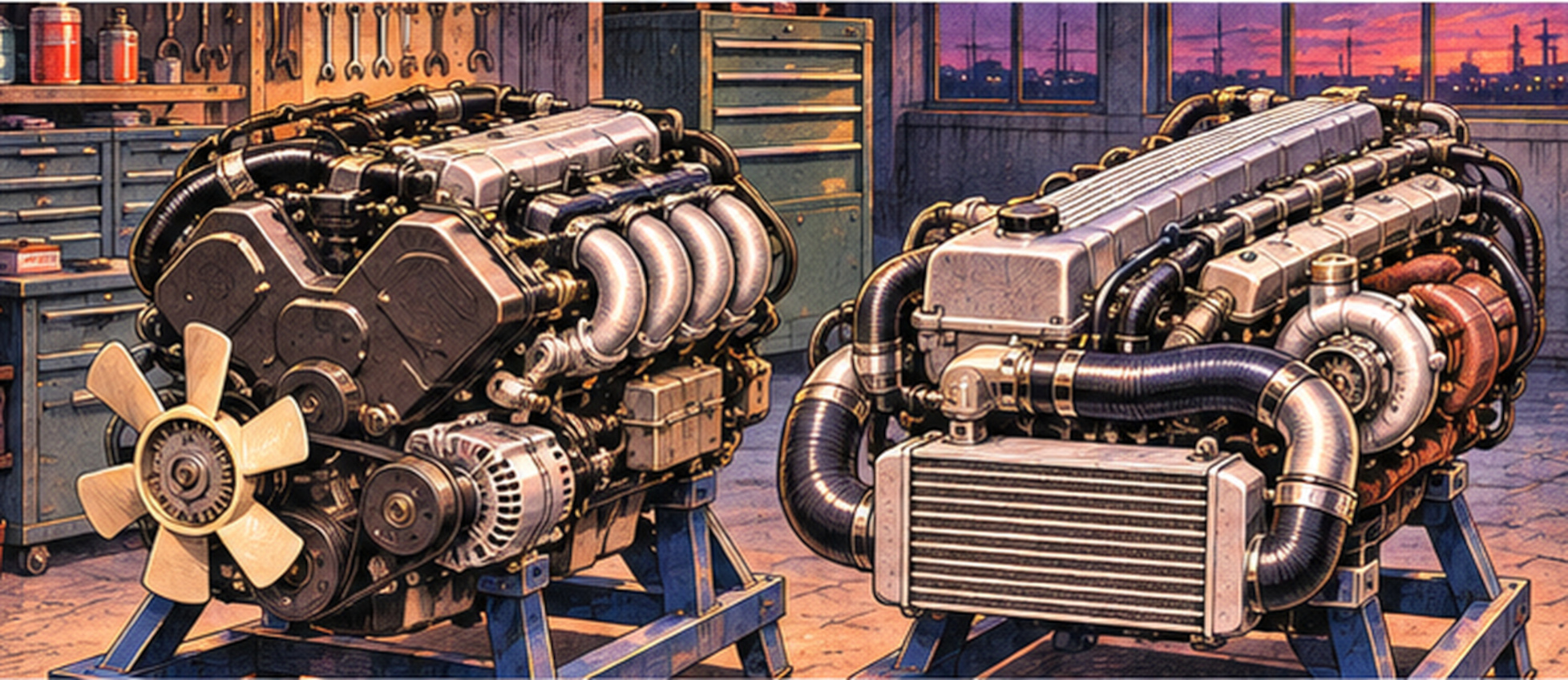
Comparison of the 1986 Leopard VG30DE (3.0L, naturally aspirated V6 DOHC, 185 PS) and Soarer 7M-GTEU (3.0L, turbocharged inline-six DOHC, 230 PS). The illustration emphasizes engine layout and forced induction. Intake runners, turbo piping, intercooler placement, and accessory details are schematic rather than exact reproductions of the production engines. Figures are period net power ratings.
The More Awkward Comparison: Toyota’s 2.0L Twin-Turbo Also Made 185 PS
The Soarer had another engine that made life uncomfortable for Nissan’s flagship Leopard.
Toyota’s 1G-GTEU was a 2.0-liter, twin-turbocharged straight-six producing 185 PS. Exactly the same headline output as Nissan’s naturally aspirated 3.0-liter V6.
Now compare four-speed automatic versions of both cars.
| 1986 4-Speed Automatic Models | Leopard 3.0L Ultima | Soarer 2.0GT Twin Turbo |
|---|---|---|
| Maximum power | 185 PS | 185 PS |
| Maximum torque | 25.0 kgm | 24.5 kgm |
| Vehicle weight | 1,460 kg | 1,420 kg |
| Weight per PS | 7.89 kg/PS | 7.68 kg/PS |
| Original Japanese list price | ¥3,837,000 | ¥3,320,000 |
Same 185 PS. Yet the Soarer was 40 kg lighter and ¥517,000 cheaper.
The independent weight-per-power calculation also favors Toyota by approximately 2.7%.
There is a qualification. The Leopard’s rated maximum torque was 0.5 kgm higher, and peak figures alone cannot establish which engine delivered stronger acceleration throughout its operating range.
Nevertheless, this is an uncomfortable comparison for Nissan. The Leopard was selling the refinement and prestige of a larger V6, while Toyota offered the same maximum power from a smaller engine at a considerably lower list price.
For a buyer more interested in the performance figures than the capacity badge, the Soarer’s 2.0GT Twin Turbo must have looked very tempting.
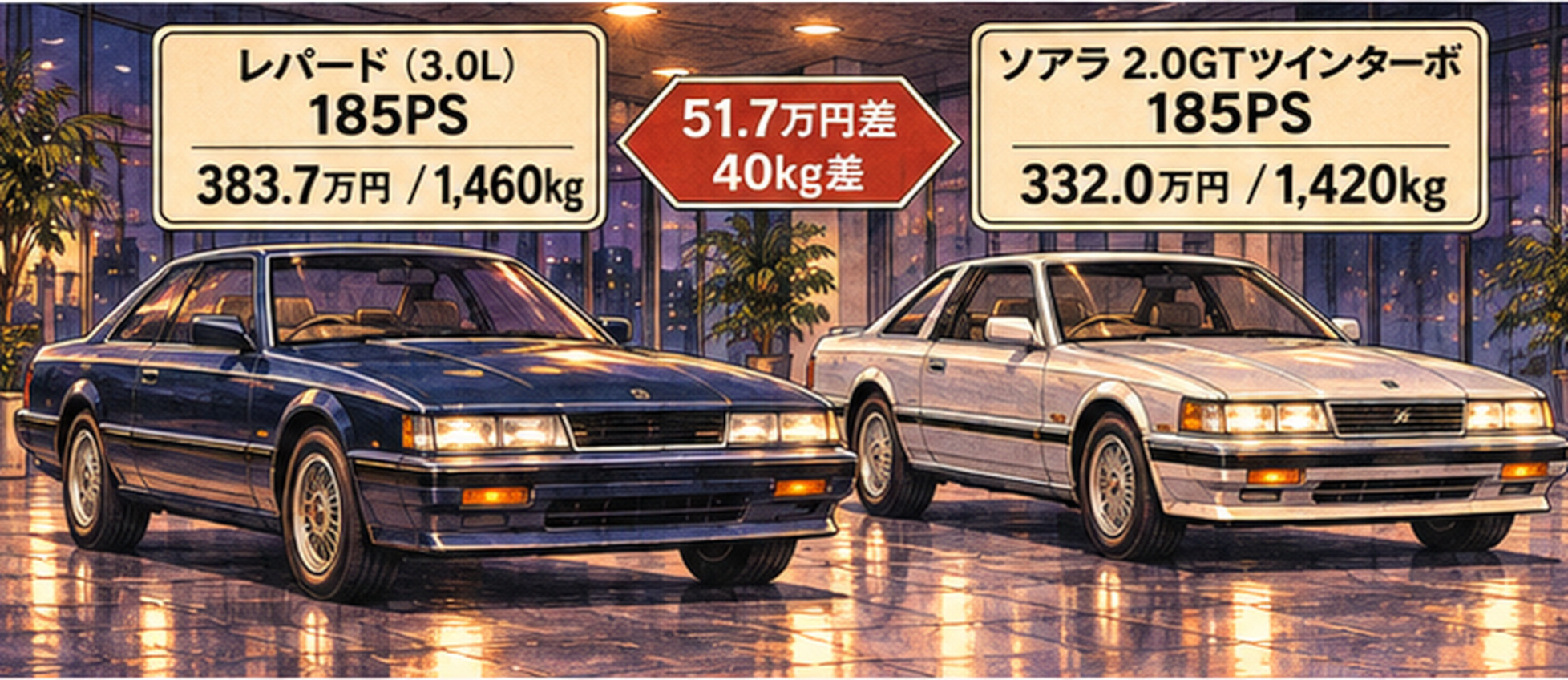
Comparison of 1986 four-speed automatic models. Leopard Ultima 3.0L: 185 PS, 1,460 kg and ¥3,837,000. Soarer 2.0GT Twin Turbo: 185 PS, 1,420 kg and ¥3,320,000. The Japanese labels show a ¥517,000 price difference and a 40 kg weight difference. Equipment specifications were not identical, and vehicle styling details are illustrative.
Did a Naturally Aspirated 2.0L Soarer Really Outrun the 3.0L Leopard?
Now for the strangest part of the story: the standing 400-meter acceleration test.
A 2025 retrospective article reproduces results attributed to a comparison published in the April 26, 1986 issue of the Japanese magazine Best Car.
| Test Vehicle | 0–100 km/h | 0–400 m | 0–1,000 m |
|---|---|---|---|
| Soarer 3.0GT Limited | 6.77 s | 14.55 s | 26.67 s |
| Soarer 2.0GT | 8.18 s | 15.37 s | 28.33 s |
| Leopard Ultima | 9.46 s | 16.36 s | 29.81 s |
| Leopard XS-II Turbo | 9.53 s | 16.89 s | 31.48 s |
These figures are reproduced in a 2025 article citing Best Car, April 26, 1986. We have not inspected the original magazine issue. The exact test-car configurations, transmissions, and measurement conditions remain unverified, so the figures should not be treated as a definitive ranking of the vehicles’ performance.
On those reproduced figures, the 3.0-liter Leopard took 0.99 seconds longer than the Soarer 2.0GT over 400 meters and 1.28 seconds longer from 0 to 100 km/h.
At first glance, it looks like an embarrassing defeat.
But something does not add up quite so neatly.
The ordinary 1986 Soarer 2.0GT used the naturally aspirated 1G-GEU inline-six, rated at just 140 PS. Its four-speed automatic version weighed 1,340 kg, giving a calculated figure of 9.57 kg/PS.
Meanwhile, the Leopard Ultima produced 185 PS and weighed 1,460 kg, equivalent to 7.89 kg/PS.
Based on the catalog figures for automatic models, the Leopard offered approximately 21% more maximum power per kilogram—yet the reproduced acceleration results show the Soarer ahead.
There is a catch: we have not confirmed that the Soarer tested in the original article was the four-speed automatic version. The 2.0GT was also available with a five-speed manual. Our 9.57 kg/PS figure is therefore a reference calculation, not a verified specification of the magazine’s test car.
Another period road test, discussed by Web Motor Magazine, recorded 15.51 seconds over 400 meters for the 185-PS Soarer 2.0GT Twin Turbo.
That makes the reported 15.37-second run by the 140-PS naturally aspirated 2.0GT particularly intriguing: in these separate reports, the lower-powered model apparently ran the quicker time.
It is entirely possible for different test cars, transmissions, road conditions, or testing methods to produce surprising results. Comparing figures from separate tests does not establish a contradiction by itself.
But neither does it justify treating the published model names and times as a final verdict without checking the original records.
What we can confirm is that a retrospective article reported this unusual result. What we cannot yet establish is precisely why it happened—or whether every test-car designation was reproduced accurately.
Was the transmission responsible? Were the conditions different? Was there a model-labeling problem in the later reproduction? The original 1986 test report is needed before drawing a firm conclusion.
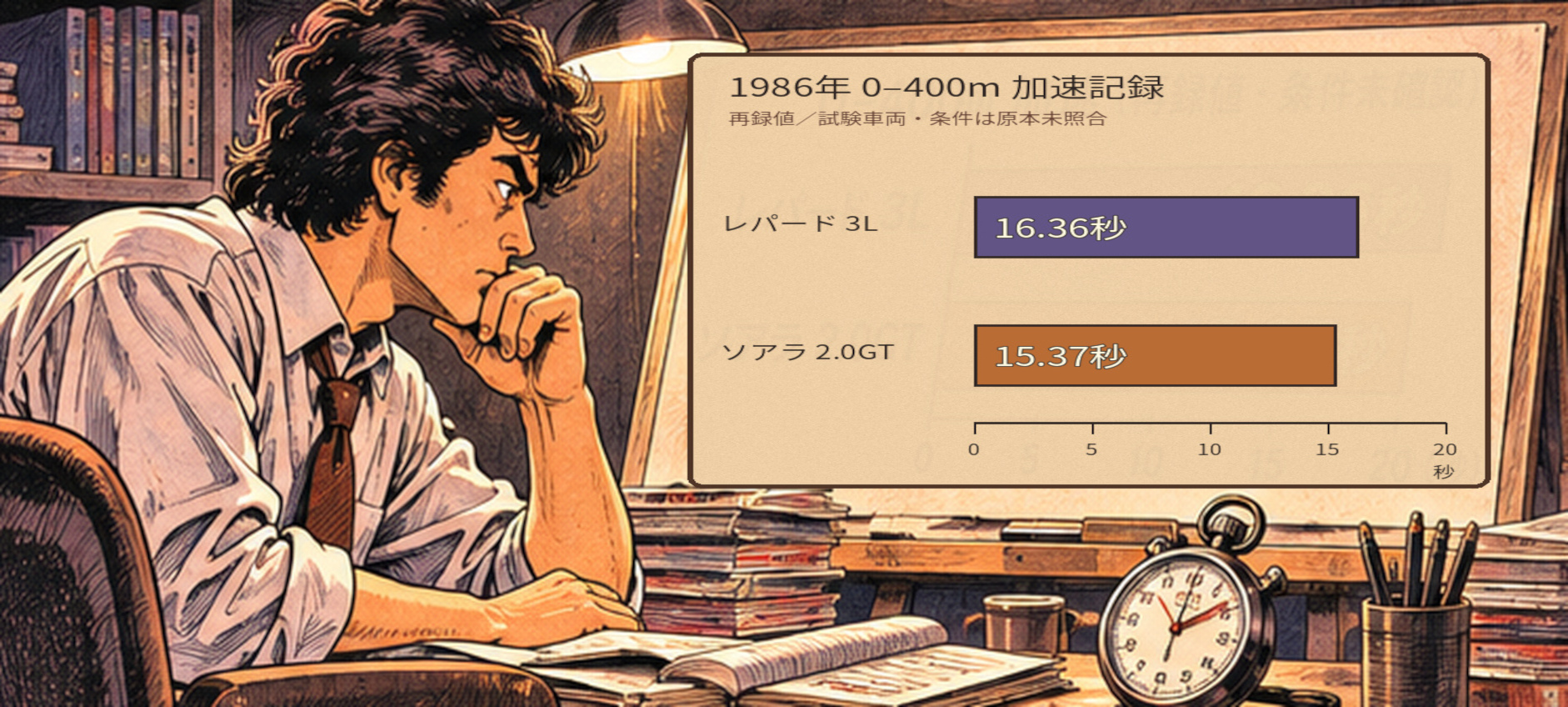
Comparison of figures reproduced from an acceleration test attributed to the April 26, 1986 issue of Best Car. The Japanese chart shows 16.36 seconds for the Leopard Ultima 3.0L and 15.37 seconds for the Soarer 2.0GT. The original magazine issue, exact test-car specifications, transmissions, and test conditions have not been verified. These figures alone do not establish a definitive performance ranking.
Horsepower Wasn’t the Whole Story: Transmissions and Suspension
Engine output is only part of acceleration performance.
Gear ratios, final-drive gearing, torque-converter behavior, shift timing, tires, road surfaces, and testing procedures can all influence the result.
The original Leopard Ultima and Soarer 3.0GT were both four-speed automatics. But Toyota also offered the 2.0GT with a five-speed manual, and without the original test-car details, comparing the engines alone is not enough.
The two cars also differed significantly underneath.
Nissan’s F31 Leopard used MacPherson struts at the front and a semi-trailing-arm independent suspension at the rear. Toyota’s Z20 Soarer used double-wishbone suspension at both ends.
The Leopard Ultima offered Nissan’s Super Sonic Suspension, which used an ultrasonic road-sensing system to help adjust shock-absorber damping.
The Soarer was available with Toyota’s electronically controlled suspension system, TEMS. Toyota also offered an electronically controlled air-suspension version of the 3.0GT Limited.
Both manufacturers were trying to combine comfort with handling precision, but through different engineering solutions.
None of this automatically proves that one car cornered better than the other. Suspension layout and electronic features tell us what the engineers chose to build; properly controlled driving tests are needed to establish the real-world differences.
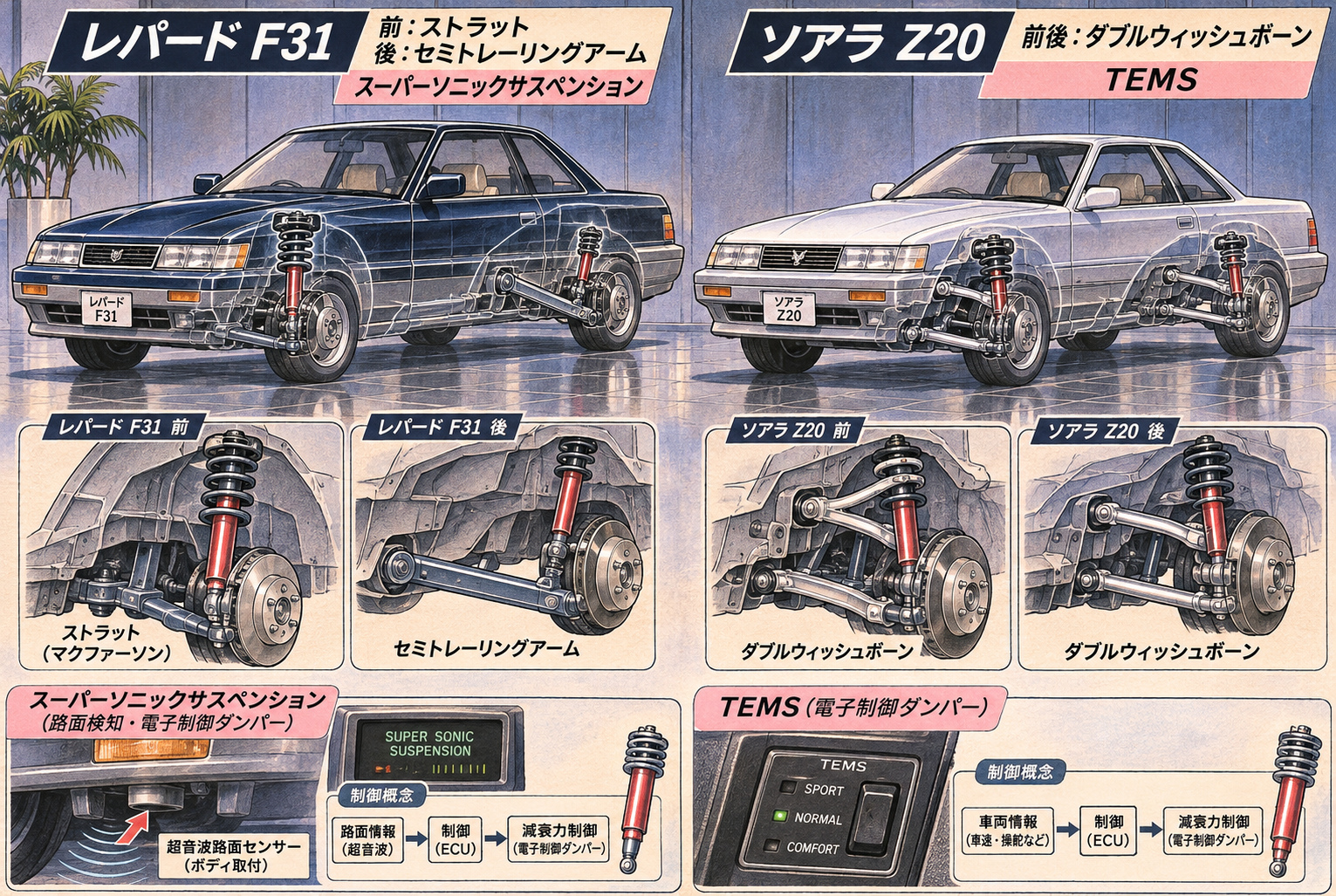
Illustrated comparison of the 1986 Leopard F31 and Soarer Z20. The Leopard used front struts and rear semi-trailing arms; the Soarer used double wishbones front and rear. The Leopard Ultima featured ultrasonic road-sensing Super Sonic Suspension, while electronically controlled TEMS was available on the Soarer. The Japanese diagrams are explanatory artwork: arm geometry, mounting points, sensors, and control panels are not exact production-component reproductions.
Was the Leopard’s Real Problem More Than Horsepower?
In 1986, Nissan could point to an advanced Japanese V6 with four camshafts and 24 valves. The Leopard was also packed with electronic features, and the Ultima was unquestionably intended to be a serious luxury GT.
Yet Toyota’s price list revealed a problem that is much harder to argue away.
The Soarer offered a 3.0-liter turbo with 45 more PS for less money than the Leopard Ultima. It also offered a cheaper 2.0-liter twin-turbo producing the same 185 PS.
The period acceleration figures, at least as reproduced in later articles, made the Soarer look formidable. The specific claim about the naturally aspirated 2.0GT remains open to further verification.
The clearest confirmed disadvantage for Nissan was not the disputed one-second acceleration gap. It was the combination of engine output, vehicle weight, and list price already visible in the 1986 specifications.
That does not prove why customers preferred one car over the other. Styling, ride quality, dealer experience, equipment, and brand perception all matter.
But anyone comparing the cars primarily through horsepower, weight, and price would have found several compelling reasons to look toward Toyota.
Nissan would eventually respond. In 1988, the Leopard gained the 255-PS VG30DET turbocharged V6.
That counterattack deserves its own article.
Editor’s Note
For someone who has always had a soft spot for Nissan, these numbers are painful.
A V6 with four camshafts and 24 valves sounded like serious machinery in 1986. Yet Toyota had a 230-PS turbocharged six, plus a 185-PS twin-turbo two-liter. And somehow Toyota managed to make the price tags look better, too.
But the detail that really got under my skin was that quarter-mile story.
My first reaction was, “Come on, Nissan. What were you doing?” Then I checked the factory specifications and started wondering about the test cars instead.
Old magazine performance tests are great fun. I love them. But extracting a model name and a stopwatch reading, then repeating the result for forty years without checking whether the cars were manual or automatic—or even exactly which versions were tested—seems a bit reckless.
There is one number, though, that does not need a stopwatch: Toyota’s 230-PS Soarer 3.0GT was ¥126,000 cheaper than Nissan’s 185-PS Leopard Ultima.
Maybe Nissan’s engineers hadn’t lost their touch at all. Maybe Toyota was simply better at putting the right engine behind the right price tag.
That’s the sort of thing you find when you stop admiring the brochure photographs and start reading the small print.
Nissan Leopard: Five-Part Series
The Nissan Leopard arrived before the Toyota Soarer, yet struggled to match its rival in the Japanese market. Across five articles, we examine sales figures, engine performance, pricing, technology, the influence of Abunai Deka, and the Leopard's changing identity through 2000.
- Part 1: How Did the Nissan Leopard Outsell the Soarer in One Class—Yet Lose Overall?
- Part 2: Did a 2.0L Toyota Soarer Really Beat Nissan’s 3.0L Leopard?
- Part 3: English edition Coming soon
- Part 4: English edition Coming soon
- Final Part: English edition Coming soon
Terms That May Need a Quick Explanation
- Standing 400-Meter Run (Zero-Yon)
- A standing-start acceleration test measuring the time needed to travel 400 meters from rest. Japanese enthusiasts commonly call it “zero-yon.” It is close to, but not exactly the same distance as, a quarter-mile drag run (402.3 meters). A lower time generally indicates stronger acceleration under the stated test conditions.
- Weight per Metric Horsepower (kg/PS)
- A simple way to compare vehicle weight and maximum engine output. Divide vehicle weight in kilograms by power in PS, or metric horsepower. A lower number means less vehicle mass per unit of rated power, but it does not directly predict acceleration times.
- Torque in kgm
- A historical unit of torque commonly used in Japanese automotive specifications. The original figures are retained here so the 1986 manufacturer ratings can be compared without changing the units or their published precision.
References
- Nissan Motor: Full Model Change of the Nissan Leopard (February 1986) (Japanese) — Original manufacturer announcement covering the second-generation F31 Leopard.
- Nissan Heritage Collection: Leopard XS-II (Japanese) — Official account of the F31 platform, V6 engine range, suspension layout, and Super Sonic Suspension technology.
- Toyota’s 75-Year History: Second-Generation Soarer (Japanese) — Official launch date, engine lineup, performance specifications, double-wishbone suspension, TEMS, and air-suspension options.
- Miki Press, Illustrated Encyclopedia of Japanese Passenger Cars, 1986–1991 (Japanese PDF) — Period-based specifications for the Leopard Ultima, including the VG30DE engine, 1,460 kg vehicle weight, four-speed automatic transmission, and ¥3,837,000 original price.
- carview!: Toyota Soarer, January 1986 Model — Grade-by-Grade Specifications (Japanese) — Original prices, vehicle weights, engine outputs, torque figures, and manual/automatic configurations for the 3.0GT, 2.0GT, and 2.0GT Twin Turbo.
- carview!: Nissan Leopard, February 1986 Model — Grade-by-Grade Specifications (Japanese) — Period specifications for the Ultima, XS-II, and other original F31 grades.
- Otona no Shumatsu Web: Retrospective Comparison of the Second-Generation Leopard and Soarer (2025) (Japanese) — Reproduces acceleration figures attributed to the April 26, 1986 issue of Best Car. The original magazine issue and detailed test conditions have not been independently inspected.
- Web Motor Magazine: Showa Classic Cars No. 93 — Toyota Soarer 3.0GT Limited (1986) (Japanese) — Period engine specifications and acceleration results from a separate road test, including the 2.0GT Twin Turbo.