

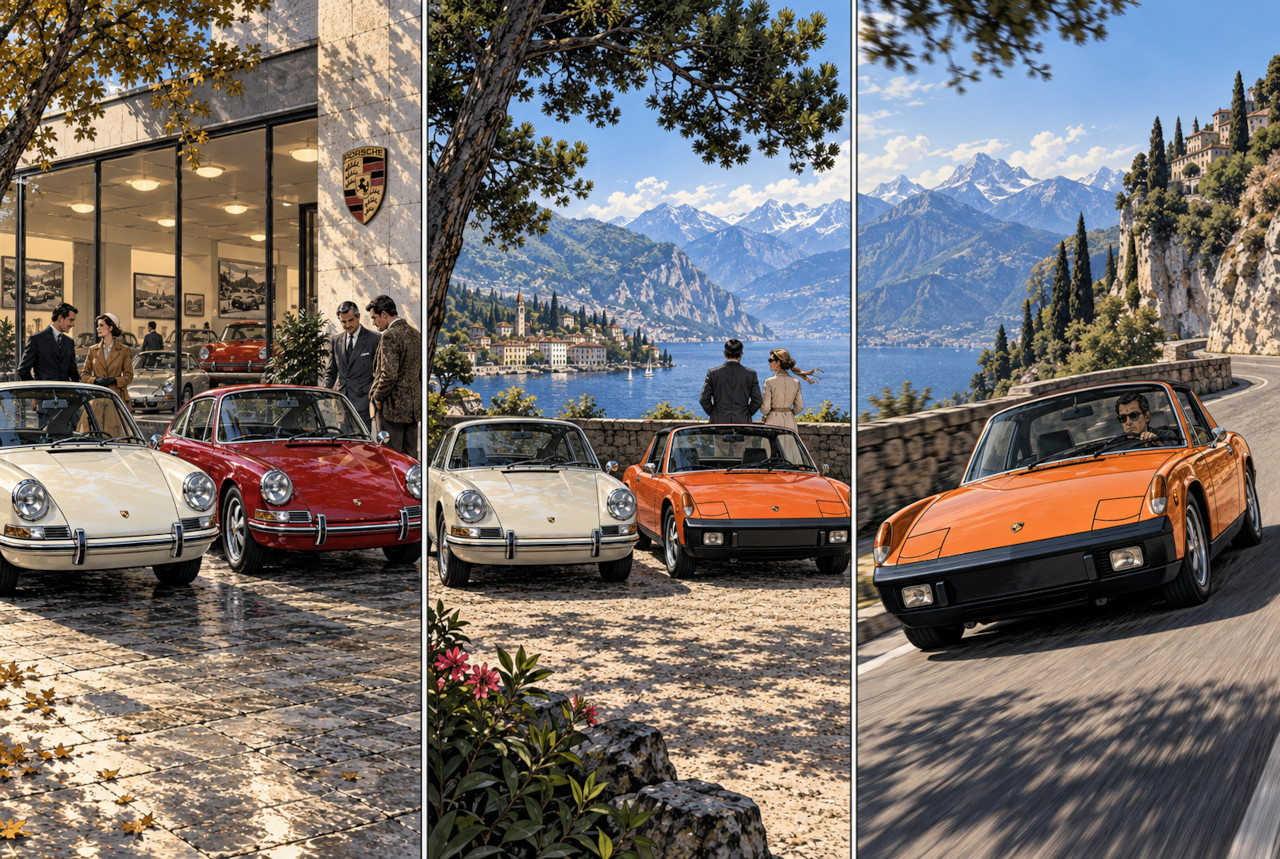
For many enthusiasts, Porsche means one thing: the 911. Seen through that lens, the 912 and 914 can feel strangely out of place. The 912 looked almost exactly like a 911 but used a four-cylinder engine. The 914 went even further: it adopted a mid-engine layout, and the four-cylinder versions used Volkswagen-derived engines. Both cars sat just outside what later became the familiar 911-centered image of Porsche.
Yet once their history is examined more closely, neither model fits comfortably into the simple category of “cheap Porsche.” Instead, they reveal another important strand of Porsche history—one that existed alongside the 911 rather than beneath it. Four cylinders, links to Volkswagen, and recurring arguments over whether these cars were “real” Porsches all became part of their identity. Despite that, both models sold in meaningful numbers and helped broaden Porsche’s customer base.
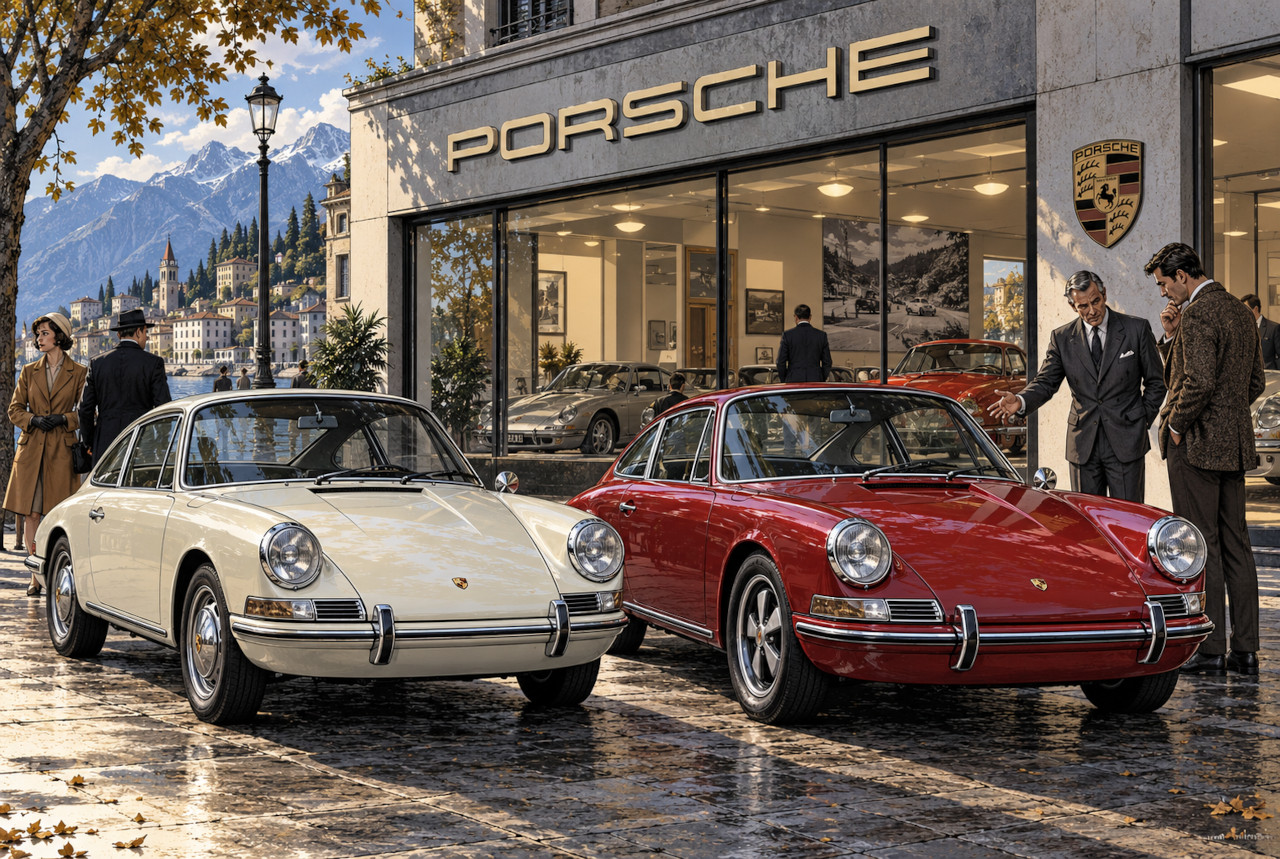 This is an AI-generated illustration intended to represent the historical atmosphere surrounding the Porsche 912.
The Other Gateway Into Porsche
The 911 entered production in 1964 and would eventually become the model that defined Porsche in the public imagination. But the early 911 was not an inexpensive car, even by Porsche standards. In 1965, Porsche introduced the 912 as a more accessible alternative. Its body was essentially that of the 911, but behind the rear axle sat a 1.6-liter air-cooled flat-four derived from the Porsche 356 rather than the 911’s six-cylinder engine.
The idea was straightforward: Porsche needed something that could bridge the gap between the outgoing 356 and the more expensive new 911. What makes the story interesting is that the 912 did not behave like a token budget model in the marketplace. In its early years, it actually outsold the 911. For many buyers at the time, the four-cylinder 912 was not a disappointing substitute for a 911—it was simply the Porsche that made more financial and practical sense.
The engine itself also deserves more respect than the phrase “entry-level four-cylinder” might suggest. It belonged to the same basic lineage as the unit used in the 356. Historically speaking, four-cylinder engines were not alien to Porsche at all. In fact, if Porsche history is viewed from the company’s early years rather than backward from the modern 911 era, the 912 looks considerably less unusual.
The 914 Changed the Formula Much More Radically
The 914 took the idea of an affordable Porsche in a much more disruptive direction. It was no longer a four-cylinder version of a 911-shaped car. The body was unique, the engine moved ahead of the rear axle into a mid-engine position, and early 914/4 models used a 1.7-liter flat-four derived from the Volkswagen 411 E.
The project made sense for both companies. Porsche wanted a sports car positioned below the 911, while Volkswagen needed a replacement for its aging sporty models. Their interests overlapped, leading to a joint project that eventually became the 914.
That shared parentage immediately complicated the car’s identity. In Europe it was actually marketed as the VW-Porsche 914, making its Volkswagen connection impossible to ignore. In the United States, however, it was sold simply as the Porsche 914. The same car therefore arrived in different markets with a slightly different brand identity—an unusual situation that helped fuel the debate over whether the 914 was a “real” Porsche.
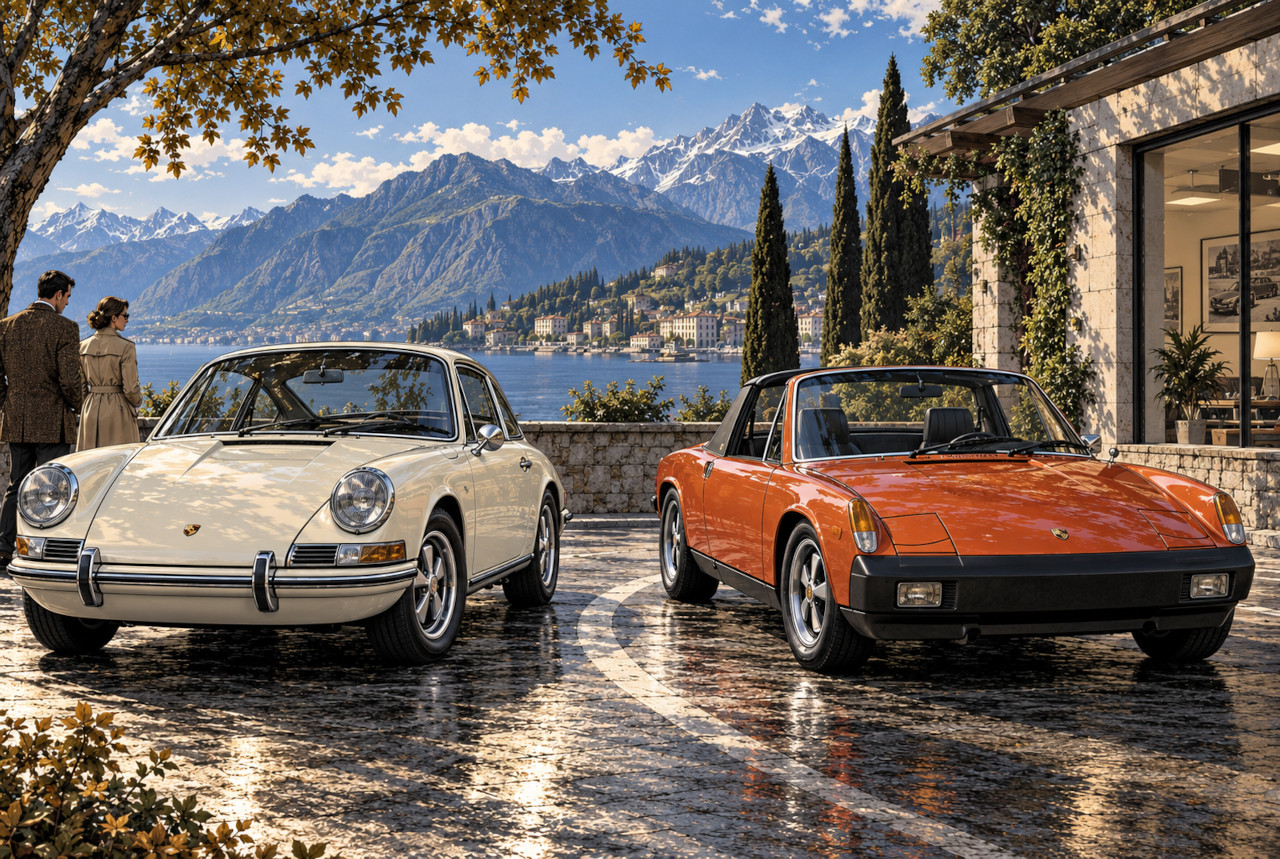 This AI-generated illustration represents the historical and design transition from the Porsche 912 to the Porsche 914.
Was the “Volkswagen-Engined Porsche” Really a Failure?
It is easy to reduce the 914 to a dismissive description: “the cheap Porsche with a Volkswagen engine.” That description contains part of the truth, but misses much of what made the car interesting. The 914/4 did use Volkswagen-derived engines, yet the chassis itself was hardly conservative. Its low body, long wheelbase and mid-engine layout placed the major masses close to the center of the car, giving it the kind of balance and agility that enthusiasts still associate with serious sports cars.
The sales figures make the story even more ironic. The four-cylinder 914/4 sold in far greater numbers than the more traditionally “Porsche-like” 914/6, which used a six-cylinder engine related to the 911 T. One major reason was price: once the six-cylinder version became expensive enough to approach a 911, buyers naturally began asking why they should not simply buy the 911 instead.
The closer Porsche tried to make the 914 resemble a conventional “proper Porsche,” the harder it became to justify its place in the lineup. That contradiction may be one of the most revealing things about the car.
And the 914 was hardly treated as disposable by Porsche engineers. Competition versions such as the 914/6 GT achieved notable racing results, while experimental cars went even further. Porsche built prototype 914/8 models using flat-eight engines derived from the 908 racing program. In other words, the same platform that some enthusiasts dismissed as a compromised entry model was considered interesting enough for Porsche to install genuine racing-derived hardware into it.
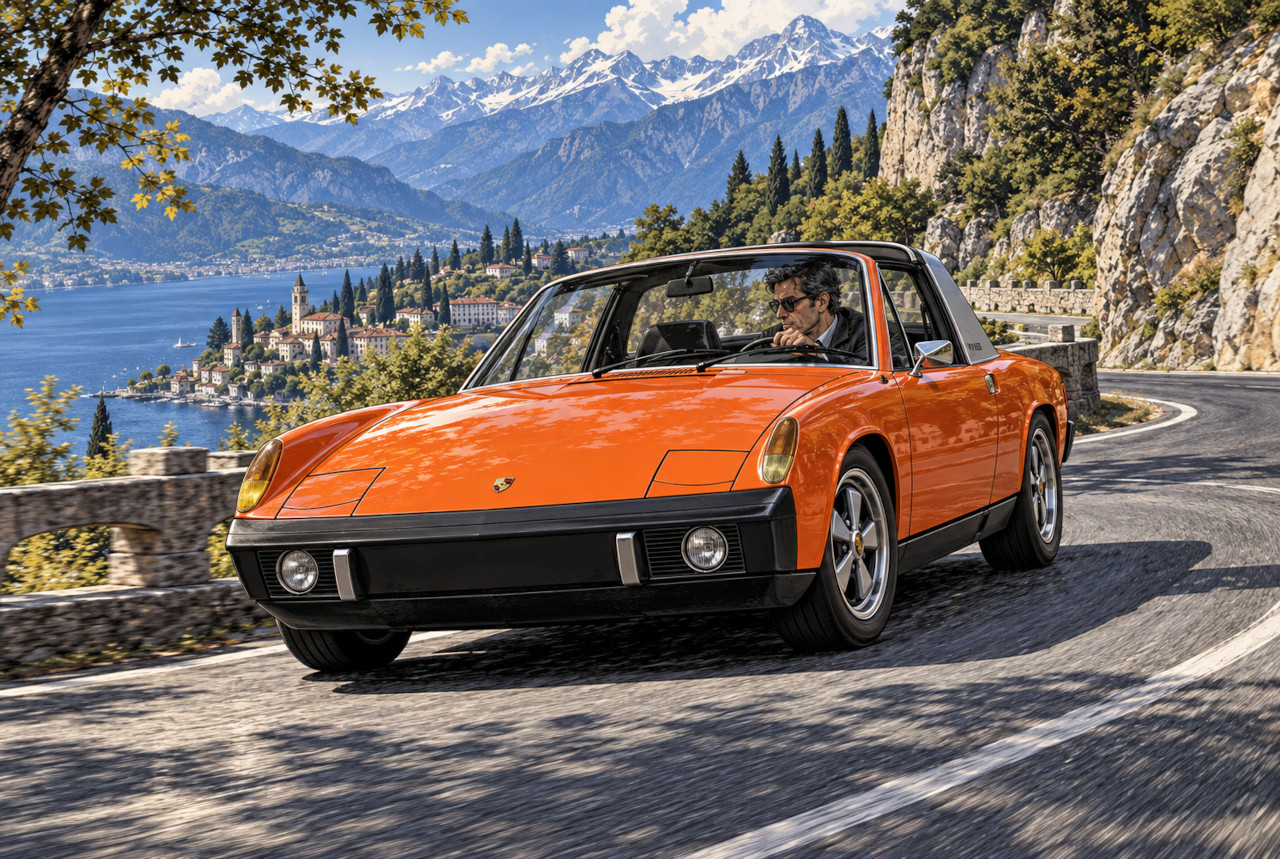 This is an AI-generated illustration depicting the driving character of the Porsche 914.
What the 911 Alone Cannot Tell Us About Porsche
Viewed together, the 912 and 914 form a surprisingly clear progression. The 912 was essentially Porsche’s attempt to make the new 911 generation more accessible, while still carrying forward the four-cylinder tradition of the 356. The 914 moved much further away from the 911 formula, combining Volkswagen involvement with a purpose-built mid-engine chassis.
From one perspective, these cars appear to move progressively farther away from the 911. From another, they show a Porsche that was actively searching for ways to survive, grow and attract new buyers without relying entirely on a single model.
That is why asking whether the 912 or 914 was a “fake Porsche” ultimately becomes less interesting than asking what a “real Porsche” is supposed to be. Does it require six cylinders? A rear-engine layout? A body that resembles a 911? Once those rules are examined historically, they start to look much less absolute.
The more closely these supposed entry-level Porsches are examined, the more they reveal about Porsche itself. The 912 and 914 were not merely side notes to the 911 story. They were evidence of a company still experimenting with what a Porsche could be.
And the next chapter becomes even stranger. The 924 would continue Porsche’s search for a more accessible sports car—but this time, the project had not even begun as a Porsche in the conventional sense.
Editor’s Note
If you look only at the 911, Porsche can seem like a company that always knew exactly what it wanted to be: expensive, focused and technically consistent. The 912 and 914 make that history look much messier—and, to me, much more interesting.
Porsche needed cheaper cars to reach more customers. But the moment it built them, people started asking whether they were “real” Porsches. That contradiction says a lot about enthusiast culture as well as the company itself. The 914 in particular was criticized for its Volkswagen engine and shared origins, yet decades later it remains an unmistakable part of Porsche history.
I tend to like cars like these. The models that sit slightly outside the official mythology often tell you more about what a manufacturer was actually worried about, experimenting with, and trying to achieve than the unquestioned flagship ever does.
References
- Porsche Newsroom — Historical Background of Porsche Cars North America
Background on Porsche’s early U.S. history, the 356, 911 and 912, including the role of the 912 as a more accessible model. - Porsche Classic — 911 F Model / 912
Official Porsche Classic information on the 912, including its relationship to the 911 and its four-cylinder engine. - Porsche Newsroom — 50 Years of the 914
Porsche’s historical overview of the 914, including its development with Volkswagen, production figures, competition history and experimental versions. - Volkswagen Newsroom — VW-Porsche 914 (1969–1975)
Volkswagen’s official history of the VW-Porsche 914, including engine origins, model development and the relationship between the four- and six-cylinder versions. - Porsche Newsroom — From the 914 to the 718: Porsche Mid-Engine Sports Cars
Official Porsche material discussing the 914’s mid-engine layout, driving characteristics and its place in the company’s sports-car lineage. - Porsche Newsroom — The Porsche 912 E
Background on the later 912 E and the continuing role of four-cylinder entry-level Porsche models in the company’s lineup.