

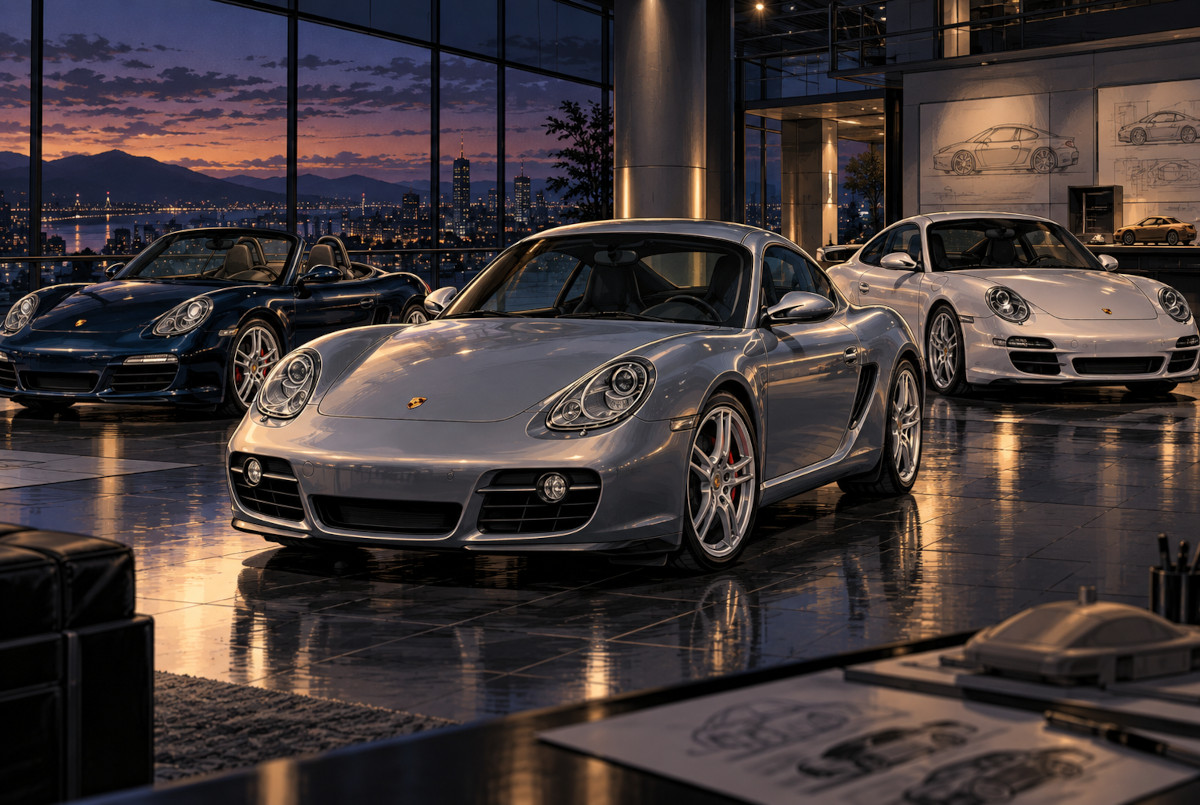
If you look at Porsche as a brand hierarchy, the 911 sits at the center and the Cayman belongs somewhere below it. At least, that is the easy way to see it. When the first Cayman S arrived in 2005, it was positioned between the Boxster S and the 911. Twenty years later, however, the Cayman had gone far enough to receive the same high-revving engine used in the 911 GT3.
Along the way, it also abandoned its naturally aspirated flat-six for a turbocharged flat-four and even changed its name to “718.” Why did the Cayman return to four cylinders, move back toward six, and eventually end up with the heart of a 911 GT3? For the final chapter of this six-part series, that strange 20-year journey is the part worth following.
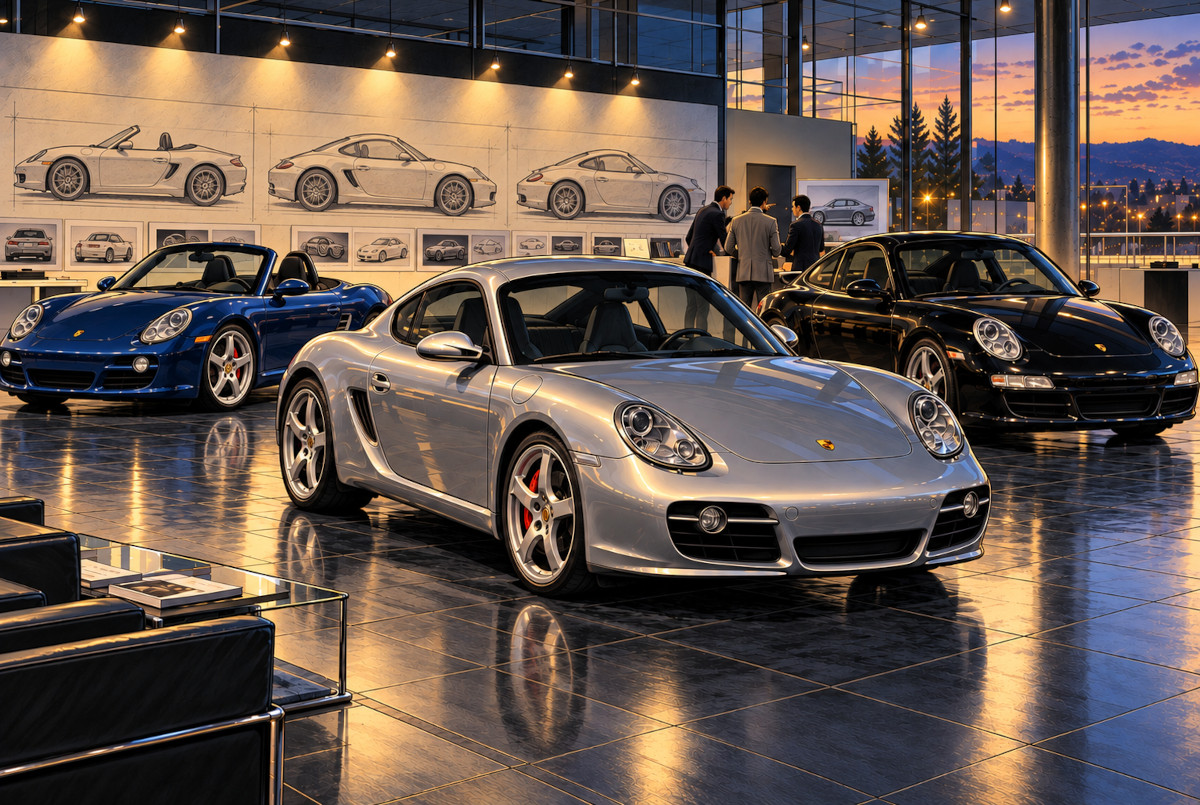 AI-generated comparison image. It does not recreate an actual Porsche showroom, development facility, or specific historical scene.
It Was Never Just a Boxster With a Roof
The first Cayman S went on sale in November 2005. Its 3.4-liter naturally aspirated flat-six produced 295 PS, with 0–100 km/h in 5.4 seconds and a top speed of 275 km/h. The contemporary 987 Boxster S used a 3.2-liter flat-six producing 280 PS, so the Cayman was not simply a closed-roof version of the same car. It arrived with an extra 15 PS from the beginning.
Porsche did not call it the “Boxster Coupé,” either. It gave the car its own name. In the model hierarchy it still sat below the 911, but Porsche clearly did not intend its character to feel like a cut-price substitute. The Cayman was already becoming difficult to classify neatly.
In 2015, the GT4 Started Trespassing on 911 Territory
The line became much blurrier with the Cayman GT4 in 2015. Its 3.8-liter naturally aspirated flat-six produced 385 PS. The engine came from the 911 Carrera S, while the chassis incorporated components drawn almost entirely from the 911 GT3. It was also the first Cayman GT model developed with Porsche Motorsport involvement.
This is an important distinction because it is often muddled: the first Cayman GT4 did not use the GT3 engine. Its engine came from the Carrera S family. Even so, bringing GT3-derived chassis hardware and braking philosophy to a Cayman mattered. The supposedly junior Porsche was beginning to borrow increasingly serious equipment from the car above it.
Then, One Year Later, the Six-Cylinder Cayman Became the “718”
In 2016 the story swung in the opposite direction. The Cayman became the 718 Cayman. The base model received a 2.0-liter turbocharged flat-four producing 300 PS, while the S used a 2.5-liter flat-four producing 350 PS.
A premium Porsche sports car with four cylinders naturally invited a certain amount of suspicion. Porsche’s answer was the name 718. It came from the small mid-engine racing Porsches of the 1950s and 1960s, cars closely associated with four-cylinder engines. Porsche was therefore presenting the return to four cylinders not simply as cost cutting, but as a connection to its own racing history.
The question raised in Part 1 — “Can a four-cylinder Porsche really be a proper Porsche?” — had returned nearly half a century later, this time through Porsche’s own branding.
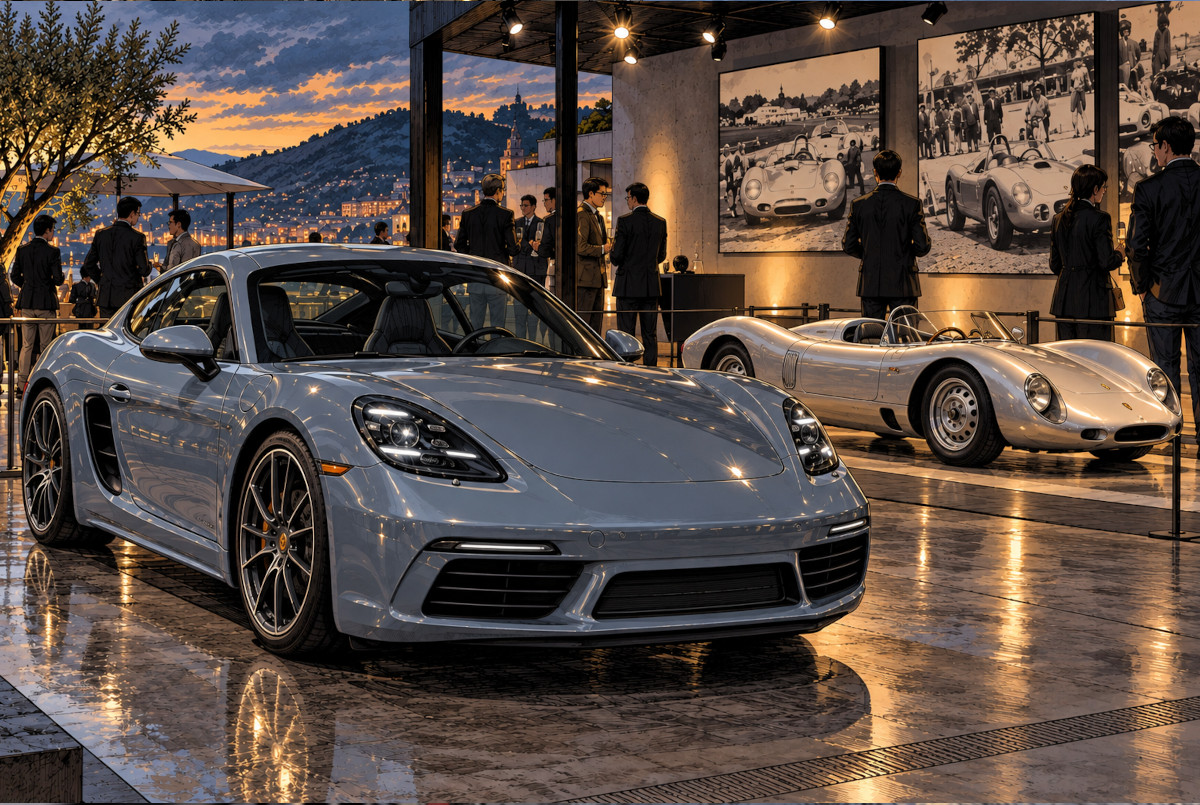 AI-generated historical comparison. The vintage racing car represents the Porsche 718 lineage and does not reproduce one specific surviving car, race photograph, or exhibition.
The Four-Cylinder Stayed — and Then the Six-Cylinder Came Back
It is tempting to say Porsche simply reversed course because enthusiasts rejected the four-cylinder 718. That is too simple. The regular four-cylinder models remained in the range. Above them, Porsche added increasingly serious six-cylinder versions: the 718 Cayman GT4 arrived in 2019 with a 4.0-liter naturally aspirated flat-six producing 420 PS, followed by the 718 Cayman GTS 4.0 with 400 PS in 2020.
| Model | Engine | Output |
|---|---|---|
| 2005 Cayman S | 3.4L naturally aspirated flat-six | 295 PS |
| 2016 718 Cayman | 2.0L turbocharged flat-four | 300 PS |
| 2019 718 Cayman GT4 | 4.0L naturally aspirated flat-six | 420 PS |
| 2021 718 Cayman GT4 RS | 4.0L naturally aspirated flat-six | 500 PS |
Porsche did not remove the four-cylinder cars and admit defeat. It kept the four-cylinder 718s and layered more focused six-cylinder models above them. By then, the idea of one simple Cayman hierarchy had become complicated even inside the 718 range itself.
Then the GT4 RS Really Did Get the 911 GT3’s Heart
The decisive step came with the 718 Cayman GT4 RS, announced in 2021. Its 4.0-liter naturally aspirated flat-six produced 500 PS, revved to 9,000 rpm, accelerated from 0–100 km/h in 3.4 seconds, and reached 315 km/h.
This time there is no need for vague phrases such as “GT3-derived.” Porsche itself describes the engine as the same high-revving unit used in the 911 GT3 Cup and the road-going 911 GT3. The Cayman had finally reached the point where a model still positioned below the 911 could legitimately claim the heart of a GT3.
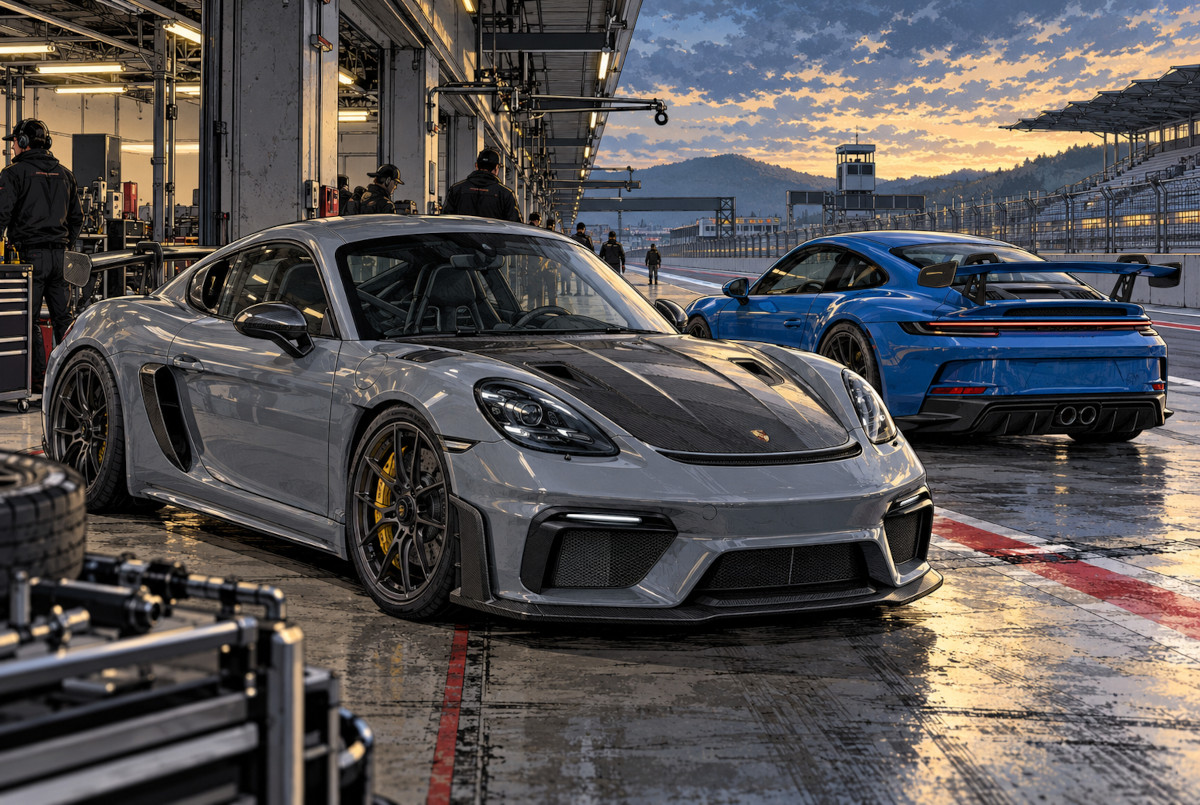 AI-generated comparison image illustrating the technical relationship between the 718 Cayman GT4 RS and 911 GT3. It does not reproduce an actual Porsche promotional photograph or a specific circuit scene.
In the End, Cylinder Count Never Decided What Made a “Real” Porsche
Production of the internal-combustion 718 Boxster and Cayman ended in October 2025, almost exactly 20 years after the original Cayman S appeared.
Look back across this six-part series and the picture becomes strangely circular. The 912 and 914 were questioned because they had four cylinders. The 924 was treated with suspicion because it began as a Volkswagen project and used an Audi-derived engine. The 944 eventually surpassed the naturally aspirated 911 Carrera on published performance figures. The 968 refined the transaxle idea until it almost priced itself out of a clear role. The Boxster helped Porsche rebuild itself through extensive parts sharing with the 911. Then the Cayman returned to four cylinders before the GT4 RS finally received the same engine as the 911 GT3.
The moment you decide that “not a 911” means second-rate, or that four cylinders somehow make a Porsche less authentic, Porsche’s own history starts producing counterexamples. That may be one reason this brand remains so complicated — and so entertaining.
The Other Porsche — 6-Part Series
Not every Porsche followed the 911 formula. From the four-cylinder 912 and VW-linked 914 to the 924, 944, 968 and the later mid-engine generation, this six-part series traces the strange history of Porsche's more accessible sports cars.
- Part 1: Four-Cylinder Porsches and a VW-Powered 914 — Were the 912 and 914 Really “Fake” Porsches?
- Part 2: Porsche 924: The VW Project That Became a Porsche
- Part 3: Was the Porsche 944 Turbo Really Faster Than the 911 Carrera?
- Part 4: Why Did the Porsche 968 Sell So Poorly? The Final Transaxle Porsche
- Part 5: Did the Porsche Boxster Help Save Porsche? How the 986 Shared Parts with the 911
- Final Part: Why Did the Porsche Cayman Become the 718? From Four Cylinders to a 911 GT3 Engine
Editor’s Note
If image and status are the priority, the 911 is probably the easier purchase. Someone asks what Porsche you drive, you say “911,” and the conversation is basically over. Say “Cayman,” and there is still a chance somebody answers, “Oh, the one that isn’t a 911.” Brand hierarchy is a funny thing.
But follow the Cayman for 20 years and that supposedly lower-ranking car eventually ends up with the same engine as a GT3. In between, it even returns to four cylinders and resurrects the 718 name. Try to decide what is “real Porsche” purely from price, badge prestige, or cylinder count, and Porsche keeps messing up the neat little ranking. If you are buying the image, you look at the badge. If you are interested in the car, you start looking underneath it. Porsche has been very good at selling both.
References
- Porsche Classic: Porsche Cayman (Type 987)
- Porsche Newsroom: The new Porsche Cayman GT4
- Porsche Newsroom: Porsche Boxster and Cayman — new model series 718
- Porsche Newsroom: The new Porsche 718 Cayman
- Porsche Newsroom: The 718 Cayman GT4 with naturally aspirated six-cylinder engine
- Porsche Newsroom: The new 718 GTS 4.0 models
- Porsche Newsroom: The Porsche 718 Cayman GT4 RS
- Porsche AG: Business Development 2025