
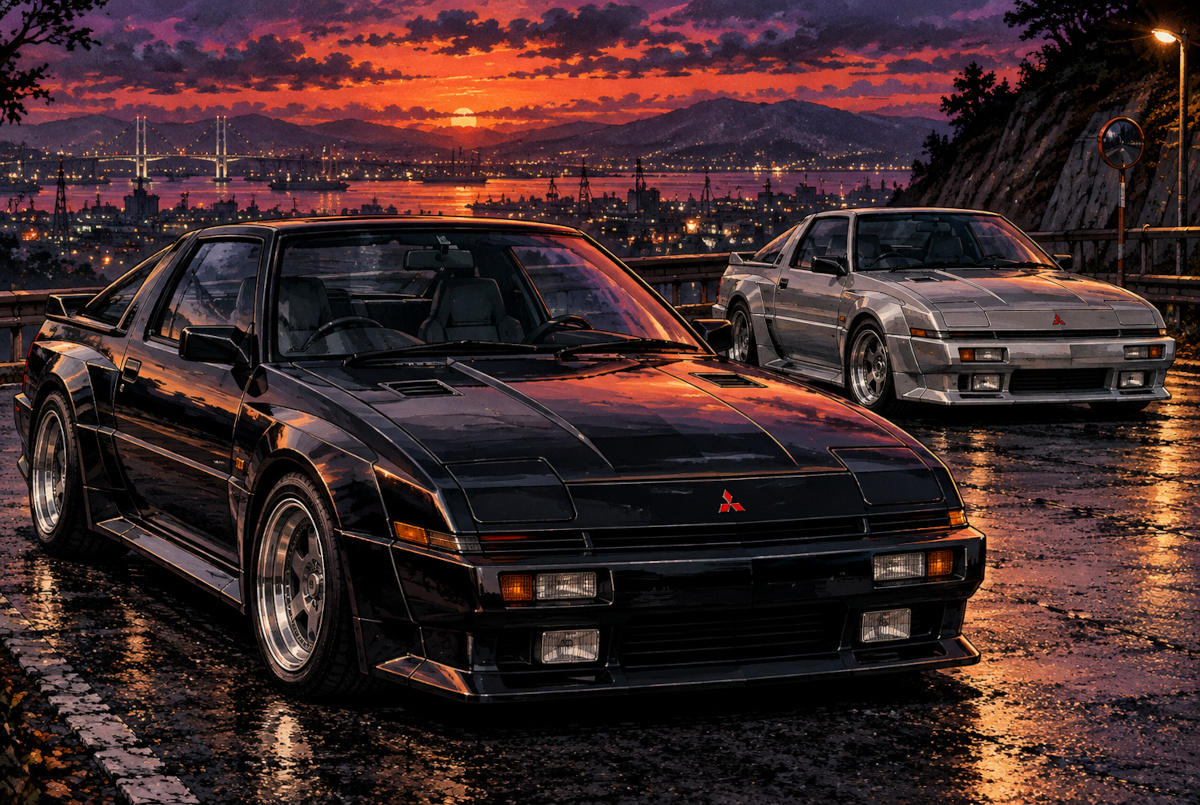
In February 1987, Mitsubishi introduced one of the most distinctive versions of its Starion sports coupe: the 2000GSR-VR, a wide-body model with dramatically flared fenders, a 2.0-liter turbocharged engine, and a limited-edition allocation of just 50 cars.
Then, in April 1988, Mitsubishi launched the final Japanese-market Starion GSR-VR with a much larger 2.6-liter engine.
Here is the strange part. Engine displacement increased by almost 28%, yet maximum power rose from 170 PS to just 175 PS. A gain of only 5 PS.
After developing the celebrated 200 PS DASH engine, why did Mitsubishi finish the Starion’s life with a larger four-cylinder engine making just 175 PS?
To investigate, we compared period specifications, calculated power and torque relative to vehicle weight, and looked at an easily overlooked factor: Japan’s unusually expensive tax treatment of wide-body cars in the late 1980s.
Two Starions, One GSR-VR Badge, Very Different Engines
First, an important distinction: the Starion GSR-VR name was used for two different Japanese-market versions.
The February 1987 2000GSR-VR was a special limited-edition model that brought the wide-body styling developed for overseas markets to Japanese customers.
Under the hood was the 1,997 cc G63B Sirius DASH 3×2 intercooled turbo engine, related to the engine fitted to the earlier GSR-V. The car was offered exclusively with a five-speed manual transmission and featured uprated suspension, eight-position adjustable shock absorbers, and a limited-slip differential.
The April 1988 2600GSR-VR followed a different formula. Mitsubishi replaced the 2.0-liter DASH engine with the 2,555 cc G54B turbocharged four-cylinder, an engine already familiar from North American-market Starions.
A four-speed automatic transmission became available alongside the five-speed manual, and Mitsubishi simplified the Japanese range to a single GSR-VR model.
The 1987 car’s advertised limit of 50 units is worth treating carefully. It describes the original limited-edition offering, not a manufacturer-verified total production figure. The sources examined here do not conclusively establish how many were ultimately built.
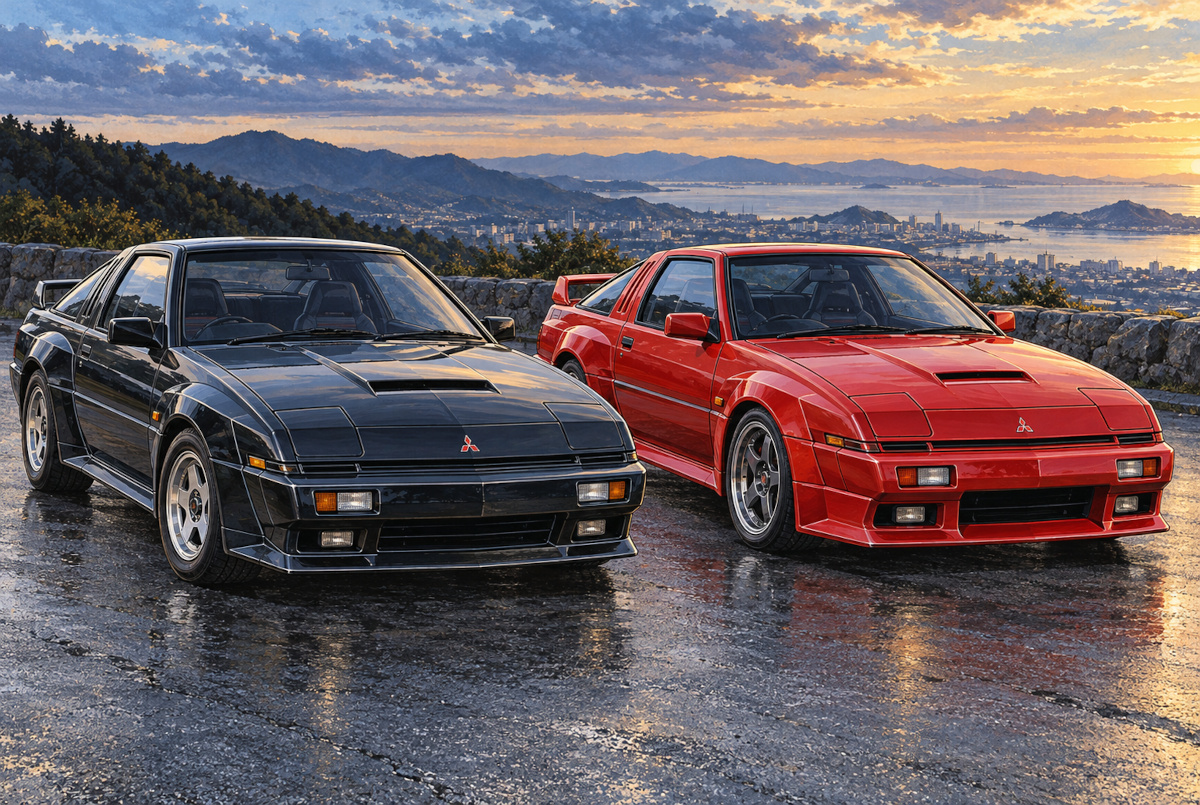
Artistic comparison inspired by the 1987 2000GSR-VR and 1988 2600GSR-VR. Details including hood design, wheels, spoilers, and body trim differ from the original production cars. Refer to the specifications below for the actual model-year differences.
Looking at period brochures and published vehicle specifications, the differences become clearer.
| Specification | 2000GSR-VR | 2600GSR-VR |
|---|---|---|
| Introduction | February 1987 | April 1988 |
| Model Code | A184A | A187A |
| Engine | G63B DASH | G54B |
| Displacement | 1,997 cc | 2,555 cc |
| Maximum Power | 170 PS at 5,800 rpm | 175 PS at 5,000 rpm |
| Maximum Torque | 26.0 kg-m at 3,000 rpm | 32.0 kg-m at 3,000 rpm |
| Curb Weight | 1,240 kg | 1,320 kg |
| Overall Width | 1,745 mm | 1,745 mm |
| Front Tires | 215/60R15 | 205/55R16 |
| Rear Tires | 215/60R15 | 225/50R16 |
| Transmission | 5-speed manual | 5-speed manual / 4-speed automatic |
Note: Japanese-market specifications. Vehicle weights refer to the five-speed manual versions. Both power and torque figures use net ratings. The 1987 model’s 50-unit allocation should not be confused with a confirmed production total.
Did the Starion Really Lose 30 PS?
In the previous article, we examined the 1984 Starion GSR-V and its 200 PS Sirius DASH 3×2 engine.
By 1987, the GSR-VR was listed at 170 PS. At first glance, that looks like a substantial loss of power.
But the numbers were obtained under different measurement systems.
The original 1984 figure of 200 PS was a gross power rating, while the 1987 figure of 170 PS was measured under the net rating system.
Miki Press’s examination of original Mitsubishi brochures specifically records the change in published output ratings for the DASH engine.
Subtracting 170 PS from 200 PS does not establish that Mitsubishi removed 30 PS of actual engine performance. The measurement conditions changed, and that distinction cannot be ignored.
Our comparison between the 1987 and 1988 GSR-VR models is different. Both the 170 PS and 175 PS figures are net ratings, allowing a more meaningful comparison of their published specifications.
Of course, the engines themselves were also different: the 1987 car retained the G63B DASH, while the 1988 car used the larger G54B.
28% More Displacement, Just 5 More PS. What Did Mitsubishi Gain?
Now for the numbers.
Displacement increased from 1,997 to 2,555 cc. That is an additional 558 cc, or approximately 27.9%.
Maximum power, however, increased from 170 to 175 PS, a rise of only 2.9%.
Maximum torque tells a very different story. It increased from 26.0 to 32.0 kg-m, a gain of approximately 23.1%. Both engines reached their quoted maximum torque at 3,000 rpm.
The larger engine also came with a weight penalty. Vehicle weight increased from 1,240 to 1,320 kg, a rise of 80 kg, or approximately 6.5%.
To put those changes into perspective, we calculated maximum power per metric ton of vehicle weight.
| Calculated Figure | 2000GSR-VR | 2600GSR-VR |
|---|---|---|
| Power per Metric Ton | 137.1 PS/t | 132.6 PS/t |
| Peak Torque per Metric Ton | 21.0 kg-m/t | 24.2 kg-m/t |
Calculations use the manufacturer’s published peak outputs and five-speed manual curb weights: 170 ÷ 1.240 and 175 ÷ 1.320 for power, and 26.0 ÷ 1.240 and 32.0 ÷ 1.320 for torque.
Despite its 27.9% larger displacement, the 2.6-liter model had approximately 3.3% less maximum power per metric ton.
Yet peak torque per metric ton increased by approximately 15.6%.
This changes how the engine swap should be understood. The 2.6-liter car did not deliver a spectacular increase in peak horsepower. Instead, it offered substantially more published peak torque, even after accounting for its greater weight.
That suggests a move toward a more torque-oriented grand tourer rather than an attempt to win another horsepower contest.
But there is an important limit to this calculation. Dividing engine torque by vehicle weight does not predict acceleration on its own. Gear ratios, final-drive gearing, traction, and the complete torque curves must also be considered. The figures identify a change in engine characteristics, not a proven winner in a road test.
The 2.0-Liter Starion Was Already a 3-Number Car
There was another surprising detail about the 1987 GSR-VR: it was already subject to Japan’s more expensive large-car tax classification, even though it had a 2.0-liter engine.
For overseas readers, Japan’s registration system distinguished smaller passenger cars, commonly called “5-number” cars, from larger “3-number” passenger cars.
At the time, one of the dimensional limits for the smaller category was a maximum width of 1,700 mm. The 2000GSR-VR measured 1,745 mm across its dramatically flared bodywork.
That extra width was enough to place it in the 3-number category, despite its displacement of just 1,997 cc.
Before Japan’s 1989 tax reform, the difference was financially significant.
The annual automobile tax for a privately owned 2.0-liter 5-number car was ¥39,500. A 3-number passenger car with an engine of no more than 3.0 liters faced an annual tax of ¥81,500.
The difference was ¥42,000 every year. The larger classification carried approximately 2.06 times the annual automobile tax.
In 1987, adding wide fenders to a 2.0-liter sports coupe could more than double its annual automobile tax.
That is a peculiar consequence of the period’s regulations. A change that made the car look more muscular also made it substantially more expensive to own, even without increasing the engine’s displacement.
Yet Mitsubishi released the limited-edition 2000GSR-VR anyway. The wide body arrived in the Japanese market a full year before the 2.6-liter final version.
So it would be wrong to say that the Starion first became a 3-number car because Mitsubishi installed a 2.6-liter engine. The 1987 wide-body 2.0-liter GSR-VR had already crossed that line.
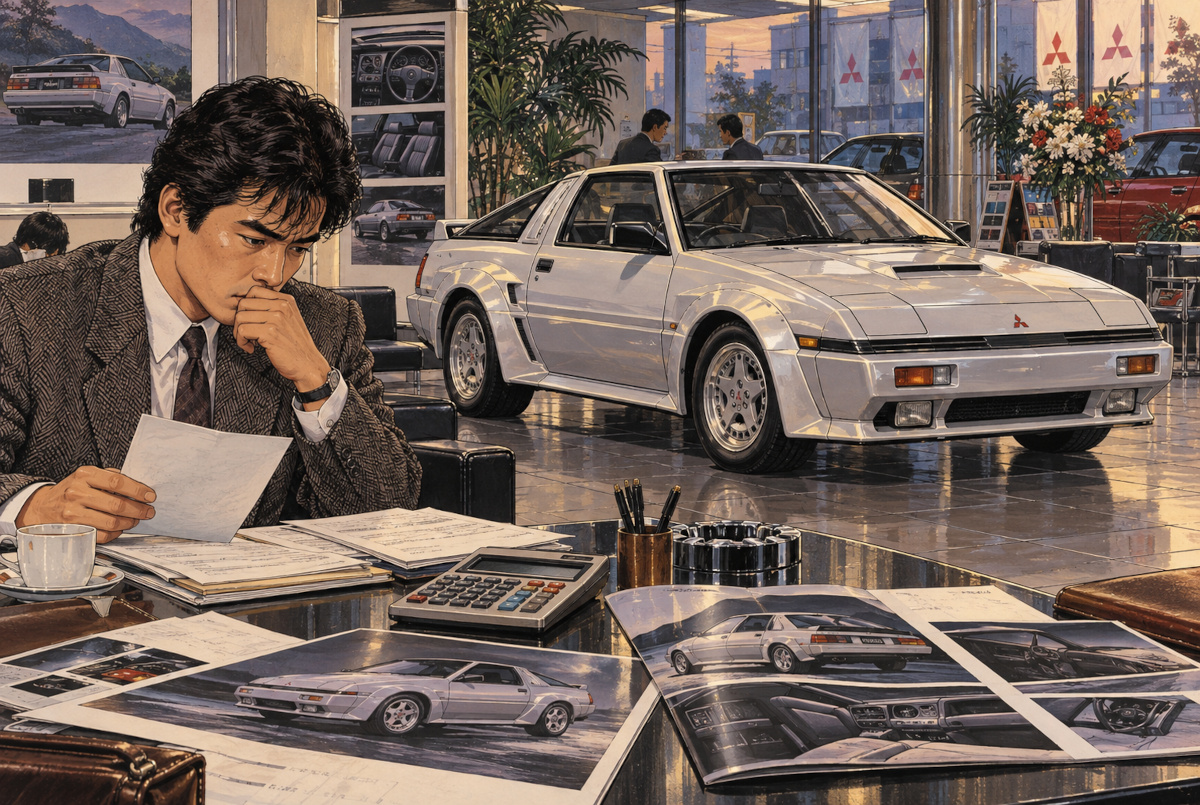
Imagined scene in a Mitsubishi showroom in 1987. The customer and dealership are fictional, and some details of the displayed car, including the hood and wheels, differ from the original 2000GSR-VR. This is not a photograph of an actual sale.
Why Do Published Prices Differ by ¥466,000?
Researching the final 2600GSR-VR reveals another puzzle: two substantially different new-car prices appear in historical records for the five-speed manual model.
One figure is ¥3,025,000. Another is ¥2,559,000.
That is a difference of ¥466,000, or approximately 15.4% of the higher figure. It is far too large to dismiss as a minor rounding error.
CarSensor lists the original new-car price at approximately ¥3.03 million. A Starion owner’s historical account records ¥3,025,000 for 1988. Meanwhile, GAZOO’s historical model database lists ¥2,559,000.
According to that owner’s account, the lower price took effect in April 1989, when Japan introduced its consumption tax and abolished the old commodity tax.
But there is a complication. GAZOO presents the ¥2,559,000 figure within its listing for the model introduced in April 1988. Its database also cautions that historical prices may reflect different tax-inclusion conventions or updates.
We have not been able to compare Mitsubishi’s original manufacturer price lists under identical conditions immediately before and after the tax reform. The exact price revision date and the extent of any underlying vehicle-price adjustment therefore remain unconfirmed.
The tax reform itself, however, is well documented.
In April 1989, Japan abolished its commodity tax and introduced a general consumption tax. While the ordinary rate was 3%, qualifying new passenger cars were temporarily subject to a special 6% consumption-tax rate.
Before the change, ordinary passenger cars were subject to a commodity-tax rate of 23%. That rate is also documented in historical tax research.
These were different taxation systems, with different taxable bases and pricing implications. It would therefore be incorrect to identify the entire ¥466,000 difference between the published Starion prices as a directly measured reduction in tax.
Nor can we determine from the available records exactly how much of the difference, if any, resulted from Mitsubishi changing its underlying vehicle price.
What is clear is that the timing matters. A buyer examining the final Starion’s original price has to consider the major changes to Japanese vehicle taxation in 1989.
The specifications alone cannot tell the whole story of what the car cost to buy and own.
Why Did Mitsubishi Finish with the North American 2.6-Liter Engine?
The G54B 2.6-liter turbo was not an entirely new engine developed specifically for the Japanese-market final Starion.
It was already in use in North American-market Starions. Mitsubishi therefore had an existing larger-displacement powertrain available when it revised the domestic model range.
The final Japanese GSR-VR combined that engine with the wide body, different-sized front and rear 16-inch tires, a limited-slip differential, and the choice of manual or automatic transmission.
From the published specifications, several explanations are plausible.
Mitsubishi may have wanted greater torque rather than higher maximum horsepower. Standardizing more components with overseas models may also have been attractive, as may simplifying the Japanese product range.
But these remain interpretations, not documented statements of Mitsubishi’s internal decision-making.
The sources examined for this article do not contain an engineering approval document or a clear statement from the development team identifying the decisive reason for replacing the DASH engine with the G54B.
It would be unjustified to declare that cost reduction, international parts commonality, or improved drivability was the single overriding motive.
What the published data does establish is that the final Starion traded the pursuit of higher peak horsepower for a markedly higher peak torque figure.
It also made that transition just before a major reform of Japan’s expensive 3-number car tax system.
The result was a different kind of high-performance coupe from the one Mitsubishi had been promoting in the middle of the decade.
Editor’s Note
The final Starion made 175 PS from 2.6 liters. I always found that slightly odd. This was the same Mitsubishi that had proudly advertised a 200 PS turbo engine a few years earlier. Wasn’t the final version supposed to be the most powerful one?
Then I started putting the actual figures side by side.
The 200 PS and 175 PS ratings weren’t even measured under the same system. And when the two GSR-VRs are compared using net figures, the larger engine has 23% more peak torque.
But the part that really bothered me was the tax situation.
Mitsubishi built a special wide-body 2.0-liter car with an advertised allocation of just 50 units, knowing that Japanese buyers would face the considerably higher 3-number automobile tax. All because those glorious flared fenders pushed the car beyond the width limit.
Personally, I’m still more drawn to the limited-edition 2.0-liter DASH model. There’s something appealing about an engine with that much mechanical ingenuity. But looking at the torque figures, I can also see why the 2.6-liter final model had its attractions.
What I’d really like to ask Mitsubishi’s engineers is this: what mattered most in the end? Performance on the road? A more marketable package? Or the practical advantage of bringing an existing North American powertrain into the Japanese lineup?
The brochures tell us what changed. They don’t give us a definitive answer about why that particular decision was made.
Next in the series: the extraordinary Starion 4WD rally project, its claimed 350 PS, the Group B ambitions behind it, and what actually happened when the prototype entered competition.
Mitsubishi Starion $2014 5-Article Series
From its 1982 origins and DASH engine to the rare GSR-VR, the ambitious 4WD rally project, and a gullwing special: four main articles and one special feature.
- Part 1: The 1982 Mitsubishi Starion Was Meant to Be Smaller—Until Chrysler Stepped In
- Part 2: Why Did Mitsubishi’s 200 PS Starion Shut Off an Intake Valve?
- Part 3: Why Did Mitsubishi Give the Starion GSR-VR a 2.6L Engine for Just 5 More PS?
- Final Part: The “Phantom” Mitsubishi Starion 4WD: 350 PS, No Group B Approval—and a Second-Place Rally Finish Coming soon
- Special: English edition Coming soon
Terms That May Need a Quick Explanation
- Gross and Net Horsepower Ratings
- Two different methods of measuring engine output. Gross ratings are obtained under conditions with fewer accessory loads, while net ratings more closely represent an engine with its normal installed equipment. Figures from the two systems should not be directly subtracted to determine a change in actual performance.
References
- Miki Press M-BASE — Mitsubishi Starion, Part 2 (July 27, 2024; Japanese-language historical study reproducing original Mitsubishi brochures, including the 1987 2000GSR-VR and the later 2.6-liter GSR-VR specifications).
- GAZOO — Mitsubishi Starion 2000GSR-VR and Its Wide-Body Fenders (September 26, 2018; Japanese automotive history feature covering the limited-edition wide body and its 3-number registration disadvantage).
- GAZOO — Mitsubishi Starion, April 1988–February 1990 (Japanese historical vehicle database listing the 2.6-liter G54B engine, specifications, equipment, and the ¥2,559,000 manual-transmission price; historical pricing conditions may vary).
- CarSensor — Mitsubishi Starion: Final-Generation Model and Grade Listings (Japanese historical vehicle-price reference, including an approximate original new-car price of ¥3.03 million).
- Minkara — “Generation Gap” (March 5, 2018; historical price account written by a Starion owner, discussing the ¥3,025,000 and ¥2,559,000 figures and the 1989 tax reform. This is an owner’s account, not an original Mitsubishi price list).
- Japanese House of Representatives — Consumption Tax Act, Act No. 108 of 1988 (Original Japanese legislative text, including the transitional 6% consumption-tax rate for qualifying passenger cars).
- National Federation of Petroleum Commercial Associations — Gasoline Demand Outlook Through Fiscal 2010 (July 2002; Japanese report documenting changes to automobile purchase and ownership taxes following the 1989 reform, including historical tax rates).