

In 2003, Mitsubishi unveiled a new Galant for the American market. It measured 4,840 mm long and 1,840 mm wide, and could be ordered with a 3.8-liter V6. This was a substantial midsize sedan built with American buyers in mind.
Four years later, Mitsubishi brought the Galant name back to Japan with the Galant Fortis. But this new sedan was only 4,570 mm long—270 mm shorter than the American Galant. And outside Japan, it was sold under a completely different name: Lancer.
Then things got even stranger. Both cars had a RALLIART performance version. The American Galant RALLIART used a naturally aspirated 3.8-liter V6 producing 258 hp and front-wheel drive. The Japanese Galant Fortis RALLIART used a 2.0-liter turbocharged four-cylinder producing 240 PS, with all-wheel drive.
Same manufacturer. Same Galant badge. Same RALLIART name. Very different machinery.
When did the Galant become two different cars depending on the country? And when production ended in Japan in 2015, was Mitsubishi retiring the Galant name—or the car itself?
To untangle this peculiar family tree, we compared original dimensions, contemporary Mitsubishi announcements, annual reports, and a revealing document issued to shareholders in 2015.
By 2003, America’s Galant Had Become a Much Larger Car
At the New York International Auto Show in April 2003, Mitsubishi presented the ninth-generation North American Galant as a 2004 model. Meanwhile, Japan was still selling its eighth-generation Galant, originally introduced in 1996.
But the divergence between the Japanese and American Galant lines had begun earlier.
On February 9, 1998, Mitsubishi had already unveiled an American-built Galant for the 1999 model year at the Chicago Auto Show. Developed specifically for the needs of the US market, it offered a 2.4-liter four-cylinder engine and a 3.0-liter V6.
So the 2004 Galant did not suddenly create a separate American branch. It continued a product-development strategy that was already well established.
The 2004 North American Galant was manufactured in Illinois and came with either a 2.4-liter inline-four or a 3.8-liter V6. At launch, these engines were rated at 160 hp and 230 hp respectively.
But forget the engines for a moment. Look at the dimensions.
Three Galants, Three Different Identities
| Specification | Japanese Galant 1996 |
North American Galant 2004 model year |
Japanese Galant Fortis 2007 |
|---|---|---|---|
| Overall length | 4,620 mm | 4,840 mm | 4,570 mm |
| Overall width | 1,740 mm | 1,840 mm | 1,760 mm |
| Wheelbase | 2,635 mm | 2,750 mm | 2,635 mm |
| Model lineage | Japanese eighth-generation Galant | North American Galant line | Sold overseas as the Lancer |
Source and methodology: Representative specifications from Mitsubishi’s period materials and vehicle catalogs. The Japanese 1996 model refers to the EA1A family, the American model to the 2004 launch specification, and the Galant Fortis to the 2007 sedan. Dimensions can vary by model year or trim. This table compares the published specifications, not measurements taken from individual cars.
Subtract the figures and the American car’s growth becomes obvious.
Compared with the 1996 Japanese Galant, the North American ninth-generation model was 220 mm longer, 100 mm wider, and had a wheelbase extended by 115 mm.
Now compare the Japanese Galant Fortis with the older Japanese Galant. Despite arriving eleven years later, the Fortis was 50 mm shorter and only 20 mm wider.
And here is a particularly odd detail: the 1996 Galant and the 2007 Galant Fortis both had a 2,635 mm wheelbase.
That does not mean they used the same platform. An identical wheelbase dimension is not proof of shared engineering.
The 2004 American Galant was also 270 mm longer than the 2007 Japanese Galant Fortis.
In North America, the Galant evolved into a larger, regionally developed sedan. In Japan, Mitsubishi later revived the Galant name on a car developed as the global Lancer. The badge survived, but the engineering family trees were different.
 The Galant grew into a larger sedan for North America, while Japan later adopted the Galant Fortis name for a car sold internationally as the Lancer. The older Galant in the background represents the nameplate’s earlier history. Vehicle proportions and exterior details are illustrative, not an exact scale comparison. Refer to the specification table above for the actual dimensions. Editorial illustration.
The 2007 Galant Fortis Was Already a Lancer Before It Reached Japan
The original Japanese Galant line ended domestic sales in 2005. But in August 2007, Mitsubishi introduced a new sedan carrying a familiar name: Galant Fortis.
It would be easy to call it Japan’s ninth-generation Galant and move on.
Unfortunately for anyone who likes a tidy model history, Mitsubishi’s own documents tell a different story.
In its 2007 Annual Report, Mitsubishi explained that the new Lancer had gone on sale first in North America in March 2007, before arriving in Japan that August as the Galant Fortis.
In other words, the car had already begun its international career as a Lancer before Japanese customers met it as a Galant.
There is no need to guess about that relationship. Mitsubishi stated it explicitly.
The new Lancer also shared a new-generation platform with the Outlander. Mitsubishi used the same platform family for the Delica D:5 and the Lancer Evolution X.
That was an important shift in the company’s product development. Rather than treating each model as an entirely separate engineering exercise, Mitsubishi was developing several vehicles around shared structural foundations.
The original Japanese Galant Fortis used a 2.0-liter MIVEC engine, with a continuously variable transmission offering a six-speed Sport Mode in relevant versions.
Its proportions, chassis family, and overall product concept were different from those of the older Japanese Galant.
Why Did Japan Get the Galant Name Instead of Lancer?
This is where the paperwork stops providing a complete answer.
Mitsubishi announced in April 2007 that its new internationally marketed Lancer would carry the Galant Fortis name in Japan.
But the official materials examined for this article do not establish the complete internal reasoning behind that naming decision.
One plausible interpretation is that Mitsubishi considered the new Lancer substantial enough to occupy a position associated with the larger, more established Galant nameplate in Japan.
That interpretation fits the company’s product lineup at the time. However, it remains an editorial inference, not a confirmed statement of Mitsubishi’s internal decision-making.
The name itself had plenty of ambition. According to Mitsubishi’s explanation, “Galant” comes from a French word associated with gallantry and elegance, while “Fortis” comes from Latin and suggests strength and courage.
Whatever its mechanical origins, the badge certainly sounded determined to impress.
 The 2007 sedan was sold in Japan as the Galant Fortis and in overseas markets as the Lancer. The two versions shared the same basic vehicle architecture, although market names and equipment specifications differed. Trim-specific bumpers, wheels, and other exterior details are artistically reconstructed. Editorial illustration.
Two RALLIART Galants: Same Badge, Completely Different Hardware
Of all the discoveries in this particular chapter of Galant history, the RALLIART story may be my favorite.
North America received a Galant RALLIART for the 2007 model year. It was a performance-oriented version of the large American Galant, with a naturally aspirated 3.8-liter V6 tuned to produce 258 hp.
It was front-wheel drive, used a five-speed automatic transmission, and featured 18-inch wheels, sport suspension, and dedicated exterior styling.
Now jump to July 9, 2008, when Mitsubishi launched the Galant Fortis RALLIART in Japan.
Despite the nearly identical name, this was an entirely different kind of machine.
The Japanese model used the 4B11 2.0-liter turbocharged MIVEC four-cylinder, producing 240 PS. Power went to all four wheels through a full-time AWD system with an Active Center Differential (ACD), combined with a six-speed Twin Clutch SST transmission.
The original Japanese retail price was ¥2,982,000, including consumption tax.
Here are the two specifications placed directly alongside each other.
| Specification | North American Galant RALLIART |
Japanese Galant Fortis RALLIART |
|---|---|---|
| Model year / launch | 2007 model year | July 2008 |
| Engine | 3.8L naturally aspirated V6 | 2.0L turbocharged inline-four |
| Maximum output | 258 hp | 240 PS |
| Driven wheels | Front-wheel drive | Full-time all-wheel drive |
| Transmission | 5-speed automatic | 6-speed Twin Clutch SST |
Note: American hp figures use mechanical horsepower, while the Japanese PS rating uses metric horsepower. The American car’s 258 hp is approximately 262 PS, so the two published output figures should not be compared without converting units. Specifications refer to the versions and model years stated above.
The Japanese RALLIART shared the 4B11 engine family and Twin Clutch SST technology with the Lancer Evolution X, although its output, drivetrain specification, and intended balance between performance and everyday usability were different.
The American RALLIART took a more traditional large-engine approach: a powerful, naturally aspirated V6 driving the front wheels.
The Japanese RALLIART took the turbocharged AWD route.
One Galant RALLIART was a 3.8-liter V6 front-driver. The other was a 2.0-liter turbocharged AWD sedan. The two shared a manufacturer, a performance badge, and a sporty mission—not a common mechanical design.
Search for “Galant RALLIART” without specifying the market, and you can find yourself looking at two remarkably different cars. For Mitsubishi enthusiasts, that is an entertaining little trap.
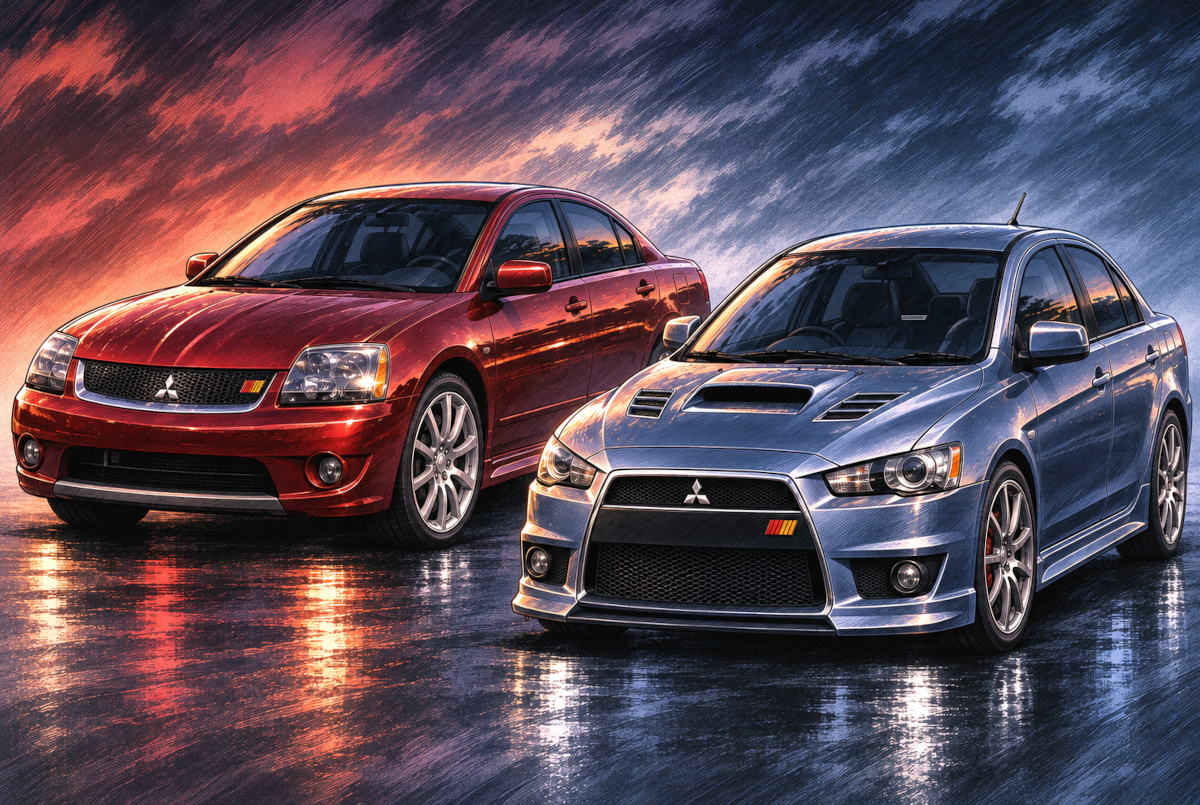
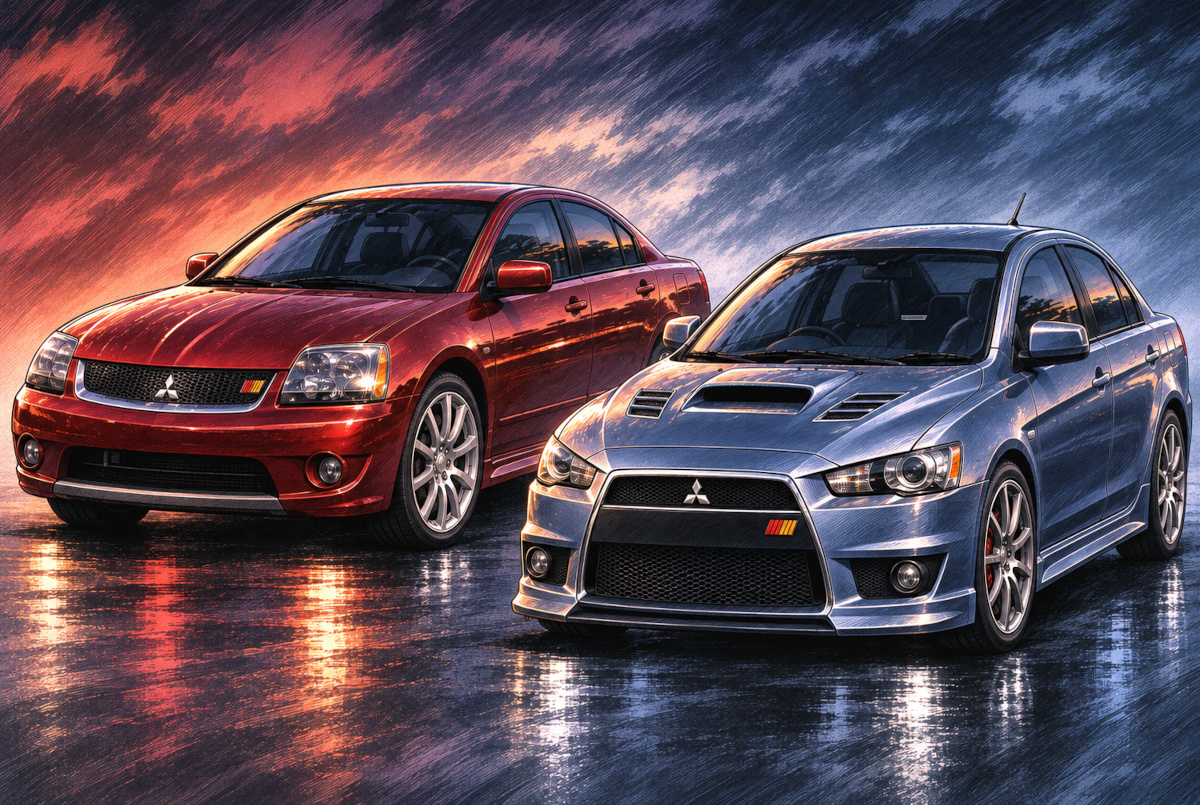 The North American 2007 Galant RALLIART (left) used a naturally aspirated 3.8-liter V6 and front-wheel drive. Japan’s 2008 Galant Fortis RALLIART (right) combined a turbocharged 2.0-liter four-cylinder with AWD. Despite sharing a performance badge, they were different vehicles. Exterior trim, wheels, and other details have been simplified or artistically reconstructed rather than reproduced as exact factory specifications. Editorial illustration.
What Actually Ended in 2015: The Galant Name or the Car?
When did the Galant finally disappear?
The answer depends on which Galant you mean, which market you are discussing, and whether you are tracking a model name or a vehicle’s production history.
The North American ninth-generation Galant ended with the 2012 model year.
This is supported by an unlikely but useful source: the US National Highway Traffic Safety Administration’s 2013 Vehicle Theft Prevention Quick Reference Guide.
The guide’s Mitsubishi entry explicitly records that the Galant was not produced after model year 2012. It was written for vehicle theft prevention, not automotive nostalgia, but it provides useful contemporary documentation.
Japan’s Galant Fortis has a different ending.
A Revealing Footnote in Mitsubishi’s 2015 Shareholder Documents
The decisive evidence appears on page 22 of Mitsubishi Motors’ Notice of the 46th Ordinary General Meeting of Shareholders, dated June 5, 2015.
The document identifies Galant Fortis and Galant Fortis Sportback as the Japanese-market names of vehicles also sold internationally as Lancer and Lancer Sportback.
It then explains that Mitsubishi discontinued production of the Japanese-market Galant Fortis and Sportback under those names in March 2015.
But the document goes further: the same models would continue to be produced for overseas markets under the Lancer and Lancer Sportback names.
That distinction completely changes the meaning of the Galant’s supposed final year.
In 2015, Mitsubishi ended Japanese-market production under the Galant Fortis name. It did not terminate the entire international vehicle family at the same moment.
In fact, Mitsubishi was still discussing the production of export-market Lancers in 2017.
In an official announcement on April 18, 2017, the company stated that Lancer production for export at its Mizushima plant was scheduled to end that December.
This was a production plan announced in 2017, not evidence that all Lancer production around the world ceased on that date.
One Nameplate, Several Different Endings
| Year | Event |
|---|---|
| 1998 | Mitsubishi unveils the US-market 1999 Galant, reflecting an established North American product strategy. |
| 2003 | The new North American Galant is unveiled for the 2004 model year. |
| 2005 | Domestic sales of Japan’s eighth-generation Galant end. |
| 2007 | The global Lancer is introduced in Japan under the Galant Fortis name. |
| 2008 | Galant Fortis RALLIART launches in Japan. |
| 2012 model year | Production of the North American Galant ends. |
| March 2015 | Japanese-market production under the Galant Fortis name ends. |
| 2017 | Mitsubishi announces plans to end Japanese production of export-market Lancers in December. |
The table reveals what a single “Galant discontinued” date cannot.
The end of the Galant name, the end of a particular regional model, the end of domestic sales, and the end of export production were different events. They did not all happen in the same year.
The Japanese Galant did not simply turn into the American Galant and then become a Lancer. The company’s model history was a branching family tree, not a straight line.
Why Did the Galant Name and the Actual Car Go Their Separate Ways?
The available documents point toward two developments: region-specific product planning and the increasing use of shared global vehicle platforms.
The North American Galant was designed around the requirements of the US midsize-sedan market, including generous cabin space and the availability of larger-displacement engines.
Meanwhile, the 2007 Lancer was developed as a globally marketed sedan on a shared platform family. It was sold under the Lancer name in overseas markets and the Galant Fortis name in Japan.
In effect, Mitsubishi was preserving a familiar Japanese nameplate while introducing a new global model.
We should be careful about assigning motives, however.
The official records confirm which models shared a platform, which names were used in different markets, and when production under those names ended. They do not fully reveal how Mitsubishi’s management weighed customer research, brand positioning, and historical recognition when choosing the Japanese name.
Those possible motivations remain interpretations rather than established facts.
What the evidence does establish is that by the 2000s, the relationship between a Mitsubishi model’s name and its engineering lineage had become increasingly dependent on market-specific branding and shared-platform product planning.
The Galant badge had a history stretching back to the Colt Galant of 1969. But by the final years of the Japanese nameplate, the car wearing that badge had a very different family history.
Editor’s Note
I originally pictured the story rather differently.
In my head, Japan’s old Galant disappeared, the larger American Galant carried on the tradition, and eventually the Galant Fortis inherited the name. A neat succession, more or less.
Then I started checking the dates, and that tidy picture fell apart.
Mitsubishi had already been developing a Galant specifically for American buyers while Japan was still selling its own eighth-generation model. And when the Galant name returned to Japanese showrooms, the new car was already being sold elsewhere as the Lancer.
Then came the RALLIARTs. A big naturally aspirated V6 with front-wheel drive in America, and a turbocharged four-cylinder with all-wheel drive in Japan. Two entirely different approaches wearing practically the same badge. Following Mitsubishi’s naming conventions can feel like trying to keep track of characters in a long-running car-magazine saga.
Part of me still wishes the 1996 Galant VR-4’s twin-turbo V6 lineage had continued uninterrupted. I have a weakness for those ambitious Mitsubishi performance sedans. But the 2008 Galant Fortis RALLIART was a serious machine in its own right, even if it followed a different engineering philosophy.
And then there is that shareholder document from 2015. Mitsubishi was retiring the Galant Fortis name in Japan while continuing to build the car for overseas buyers as a Lancer.
So the badge had effectively clocked out, but the car underneath was still reporting for duty abroad. That is a wonderfully peculiar ending for such a long-established name.
What finally convinced me was this: a badge alone cannot tell you a car’s history. You have to ask where it was sold, which platform it used, what it was called elsewhere, and when each particular version actually stopped being produced.
Only then does the Galant family tree start to make sense.
In the final installment of this seven-part series, we’ll return to the beginning in 1969 and trace the complete Galant story—from the Colt Galant and GTO to the VR-4, GDI, and Galant Fortis. What did Mitsubishi preserve, and what did it leave behind?
Mitsubishi Galant: Seven-Part History Series
From the original Colt Galant and the Galant Sigma to the rally-winning VR-4, GDI technology, and the end of the Galant name. Across seven articles, we explore the cars, engineering, motorsport history, and legacy of one of Mitsubishi's defining model lines.
- Part 1: The Colt Galant Came Before Mitsubishi Motors—and Led to the GTO and FTO (Part 1)
- Part 2: The Galant Sigma Was a Hit—So Why Did Mitsubishi Abandon RWD? (Part 2)
- Part 3: The Galant VR-4 Won Six WRC Rallies. Why Did Mitsubishi Replace It? (Part 3)
- Part 4: The Evo Got the 4G63—So Why Did the Galant VR-4 Still Make 240 PS? (Part 4)
- Part 5: Mitsubishi’s “Engine of the 21st Century”: Did GDI Really Deliver 35% Better Fuel Economy? And Why Was There a 280 PS VR-4?
- Part 6: Why Were There Two Different Mitsubishi Galants—and Two Different RALLIARTs?
- Final Part: Did the Mitsubishi Galant Really Die? The VR-4 Legacy Behind S-AWC Coming soon
Terms That May Need a Quick Explanation
- Vehicle Platform
- The shared structural and engineering foundation used to develop one or more vehicle models. Cars with different names and body styles may use related platforms without having identical bodies or mechanical specifications. Conversely, identical wheelbase figures do not prove that two cars share a platform.
- Twin Clutch SST (Sport Shift Transmission)
- Mitsubishi’s dual-clutch automated transmission system. Two clutches manage different sets of gears, enabling rapid changes between ratios. It differs mechanically from a conventional torque-converter automatic transmission.
References
- Mitsubishi Motors — All-New 1999 Galant Unveiled at the Chicago Auto Show (February 9, 1998) — Period Mitsubishi announcement reproduced by The Auto Channel, covering the American-built sedan and its 2.4-liter and 3.0-liter engine choices.
- Mitsubishi Motors — Pricing Announcement for the All-New 1999 Galant (July 27, 1998) — Contemporary release describing the development of the Galant specifically for the US market.
- Mitsubishi Motors — 2004 North American Galant Launch (April 16, 2003) — Period manufacturer announcement reproduced by The Auto Channel, including vehicle dimensions, engine specifications, and product positioning.
- Autoweek / Automotive News — Mitsubishi’s New Galant at the 2003 New York Auto Show — Contemporary coverage of North American production and sales plans.
- GAZOO — 1996 Mitsubishi Galant VX Specifications (Japanese) — Length, width, and wheelbase of the Japanese eighth-generation Galant.
- Mitsubishi Motors — Official Car History — Manufacturer’s English-language historical account of the Galant Fortis, its August 2007 debut, 2.0-liter MIVEC engine, and July 2008 RALLIART addition.
- Mitsubishi Motors — Annual Report 2007, p. 16 — Primary source confirming that the new Lancer launched in North America in March 2007 and was introduced in Japan that August as the Galant Fortis, with a platform shared by other Mitsubishi models.
- Mitsubishi Motors — Meaning and Origin of the Galant Fortis Name (Japanese FAQ) — Manufacturer’s explanation of the Galant and Fortis name elements.
- Mitsubishi Motors North America — 2007 Galant RALLIART Announcement (February 8, 2006) — Period manufacturer release covering the 3.8-liter V6, 258 hp output, and RALLIART equipment.
- Mitsubishi Motors — Galant Fortis RALLIART Launch (July 9, 2008) — Manufacturer announcement covering the 240 PS turbocharged AWD sedan, Twin Clutch SST, and original ¥2,982,000 retail price.
- GAZOO — 2008 Galant Fortis RALLIART Specifications (Japanese) — 4B11 turbo engine, model dimensions, AWD configuration, and original Japanese price.
- US National Highway Traffic Safety Administration — 2013 Vehicle Theft Prevention Quick Reference Guide, p. 21 — Official record stating that the North American Galant was not produced after model year 2012.
- Mitsubishi Motors — Notice of the 46th Ordinary General Meeting of Shareholders (June 5, 2015), p. 22 — Primary source confirming the March 2015 end of Japanese-market Galant Fortis production under that name and continued production as Lancer and Lancer Sportback for overseas markets.
- Mitsubishi Motors — Transfer of RVR Production from Okazaki to Mizushima (April 18, 2017) — Official announcement stating that Japanese production of export-market Lancers was scheduled to end in December 2017.