
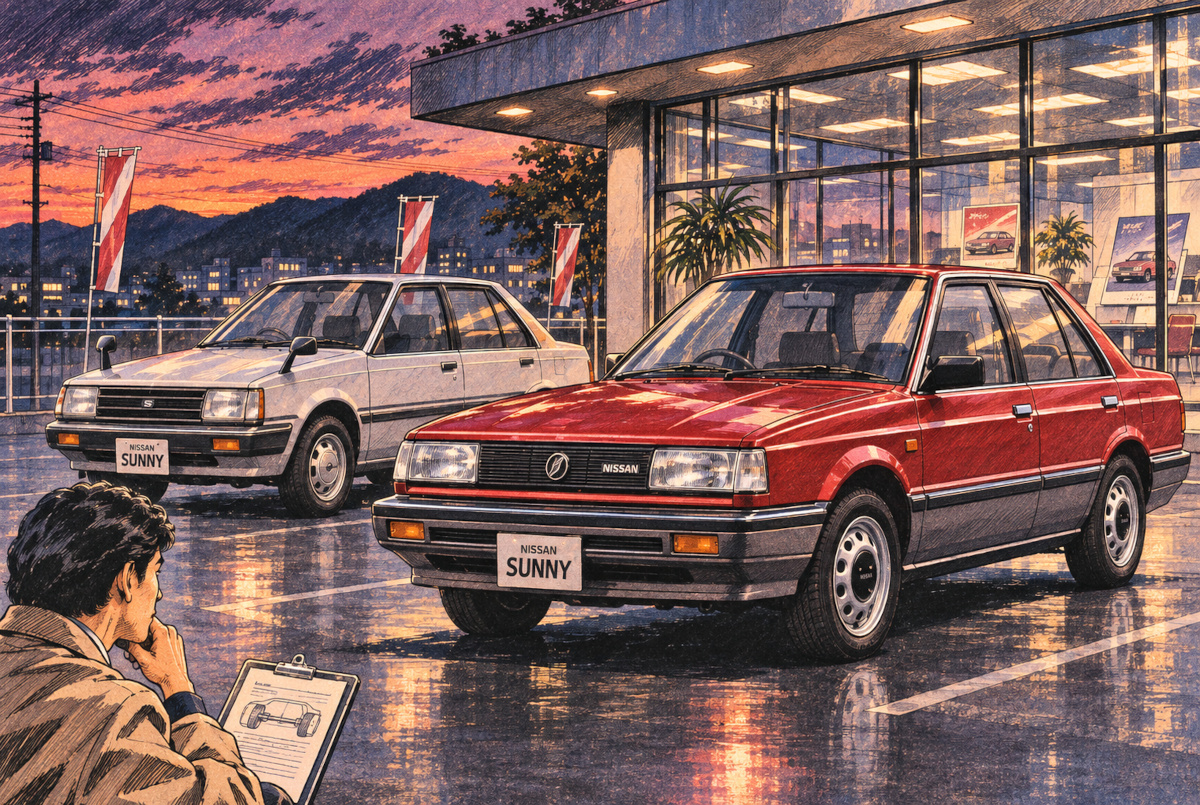
In October 1981, Nissan made a major break with the Sunny’s past. After 15 years of rear-wheel drive, Japan’s familiar little family car switched to front-wheel drive with the fifth-generation B11.
Toyota’s rival Corolla would not make the same transition in its mainstream sedan range until May 1983. That gave the Sunny a 19-month head start.
There is another surprise. According to Nissan’s own Heritage Collection, annual production of the B11 in 1983 exceeded that of major international models including the Toyota Corolla and Volkswagen Golf.
Then, in September 1985, Nissan introduced the sharply styled B12, better remembered in Japan as the “Trad Sunny.” Its restrained, almost old-fashioned appearance became a major part of its appeal.
So Nissan moved the Sunny to FWD ahead of the Corolla and claimed a remarkable production record. But was the celebrated Trad Sunny really such a great car? And why did Nissan take such a different approach to sporty small cars from Toyota’s rear-drive AE86?
Rather than taking the reputation of either car at face value, we compared Nissan and Toyota’s official specifications, checked the production claims, and calculated what actually changed between the B11 and B12 generations.
1981: The Sunny Abandons 15 Years of Rear-Wheel Drive
The fifth-generation B11, launched in October 1981, was the first front-wheel-drive Sunny.
The previous generations had used longitudinally mounted engines driving the rear wheels. The B11 adopted a transverse engine layout, sending power to the front wheels instead. Nissan also replaced the long-serving A-series engine family with E-series engines developed for front-wheel-drive applications.
The engineering advantages were significant. By eliminating the long propeller shaft and rearranging the drivetrain at the front of the car, Nissan could make more efficient use of the available body dimensions. More space could be devoted to passengers rather than mechanical components.
Nissan also worked on reducing noise and vibration and improving the heating and ventilation systems. This was more than a change in which wheels received the engine’s power.
There is one important qualification, however. The B11 was Nissan’s first FWD Sunny, not Nissan’s first FWD car.
That distinction belongs to the Cherry, introduced in 1970. Nissan subsequently developed its front-wheel-drive experience through models including the Pulsar. By the time the Sunny made the switch, FWD was not an untested experiment for the company.
The B11 initially centered on 1.3-liter and 1.5-liter four-cylinder engines. In September 1982, Nissan added the 1.5-liter turbocharged “Leprix” series, combining the new drivetrain layout with a sportier offering.
For someone familiar with the simple, rear-wheel-drive Sunnys of the 1960s and 1970s, this was quite a transformation. The badge was familiar, but much of the engineering beneath it was new.
Nineteen Months Ahead of the Corolla—but Toyota Had Another Plan
Toyota’s official 75-Year History records May 12, 1983, as the launch date of the fifth-generation E80 Corolla. This was the generation in which the mainstream Corolla sedan adopted front-wheel drive.
Putting the two manufacturers’ launch dates side by side reveals an interesting timeline.
| Period | Nissan Sunny | Toyota Corolla |
|---|---|---|
| October 1981 | FWD B11 introduced | Mainstream sedan still RWD |
| May 1983 | FWD B11 remains on sale | E80 sedan switches to FWD |
| May 1983 | — | AE86 Levin/Trueno retains RWD |
| September 1985 | FWD B12 introduced | E80 generation remains on sale |
From October 1981 to May 1983 is 19 months.
The Sunny therefore moved to front-wheel drive one year and seven months before the mainstream Corolla sedan.
That does not mean Toyota was 19 months behind Nissan in developing FWD technology. Toyota had already produced front-wheel-drive cars, including the Tercel. The comparison here concerns two rival mainstream nameplates, not the first FWD vehicle made by either manufacturer.
What makes the Corolla’s 1983 transition particularly interesting is that Toyota did not move every variant to FWD.
Its new family sedans adopted front-wheel drive, while the sporty Corolla Levin and Sprinter Trueno retained rear-wheel drive in their AE86 forms.
In effect, Toyota divided the work: FWD for mainstream family transport, RWD for the sporty coupes.
Nissan, meanwhile, committed its core Sunny range to FWD. The two companies were responding to similar market pressures but making different decisions about how to preserve sporting appeal.
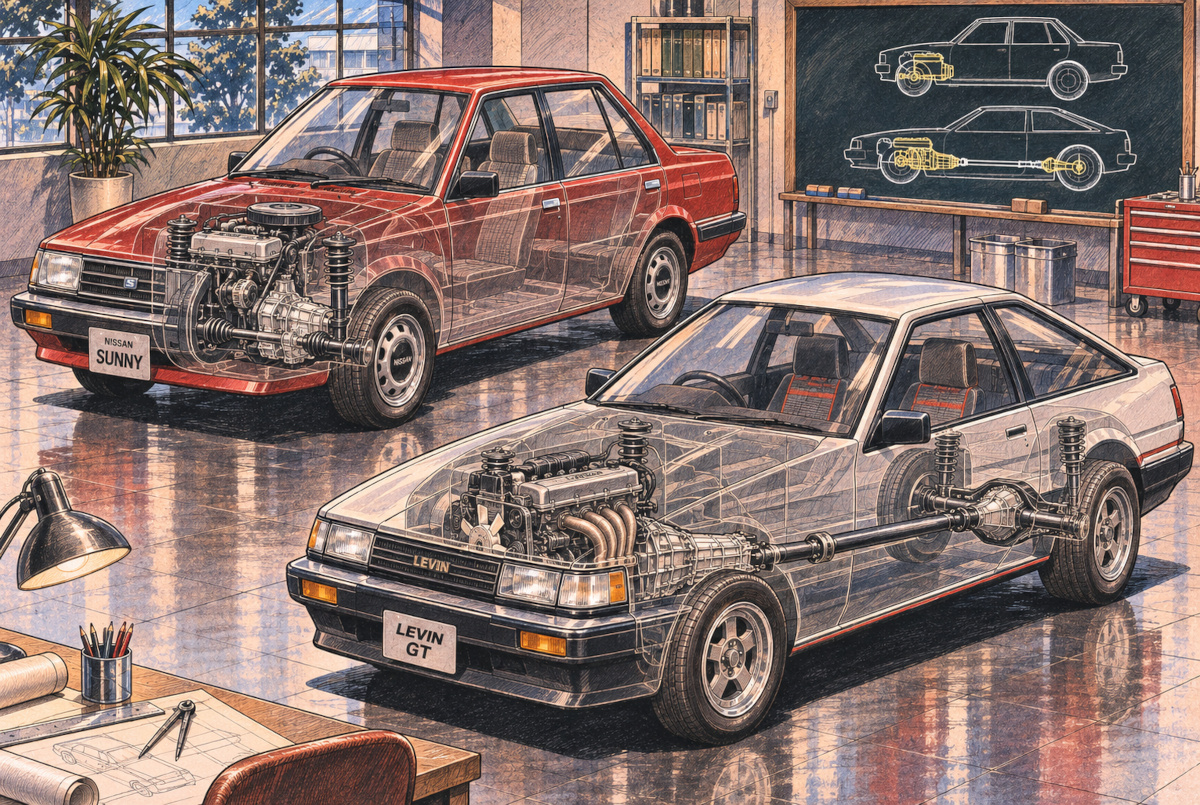
AI-generated conceptual comparison of the 1981–82 Nissan Sunny B11 FWD layout and the 1983 Toyota Corolla Levin AE86 RWD layout. Engine accessories, suspension components, and other mechanical details have been simplified to illustrate the differences in power transmission. Some exterior details, including the B11’s door mirrors, and the AE86’s rear suspension area do not exactly reproduce factory specifications. This is not a verified technical service diagram.
Was the B11 the World’s Most-Produced Car in 1983?
Now for a claim that deserves more attention than it usually receives.
In its English-language Heritage Collection, Nissan states that the B11 Sunny achieved the highest annual production output in 1983 among major worldwide best-selling models such as the Volkswagen Golf and Toyota Corolla.
That is a remarkable statement for a car often remembered mainly as an inexpensive Japanese family sedan.
In the previous installment of this series, we examined a historical source placing the Sunny second in a 1975 world production ranking. The 1983 claim is different: it appears directly in Nissan’s own official historical account.
However, Nissan’s page does not provide the actual 1983 production total, the original ranking table, or a complete explanation of which vehicles and production locations were counted.
Did the comparison include overseas factories? Were different body styles and related nameplates combined? Which other manufacturers’ models were included?
Those questions cannot be resolved from the published information alone.
We can therefore report that Nissan officially describes the B11 as having led these major models in annual production in 1983, but we cannot independently establish that it ranked first among every passenger-car nameplate worldwide under one comprehensive, consistently defined method.
Toyota’s historical records provide another useful comparison. On March 1, 1983, Toyota announced that cumulative Corolla production had exceeded 10 million vehicles since the model’s introduction in 1966.
That figure included passenger and commercial versions of the Corolla series.
The difference between the two records is fundamental.
Nissan’s B11 statement concerns production in a single year. Toyota’s 10-million-unit milestone concerns cumulative production over more than 16 years.
Both are impressive achievements, but they measure different things. Comparing them as if they belonged to the same ranking would be meaningless.
It is also worth remembering that the B11 was sold in North America under the Sentra name. The Sunny had become more than a domestic Japanese bestseller; it was an important part of Nissan’s international small-car business.
Exactly how its overseas versions were counted in the 1983 production comparison remains an open question.
1985: What Actually Changed with the Boxy “Trad Sunny”?
Nissan introduced the sixth-generation B12 in September 1985.
The rounded styling that had appeared on earlier Sunnys was now firmly in the past. The B12 was upright, angular, and deliberately restrained. Its straight lines, tidy proportions, and conventional sedan appearance suggested something more conservative than fashionable.
In Japan, this generation became known as the “Trad Sunny,” a nickname derived from Nissan’s advertising language. The word “trad” evoked traditional, enduring values rather than the latest passing trend.
According to Nissan’s Heritage Collection, the model was a commercial success and helped attract younger customers to a nameplate whose owner demographic had been relatively mature.
That is Nissan’s historical assessment. We were unable to confirm detailed age-by-age buyer statistics or a directly comparable Corolla-versus-Sunny sales breakdown for the same period.
But what about the actual car? How much progress lay beneath that understated appearance?
To investigate, we compared two four-door sedans preserved in Nissan’s Heritage Collection: a 1982 B11 Sunny 1500 SGL Extra and a 1988 B12 Sunny 1500 EX Saloon.
| Specification | Sunny B11 | Sunny B12 |
|---|---|---|
| Vehicle examined | 1982 1500 SGL Extra | 1988 1500 EX Saloon |
| Overall length | 4,050mm | 4,175mm |
| Overall width | 1,620mm | 1,640mm |
| Wheelbase | 2,400mm | 2,430mm |
| Curb weight | 800kg | 900kg |
| Drivetrain | FWD | FWD |
Sources: Nissan Heritage Collection specifications for the 1982 B11 and 1988 B12. The B12 example is a post-1987-update vehicle. Because the model years and trim levels differ, this is not a perfectly controlled comparison of identical equipment specifications. The weight difference must not be attributed solely to the generational redesign.
The B12 was 125mm longer and 20mm wider than the B11 example.
Yet the wheelbase increased by only 30mm.
That is where the numbers become interesting.
We calculated how much of the additional body length was represented by the longer wheelbase:
30 / 125 x 100 = 24%.
In other words, the wheelbase extension accounted for only 24% of the increase in overall length.
The remaining difference can be calculated directly:
125mm – 30mm = 95mm.
Those 95mm represent the combined increase in the front and rear overhangs—the portions of the vehicle extending beyond the front and rear axle centers.
The B12 certainly grew, but most of its additional overall length was not wheelbase extension. A larger exterior did not automatically mean an equally large increase in passenger space.
To determine the actual change in cabin room, we would need comparable interior measurements, not just overall dimensions and wheelbase.
The two preserved cars also differ in curb weight by 100kg. But it would be equally careless to declare that the B12 had simply become 100kg heavier because of its redesign. The vehicles come from different years and equipment levels.
The B12’s appeal clearly involved more than a claim of maximum interior space or minimum weight.
Its tidy styling, perceived quality, equipment, and range of available models all helped shape its identity. The Trad Sunny was selling a particular idea of a respectable small sedan, not merely a larger set of dimensions.
The RZ-1: A Completely Different Kind of Sunny
In February 1986, Nissan introduced the Sunny RZ-1, a sharply styled three-door coupe derived from the B12 generation.
Where the Trad Sunny sedan was upright and conventional, the RZ-1 was low, angular, and unmistakably sporty in appearance.
The initial range used 1.5-liter SOHC engines, including turbocharged versions. In August 1986, Nissan expanded the lineup with a 1.6-liter twin-cam series using the CA16DE engine.
With four valves per cylinder and double overhead camshafts, the 1,598cc CA16DE produced a published 120PS.
Nissan’s Heritage Collection includes a 1989 Sunny RZ-1 Twin Cam NISMO, equipped with special suspension components, aerodynamic body parts, distinctive seats, a leather-wrapped steering wheel, and other changes.
The preserved example weighs 1,050kg.
This was more than a standard coupe with a few sporty badges. Nissan had developed a substantially differentiated performance-oriented variant within the Sunny family.
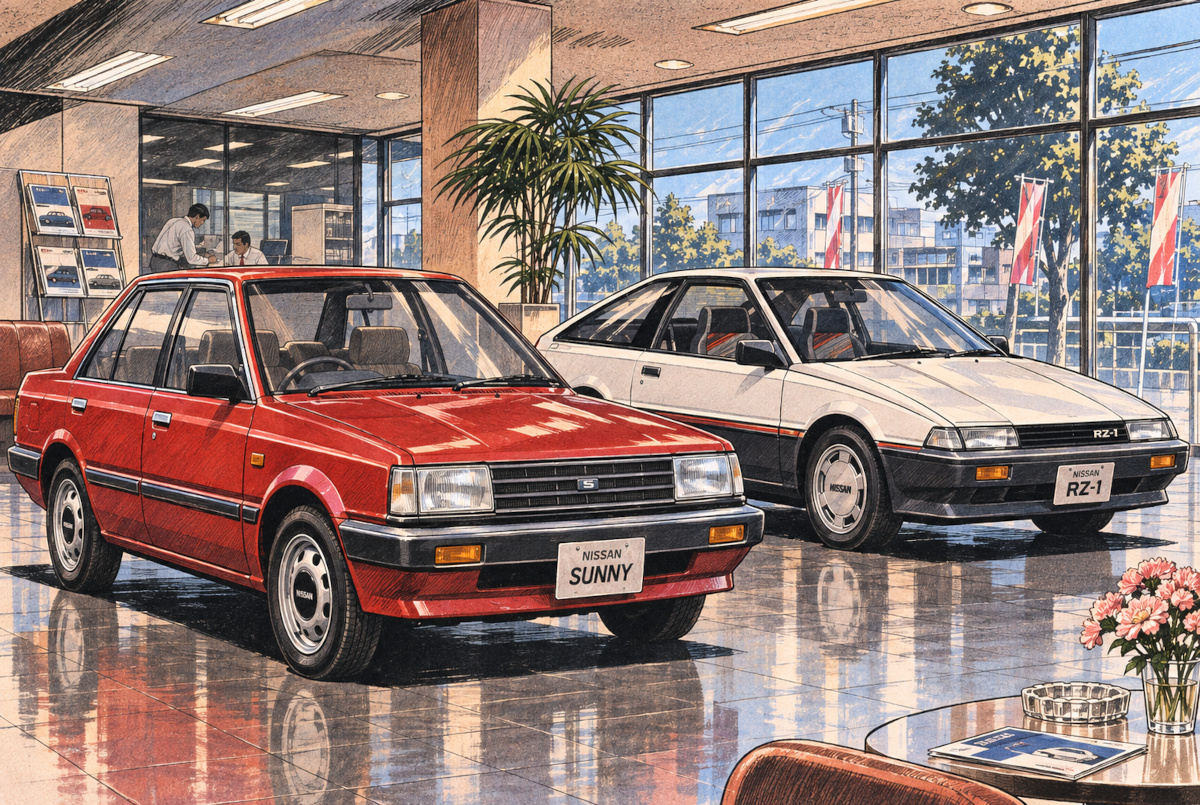
AI-generated editorial illustration comparing the four-door Trad Sunny B12 introduced in 1985 with the Sunny RZ-1 coupe introduced in 1986. The illustration emphasizes the contrast between their body designs. Details such as the grille, wheels, and rear quarter windows are approximate and do not reproduce every original factory specification.
However, the RZ-1 remained a front-wheel-drive car.
That distinction becomes especially interesting when we place it beside Toyota’s Corolla Levin AE86.
Why Toyota Kept the AE86 Rear-Wheel Drive While Nissan Chose FWD
The AE86 Corolla Levin, introduced in May 1983, combined Toyota’s 1.6-liter 4A-GEU twin-cam engine with rear-wheel drive.
The 1986 RZ-1 Twin Cam used a transverse-mounted 1.6-liter CA16DE twin-cam engine driving the front wheels.
Both were compact Japanese sporting cars, but they represented different engineering approaches.
| Specification | Sunny RZ-1 Twin Cam | Corolla Levin AE86 |
|---|---|---|
| Introduction | Twin-cam version added in 1986 | May 1983 |
| Drivetrain | FWD | RWD |
| Engine | CA16DE | 4A-GEU |
| Displacement | 1,598cc | 1,587cc |
| Published maximum power | 120PS | 130PS (gross) |
Sources: Nissan Heritage Collection’s 1989 RZ-1 Twin Cam NISMO and Toyota’s 75-Year History specifications for the 1983 AE86. The vehicles differ in model year and specification, and their published power figures have not been established as directly comparable under identical measurement conditions.
At first glance, the Toyota appears to have a 10PS advantage.
But there is a problem with that simple comparison.
Toyota’s historical specification explicitly labels the AE86’s 130PS figure as “Gross.” Nissan’s Heritage Collection lists 120PS for the RZ-1, but we have not verified that the two published values were obtained under identical test conditions.
It would therefore be misleading to treat the difference as a direct measure of the cars’ relative performance.
And even matching horsepower measurements would not settle the matter. Vehicle weight, gearing, torque delivery, tire specifications, and chassis behavior would still need to be considered.
The more revealing difference is in the drivetrain philosophy.
Toyota switched the mainstream Corolla sedan to FWD while deliberately retaining RWD for the Levin and Trueno sports models.
Nissan instead developed its Sunny-based sporty coupe around FWD architecture.
The AE86 preserved the driving characteristics associated with a lightweight rear-wheel-drive coupe. The RZ-1 explored what a front-wheel-drive compact sports model could offer. Their similar engine sizes concealed fundamentally different design priorities.
Which was more enjoyable depended on what a driver valued. The published specifications alone cannot decide that question.
1990: The Trad Sunny’s Approach Lives On
In January 1990, Nissan introduced the seventh-generation Sunny B13.
Nissan’s own historical description characterizes the B13 as a natural evolution of the preceding B12, continuing its neat styling and emphasis on quality.
The Trad Sunny concept, then, was not simply a brief styling experiment abandoned after one generation.
That does not prove the B12 was objectively the best family car of its day. We would need directly comparable road tests, ownership data, and contemporary market evidence to make such a claim.
But the succession of models tells us something about Nissan’s thinking during the 1980s.
The B11 represented a major mechanical turning point, replacing the Sunny’s traditional RWD layout with FWD.
The B12 concentrated on making that new-generation family car feel more polished, substantial, and desirable.
Meanwhile, the RZ-1 pursued sporting character without returning to the rear-wheel-drive formula retained by Toyota’s AE86.
Throughout the decade, Nissan was competing with Toyota while pursuing its own answers to what a modern compact car should be.
Editor’s Note
Finding out that the Sunny adopted FWD 19 months before the Corolla sedan gave me a certain satisfaction. That’s the kind of detail a Nissan enthusiast enjoys.
Of course, the Cherry had already introduced Nissan drivers to FWD years earlier. Pretending the Sunny invented the technology would make for a better headline than a better history article.
What really caught me off guard was the 1983 production claim. Nissan’s own archive says the B11 topped major international models such as the Corolla and Golf. Yet it gives us neither the precise output figure nor the original counting rules.
That bothers me. If a statistic is impressive enough to preserve in a manufacturer’s official history, surely the underlying numbers deserve some attention too.
And then there’s the Trad Sunny itself. I’ve always liked its unapologetically boxy appearance. There’s something appealing about a car that doesn’t try too hard to look exciting.
Still, I was surprised to discover that the B12 example was 125mm longer than the B11 while its wheelbase had increased by only 30mm. That’s why I’m reluctant to repeat the usual praise about a more spacious, more sophisticated new model without checking what actually changed.
The RZ-1 raises another question. Its sharp, futuristic styling was almost the opposite of the conservative Trad sedan, yet it was still based on Nissan’s FWD thinking. Toyota, meanwhile, deliberately kept the AE86 rear-wheel drive.
I don’t think the interesting question is simply which company was right. It’s that two major manufacturers looked at the same era and arrived at such different answers.
So was the B12 a masterpiece? I wouldn’t call it an engineering revolution. But I do think Nissan worked unusually hard to make an ordinary family sedan feel like something more than ordinary transportation.
There’s a certain stubborn pride in that. And for a classic-car enthusiast, that kind of quiet effort is worth remembering.
Terms That May Need a Quick Explanation
- Wheelbase
- The distance between the centers of a vehicle’s front and rear axles. It is different from overall vehicle length, and a longer wheelbase does not automatically translate into an equivalent increase in passenger space.
Nissan Sunny: 60 Years of History - Eight-Part Series
Born in 1966, the Nissan Sunny challenged the Toyota Corolla and helped shape Japan's mass-market car industry. Across eight articles, we examine its development, engineering, performance, sales, motorsport history, and why the Sunny name disappeared from Japan while surviving in overseas markets.
- Part 1: Did Toyota’s “Extra 100cc” Really Beat the Datsun Sunny? The 89cc Battle (Part 1)
- Part 2: Did the Datsun Sunny Really Make the Corolla Look Small? The B110 and GX-5 (Part 2)
- Part 3: Was the Datsun Sunny Really No. 2 in World Production? The B210 and B310 (Part 3)
- Part 4: The Sunny Went FWD 19 Months Before the Corolla—Was the B12 Really That Good? (Part 4)
- Part 5: English edition Coming soon
- Part 6: English edition Coming soon
- Part 7: English edition Coming soon
- Final Part: English edition Coming soon
References
- Nissan Heritage Collection: Sunny 1500 SGL Extra (Japanese) — Official specifications for the 1982 B11, its transition to FWD, engine changes, equipment, and the Leprix turbo.
- Nissan Heritage Collection: Sunny 1500 SGL Extra (English) — Nissan’s explanation of the Cherry as its first FWD car, the B11’s position in its FWD history, North American Sentra branding, and the 1983 annual production claim.
- Toyota 75-Year History: Fifth-Generation Corolla (Japanese) — Official launch date of May 12, 1983, and the transition of family sedans to FWD while sports coupes retained RWD.
- Toyota Motor Corporation: Toyota Corolla Series Tops 10 Million Cumulative Production Mark, March 1, 1983 (English) — Contemporary announcement documenting the cumulative production milestone and the scope of the Corolla series counted.
- Nissan Heritage Collection: Sunny 1500 EX Saloon (Japanese) — B12 introduction, Trad Sunny identity, model history, and specifications for the preserved 1988 sedan.
- Nissan Heritage Collection: Sunny 1500 EX Saloon (English) — Official discussion of the Trad Sunny advertising, customer demographic, and dimensions of the 1988 example.
- Nissan Heritage Collection: Sunny RZ-1 Twin Cam NISMO (Japanese) — Model development, CA16DE engine, published 120PS output, curb weight, and NISMO-specific equipment.
- Toyota 75-Year History: Corolla Levin AE86 (Japanese) — RWD architecture, 4A-GEU engine, displacement, and published gross horsepower specification.
- GAZOO Vehicle Catalogue: Nissan Sunny RZ-1 (Japanese) — Supplementary model history covering the RZ-1’s introduction, engines, and sporting role within the Sunny range.
- Nissan Motor Corporation: Corporate History of the 1990s (Japanese) — Official chronological record confirming the Sunny B13’s introduction in January 1990.
- Nissan Heritage Collection: Sunny 1500 Super Saloon (Japanese) — Official description of the B13 as a natural evolution of the B12, continuing its restrained styling and emphasis on quality.