On August 27, 2026, Nissan launched a refreshed Fairlady Z in Japan. Known simply as the Nissan Z in markets such as the United States, the RZ34 sports coupe gained several updates, including a striking new Unryu Green paint finish.
But the color wasn’t what caught my attention. It was the price of the NISMO version.
The base Fairlady Z starts at ¥5,737,600 in Japan, while the Z NISMO is listed at ¥9,752,600. That’s a difference of ¥4,015,000. Then I went digging through old Skyline GT-R catalog material and found something rather peculiar: the 1990 R32 Skyline GT-R NISMO actually cost ¥40,000 less than the regular GT-R.
Thirty-six years apart, two NISMO models tell very different stories. Why was the earlier one cheaper while the modern Z commands such a substantial premium? And what exactly does that NISMO badge buy?
The ¥4 Million Price Gap Is Real, but There’s a Catch
First, let’s establish the comparison. These are Nissan’s official Japanese list prices for the 2026 Fairlady Z range, using six-speed manual versions throughout.
| Model / Grade | Price (JPY) | Gap to NISMO |
|---|---|---|
| Base Fairlady Z | ¥5,737,600 | ¥4,015,000 |
| Version ST | ¥6,999,300 | ¥2,753,300 |
| Z NISMO | ¥9,752,600 | — |
Note: These are Nissan’s Japanese manufacturer-suggested retail prices announced on August 27, 2026, including consumption tax. The Z NISMO also requires a special paint option costing at least ¥49,500, raising its minimum vehicle price to ¥9,802,100 before registration and other charges. The table compares the published base prices before that mandatory paint charge.
The headline-grabbing ¥4 million gap comes from comparing NISMO with the cheapest Z. But the better-equipped Version ST already includes 19-inch forged wheels, multi-piston performance brakes and a limited-slip differential.
Compare NISMO with Version ST instead, and the difference falls to ¥2,753,300.
In other words, the Z NISMO costs about 1.70 times as much as the base Z, but only 1.39 times as much as Version ST. The choice of comparison car changes the impression considerably.
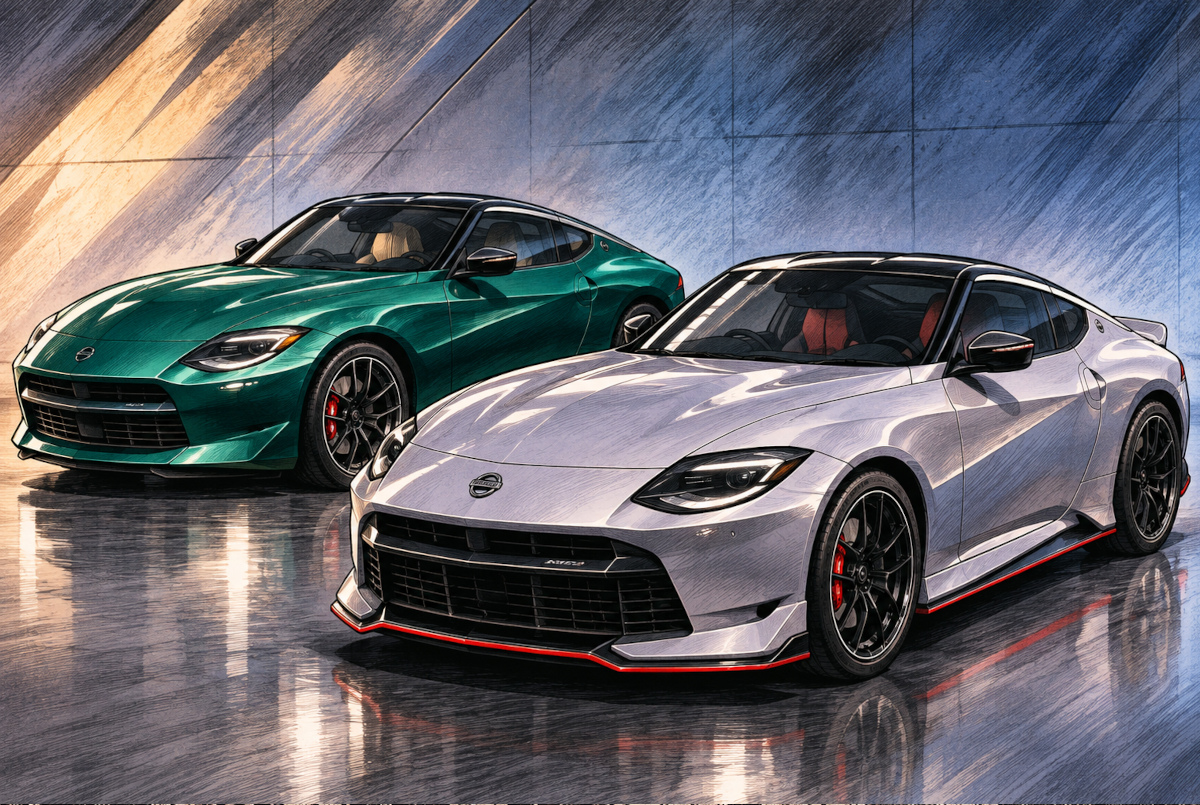
Illustrated comparison of the 2026 Fairlady Z Version ST in green and the Z NISMO in silver-white. The NISMO has dedicated aerodynamic components and is 25 mm wider. The actual refreshed 2026 cars use a front Z emblem; some emblem and bodywork details in this illustration differ from the production vehicles.
Only 15 More Horsepower? The Numbers Have a Surprise
So what does that additional ¥2.75 million buy? For a more meaningful performance comparison, let’s put the six-speed manual Version ST and Z NISMO side by side.
| Specification | Version ST | Z NISMO |
|---|---|---|
| Maximum power | 405 PS | 420 PS |
| Peak torque | 475 N·m | 520 N·m |
| Vehicle weight | 1,590 kg | 1,640 kg |
| Weight per PS | 3.93 kg | 3.90 kg |
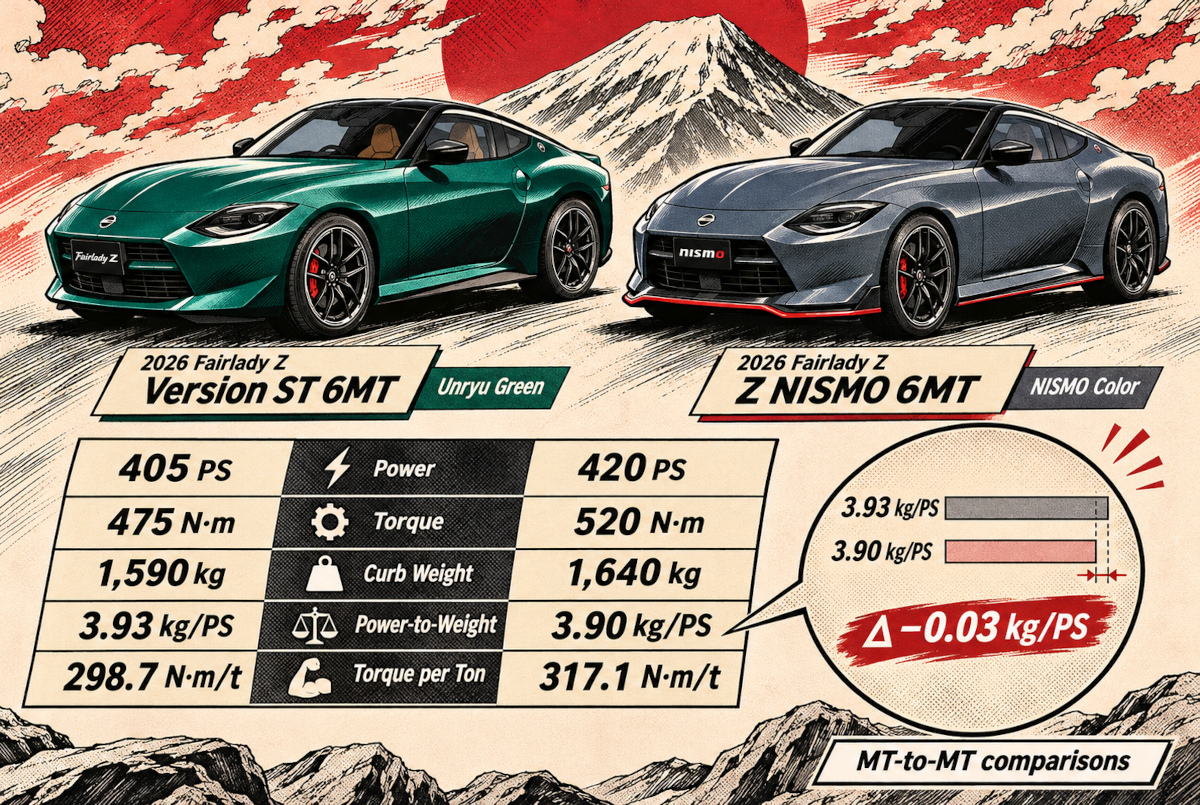
The NISMO produces 15 PS more, an increase of approximately 3.7%. But it also weighs another 50 kg. That makes the power-to-weight comparison rather less dramatic than the horsepower figures suggest.
Using the published specifications, we calculated:
Version ST: 1,590 kg ÷ 405 PS = 3.9259 kg/PS.
Z NISMO: 1,640 kg ÷ 420 PS = 3.9048 kg/PS.
After accounting for the additional weight, the improvement in weight per unit of power is only about 0.54%.
Torque tells a somewhat different story. Peak torque rises by approximately 9.5%, from 475 to 520 N·m. Dividing each figure by vehicle weight in metric tonnes gives 298.7 N·m/t for Version ST and 317.1 N·m/t for NISMO, an improvement of approximately 6.1%.
These are our calculations from published specifications, not measured acceleration or lap-time results. Gear ratios, tire grip, power delivery and vehicle dynamics all affect real-world performance.

Comparison of the 2026 Version ST and Z NISMO, both with six-speed manual transmissions. NISMO gains 15 PS and 45 N·m while adding 50 kg. Weight per PS improves by approximately 0.54%. The graphic’s −0.03 kg/PS figure is the difference between rounded display values; the difference before rounding is approximately −0.021 kg/PS. Vehicle appearances are illustrative.
This is where the NISMO begins to make more sense. Its purpose is not simply to win a horsepower contest.
The refreshed model receives GT-R-derived two-piece drilled front brake rotors, dedicated suspension tuning and a low-friction steering rack. A newly offered NISMO-specific short-throw six-speed manual is accompanied by specially calibrated throttle response and ignition timing.
Rather than buying 15 extra PS, the customer is buying a car whose acceleration, cornering and braking responses have been developed together as a complete performance package.
Why Was the 1990 R32 GT-R NISMO Cheaper?
Now rewind to 1990.
When the R32 Skyline GT-R arrived in Japan in August 1989, its listed price was ¥4.45 million. The GT-R NISMO introduced in March 1990 was priced at ¥4.41 million, according to period catalog material documented by Japanese automotive publisher Miki Press.
That’s a ¥40,000 discount for the NISMO.
There are important qualifications. These are published prices from different launch dates, and they have not been adjusted for inflation. Nor would it make sense to compare the buying power of ¥4.41 million in 1990 directly with ¥9.75 million in 2026. The striking point is the relationship between each NISMO and its contemporary standard model.
The R32 GT-R NISMO was a homologation special developed to support Nissan’s Group A touring-car racing program. A total of 560 were produced, including 500 offered to the public.
Both the regular GT-R and the road-going GT-R NISMO were officially rated at 280 PS. But NISMO used larger, more durable metal turbocharger turbines in place of the standard ceramic units. Its front bumper gained additional cooling openings, while revised aerodynamic parts included a hood-edge molding and an extra rear spoiler.
Meanwhile, equipment such as ABS, air conditioning, the audio system and rear wiper was deleted. The resulting 1,400 kg curb weight was 30 kg below that of the regular GT-R.
This was not a luxury trim loaded with extras. It was a road-legal evolution model built around the needs of a racing program.
Removing equipment is part of the explanation for the different pricing structure. But the available historical material does not establish exactly how Nissan arrived at a price ¥40,000 below the standard GT-R, so the discount cannot be attributed to those deletions alone.
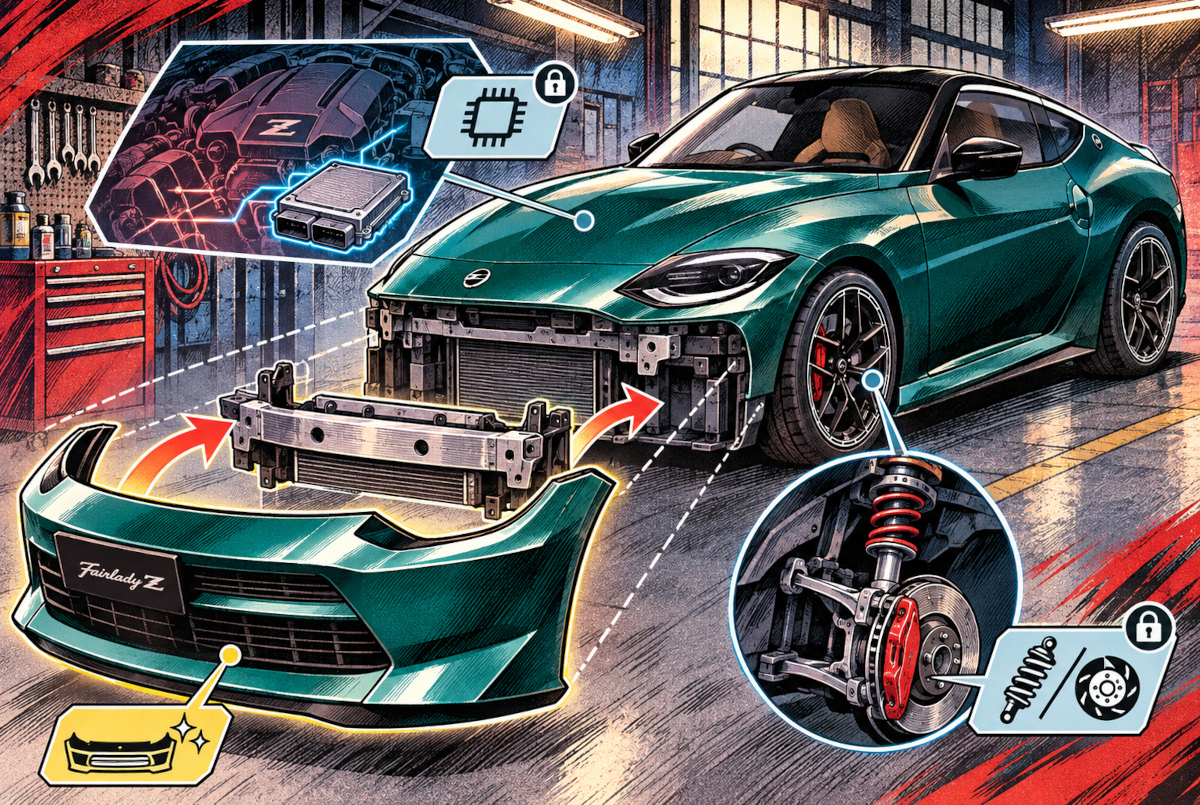
Illustration inspired by the 1990 Skyline GT-R NISMO (BNR32). The two additional NISMO bumper ducts are the rectangular openings beside the upper part of the license plate, not the lower openings highlighted by the yellow guide lines. The production model also featured a hood-edge molding. Some details, including the plate and guide-line placement, are artistic rather than exact reproductions. This is not a period photograph.
The Japanese Art of Making a Regular Car Look Like a NISMO
There is another part of this story that longtime Japanese tuning enthusiasts will recognize.
In the R32 era, owners could fit NISMO-style aerodynamic parts to a regular GT-R. The distinctive front bumper ducts were particularly tempting. Japanese enthusiasts sometimes called this NISMO-bake: essentially, dressing a standard car to resemble a genuine NISMO model.
A related expression, R-bake, referred to turning an ordinary Skyline such as a GTS-t into something resembling a GT-R. They were different modifications, but the underlying fascination was similar: the appearance of the special model mattered.
And the idea hasn’t disappeared.
In February 2024, Japanese tuning publication WEB OPTION documented an RZ34 modified by the specialist shop Advance. The standard Z had received a genuine NISMO front bumper.
According to the report, the bumper itself cost approximately ¥110,000. Once the different reinforcement component and painting were included, the total approached ¥300,000.
That was a reported cost for the front-end conversion, not a complete exterior transformation or a mechanical NISMO conversion. The example also predates the August 2026 facelift; compatibility with the newly revised models has not been established.

Conceptual illustration of an exterior NISMO-style conversion. Replacing bumper components does not automatically provide NISMO-specific engine calibration, suspension tuning or braking performance. Shapes and mounting positions are schematic, not a factory parts diagram. The documented 2024 swap involved a pre-facelift RZ34; fitment on the refreshed 2026 model remains unverified.
Still, that approximately ¥300,000 front-end modification is worth thinking about alongside the ¥2.75 million difference between Version ST and NISMO.
You can imitate some of the appearance without spending anything like the full premium. But a bumper swap cannot reproduce the factory NISMO’s integrated chassis and powertrain tuning.
So What Is the NISMO Badge Actually Worth?
The 1990 R32 NISMO had a clearly defined motorsport purpose and a publicly limited run of 500 road cars. In contrast, Nissan’s August 2026 launch announcement does not specify an equivalent production limit for the refreshed Z NISMO.
A NISMO badge, in other words, does not automatically mean a numbered limited edition.
Yet exclusivity isn’t always just about production numbers. For some buyers, the appeal lies in owning the factory-developed performance version rather than a standard car modified to look like one. The engineering package, the history behind the name and the satisfaction of owning the genuine article can all matter.
What we cannot do is split that ¥2.75 million premium into an exact bill for components, development costs and brand value. Nissan has not published the information needed for such a calculation. Nor does the badge guarantee any particular future resale value.
Fifteen extra horsepower cannot explain the entire NISMO premium. But measurable performance alone cannot account for every reason someone might willingly pay it, either.
Editor’s Note
Back in the R32 days, those little bumper ducts were enough to make you stop and look twice. “Wait, is that a real NISMO?” And of course, plenty of us understood the temptation to fit the same parts to a regular GT-R.
It amuses me that this kind of tuning culture is still alive. It also amuses me that a name attached to a car ¥40,000 cheaper in 1990 can now sit on one costing more than ¥4 million above the entry-level Z. NISMO has certainly moved up in the world.
After going through the specifications, though, I can see why the badge carries more weight than the horsepower figure suggests. You can buy a bumper. You can’t buy the complete factory development process just by bolting that bumper on.
And here’s the annoying part: knowing that only makes the genuine car more desirable.
Maybe the real question for an enthusiast isn’t whether the NISMO is worth ¥2.75 million more on a spreadsheet. It’s whether you want it badly enough to pay the difference. That stubborn gap between what a car can prove and what it makes you feel is exactly why this hobby is so entertaining—and so expensive.
Terms That May Need a Quick Explanation
- Homologation
- Official approval that allows a car or component to meet a racing category’s eligibility requirements. Group A regulations imposed production-volume requirements and limits on permitted modifications, making certain road-car specifications important for competition.
- NISMO-bake
- A Japanese enthusiast expression for making a regular car resemble a genuine NISMO model, often by fitting NISMO-style exterior components. The Japanese word bake here refers to a transformation or disguise. It does not make the converted car a factory NISMO.
References
- Nissan Motor Co. — Nissan Launches the Refreshed Fairlady Z and Fairlady Z NISMO in Japan (August 27, 2026) — Official English release covering Japanese list prices, the new manual NISMO, brake and chassis changes, and the required special paint surcharge.
- Nissan Motor Co. — Japanese Press Release for the Refreshed Fairlady Z and Z NISMO (August 27, 2026) — Original Japanese announcement and price schedule.
- Nissan Japan — Fairlady Z Performance — Official Japanese specifications and explanations of the standard Z’s performance equipment.
- NISMO — Motorsport History, Group A Part 3: The BNR32 Skyline GT-R (1989–1990) — Official historical background on Group A regulations and Nissan’s touring-car development.
- Miki Press M-BASE — Catalogs and Their Era, Part 93 (April 27, 2020) — Japanese archival discussion of period R32 GT-R NISMO catalogs, including its ¥4.41 million price, 500-car public allocation, technical changes and deletion of comfort equipment.
- Goo-net — Nissan Skyline GT-R R32 Catalog and Price Information — Supplementary Japanese historical vehicle-price information.
- WEB OPTION / Motor Fan — Advance’s RZ34 NISMO Bumper Conversion (February 25, 2024) — Japanese specialist report documenting the bumper installation and its approximately ¥300,000 total cost.
- Motor Fan — Refreshed Fairlady Z and Z NISMO Technical Comparison (November 6, 2026) — Japanese specifications used to cross-check manual-transmission vehicle weights, power and torque figures.