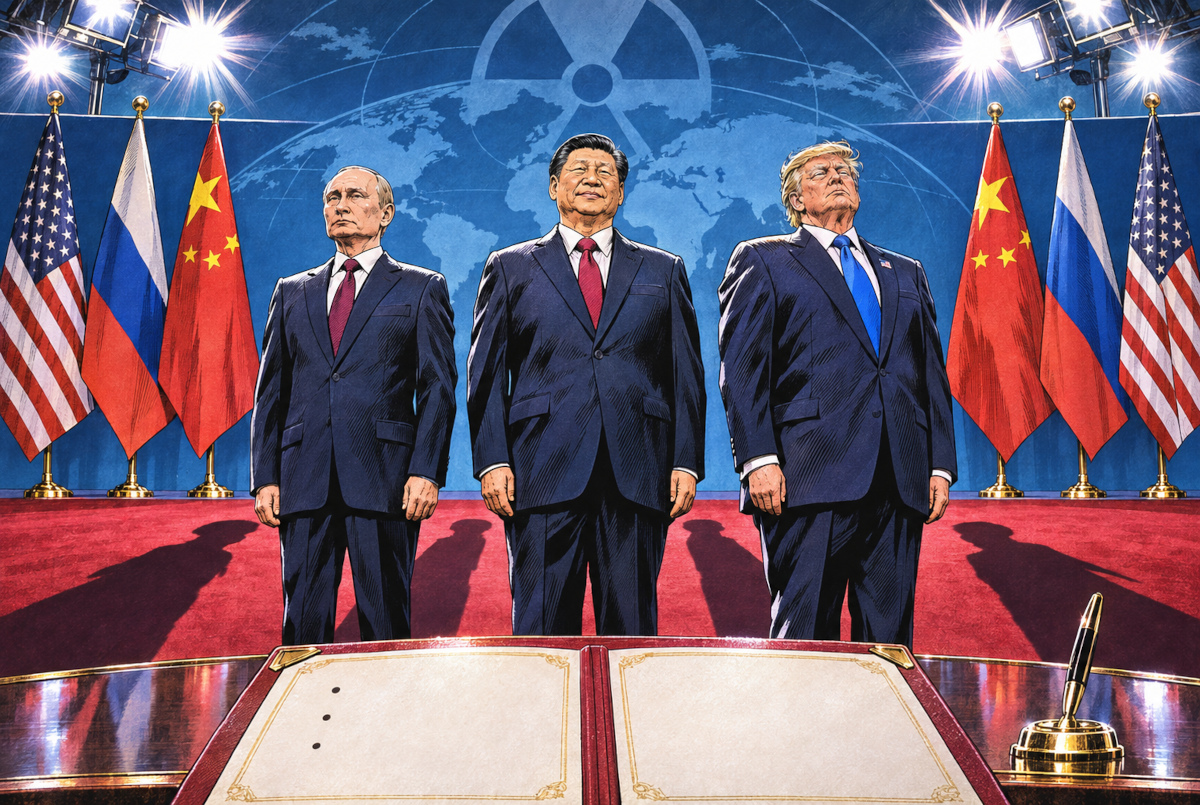
On November 19, 2026, three of the world’s most powerful leaders stood together in Shenzhen, China: Donald Trump, Xi Jinping and Vladimir Putin. The cameras captured a historic moment. The leaders followed it with something even more ambitious in name: a four-point “Declaration toward Peace.”
But what kind of peace were they talking about? Russia’s invasion of Ukraine was ongoing, and the United States remained involved in the war in Iran. Both conflicts involved countries represented in that photograph. So what, exactly, did the three leaders promise to change?
First, one important distinction: Japan was not excluded from APEC. Prime Minister Sanae Takaichi attended the main APEC Leaders’ Meeting, which brought together representatives of 21 member economies. Japan was absent from a separate, three-way summit involving the United States, China and Russia.
Trump’s Closed Eyes, Xi’s Center Stage
Before the trilateral summit, footage from an APEC plenary session showed Trump with his eyes closed for roughly ten seconds while Xi was speaking. The White House denied that he had fallen asleep, saying he was reviewing documents. The footage alone does not establish whether he was sleeping. And importantly, this happened during the main APEC meeting, not the three-leader summit.
Later that day, Trump, Putin and Xi met around a large round table. Xi occupied the central position, with Putin and Trump on either side in the official photographs. China described the gathering as a groundbreaking first in the history of the three countries’ relations.
German Chancellor Friedrich Merz was less impressed. He criticized the Shenzhen meeting as primarily a photo opportunity. The Associated Press also examined how the event’s symbolism, despite limited concrete progress, helped project China’s diplomatic influence.
That raises a rather awkward question: Was the photograph more consequential than the agreement?
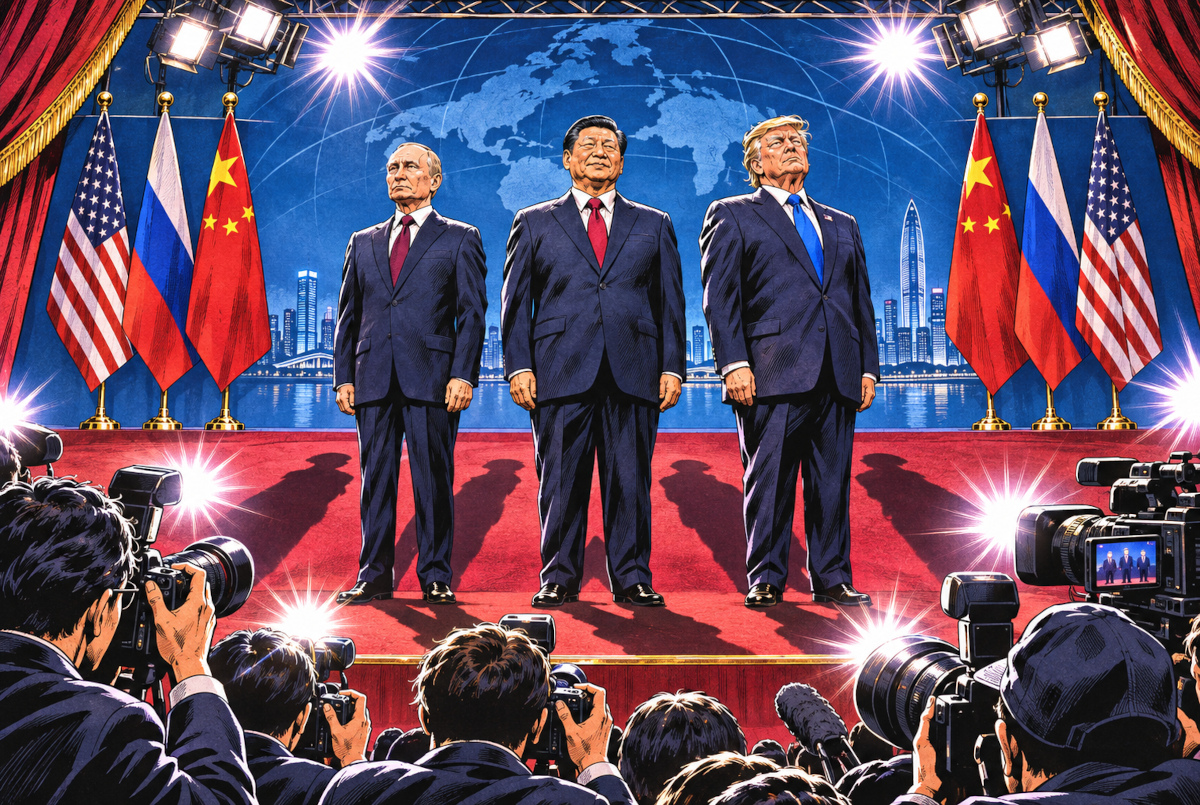
AI-generated editorial illustration inspired by the November 19, 2026, summit in Shenzhen. The venue, photographers and staging are artistic interpretations, not an accurate reconstruction of the actual event.
Four Points in the Peace Declaration—and Some Conspicuous Omissions
The joint declaration published by the White House on November 19 is surprisingly brief. It contains just four substantive points. Reading the original English document, rather than relying on headlines, reveals exactly what was agreed upon.
| Area | What the three countries agreed |
|---|---|
| 1. United Nations | Commit to UN reform so the organization can respond more effectively to global challenges and fulfill its peace and security mission. |
| 2. Energy | Plan to increase the production and supply of refined petroleum products and support stable energy flows. |
| 3. International justice | Emphasize state consent and the immunities of state officials, and oppose abuses of jurisdiction by the International Criminal Court (ICC) and similar bodies. |
| 4. Nuclear weapons | Reaffirm that nuclear war must never be fought and commit to dialogue on nuclear risk reduction and nonproliferation. |
UN reform and the prevention of nuclear war are serious matters. But a close reading reveals something else: the declaration does not explicitly mention the wars in Ukraine or Iran. It specifies no ceasefire conditions, no implementation deadlines and no numerical targets for reducing nuclear arsenals.
There is an important distinction here. According to China’s Ministry of Foreign Affairs, the leaders did discuss Ukraine, the Middle East and other international issues. The absence of those subjects from the joint declaration does not mean they were ignored in the meeting.
What it does mean is that the publicly released agreement contains no concrete plan for resolving those wars. The leaders discussed the crises, but the declaration does not tell us how their discussions would translate into action.
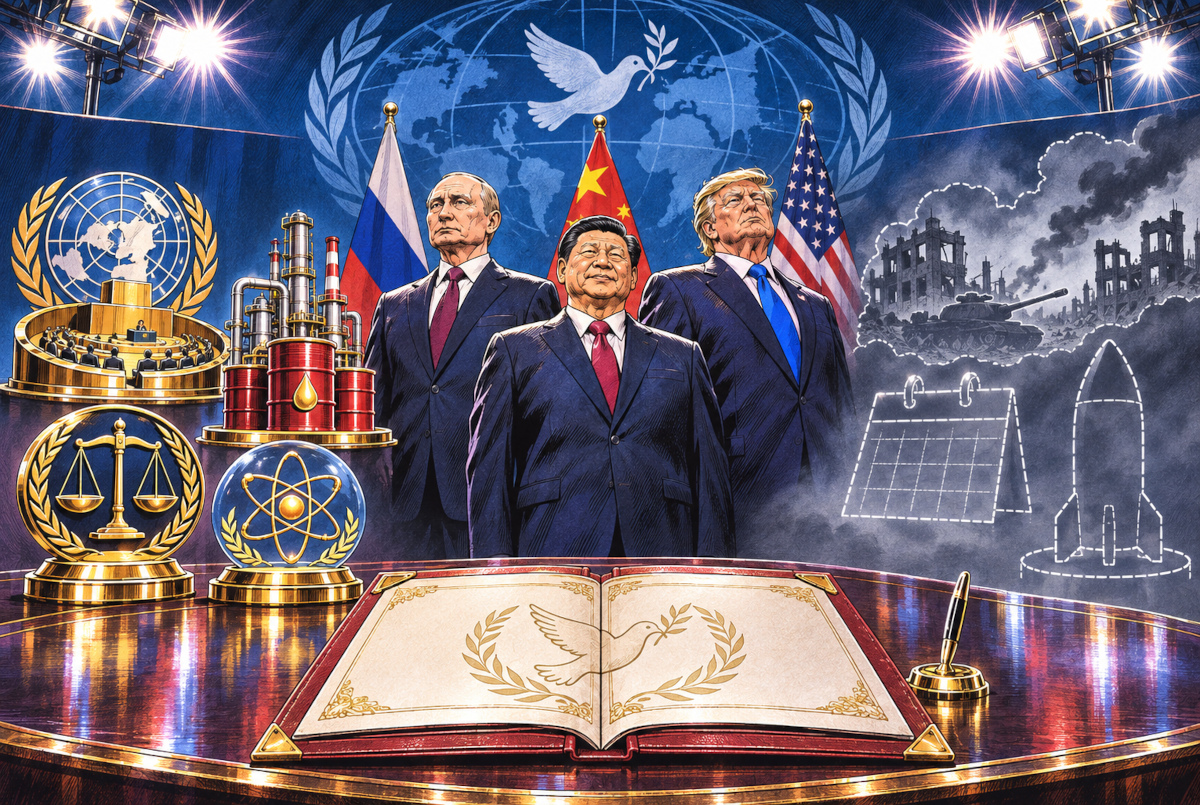
AI-generated conceptual illustration. The four symbols represent UN reform, refined petroleum products, international jurisdiction and nuclear risk dialogue. The unfilled symbols represent specific measures absent from the published declaration, not proof that those issues were never discussed privately.
Three Countries Hold 90.93% of the World’s Nuclear Warheads
One detail bothered me enough to reach for a calculator: just how many nuclear warheads do these three countries possess?
Using the Stockholm International Peace Research Institute’s (SIPRI) estimates for January 2026, the figures are:
United States: 5,042 warheads. Russia: 5,420. China: 620.
Adding the three inventories gives 11,082 nuclear warheads. SIPRI estimates the worldwide total at 12,187.
The calculation is straightforward:
11,082 ÷ 12,187 × 100 = 90.93%
In other words, the three countries at the Shenzhen summit account for approximately 90.93% of the world’s estimated nuclear-warhead inventory. The remaining nuclear-armed countries collectively account for 1,105 warheads, or about 9.07%.
These are total inventory figures, including retired warheads awaiting dismantlement. They do not represent the number of weapons immediately available for military use, nor the number of deployed missiles.
There is a genuine reason to welcome nuclear dialogue. The New START treaty between Washington and Moscow expired on February 5, 2026, leaving an important gap in legally binding strategic arms-control limits between the two countries.
The Shenzhen declaration acknowledges the danger of nuclear war and promises dialogue on reducing nuclear risks. That is not meaningless. But it provides no numerical disarmament commitment, negotiation timetable or verification mechanism.
That is the striking contrast: the leaders of countries holding roughly nine-tenths of the world’s nuclear warheads pledged to discuss nuclear risks, but did not publicly commit to reducing their inventories by any specified amount.
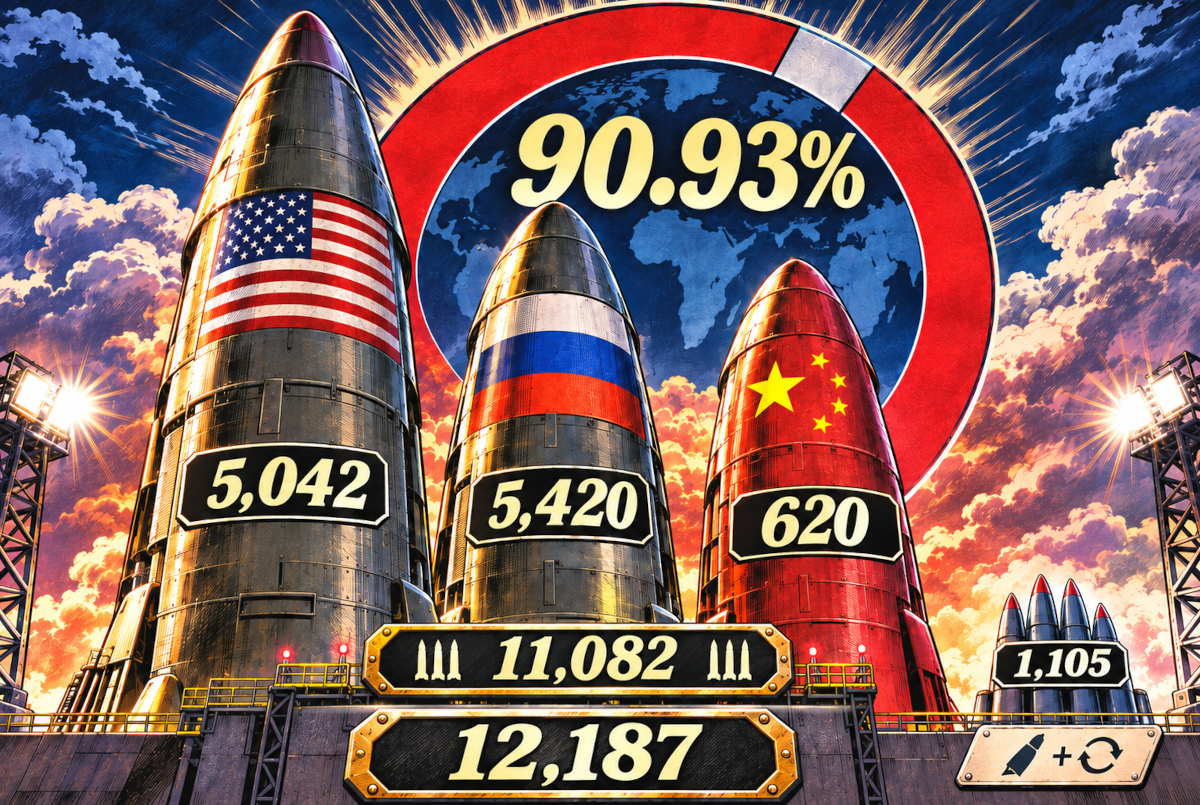
AI-generated infographic using SIPRI estimates for January 2026. The U.S., Russia and China hold a combined estimated inventory of 11,082 warheads out of a global total of 12,187 (90.93%). Figures include retired warheads awaiting dismantlement. Missile shapes and sizes are illustrative and do not represent actual deployments or proportional arsenals.
Japan Wasn’t at the Summit. The ICC Issue May Matter More.
There is another detail in the declaration that deserves more attention than the photograph: its third point, concerning the International Criminal Court (ICC).
In March 2023, ICC judges issued an arrest warrant for Vladimir Putin over alleged war crimes involving the unlawful deportation and transfer of Ukrainian children. In August 2026, the United States imposed sanctions on Tomoko Akane, the Japanese president of the ICC.
The Shenzhen declaration, meanwhile, emphasizes state consent and the immunities of state officials while warning against the abuse of jurisdiction by the ICC and similar institutions.
This places the three countries on common diplomatic ground over the limits of international criminal jurisdiction, despite their many other disagreements. It does not, however, overturn the ICC’s arrest warrant against Putin or change the Court’s legal authority by itself.
Japan’s position provides an especially revealing contrast.
Prime Minister Takaichi participated in the main APEC meeting. On November 18, she spoke with Putin for approximately 30 minutes. On the evening of November 19, Trump briefed her by telephone for about 20 minutes on his meetings with China and Russia.
Japan was therefore not entirely shut out of the diplomatic process. But being briefed afterward is not the same as participating in a three-way negotiation.
More importantly, Takaichi publicly acknowledged that Japan and the United States held different positions regarding the ICC. Japan has consistently supported the Court and its role in upholding international law.
Here is the distinction that tends to get lost in dramatic headlines: Japan’s absence from the trilateral summit did not mean Japan was excluded from APEC, and its disagreement with one part of the declaration is more concrete than simply claiming that Japan was ignored.
Editor’s Note
When I first saw the three leaders standing together, the photograph reminded me of an old-school magazine spread featuring political heavyweights. Three powerful men, serious expressions, an impressive backdrop. Then came the words “peace declaration.” My immediate reaction was: Fine, but what happens to the wars?
What really sent me digging was the nuclear arithmetic. These countries possess about 91% of the world’s nuclear warheads, yet their joint statement offers no specific number of warheads to eliminate. I am not expecting an entire arms-control treaty to emerge from one afternoon’s meeting. But if the announcement is supposed to mark a historic step toward peace, I want to see what the next step actually is.
And the ICC provision is the detail I find hardest to ignore. Japan supports the Court, while its closest security ally has sanctioned the Court’s Japanese president. Then the United States joins China and Russia in issuing a declaration about the limits of international jurisdiction. That is a more consequential diplomatic question than who stood where in the photograph.
The summit may yet lead to useful negotiations. Or it may remain best remembered for its optics. The photograph is finished. The practical roadmap to peace is still missing from the public record.
Terms That May Need a Quick Explanation
- International Criminal Court (ICC)
- A permanent international court based in The Hague, Netherlands. It prosecutes individuals accused of serious international crimes, including war crimes and crimes against humanity, under the conditions set by its founding treaty. Japan is a party to the Rome Statute; the United States, China and Russia are not.
References
- The White House: U.S.-Russia-China Heads of State Declaration toward Peace (November 19, 2026) — Original English text of the four-point declaration.
- Ministry of Foreign Affairs of China: President Xi Jinping Chairs China-Russia-U.S. Summit — Official account of the leaders’ discussions, including Ukraine and the Middle East.
- Stockholm International Peace Research Institute (SIPRI): Global Nuclear Weapon Inventories, January 2026 (PDF) — Original dataset used for the country-level nuclear inventory calculation.
- Hiroshima Prefectural Government: Global Nuclear Weapon Inventories, January 2026 (Japanese) — Detailed SIPRI-based table showing deployed, stored and retired warheads and the global total.
- Ministry of Foreign Affairs of Japan: Prime Minister Takaichi’s Attendance at the APEC Leaders’ Meeting 2026 — Official English account of Japan’s participation. Japanese original.
- Ministry of Foreign Affairs of Japan: Japan-U.S. Summit Telephone Talk (November 19, 2026) — Official English record of Trump’s briefing to Takaichi. Japanese original.
- Ministry of Foreign Affairs of Japan: The Sanctions against the International Criminal Court (August 19, 2026) — Japan’s official response to sanctions against ICC President Tomoko Akane.
- Ministry of Foreign Affairs of Japan: Sanctions on the International Criminal Court (October 9, 2026) — Japan’s continuing support for the ICC and its position on U.S. sanctions.
- FNN Prime Online: Prime Minister Takaichi’s Remarks Following Her Telephone Call with Trump (Japanese, November 19, 2026) — Includes her comments on differing Japanese and U.S. positions regarding the ICC.
- International Criminal Court: Situation in Ukraine — Background on the Court’s proceedings. See also the ICC’s March 17, 2023, arrest-warrant announcement.
- United Nations: Secretary-General’s Statement on the Expiration of the New START Treaty (February 5, 2026).
- Associated Press: One Photo That Captures the Historic Talks Between China, the U.S. and Russia (November 20, 2026) — Analysis of the summit’s diplomatic symbolism.
- Reuters: Trump’s Personalized Diplomacy Hits Its Limits with 3-Way Summit (November 20, 2026) — Diplomatic analysis and German Chancellor Friedrich Merz’s criticism.
- The Guardian: Trump Accused of Falling Asleep During Xi Jinping’s Speech at APEC (November 19, 2026) — Reporting on the footage and the White House response.