

Monks lending money at interest? Using donations meant to honor the dead?
It sounds like a peculiar contradiction, but that is exactly what some Buddhist temples in medieval Japan were doing. Money donated for memorial rites could become capital for loans to merchants and others.
What surprised me was the interest rate. Temple memorial funds were commonly lent at around 2% per month, while ordinary moneylenders charged approximately 5–6%. The temples were actually offering cheaper credit.
Better still, records associated with Kyoto’s Daitoku-ji Temple reveal a financial arrangement involving 16 Sakai merchants, a recorded total of 170 kanmon, and 10 kanmon 200 mon in collected interest around 1506.
We cannot measure divine power. Fortunately, medieval accountants left numbers we can examine.
Temples Didn’t Survive on Prayers Alone
From the Heian period onward, influential Japanese temples and shrines derived income from shōen, or landed estates. Agricultural taxes and rents helped support religious institutions.
These were not merely places of worship. Some were substantial economic organizations with rights to collect revenue from land.
By the later medieval period, warfare and changes in land control made estate income harder to secure in some cases. Religious institutions needed other ways to support their buildings, ceremonies and communities.
One important development, particularly among Zen Buddhist temples, was the financial use of shidōsen—property and funds donated to support memorial rites for the dead.
The arrangement was remarkably practical. A donor contributed money for Buddhist memorial services. Instead of spending the entire donation immediately, the temple could retain it as capital and lend it to borrowers.
Those borrowers paid interest. The income could then finance further memorial rites and temple operating expenses.
The donation was not simply spent. It became capital capable of generating recurring income.
The closest modern analogy is an endowment fund, although medieval temple finance operated under very different laws and institutions.
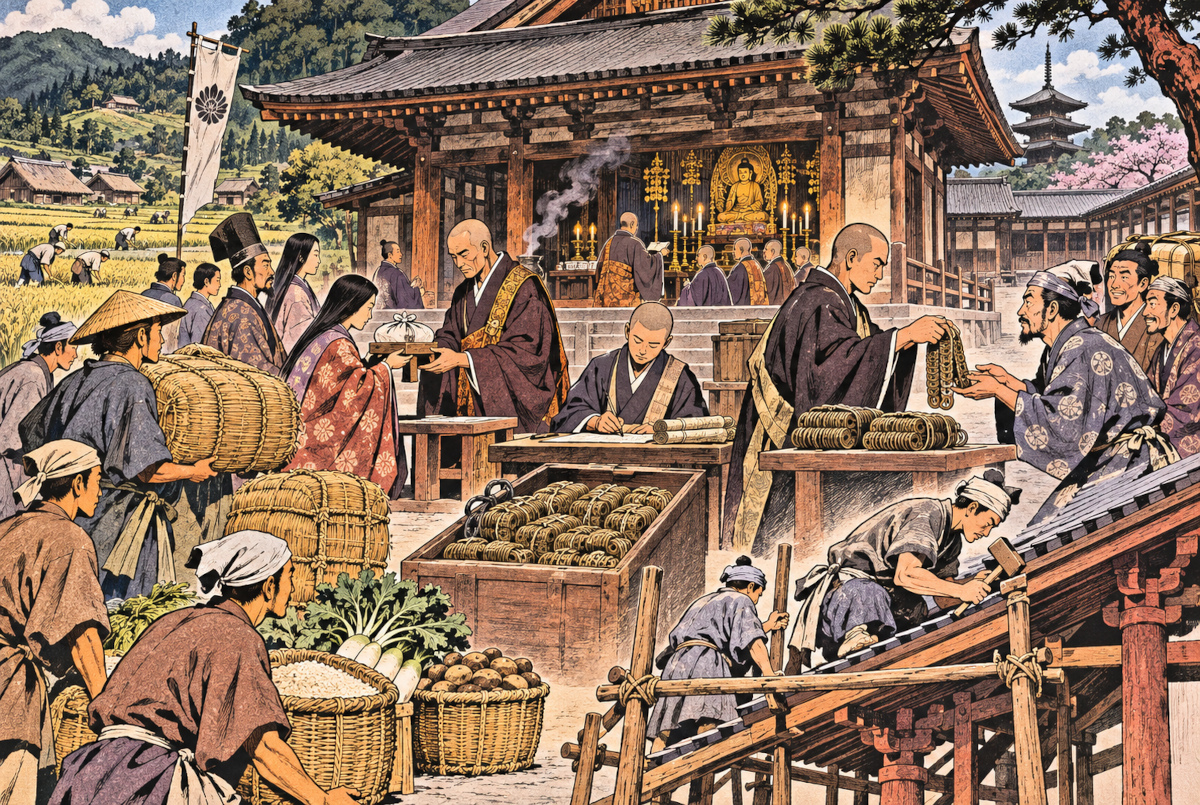
AI-generated conceptual illustration of medieval temple finances. It combines estate revenues, memorial donations, merchant lending, interest income and temple maintenance in one scene. The people, buildings and activities are not an exact reconstruction of one temple or a single historical moment.
Was a 2% Monthly Temple Loan Cheap? Let’s Do the Math
A 2023 study by Tomoko Watanuki of Kobe University examines how shidōsen funds were lent and managed in late medieval Japan.
The study describes a typical monthly interest rate of approximately 2% for shidōsen lending, compared with a standard rate of around 5–6% for private lenders such as dosō.
Suppose someone borrowed 100 mon, a unit of medieval Japanese currency, for one month.
| Type of lending | Monthly interest | Interest on 100 mon for one month |
|---|---|---|
| Typical shidōsen lending | 2% | 2 mon |
| Typical private lending | 5% | 5 mon |
| Typical private lending | 6% | 6 mon |
With the same principal and the same borrowing period, the private lender charged 2.5 to 3 times as much interest.
Of course, 2% per month would be expensive by many modern lending standards. But relative to the comparison rates documented for the period, temple lending was comparatively cheap.
These are historical reference rates, not proof that every temple or moneylender charged identical terms.
There was another advantage for lenders.
In 1441, the Muromachi shogunate—the military government of the time—issued a tokusei debt-relief order. Certain shidōsen loans, including those properly registered in temple records and charging no more than 2% monthly interest, were exempted from the debt cancellation.
In other words, qualifying temple loans did not merely offer lower rates. Their creditors also received a particular form of legal protection.
Money donated for religious remembrance had become a financial asset with institutional privileges.
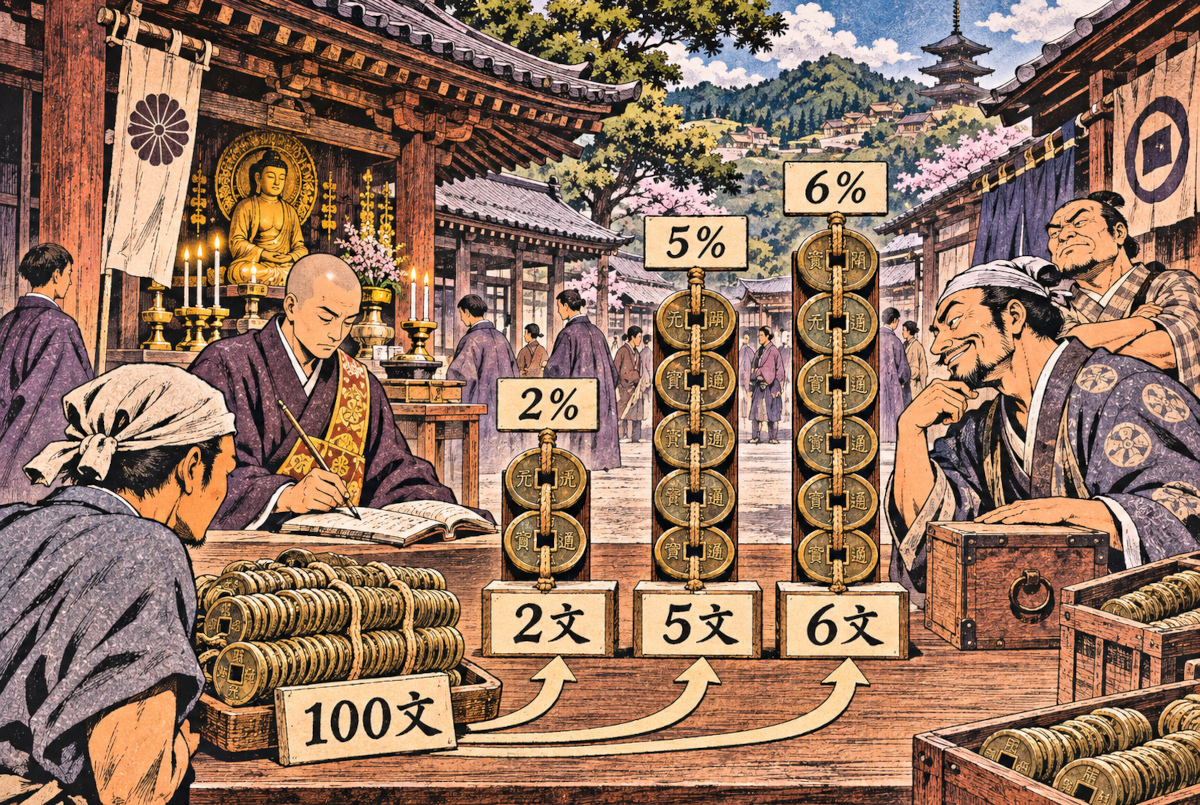
Illustrative comparison using historical reference rates. On a 100-mon loan for one month, 2% interest amounts to 2 mon, while 5–6% amounts to 5–6 mon. These figures are representative rates discussed in historical research, not universal contract terms. The characters and coin details are artistic interpretations.
In 1502, Someone Specified Exactly How the Profits Should Be Split
Here is where the historical evidence gets particularly interesting.
A document dated December 20, 1502, concerning Daitoku-ji Temple in Kyoto discusses a donation of 100 kanmon in shidōsen associated with Owa Sōrin, a wealthy merchant from Sakai.
Sōrin had died the previous year. The document records instructions concerning the use of income generated by the donated funds.
The annual proceeds were to be divided equally:
50% for the temple’s ordinary operating expenses, and 50% for meals provided to monks during memorial observances.
There is an important distinction here. The agreement did not simply divide the original 100 kanmon into two portions.
It specified how the income produced by the fund was to be distributed.
That is a very different financial arrangement from handing over money to pay for a single ceremony.
The capital could remain in use, while its returns supported continuing religious obligations and the temple itself.
Faith and financial management were not competing ideas in this document. They were components of the same arrangement.
170 Kanmon, 16 Merchants, and a Recorded 6%: What Does It Really Mean?
Another document, apparently dating from 1506, concerns the management of memorial funds associated with Shōgen-in, a subtemple of Daitoku-ji.
It lists 16 Sakai merchants connected with funds totaling 170 kanmon. The interest received for the period from the first through the sixth month of 1506 amounted to 10 kanmon 200 mon.
One kanmon equals 1,000 mon. Converting the recorded amounts into the same unit gives:
Recorded total: 170,000 mon
Interest received: 10,200 mon
The calculation is straightforward:
10,200 ÷ 170,000 × 100 = 6.0%
At first glance, that might look like a six-month interest rate. But that interpretation would be misleading.
The 6.0% figure is simply the recorded interest receipts divided by the recorded total amount of funds. It is not the contractual rate charged to every borrower, nor is it the temple’s net profit margin.
Watanuki’s research shows that payment marks can be identified for seven of the 16 merchants. The recorded 170 kanmon also includes movements of funds between individuals and a 10-kanmon contribution associated with repairs.
We therefore cannot assume that the entire amount was continuously lent for six months on identical terms. Nor can we conclude that the remaining nine merchants deliberately defaulted.
What the records establish is that the temple tracked funds, managed loans, collected interest and documented payments.
There is another revealing detail. The local administrative work was connected with Yōshun-an, a Daitoku-ji-affiliated religious establishment in Sakai.
Its personnel handled interest collection and reports to Shōgen-in in Kyoto. Rather than every transaction being performed directly at the main temple, financial administration could involve people working in different places.
The merchants were not necessarily borrowing for religious purposes. The study suggests that the funds could be used in commercial activities, including trade, although the precise business activities of every individual are not documented.
Money originally donated for memorial services was helping finance economic activity beyond the temple walls.
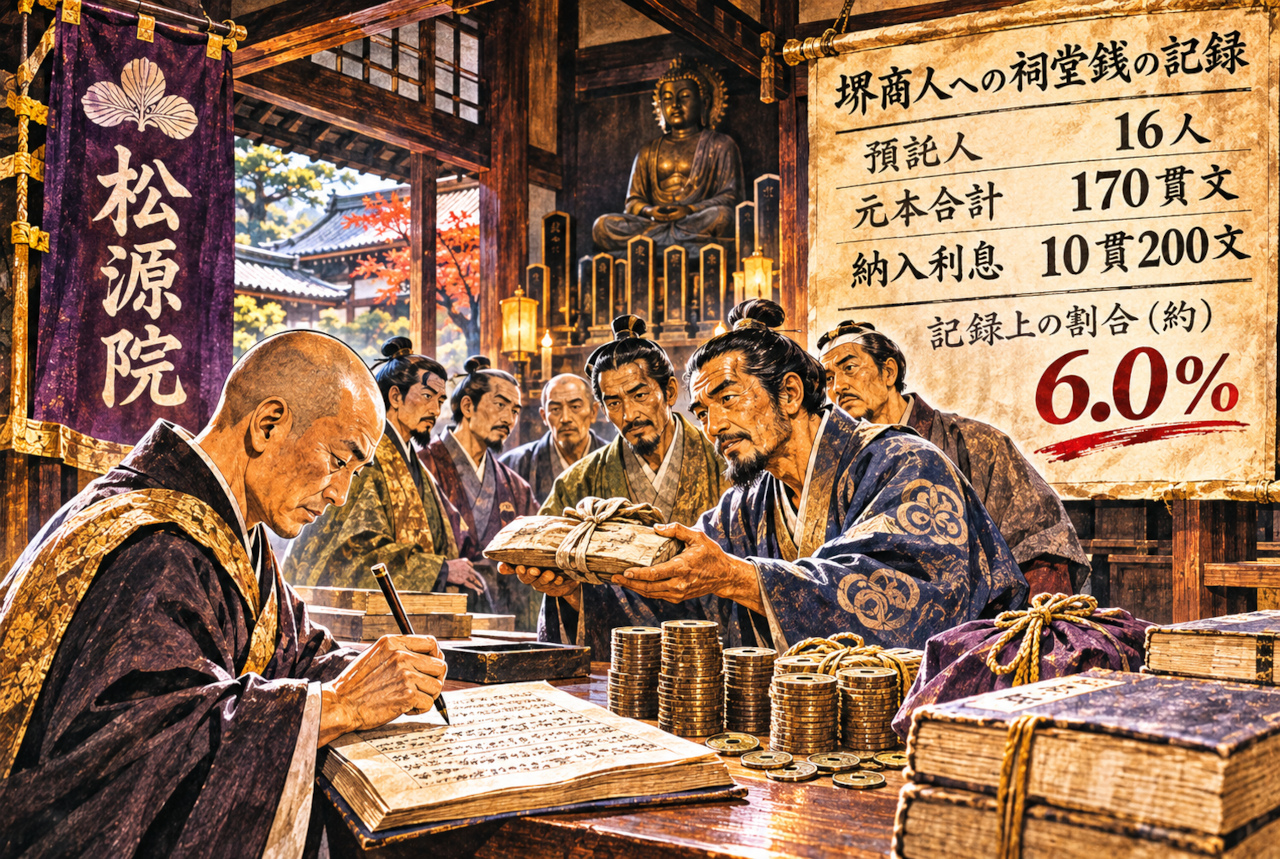
AI-generated interpretive illustration based on records associated with Shōgen-in around 1506. The 16 merchants, 170 kanmon and 10 kanmon 200 mon in recorded interest receipts are drawn from historical research. The calculated 6.0% is the ratio of recorded receipts to the recorded total, not a contractual interest rate. Personnel at Yōshun-an in Sakai were involved in collecting and reporting the payments. The people, interior and displayed accounting board do not reproduce an actual documented scene or surviving ledger.
So Were Medieval Temples Really Banks?
Not in the modern sense.
Medieval Japan had no banking system equivalent to today’s regulated institutions. Lending, credit arrangements and property management were conducted by temples, merchants, dosō and various other participants.
Nor did temples suddenly discover lending during the late medieval period. Accounts of temple-related lending can be found in much earlier Japanese sources.
Still, the financial functions described in these records are unmistakable.
Temples retained capital contributed for religious purposes, documented borrowing arrangements, collected interest and allocated the proceeds to specified expenses.
Calling them “medieval banks” is an analogy, not a precise institutional description. But it captures one remarkable fact: religious organizations could function as important participants in the credit market.
Editor’s Note
I don’t believe in gods or Buddhas. And I seriously doubt that the dead care about interest rates.
The living, however, were remarkably attentive to every detail. They recorded principal, negotiated terms, checked payments and specified exactly where the returns were supposed to go.
So much for the idea that monks spent all their time contemplating the mysteries of existence. They could be pretty sharp with the accounts, too.
I’ll admit that I went into this expecting to find an uncomplicated story about religious moneylenders charging outrageous interest. Instead, the evidence pointed to comparatively low rates and an arrangement designed to keep memorial services funded over time.
That was not quite the scandal I expected.
What still strikes me as peculiar is the journey the money took. A donation made in memory of someone who had died could wind up financing a merchant’s business.
No supernatural intervention was needed to generate that income.
People took religious belief, built a financial system around it, and made the money circulate.
If you ask me, the person who figured out that arrangement was performing a more impressive feat than any statue ever could.
Are Shrines and Temples Businesses? — Seven-Part Series
Faith, donations, land, lending, and religious authority. From the construction of Nara's Great Buddha to modern religious finances, this seven-part investigation examines how money and religion became intertwined in Japan.
- Part 1: Belief Is Free. Building a Giant Buddha Isn’t: Nara’s 2.6 Million Mystery (Part 1)
- Part 2: Money for the Dead, Loans for the Living: Medieval Japan’s Temple Lenders (Part 2)
- Part 3: English edition Coming soon
- Part 4: English edition Coming soon
- Part 5: English edition Coming soon
- Part 6: English edition Coming soon
- Final Part: English edition Coming soon
Terms That May Need a Quick Explanation
- Shōen (荘園)
- Landed estates that generated income for aristocrats, major temples and shrines, and other powerful groups in premodern Japan. Revenue-collection rights were particularly important, and the system differed from modern landownership.
- Shidōsen (祠堂銭)
- Money or property donated to support memorial rites for the deceased. In medieval Japan, such funds could be lent to borrowers, with interest income used for memorial observances and temple expenses.
- Dosō (土倉)
- A term associated with medieval Japanese lenders and facilities involved in lending, collateral and financial transactions. The historical category does not correspond exactly to a modern bank or pawnshop.
- Tokusei (徳政)
- In this context, measures issued by medieval military governments concerning debt cancellation or debt relief. Their scope and exemptions varied according to the specific order.
References
- Tomoko Watanuki, “A Study on the Use of Shido-sen in the Late Middle Ages” (2023), Kokumin Keizai Zasshi, Vol. 227, No. 3, Kobe University (Japanese). The main research source for memorial-fund lending, interest rates, the 1441 debt-relief exemptions, the 1502 allocation of proceeds, and the 1506 records involving Sakai merchants.
- Habikino City — “Shōen” (Landed Estates) (Japanese). Official municipal historical explanation of the development of estates and their role in providing revenue to powerful temples and other institutions.
- Bank of Japan, Currency Museum — “The Emergence of Coin Selection: The Breakdown of One Coin = One Mon” (Japanese). Background material on monetary circulation and coin-quality issues in late medieval Japan.
- Yukiko Sakō, “On the Origins of Interpretations of Dosō in Medieval Japan,” Legal History Review, Vol. 68 (2019) (Japanese). Research questioning the conventional treatment of dosō as a single, straightforward category of professional moneylender.