
If you have ever built an electronics project, chances are you know the names PIC, AVR, or perhaps Hitachi’s H8. Today, the ESP32 is a familiar choice for countless hobbyists. But the story of the goes much further back—to a tiny Texas Instruments device introduced in 1974: the TMS1000.
Here is the part that caught my attention. The TMS1000 had just 32 bytes’ worth of RAM. Not 32 gigabytes. Not megabytes. Not even kilobytes. Just 32 bytes. What on earth could you control with that?
Comparing TI’s original technical documentation with the specifications of the first-generation ESP32 reveals a 16,640-fold difference in RAM capacity between devices introduced roughly 42 years apart.
The Intel 4004 Arrived in 1971—but a CPU Was Not Yet a Complete Microcontroller
In November 1971, Intel introduced the 4004, a 4-bit microprocessor born from a calculator project for the Japanese company Busicom.
It was a remarkable achievement. But there is an important distinction: the 4004 was a , not a complete microcontroller on its own.
Intel’s MCS-4 family divided the job among several . The 4004 executed instructions, the 4001 stored program instructions in , the 4002 provided RAM for working data, and the 4003 was a shift register used to expand input/output capabilities.
Even a minimal programmed MCS-4 system needed at least the CPU and a ROM chip. The other devices could be added according to the application’s requirements.
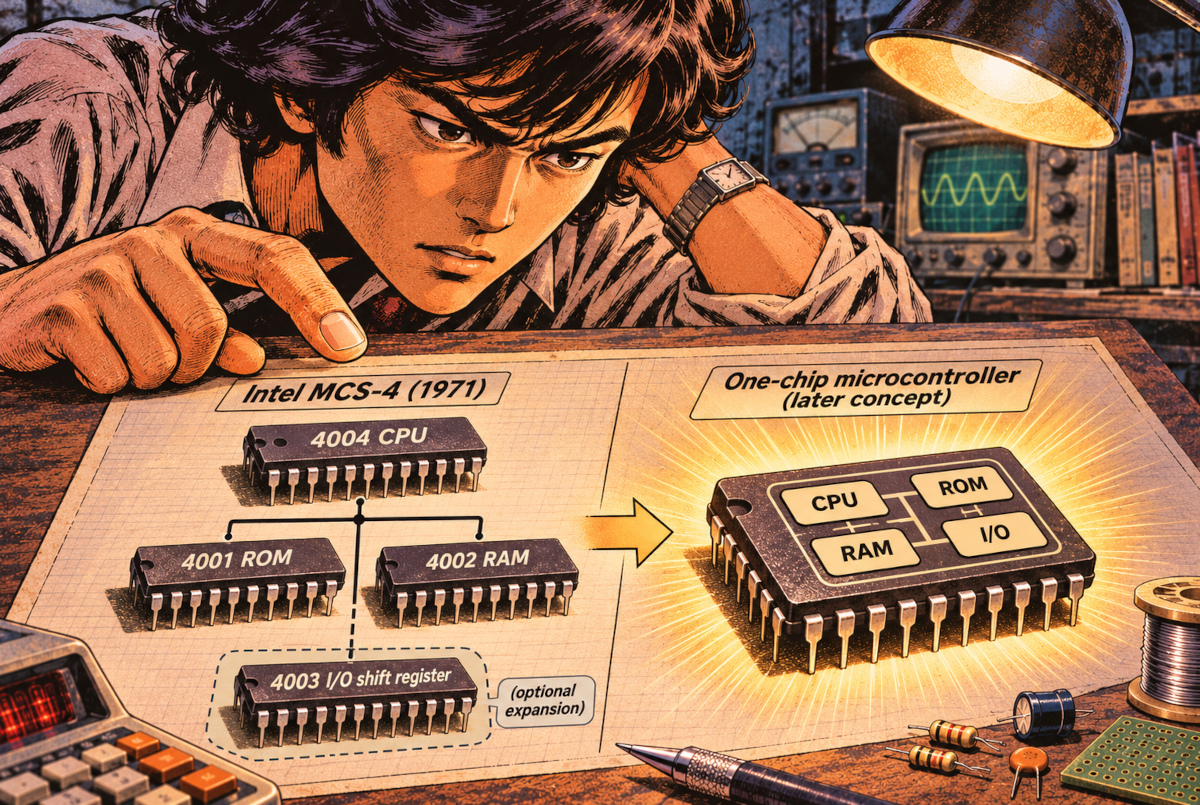
Conceptual comparison of Intel’s MCS-4 architecture and a later single-chip microcontroller. The 4003 provided optional I/O expansion, while the 4002 was not required in the minimum configuration either. Chip connections are simplified for illustration.
That distinction explains the terminology. A CPU performs calculations and executes instructions. A microcontroller unit (MCU) brings a CPU, memory, and input/output functions together on one chip to control a device.
Today, that arrangement seems perfectly ordinary. In the early 1970s, it represented a fundamental change in how electronic products could be designed.
In 1974, Texas Instruments Put the Controller on One Chip
Texas Instruments announced the TMS1000 family in 1974. Developed from earlier single-chip calculator technology, it became one of the pioneering general-purpose microcontroller families.
TI’s 1975 technical manual shows what was inside: a 4-bit arithmetic unit, program ROM, data RAM, input circuitry, output circuitry, and oscillator circuitry—all integrated into one IC.
To see why this mattered, I compared four early devices using their historical specifications.
| Device | CPU | Program ROM | Data RAM / Registers |
|---|---|---|---|
| Intel 4004 1971 |
4-bit | External | External |
| TI TMS1000 1974 |
4-bit | 1,024 × 8 bits | 64 × 4 bits |
| GI PIC1650 1976 |
8-bit | 512 × 12 bits | 32 eight-bit registers |
| Intel 8048 1976 |
8-bit | 1,024 × 8 bits | 64 bytes |
Compiled from contemporary manufacturer documentation and technical histories. The Intel 4004 also contained internal registers, but the table distinguishes those from external working-data RAM. The PIC1650’s 32 registers included special-purpose control registers. Program ROM capacities are shown with their instruction-word widths and should not be compared as if every word were the same size.
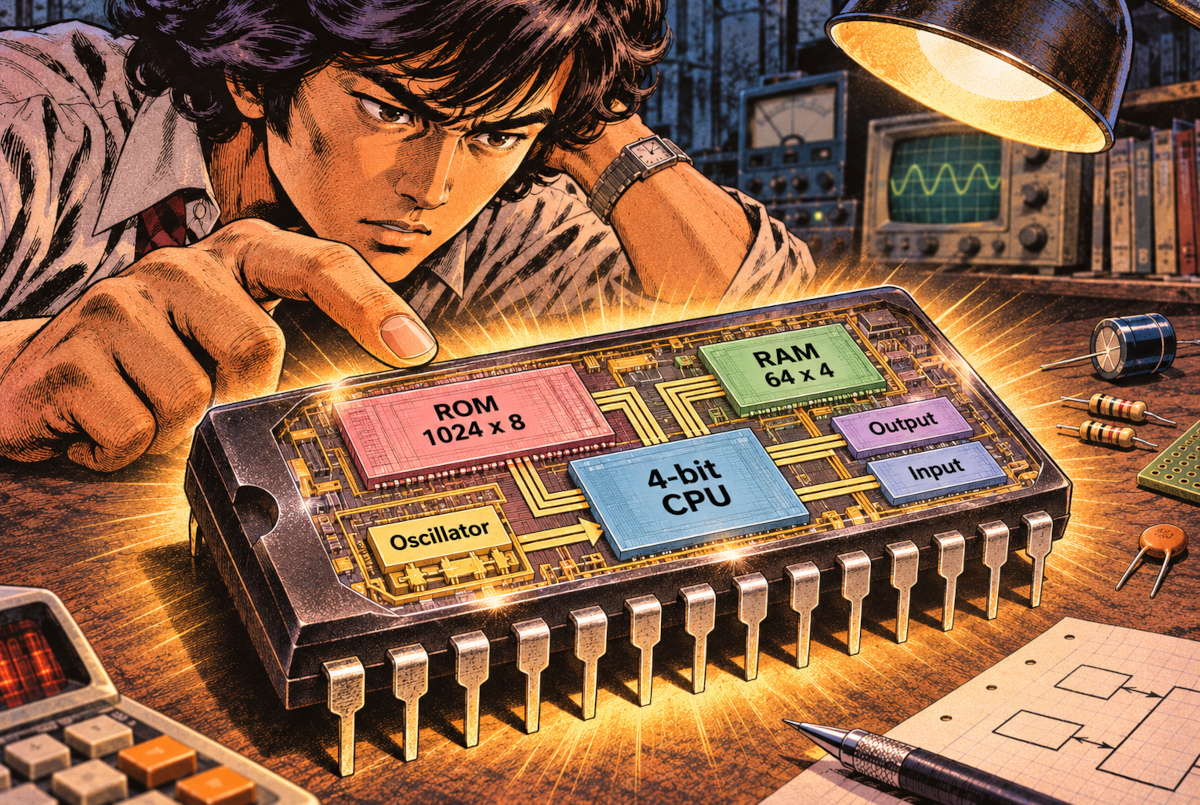
Simplified TMS1000 architecture based on TI’s 1975 documentation. Program ROM contained 1,024 eight-bit words, while RAM contained 64 four-bit words, equivalent to 32 bytes of storage. The positions and connections of the blocks are illustrative, not a photograph or an exact physical die layout.
The TMS1000’s RAM organization is worth examining. It contained 64 storage locations, each holding four bits:
64 × 4 = 256 bits
Since eight bits equal one byte:
256 ÷ 8 = 32 bytes
Strictly speaking, the device used four-bit memory words rather than modern eight-bit bytes. The 32-byte figure is a capacity equivalent.
That tiny memory could hold input states, counters, and small working values while the program carried out predefined control operations. It was not intended to store documents or large amounts of data. Its job was to remember just enough to make a machine respond correctly.
And that leads to a rather different question: if the entire system was so limited, why was integrating it on one chip such a big deal?
Why Squeeze Everything into a Single IC?
The answer was not simply to make computers smaller.
Fewer IC packages meant fewer connections, less wiring, less circuit-board space, and fewer components to assemble. For products manufactured in quantity, that could reduce production complexity and improve reliability.
A controller no longer had to occupy an elaborate collection of separate chips just to perform a relatively simple job.
But there was an awkward trade-off.
The TMS1000 used mask ROM. Its program was fixed during semiconductor manufacturing. TI’s 1975 documentation described a development process in which a program was prepared, simulated, and submitted to the manufacturer so that the appropriate mask-programmed devices could be produced.
You could determine how the machine behaved by writing a program. What you could not do was take the finished production chip, connect a USB cable, and rewrite it whenever you changed your mind.
That distinction is easy to overlook when looking at modern microcontrollers. A programmable controller was a major advance, but programmability did not necessarily mean convenient reprogramming after manufacture.
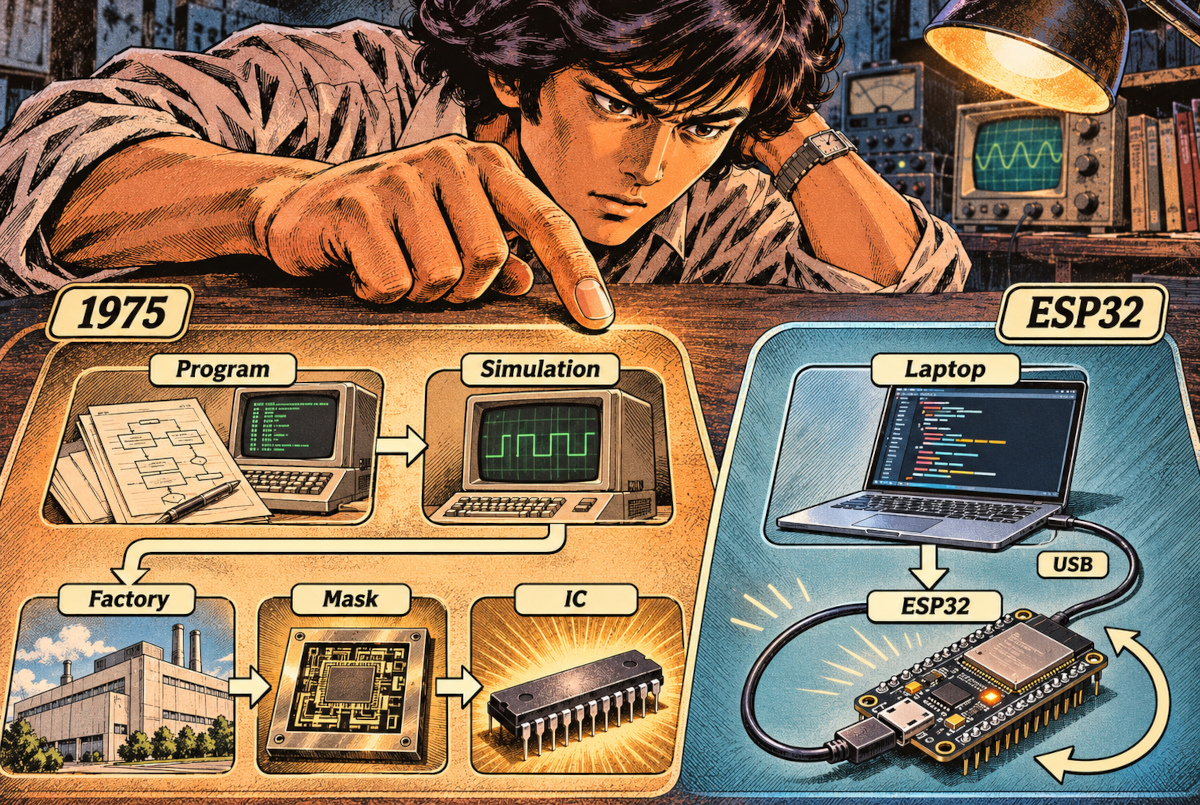
Conceptual comparison of TMS1000 development in 1975 and a modern ESP32 development workflow. The historical process involved manufacturer-made masks, prototype evaluation, and production; intermediate steps are omitted. Modern ESP32 development boards commonly use USB-to-UART circuitry for firmware uploading, rather than native USB on the original ESP32 chip.
From 32 Bytes to the ESP32: How Big Is the Difference?
Now for the comparison that started this investigation.
According to Espressif’s official datasheet, the original ESP32 family, launched in 2016, provides 520 KB of on-chip SRAM.
Using 1 KB = 1,024 bytes:
520 × 1,024 = 532,480 bytes
Divide that by the TMS1000’s 32-byte RAM equivalent:
532,480 ÷ 32 = 16,640 times.
That is the difference in stated RAM capacity between a 1974 controller and the original 2016 ESP32—a gap of 42 years between their introduction dates.
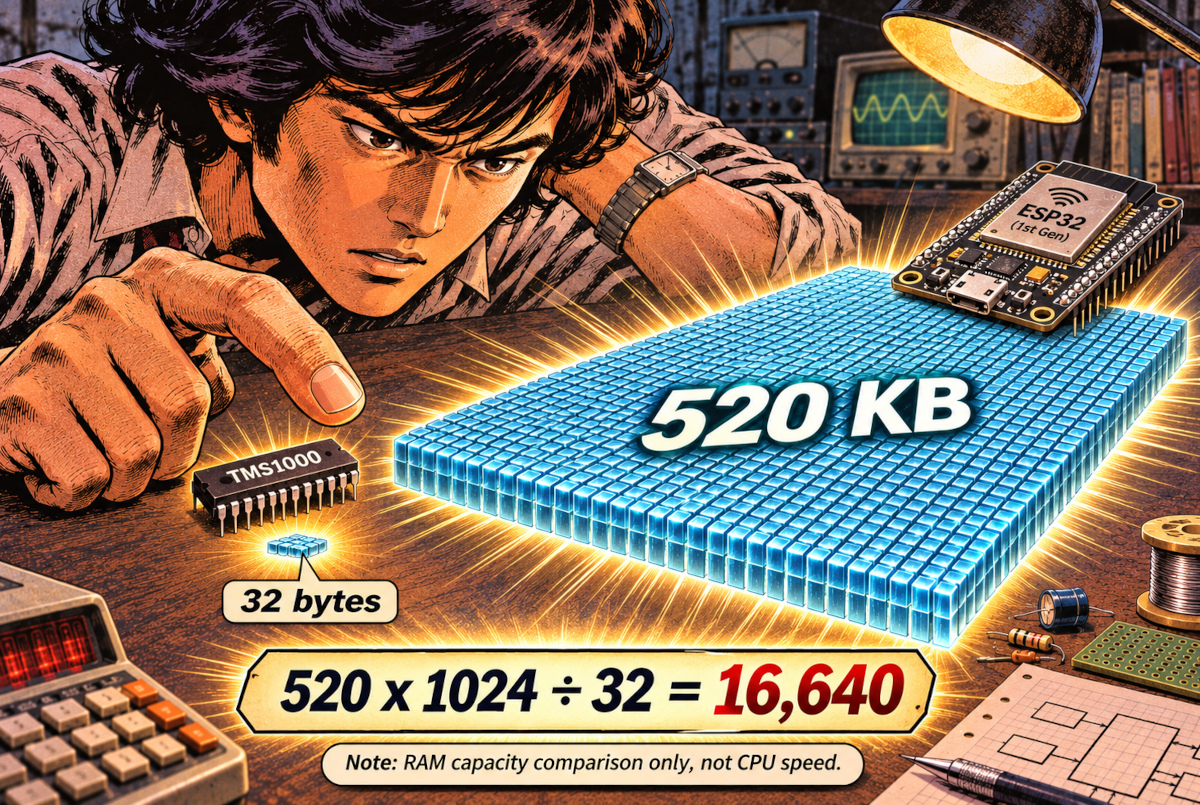
Comparison of the TMS1000’s 32-byte RAM equivalent and the original ESP32’s rated 520 KB of on-chip SRAM. Using 1 KB = 1,024 bytes gives a capacity ratio of 16,640:1. The illustrated memory blocks are not drawn to an exact numerical or area scale. This compares memory capacity, not CPU performance.
There are important limits to that comparison. The processors use fundamentally different architectures and memory organizations, and not every byte of the ESP32’s SRAM is freely available to an application.
So the figure does not mean that the ESP32 processes instructions 16,640 times faster. It is a comparison of nominal memory capacities, nothing more.
Still, there is something remarkable about the journey from a machine controller with 32 bytes’ worth of RAM to a chip that combines processing, Wi-Fi, and Bluetooth.
Perhaps the more surprising lesson is that the original TMS1000 did not need enormous memory in the first place. It needed enough memory to perform its particular job. That basic principle has never disappeared from embedded engineering.
Editor’s Note
I originally assumed that PIC might be somewhere near the beginning of the single-chip microcontroller story. Then I started looking through the older documentation and found the TMS1000 waiting there, years earlier.
What really got me, though, was the development process. Write your program, check it, send it off, and have the IC manufactured. Today, a hobbyist can upload a new program repeatedly just to get one LED blinking properly. Back then, the stakes of getting the program right were rather different.
And yet I can see the appeal. Imagine squeezing a set of instructions into that little piece of silicon, connecting it to a circuit, and watching the hardware do exactly what you told it to do. That is the sort of moment that makes somebody want to become an engineer.
There is one more historical oddity I cannot leave alone. By 1974, the single-chip microcontroller already existed. Yet when the microcomputer craze took off in Japan, the machine that captured so many enthusiasts’ imaginations was a circuit board carrying separate CPU and memory chips.
Next in Part 2: From NEC’s 1976 TK-80 to Hitachi’s H8. Why did Japanese electronics enthusiasts fall in love with a board full of exposed ICs when a one-chip computer had already been invented?
Terms That May Need a Quick Explanation
- Mask ROM
- Read-only memory whose contents are defined during semiconductor manufacturing. It is suitable for mass production but cannot ordinarily be reprogrammed after the chip has been manufactured.
The History of One-Chip Microcontrollers: From Early MCUs to IoT — Seven Parts
From the Intel 4004 and TI TMS1000 to Japan's TK-80 and H8, PIC, Arduino, Raspberry Pi, and ESP32. Seven articles trace how embedded control evolved into IoT.
|
|
|
|
|
|
|
References
- Intel, “Announcing a New Era of Integrated Electronics” — The development of the Intel 4004 and its origins in Busicom’s calculator project.
- Intel, “MCS-4 Micro Computer Set Users Manual” (1973, archived copy) — Original specifications and system architecture for the 4004, 4001, 4002, and 4003.
- Computer History Museum, “1974: General-Purpose Microcontroller Family is Announced” — The TMS1000’s origins and its place in early MCU history.
- Texas Instruments, “TMS1000 Series MOS/LSI One-Chip Microcomputers” (1975, archived copy) — Original architecture, ROM and RAM organization, and program development procedures.
- General Instrument, “Microelectronics Data Catalog” (1977, archived copy) — PIC1650 program ROM and register-file specifications.
- Microchip Technology, “8-bit PIC MCUs” — The history and development of the PIC microcontroller family.
- Intel, “8048H/8035HL Data Sheet” (1980, archived copy) — Specifications for the Intel 8048 family, including on-chip memory and I/O.
- Espressif Systems, “ESP32 Series Datasheet” — Official on-chip SRAM specification used in the 16,640-fold comparison.
- Espressif Systems, “Chip Series Comparison” — The original ESP32 family’s 2016 launch year and 520 KB SRAM specification.
- Information Processing Society of Japan, Computer Museum, “TK-80” (Japanese) — Historical documentation of NEC’s 1976 microcomputer training kit, discussed in Part 2.