
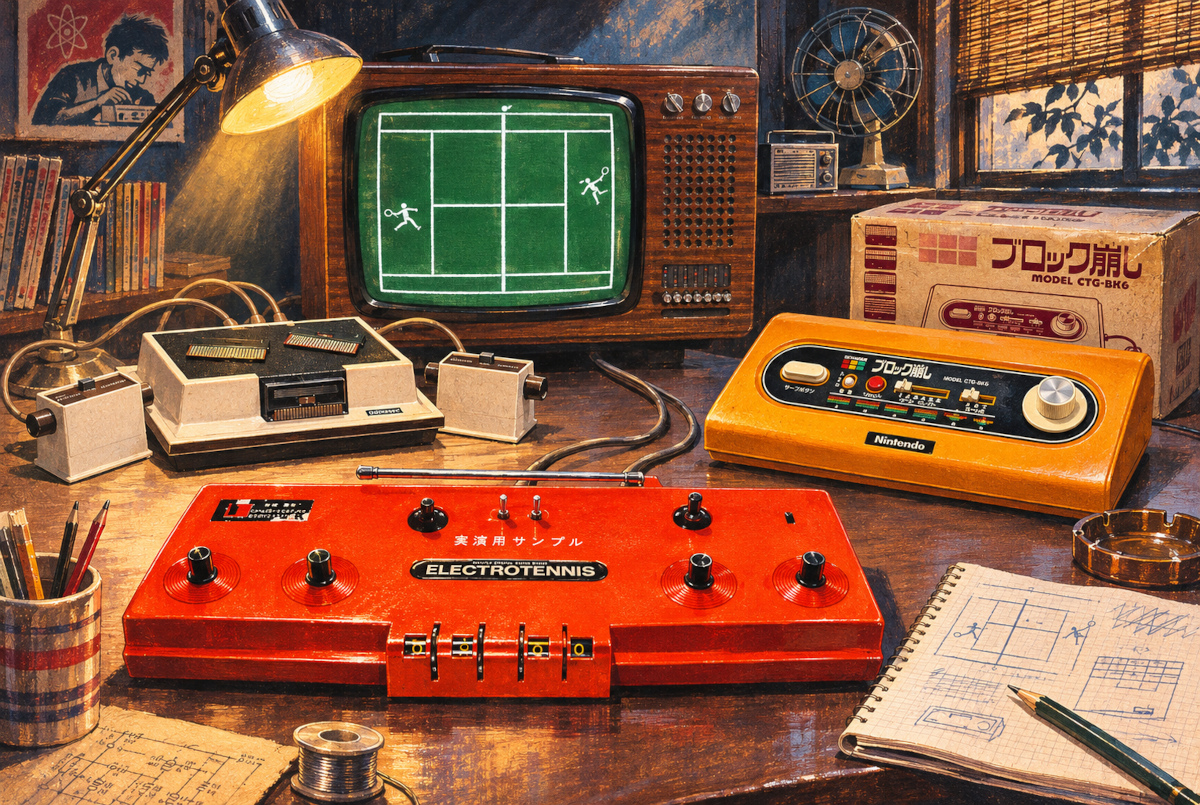
The Nintendo Famicom arrived in 1983. But Japan had already produced a home television game eight years earlier—and it came from a company better known for tabletop baseball games.
In 1975, Japanese toy manufacturer Epoch released TV Tennis. Nintendo and other companies soon entered the market, offering machines that turned an ordinary television into a playing field for electronic tennis, hockey, and eventually block-breaking games.
So what exactly changed between those early experiments and the Famicom? Looking at manufacturers’ records, launch prices, and interviews with the engineers reveals something remarkable: within just two years, a Japanese home game console appeared at roughly half the price of an earlier rival, while the technology behind the games was undergoing a fundamental change.
The First Commercial Home Video Game Console Came From America
In 1972, the American electronics company Magnavox released the Odyssey, widely recognized as the world’s first commercial home video game console. The Smithsonian Institution preserves an example of this pioneering machine.
Its electronic display was remarkably simple: white rectangles, dots, and lines. To create more elaborate playing fields, users placed transparent colored overlays directly on the television screen. The console itself did not generate the detailed backgrounds or illustrated players seen on those overlays.
Also in 1972, Atari introduced the coin-operated arcade game PONG. Unlike the Odyssey, PONG was designed for commercial locations rather than the living room. Atari’s home version followed in 1975, sold through the American retailer Sears under the Tele-Games Pong name.
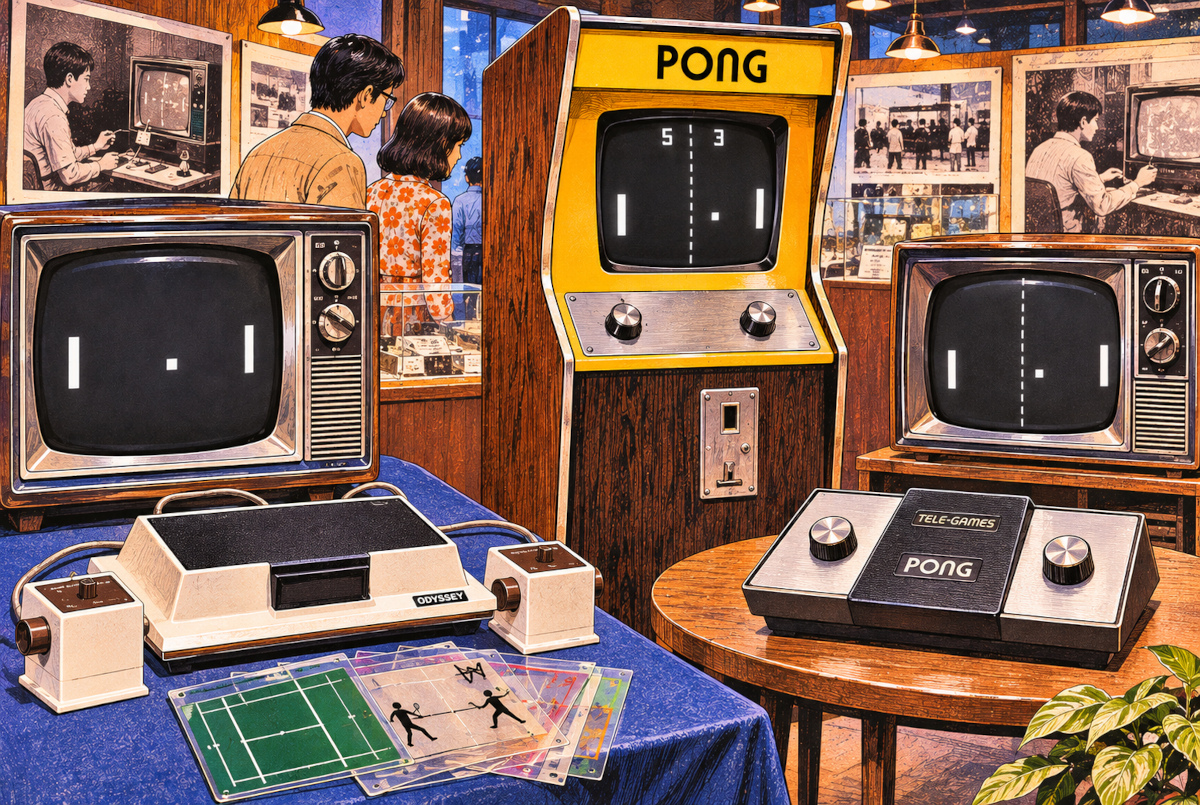
Illustration of three early video game machines from 1972–1975. The Odyssey generated simple white shapes and used transparent screen overlays for visual backgrounds. Console displays, connections, and certain hardware details are simplified for explanation.
In 1975, the Company Behind Japan’s Tabletop Baseball Game Entered Video Gaming
On September 12, 1975, Epoch released TV Tennis in Japan at a price of ¥19,500. The company, known for its popular tabletop baseball game called Yakyuban, describes TV Tennis in its official history as Japan’s first domestically produced television game machine.
The game was monochrome. Players controlled simple on-screen paddles to return a moving ball. What makes the machine particularly unusual today, however, is the way it connected to a television.
TV Tennis transmitted its video signal using UHF radio waves, which the television received through its tuner. This was a very different arrangement from plugging a modern console into an HDMI port. It also did not mean the controllers were wireless: the controls were built into the game unit itself.
Video input terminals were not standard features on many televisions of the period. Epoch therefore used radio transmission to turn the household television into a game display.
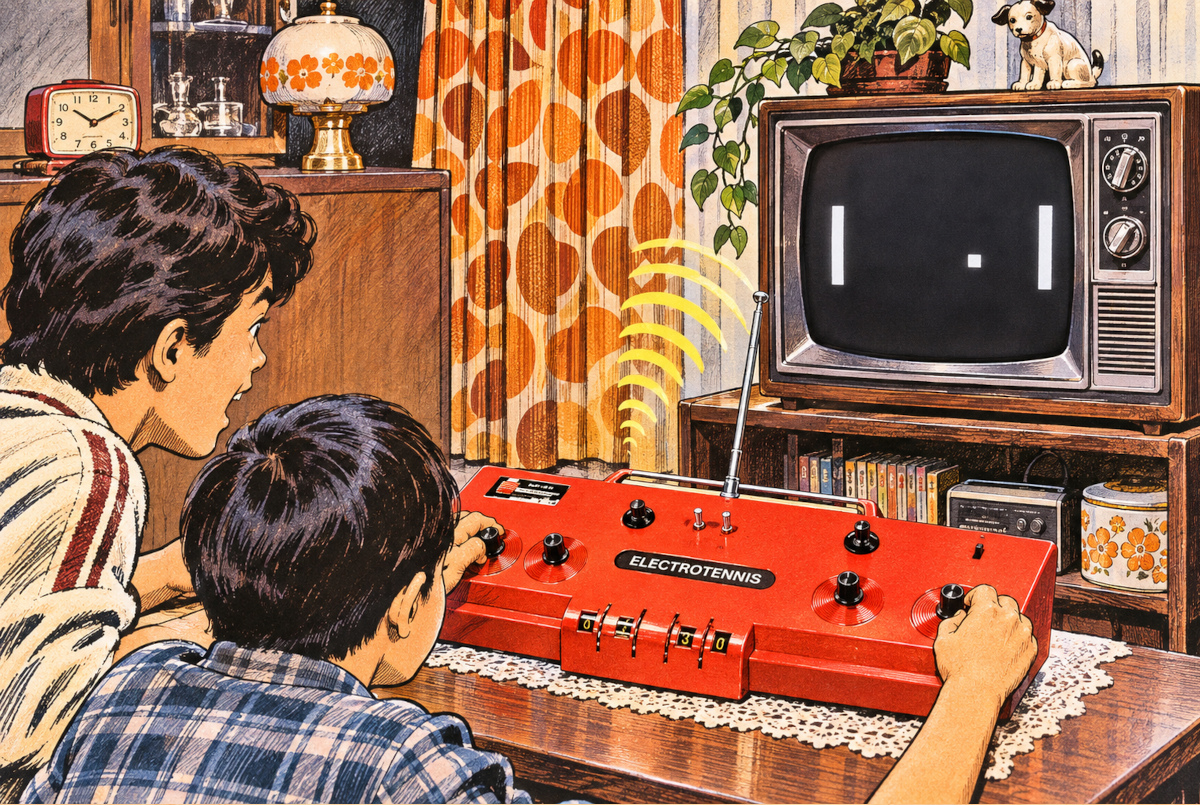
Conceptual illustration of Epoch’s 1975 TV Tennis. The machine transmitted a UHF video signal to a television, while players recorded scores manually using counters on the console. The antenna arrangement and receiving equipment are partially simplified.
How Did a ¥19,500 TV Game Become a ¥9,800 Purchase Just Two Years Later?
To understand the competition, consider the original Japanese launch prices of four early home game machines.
| Launch year | Manufacturer and model | Launch price |
|---|---|---|
| 1975 | Epoch TV Tennis | ¥19,500 |
| 1977 | Nintendo Color TV-Game 6 | ¥9,800 |
| 1977 | Nintendo Color TV-Game 15 | ¥15,000 |
| 1979 | Nintendo Color TV-Game Block Kuzushi | ¥13,500 |
Note: These are original Japanese launch prices, excluding subsequent price reductions and separately sold accessories. They have not been adjusted for inflation.
The difference between Epoch’s 1975 TV Tennis and Nintendo’s 1977 Color TV-Game 6 was ¥9,700.
The calculation is straightforward:
(¥19,500 − ¥9,800) ÷ ¥19,500 × 100 = approximately 49.7%.
In other words, Nintendo’s 1977 machine launched at approximately 49.7% less than Epoch’s 1975 machine. It also offered six play modes covering variations of tennis, hockey, and volleyball.
There is an important distinction here. This was not a 49.7% price cut on the same product, nor does it prove that the average market price fell by that percentage. These were different machines, with different designs and features.
Nor does the price comparison establish that Nintendo’s console was twice as powerful. It does, however, show how sharply the entry price could differ between products released only two years apart.
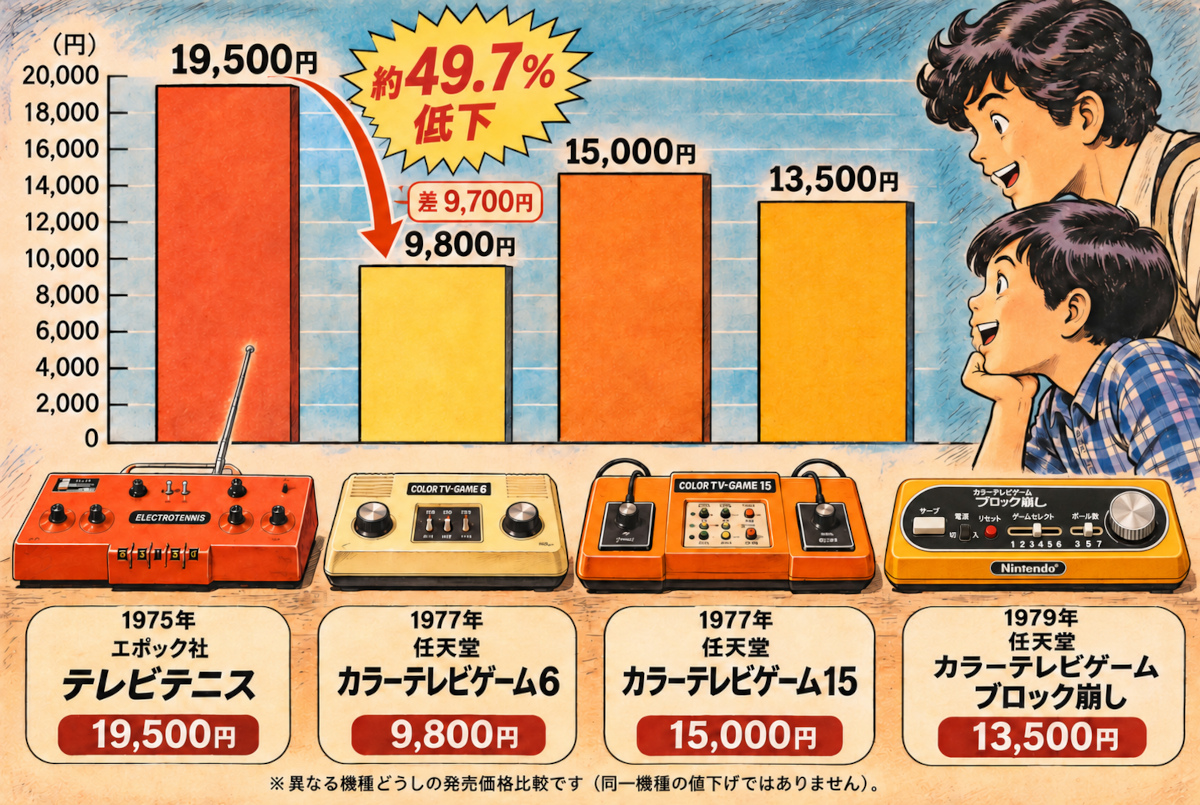
Original Japanese launch prices for four home game machines released from 1975 to 1979. The gap between Epoch TV Tennis (¥19,500) and Nintendo Color TV-Game 6 (¥9,800) was ¥9,700, or approximately 49.7% of the former’s price. This compares different products, not a price reduction on one model. Hardware details and relative physical sizes are simplified.
Did Nintendo’s Color TV-Game 15 Really Contain 15 Games?
The names Color TV-Game 6 and Color TV-Game 15 raise another question. What exactly counted as a “game” in 1977?
Color TV-Game 15 offered 15 variations, but that did not mean it contained 15 independent software titles in the modern sense. Many modes were variations of similar paddle-game ideas, changing rules or playing conditions such as singles and doubles.
The underlying technology explains why.
Dedicated home game machines of this period commonly implemented gameplay through purpose-built electronic circuits. Nintendo engineers later recalled an era when game behavior was designed in hardware rather than written as conventional software.
Advances in semiconductor manufacturing allowed multiple play modes to be implemented using , including LSI devices. Mass production also helped make these machines economically practical.
So the progression from six to fifteen modes was not equivalent to adding nine modern game cartridges. It reflected how much gameplay variation engineers could build into a fixed electronic system.
Meanwhile, American Consoles Were Moving Toward Replaceable Games
While Japanese manufacturers competed in dedicated TV game machines, a different architecture was already emerging in the United States.
In 1976, Fairchild introduced the Channel F, a pioneering home console that stored game programs on removable semiconductor . Atari followed in 1977 with the Video Computer System, or VCS, later known as the Atari 2600. Its launch library included Combat.
The difference was fundamental.
A dedicated TV game machine generally offered the selection of games built into its circuitry. A cartridge-based system allowed owners to purchase new game programs and run them using the processing hardware inside the console.
There is a historical trap here: the 1972 Odyssey also used interchangeable cards. But those cards primarily altered electrical connections in the console. They were not ROM cartridges containing game programs in the later Channel F or Atari sense.
Both systems involved inserting something into a machine. Technically, however, they represented very different approaches to changing a game.
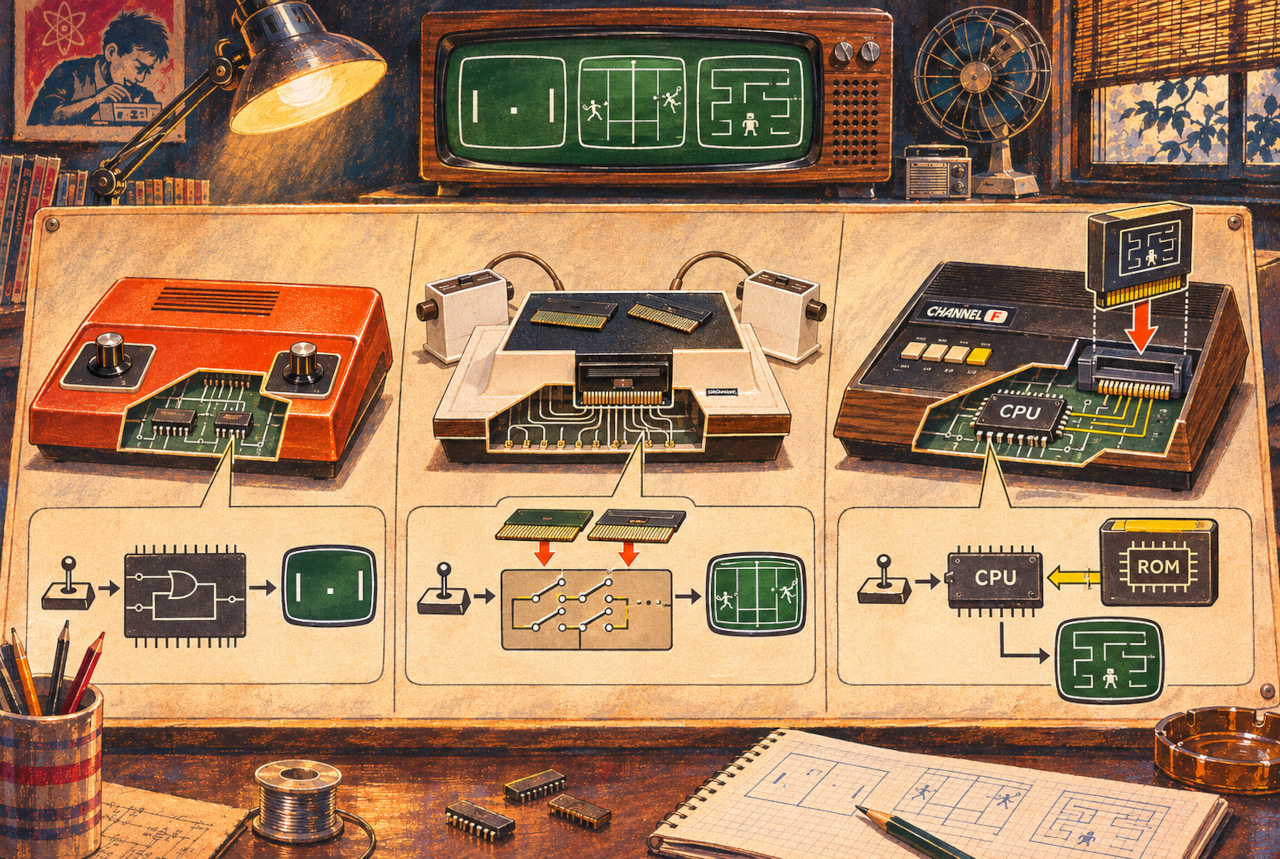
Conceptual comparison of three early game architectures: dedicated game circuitry, the Odyssey’s circuit-switching cards, and the Channel F’s removable ROM cartridges. Circuit layouts, component placement, and example screens are simplified and are not exact reproductions of the original hardware.
Was Nintendo’s 1979 Block-Breaking Console Actually a Hit?
Atari released the arcade game Breakout in 1976, helping establish block-breaking as a popular form of electronic entertainment. The game also influenced Japanese manufacturers.
In 1979, Nintendo launched its home machine Color TV-Game Block Kuzushi, priced at ¥13,500. It offered six gameplay variations, with players moving the paddle horizontally using a large rotary control.
One detail is especially notable: the console’s exterior design was handled by Shigeru Miyamoto, who would later become famous for creating Mario. This does not mean he programmed the console’s games.
But there is a twist to Nintendo’s early history.
Masayuki Uemura, the former Nintendo engineering leader, later recalled that the Space Invaders boom drew attention toward arcade gaming and that Block Kuzushi did not sell as strongly as expected.
Arcade games were advancing rapidly. Taito’s Space Invaders appeared in 1978, followed by Galaxian in 1979. Arcade machines were increasingly offering experiences that dedicated home machines struggled to match.
Uemura’s recollection does not, by itself, establish a precise sales total or prove that the arcade boom was the only cause of Block Kuzushi’s performance. It does challenge the convenient idea that Nintendo’s hardware business was an uninterrupted success story before the Famicom.
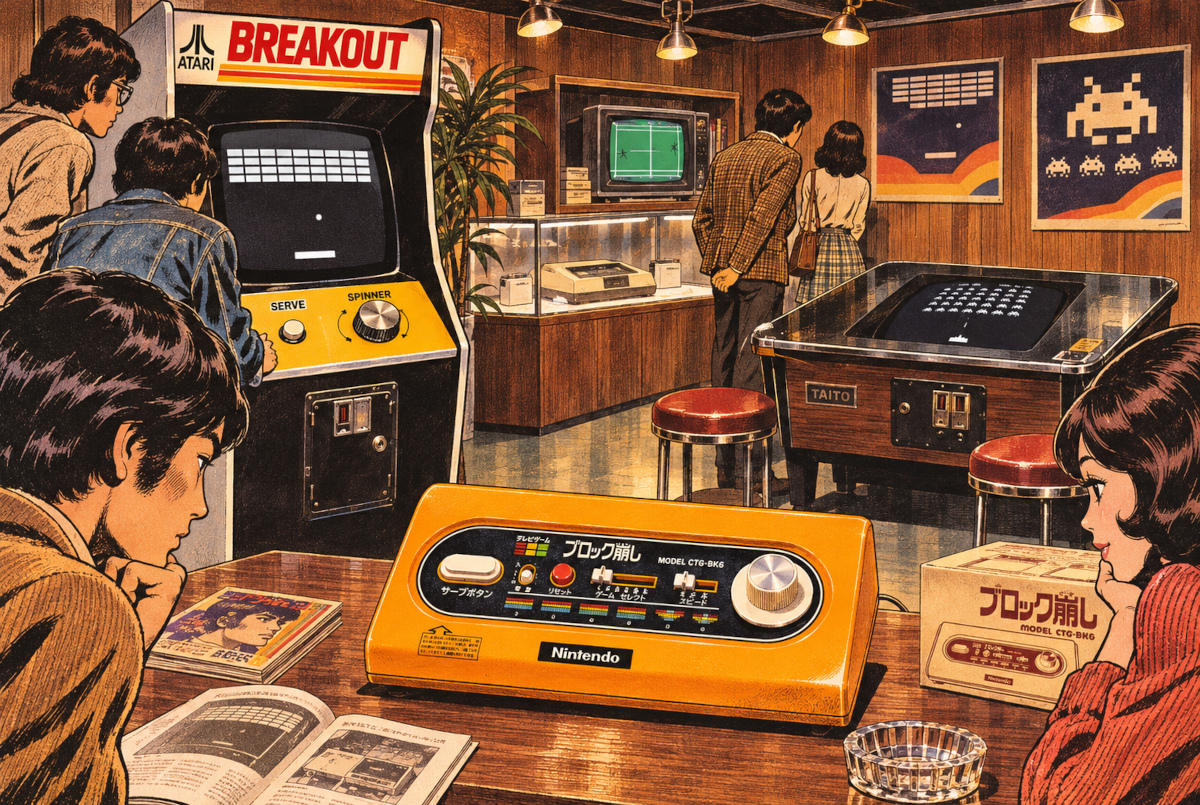
Illustration comparing Atari’s 1976 arcade game Breakout, Taito’s 1978 Space Invaders, and Nintendo’s 1979 home console Block Kuzushi. The arrangement highlights differences between arcade and home hardware. Cabinet decorations, certain hardware details, and the exhibition setting are illustrative rather than exact historical reproductions.
Those Eight Years Before the Famicom Were Anything but Empty
Japan had a domestically produced television game priced at ¥19,500 in 1975. By 1977, Nintendo was offering another home game machine for ¥9,800.
Behind that change were advances in semiconductor technology, cooperation between toy companies and electronics manufacturers, and ideas that crossed national borders.
Yet these early dedicated machines shared a limitation: the selection of games was largely fixed when the hardware was manufactured.
The development of interchangeable game software would eventually change that relationship. In Japan, its impact would become much clearer in the years that followed.
In Part 2, we will examine Atari, Japan’s Cassette Vision, and the machines that brought replaceable games into the home before the Famicom.
Editor’s Note
What caught my attention first was the price. Epoch wanted ¥19,500 for TV Tennis in 1975. Even today, convincing me to spend that much on a machine with essentially one type of game would take some work.
Then, only two years later, Nintendo had a machine on sale for ¥9,800. And Nintendo itself apparently had a difficult time with Block Kuzushi in 1979.
So much for the tidy version of history in which Nintendo simply turned up, made successful games, and carried on winning. The years before the Famicom were full of companies experimenting, competing, and occasionally getting the timing wrong.
The other thing I like is that Japan’s early home video game business was being led by a company known for tabletop baseball, with electronics manufacturers helping to make the technology possible.
I started out looking into old game consoles and ended up following the business of toy manufacturers and the semiconductor industry of the 1970s. That’s usually where the better story is hiding.
Terms That May Need a Quick Explanation
- UHF (Ultra High Frequency)
- A radio-frequency range used in television broadcasting and other applications. Epoch’s TV Tennis transmitted its video signal using UHF radio waves, allowing a television to receive the game’s picture.
- LSI (Large-Scale Integration)
- A type of integrated circuit containing many electronic components on a single semiconductor chip. Such technology helped manufacturers implement game functions in increasingly compact and economical hardware during the 1970s.
References
- Epoch Co., “Toy History” (Japanese) — Official company chronology identifying the 1975 TV Tennis as Japan’s first domestically produced television game machine.
- Smithsonian National Museum of American History, “Magnavox Odyssey Video Game Unit, 1972” — Museum collection record documenting the early commercial home console.
- GAME Watch, “The Anniversary of Japan’s First Home TV Game, TV Tennis” (Japanese) — Historical article covering the September 12, 1975 release, original price, and UHF connection.
- GAME Watch, “DIEC 2005: The Origins of Game Design and Technology” (Japanese) — Report on a presentation by Masayuki Uemura concerning early Nintendo hardware, prices, and collaboration with Mitsubishi Electric.
- Nintendo, “Iwata Asks: Game & Watch,” Part 1 (Japanese) — Official developer interview covering Nintendo’s early dedicated TV game machines, hardware-based game design, and Shigeru Miyamoto’s work on Block Kuzushi’s exterior.
- Nintendo DREAM WEB, “Masayuki Uemura Speaks at Length,” Part 1 (Japanese) — Interview discussing Nintendo’s early console business and the impact of the Space Invaders boom.
- The Strong National Museum of Play, “Early Home Video Game History: Making Television Play” — Historical overview of the Odyssey, Home Pong, cartridge-based consoles, and the rise of home video gaming.
- Computer History Museum, “Channel F Video Entertainment Computer, Fairchild, 1976” — Museum record identifying Channel F as an early home console with removable semiconductor ROM game cartridges.
- Taito Corporation, “70 Years of Taito: Company History” (Japanese) — Official chronology documenting the arrival and popularity of Space Invaders in 1978.