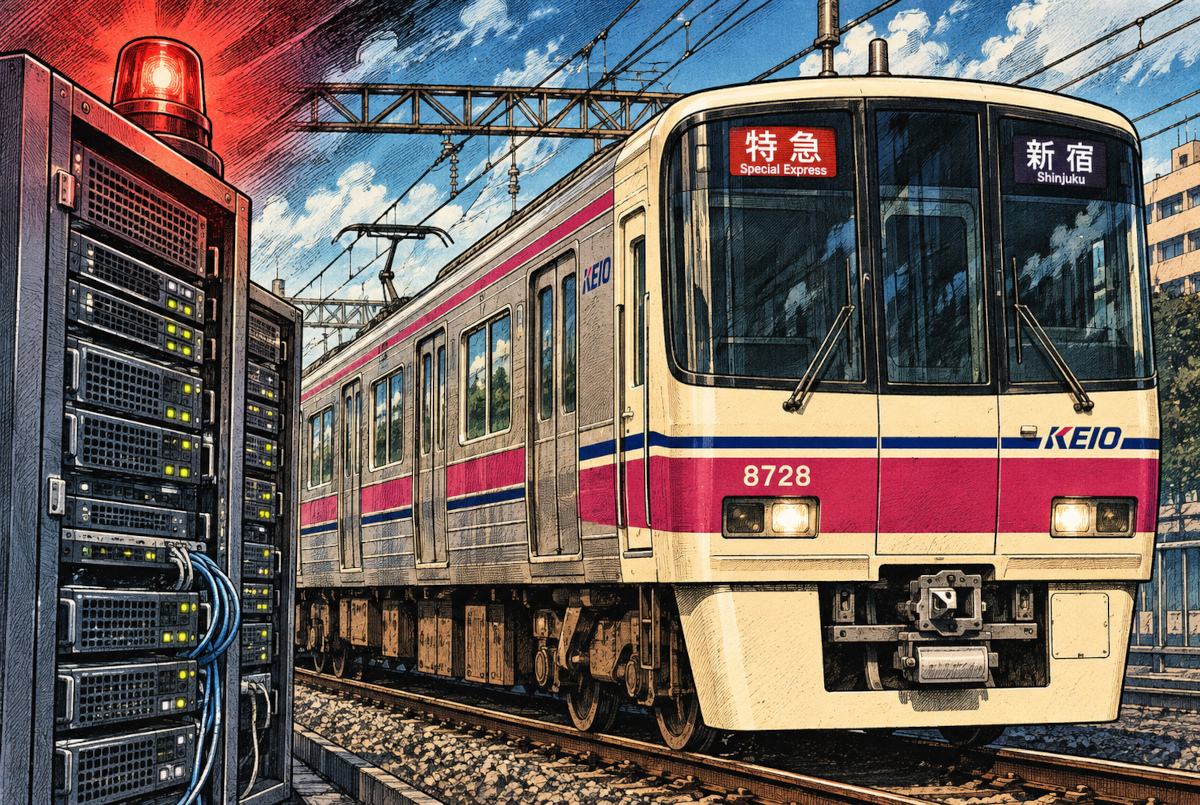
, again? And at a company as large as Keio?
On November 24, 2026, Keio Corporation, a major railway operator and diversified business group in the Tokyo metropolitan area, published the findings of its investigation into a ransomware attack discovered on September 26.
Adding together the categories of potentially exposed personal information produces a total of approximately 11.07 million people. However, these categories contain overlapping individuals, so the figure does not represent the number of unique people affected.
Cybercriminals are already using to automate multiple stages of their operations. So why does ransomware, a threat that has been around for years, continue to cause data breaches on such an enormous scale?
Reading through the footnotes of Keio’s official disclosure revealed something particularly odd — something that has less to do with the sophistication of the attack than with the information companies choose to retain.
What Does the 11 Million Figure Actually Mean?
First, it is important to distinguish between information confirmed to have been leaked and information that may have been exposed.
| Category | Confirmed Leakage | Potential Exposure |
|---|---|---|
| Customers, business partners and others | Approx. 150 | Approx. 10,630,000 |
| Job applicants | Approx. 160 | Approx. 360,000 |
| Employees, former employees and dependents | Approx. 12,000 | Approx. 77,000 |
| Sum of categories | Approx. 12,300 | Approx. 11,070,000 |
Source: Calculated by this website using Keio Corporation’s November 24, 2026 disclosure. The approximately 150 confirmed cases in the first category concern rental property customers and related individuals. The figures contain overlaps and do not represent unique individuals. Totals have been rounded because the original figures are approximate.
The potentially exposed information includes passport copies, credit card numbers, identity verification documents submitted during property transactions, and documents containing Japan’s My Number personal identification numbers.
This does not mean that every potentially affected individual had all of these types of information stolen.
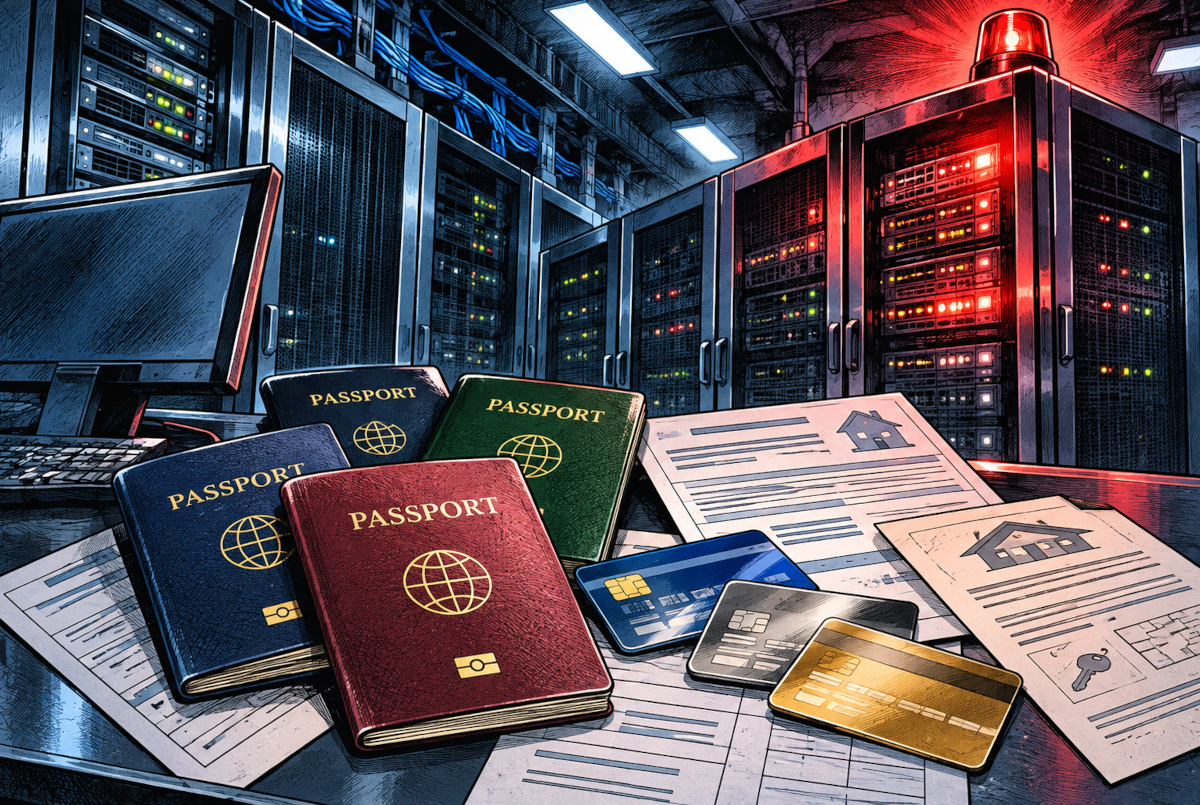
AI-generated illustration representing the types of personal information held by businesses, including passport copies, credit card numbers, job application documents and identity verification records. It does not depict the actual incident or documents involved, nor does it imply that all illustrated information was confirmed to have been leaked.
Anyone who may be affected should consult Keio’s official disclosure for the relevant dates and categories of information. Be cautious about suspicious emails and telephone calls. If your credit card number may have been exposed, review your statements and contact your card issuer if necessary.
Why Were Credit Card Applications from 14 Years Ago Still Relevant?
The detail that caught my attention was buried in footnote 4 on the second page of Keio’s official announcement.
The company provided the following breakdown of credit card numbers potentially exposed in the incident.
| Category | Credit Card Numbers |
|---|---|
| Keio Plaza Hotel Executive Card applicants | 382 |
| Keio Closet Seiseki-Sakuragaoka customers | 109 |
| Keio Department Store credit cards | Approx. 20,000 |
| Sum of categories | Approx. 20,500 |
Source: Footnote 4 of Keio Corporation’s November 24, 2026 disclosure. The arithmetic sum is 382 + 109 + approximately 20,000 = approximately 20,491. The total has been rounded to approximately 20,500 to reflect the precision of the original figures.
Consider the first 382 records. The relevant card application period ran from March 2012 to January 2018.
Calculate the elapsed time between those application dates and the discovery of the attack in September 2026, using calendar months, and something interesting emerges.
The information relates to applications submitted between approximately 8 years and 8 months and 14 years and 6 months before the attack was discovered.
Why were credit card numbers associated with applications submitted so many years earlier still among the potentially exposed information?
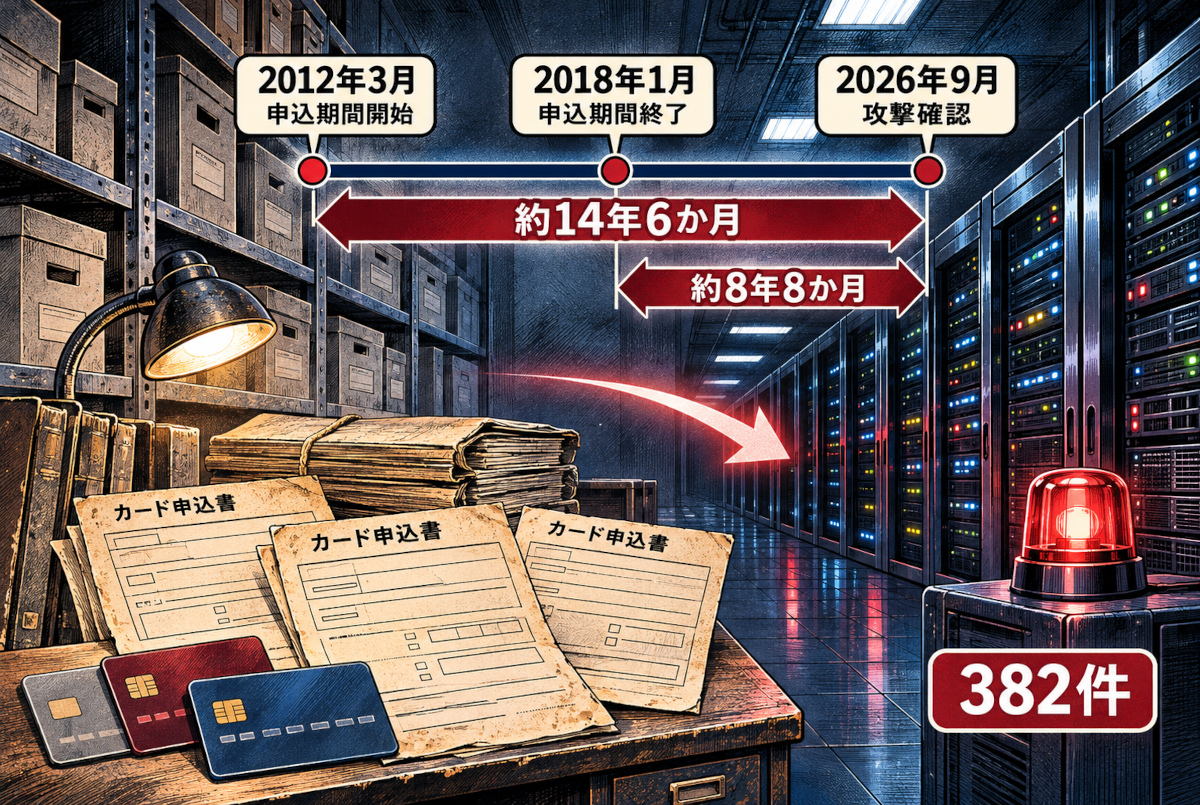
Credit card numbers associated with 382 Keio Plaza Hotel Executive Card applications were among the potentially exposed information. The Japanese labels indicate March 2012, January 2018 and September 2026. The periods shown are the elapsed time between the application dates and the discovery of the attack, not verified data retention periods. The illustration does not establish how the records were stored or migrated, and the timeline is not drawn to scale. AI-generated illustration.
Article 22 of Japan’s Act on the Protection of Personal Information (APPI) requires businesses to endeavor to delete personal data without delay once it is no longer necessary for its intended use.
Other information, however, may need to be retained under separate rules. Japanese hotels are required to retain guest registers for three years. Japan’s Ministry of Health, Labour and Welfare also requires hotels to retain passport copies for foreign guests who do not have an address in Japan.
Keeping old information is therefore not inherently wrong. The real question is whether there is still a legitimate reason to retain it.
Keio’s public disclosure does not establish why these particular card numbers were retained, when they entered the affected systems, or whether they had subsequently been updated. Their presence alone does not establish a violation of Japanese law.
Eleven Years of Warnings, Yet Reported Cases Have Doubled
On January 29, 2026, Japan’s Information-technology Promotion Agency (IPA) published its annual ranking of the country’s ten major information security threats.
Ransomware attacks ranked first among threats facing organizations. They had appeared in the rankings for eleven consecutive years, from 2016 through 2026.
To see whether the problem has actually diminished over time, I extracted the first-half figures from Japanese police statistics and compared equivalent six-month periods.
| Reporting Period | Reported Ransomware Cases in Japan |
|---|---|
| January–June 2021 | 61 |
| January–June 2022 | 114 |
| January–June 2023 | 103 |
| January–June 2024 | 114 |
| January–June 2025 | 116 |
| January–June 2026 | 123 |
Source: Compiled by this website using statistics published by Japan’s National Police Agency and the Osaka Prefectural Police.
123 ÷ 61 = approximately 2.02.
Changes in reporting practices and reporting rates must be taken into account. Nevertheless, the number of cases reported to the police in the first half of 2026 was approximately twice the figure recorded for the same period five years earlier.
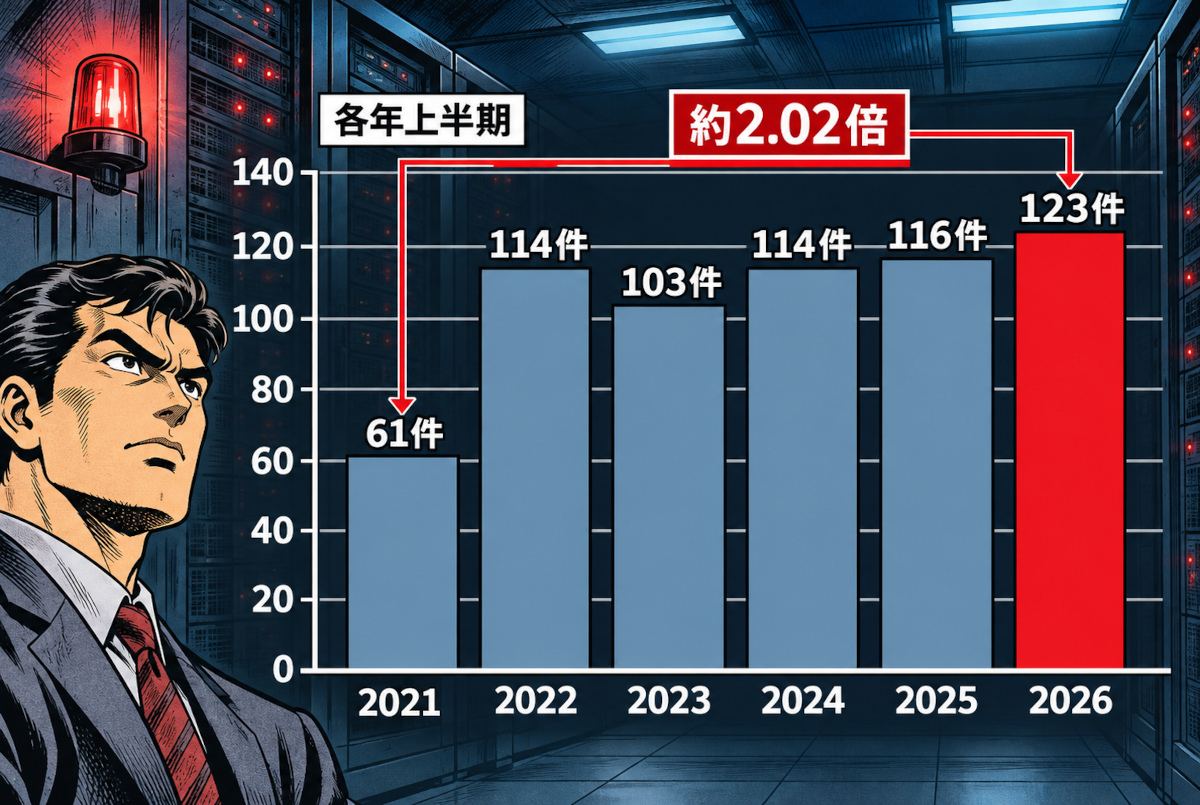
Reported ransomware cases in Japan during January–June of each year. The 2026 figure was approximately 2.02 times the 2021 figure. The Japanese labels indicate first-half figures, reported cases and the comparison ratio. Unreported incidents and separately classified non-encrypting data extortion attacks are excluded. Compiled from National Police Agency statistics. AI-generated visualization; minor graphical deviations in bar heights may occur. The accompanying table provides the exact reported figures.
Another revealing detail comes from the National Police Agency’s 2025 survey of ransomware intrusion routes.
Of 92 valid responses, 61 identified VPN equipment and 19 identified remote desktop services as the route of intrusion.
(61 + 19) ÷ 92 × 100 = approximately 87.0%.
Those two categories alone accounted for nearly nine out of ten valid responses.
Attackers do not necessarily need sophisticated AI to exploit weaknesses in established remote-access systems. Before organizations worry exclusively about the next generation of cyberattacks, they still need to address vulnerabilities associated with technologies that have been around for years.
The specific intrusion route used in the Keio ransomware attack, however, has not been established in the public information reviewed for this article.
AI Agents Do Not Make Ransomware Obsolete
In November 2025, AI developer Anthropic reported that it had observed a particular cyberespionage campaign in which AI was estimated to have performed 80–90% of the operational work.
On November 16, 2026, Google also reported real-world threat activity involving multiple AI agents.
These reports suggest that my initial reaction — ransomware, again? — needs some reconsideration.
AI agents can be used to automate tasks and decision-making during an attack. Ransomware is malicious software used to extort victims, often by encrypting their data. The two are not competing technologies.
Instead of replacing ransomware, AI could make ransomware operations faster and easier to scale.
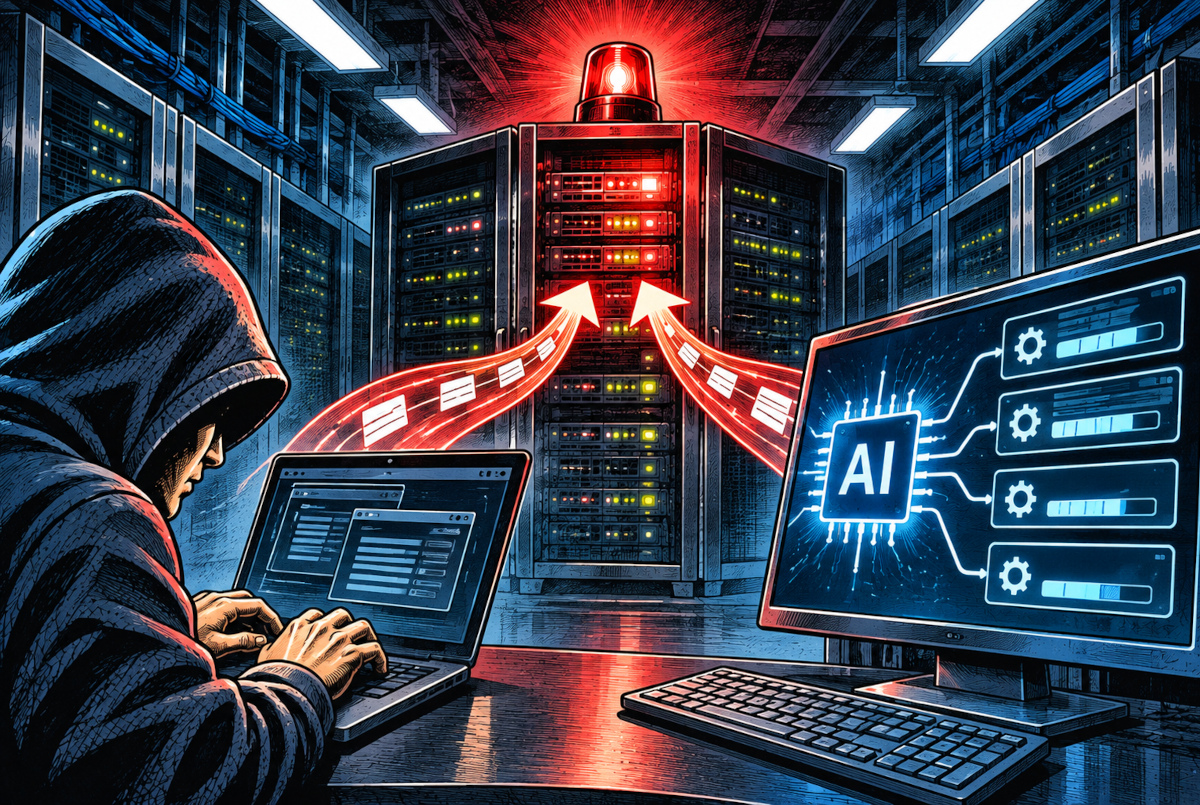
AI-generated conceptual illustration comparing conventional human-directed attacks with attack operations automated through AI agents. In practice, human instructions and AI processing may be combined. This illustration does not suggest that AI was used in the Keio attack, nor does it reconstruct the actual attack environment or network routes.
There is no confirmed evidence in the public information reviewed for this article that AI was used in the attack against Keio. The distinction matters: AI-assisted cyberattacks are a documented threat, but their involvement in this particular incident remains unconfirmed.
Keio Had Actually Been Investing in Cybersecurity
It would be easy to assume that Keio had simply neglected cybersecurity. Its own publications from before the incident suggest a more complicated picture.
During fiscal year 2024, the company was promoting biometric authentication, endpoint detection and response (EDR), and updates to its antivirus software.
In fiscal year 2025, it also began conducting information system audits based on the group’s security guidelines.
This was not a company that had done nothing about cybersecurity.
The list of companies covered by Keio’s November disclosure reveals another dimension of the problem. Counting the companies by business sector produces the following breakdown:
- Transportation: 8 companies
- Real estate: 4 companies
- Hotels: 6 companies
- Construction and facilities: 5 companies
- Daily life and consumer services: 24 companies
That is a total of 47 companies, including Keio Corporation itself.
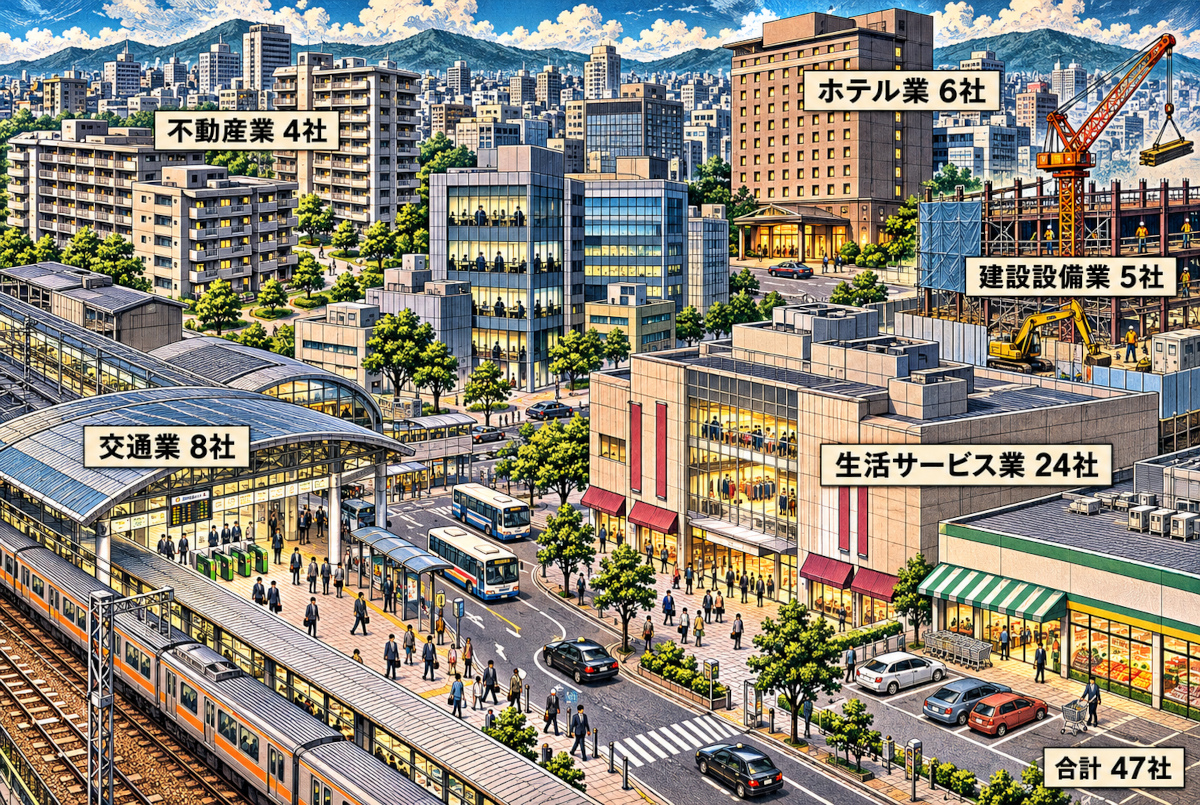
AI-generated conceptual illustration of the 47 companies listed in Keio Corporation’s November 24, 2026 disclosure, grouped by business sector. The Japanese labels show transportation (8), real estate (4), hotels (6), construction and facilities (5), and daily life and consumer services (24). The illustration does not reproduce actual Keio vehicles, facilities, locations or network architecture. Inclusion in the list does not mean that a data leak was confirmed at every company.
Railway operators, hotels, property businesses and retailers handle different types of personal information and rely on different information systems.
Installing security products is only part of the job. A business also needs to establish how much of its infrastructure is actually protected and how effectively an intrusion can be contained if its defenses are breached.
Following the incident, Keio itself announced plans to identify issues in its IT governance.
Editor’s Note
My first reaction was simple: ransomware, again? Surely a major corporation should have moved beyond worrying about something this familiar.
But the figures tell a different story. Reported cases have increased, and attackers now have AI tools that can automate work that once required more direct human involvement.
Still, there is one question I would quite like to put to corporate executives.
How much personal information does your company retain, and how old is the oldest of it?
Management might be able to produce a report showing how many millions of yen have been spent on cybersecurity. I wonder how many executives could answer that rather more basic question.
Even the most sophisticated security system can potentially be breached. But information that is no longer needed and has been securely and irreversibly deleted cannot be stolen from the systems that no longer hold it.
I started out investigating the future of cybersecurity and somehow ended up back at one of the oldest principles of information management.
Terms That May Need a Quick Explanation
- EDR (Endpoint Detection and Response)
- A security technology that monitors computers, servers and other endpoints for suspicious activity and assists with detection, investigation and containment. Installing EDR does not guarantee protection against every attack.
References
- Keio Corporation: Notice and Apology Regarding Personal Information Leakage Following a Ransomware Attack (November 24, 2026; Japanese PDF). Primary source for the affected information categories, card application dates, credit card numbers and list of companies.
- Keio Corporation: Integrated Report 2025 (p. 70, Risk Management; Japanese PDF). Documents cybersecurity initiatives undertaken before the incident.
- Keio Corporation: Compliance and Risk Management (Japanese). Includes information about fiscal year 2025 security initiatives.
- Information-technology Promotion Agency, Japan (IPA): 10 Major Information Security Threats 2026 (Japanese).
- National Police Agency, Japan: Cybersecurity Threat Assessments and Statistics (Japanese).
- Osaka Prefectural Police: Cybersecurity Threats During the First Half of 2026 (Japanese). Source for the comparison of reported ransomware cases.
- National Police Agency, Japan: White Paper on Police 2026: Ransomware Threats (Japanese). Includes survey data on intrusion routes.
- Anthropic: Disrupting an AI-orchestrated cyber espionage campaign (November 2025).
- Google Threat Intelligence Group: GTIG AI Threat Tracker: Agentic Threat Activity Crosses a Significant Threshold (November 16, 2026).
- Personal Information Protection Commission, Japan: When Must Collected Personal Information Be Discarded? (Japanese). Official guidance concerning personal data deletion.
- Ministry of Health, Labour and Welfare, Japan: Enforcement Regulations of the Hotel Business Act (Japanese). Includes requirements for retaining guest registers.
- Ministry of Health, Labour and Welfare, Japan: Partial Revision of the Hygiene Management Guidelines for the Hotel Business (January 20, 2026; Japanese). Guidance concerning guest identification and passport copies.