

On November 23, 2026, OpenAI began rolling out a version of GPT-6.2 optimized for everyday conversations in the ChatGPT chat tab. Available to Plus, Pro, Business and Enterprise users as part of a gradual rollout, the new model delivers substantial improvements in image understanding and instruction following.
Yet something peculiar has been happening during our editorial work. Regenerating an article after fact-checking can take an unusually long time. Text appears painfully slowly, sometimes ending in a . The problem seems particularly noticeable in long conversations.
AI is getting smarter, so why are we still spending so much time waiting? We compared OpenAI’s performance evaluations with its official incident reports to find out what the numbers actually tell us.
Image Understanding Improved by 51%. But What About Speed?
Using the evaluation results published by OpenAI on November 23, we calculated the relative improvement in scores from GPT-6 to GPT-6.2.
| Evaluation | GPT-6 | GPT-6.2 | Relative Improvement |
|---|---|---|---|
| Image understanding | 47.4% | 71.7% | +51.3% |
| Complex instruction following | 62.5% | 78.1% | +25.0% |
| Expert-level tasks (1) | 52.0% | 65.0% | +25.0% |
| Challenging web research (2) | 54.4% | 64.5% | +18.6% |
Source: OpenAI’s November 23, 2026 release notes. Relative improvements calculated by this publication using (new score − previous score) ÷ previous score × 100. (1) The lowest reasoning setting included in the evaluation. (2) OpenAI’s internal version of BrowseComp at the Extra High reasoning setting.
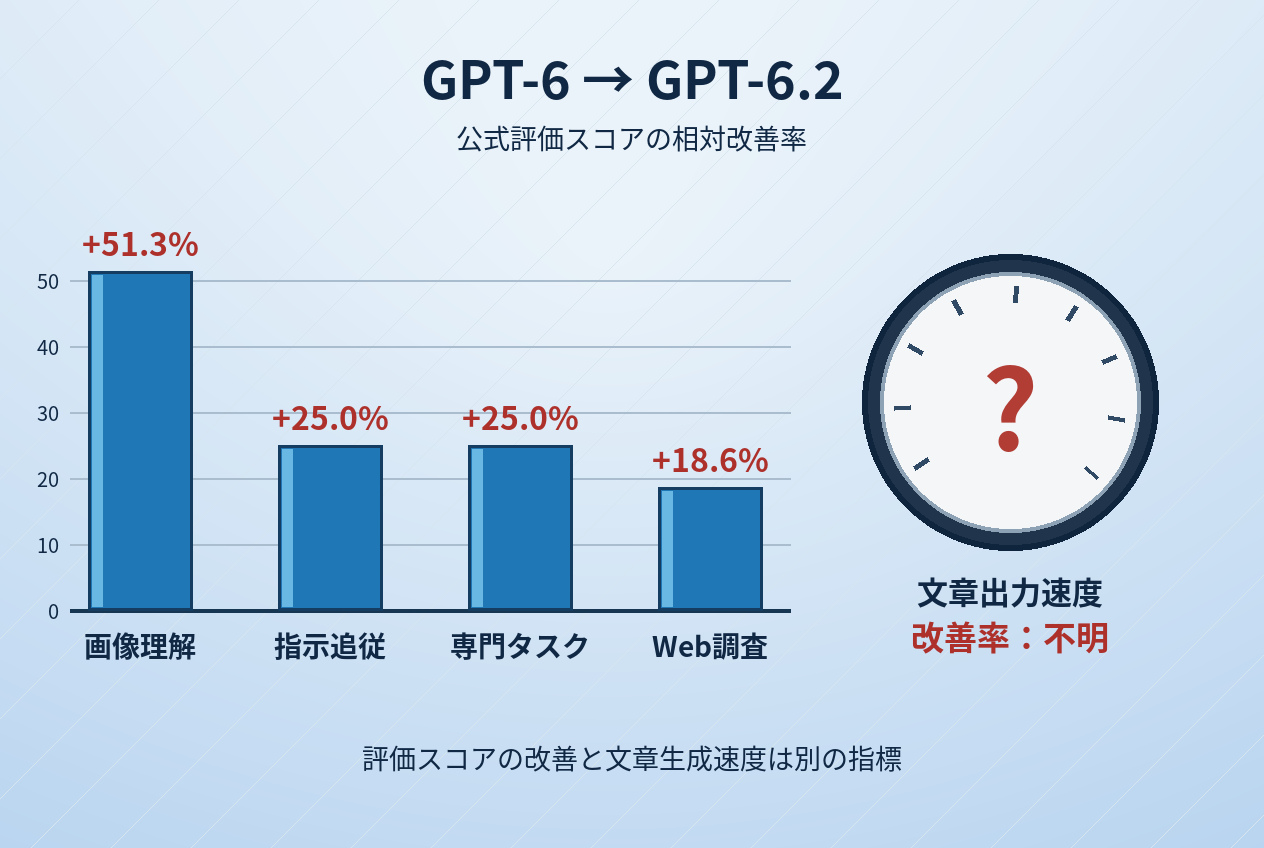
Chart created by this publication using OpenAI’s November 23, 2026 evaluation results. Testing conditions differ between categories. The announcement does not quantify improvements in text generation speed.
The image understanding score rose by 24.3 percentage points, equivalent to a relative improvement of approximately 51%. Impressive, certainly. But these results provide no corresponding comparison of how quickly the models generate text.
A smarter model is not necessarily a faster model.
A New Model Arrives, and Errors Follow
Putting selected incidents from OpenAI’s November status history alongside its model announcements reveals an interesting timeline.
| Date | Event |
|---|---|
| November 9 | Increased conversation errors in ChatGPT |
| November 17 | GPT-6.2 Astra and Sol announced for Work and Codex |
| November 18 | Increased conversation errors affecting Free and Go users |
| November 19 | Elevated API errors involving GPT-6 Luna |
| November 23 | GPT-6.2 rollout begins in the ChatGPT chat tab |
| November 23 | Intermittent GPT-6 conversation errors on paid ChatGPT plans |
Dates follow OpenAI’s official announcements and incident reports. Calendar dates may differ depending on the reader’s time zone. API incidents are distinguished from incidents affecting ChatGPT itself.
We examined the November 23 incident updates and calculated the intervals between them. Eight minutes elapsed between the initial investigation notice and the identification of the problem, followed by another 14 minutes before a mitigation was reported. The final recovery announcement came 26 minutes later.
That adds up to 48 minutes. Interestingly, the interval between the mitigation announcement and confirmed recovery accounted for approximately 54% of the entire reporting period.
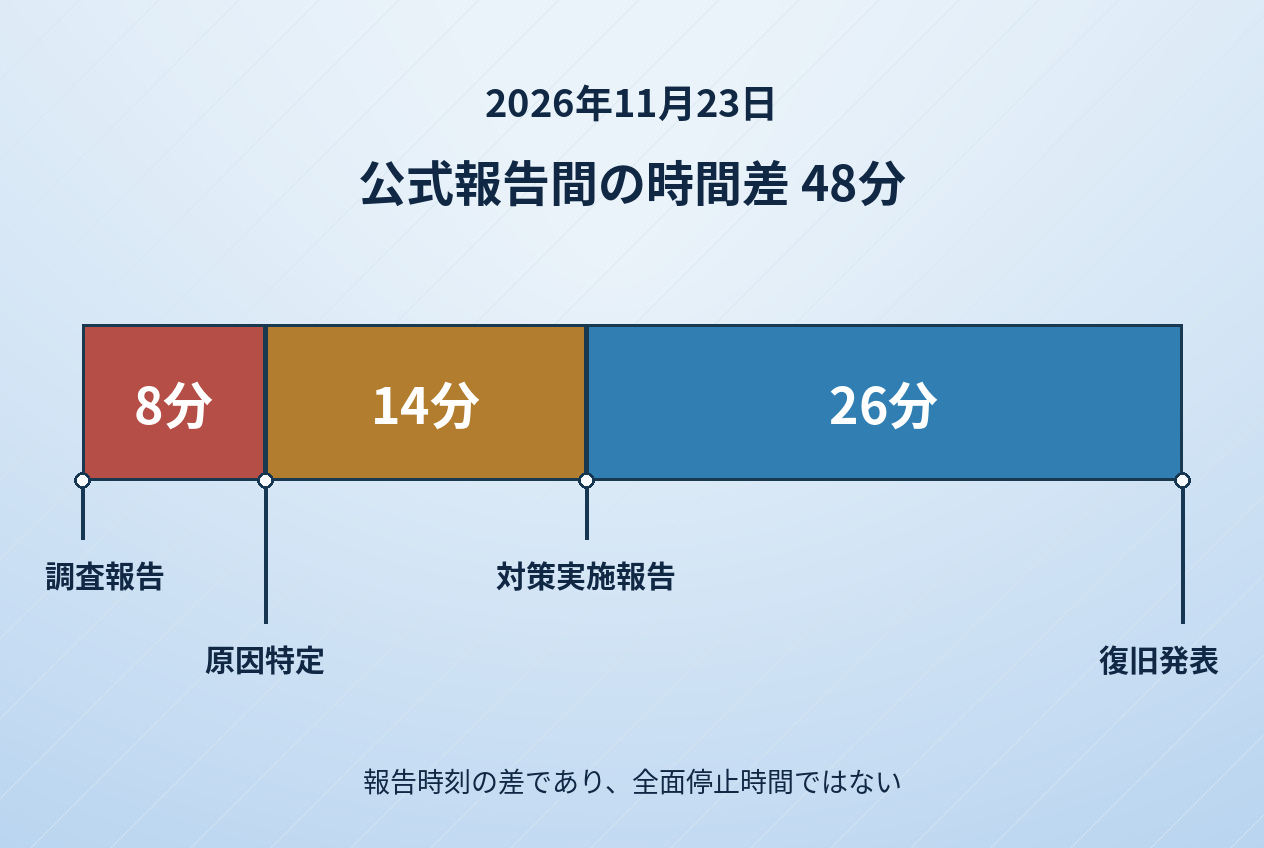
Calculated from OpenAI’s official incident updates concerning GPT-6 conversation errors on paid ChatGPT plans. The 48-minute interval does not represent the full duration of the incident or a complete outage affecting every user.
The distinction matters. These are intervals between public updates, not necessarily the exact times at which the underlying engineering work began or ended.
OpenAI’s report does not disclose the specific technical cause of this incident. The timing overlaps with the GPT-6.2 rollout, but that alone is not evidence that the new model caused the disruption.
ChatGPT Can Fail Without a GPU Failure
An earlier incident provides a useful example. On September 29, 2026, users of ChatGPT and the experienced errors and timeouts.
OpenAI’s post-incident report explains that a feature rollout triggered repeated background checks. These generated additional connections and retries between internal services until the shared network infrastructure ran out of connection capacity.
Even a perfectly capable AI model cannot deliver an answer if the surrounding infrastructure fails to do its job. Whether the timeouts encountered during our own editorial work had the same cause remains unknown.

AI-generated conceptual illustration based on OpenAI’s post-incident report for September 29, 2026. It depicts a service-side connectivity bottleneck, not OpenAI’s actual infrastructure, the confirmed operating condition of individual GPUs, or a failure of the user’s internet connection.
OpenAI Uses AI to Investigate Its Own Slowdowns
On November 19, OpenAI introduced its Performance Factory, an internal system that uses Codex agents to investigate deteriorating service performance, develop proposed fixes and verify the results after deployment.
Its engineering report also acknowledges recurring problems with first- latency: the delay before ChatGPT begins generating a response.
In just over three months, the system tracked more than 1,700 investigations and identified underlying causes in over 600 cases. These figures describe internal performance investigations, not the number of public ChatGPT outages.
Another number deserves attention. When human reviewers examined 100 proposed diagnoses, they found 70 accurate. The remaining 30 required refinement or lacked adequate evidence of causation.
OpenAI therefore uses independent AI review sessions to challenge diagnoses and proposed fixes, while engineers review changes before deployment.
There is something rather telling about this: even the company building the AI does not simply accept its first convincing explanation.
Everything Is Operational. So Why Am I Still Waiting?
When we checked OpenAI’s status page on November 24, the service was reported as operational. However, the page explicitly notes that availability figures aggregate different subscription tiers, models and error types. Individual users may have different experiences.
Consider a hypothetical batch of 100 requests. Suppose 90 receive complete responses in 10 seconds, while the remaining 10 take 120 seconds.
- Mean response time: 21 seconds
- Median response time: 10 seconds
- Response time for the slowest 10 requests: 120 seconds
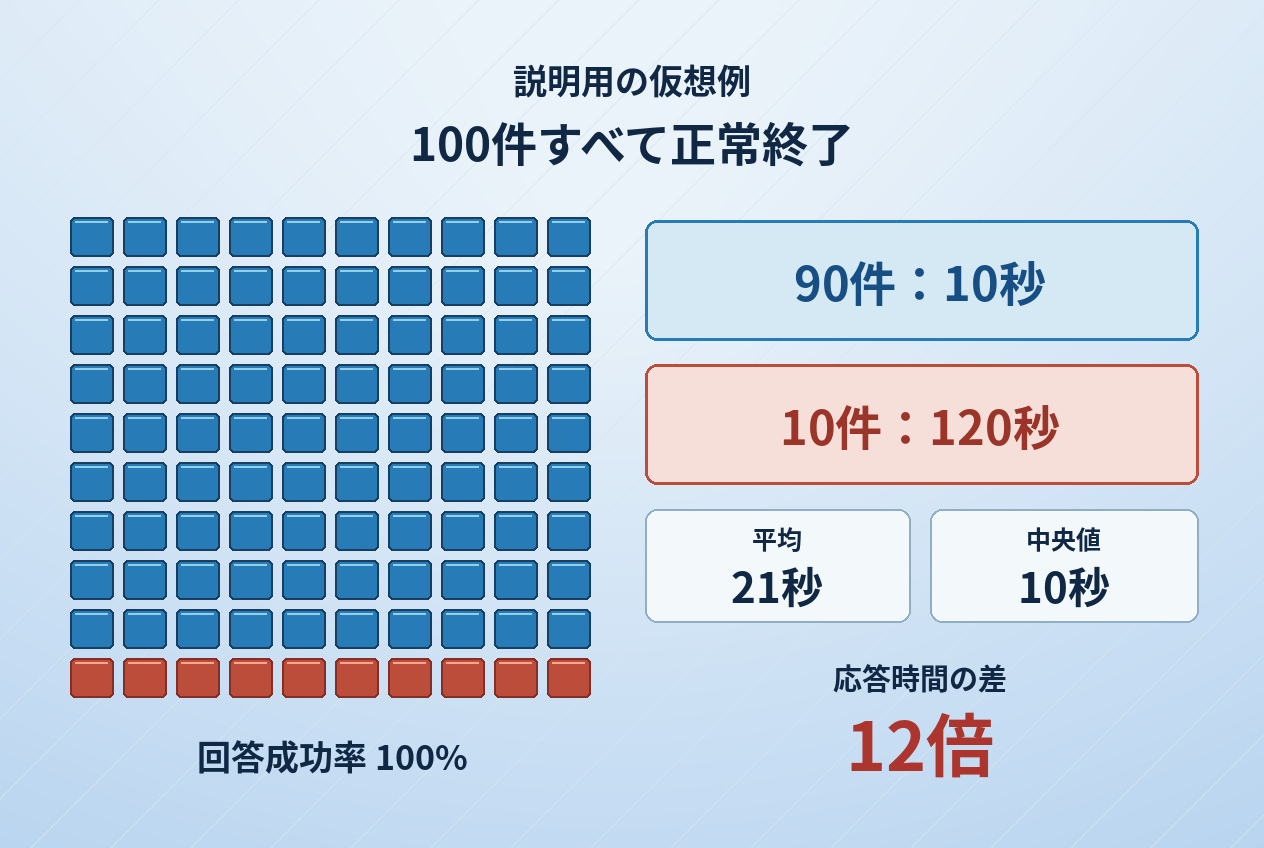
Hypothetical example calculated by this publication for explanatory purposes. All 100 requests succeed, but response times differ by a factor of twelve. These are not measured ChatGPT performance statistics.
The arithmetic is straightforward: (90 × 10 + 10 × 120) ÷ 100 = 21 seconds.
Since every request eventually completes successfully, the request success rate in this hypothetical example is 100%. Yet one in ten requests takes twelve times as long as the others.
A service being operational does not mean every user is getting a satisfactory response time.
Editor’s Note
Giving a car more horsepower does not make it any quicker through a traffic jam. I suspect much the same principle applies to ChatGPT.
I can understand waiting for an AI to work through a difficult research question. What bothers me is waiting all over again when the research is already finished and all I need is a minor correction to an article.
That is the part I find genuinely peculiar.
In Part 2, we will examine why correcting 300 characters can mean regenerating an entire 8,000-character document. Looking more closely at reasoning, text generation and memory may help explain why such an apparently simple editing job can take so long.
Why Is ChatGPT So Slow? — A Three-Part Investigation
AI keeps getting smarter, yet users still experience slow responses and timeouts. Across three articles, we examine official outage reports, the technical reasons behind slow text generation, and practical ways to improve the ChatGPT experience.
- Part 1: Part 1: GPT-6.2 Is Smarter. So Why Is ChatGPT Still So Slow?
- Part 2: English edition Coming soon
- Final Part: English edition Coming soon
References
- OpenAI: ChatGPT Release Notes (November 17 and November 23, 2026)
- OpenAI Status: Official Incident History
- OpenAI Status: Elevated Errors with GPT-6 Conversations on Paid ChatGPT Plans (November 23, 2026)
- OpenAI Status: Post-Incident Report on Errors Across ChatGPT, Codex and the API (September 29, 2026)
- OpenAI: How OpenAI’s Performance Factory Keeps ChatGPT Fast (November 19, 2026, Japanese edition) — Official English edition
- OpenAI Status: Service Availability and Aggregate Reporting Disclaimer
This article is based on publicly available information as of November 24, 2026. Relative benchmark improvements, intervals between incident updates and the hypothetical response-time example were independently calculated by this publication. No independent GPT-6 versus GPT-6.2 text generation speed benchmark was conducted for this article.