
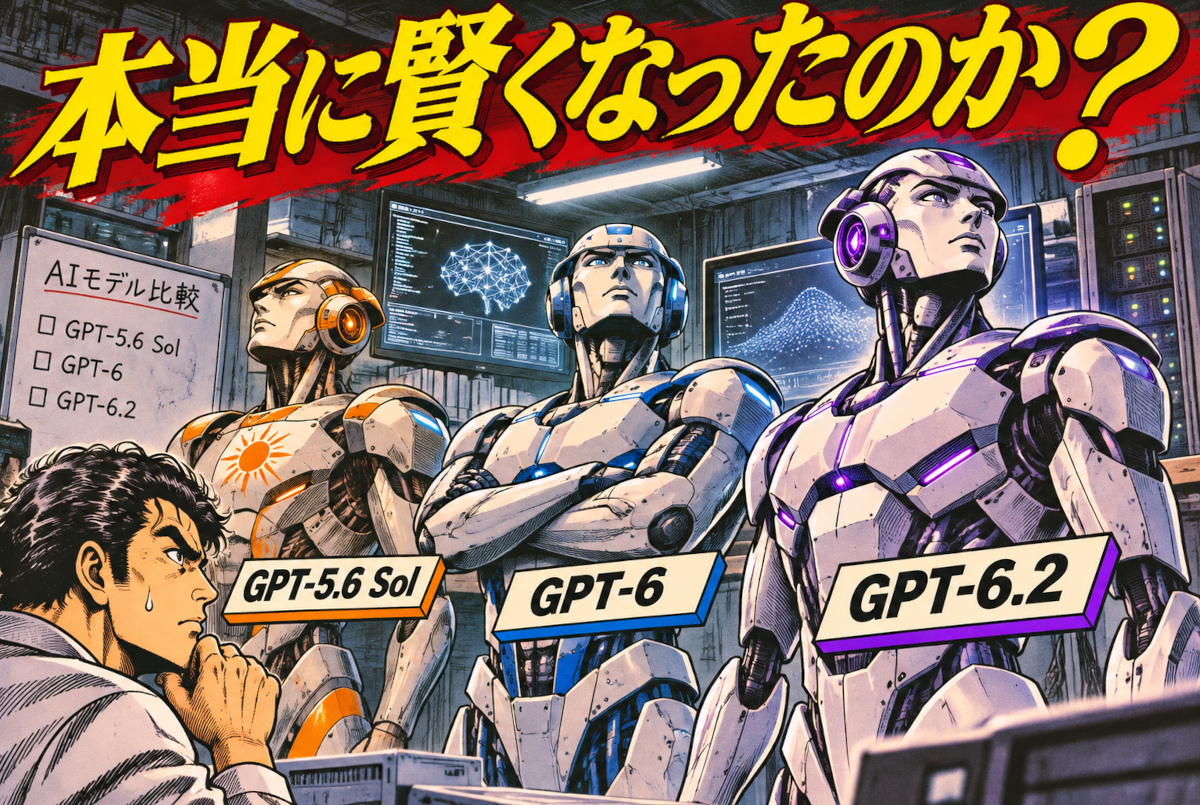
On November 23, 2026, OpenAI began rolling out GPT-6.2 to ChatGPT users. Just 47 days had passed since GPT-6 arrived on October 7.
Eligible paid subscribers can now choose between GPT-5.6 Sol, GPT-6 and GPT-6.2. Conventional wisdom suggests that the model with the biggest version number should be the obvious choice.
But digging into OpenAI’s 30-page technical report, GPT-6.2 in ChatGPT System Card, reveals some rather curious numbers.
Image understanding scores have improved by around 51%. Yet GPT-6.2 trails the older GPT-5.6 Sol in a particular test of behavioral flexibility, and it does not outperform GPT-6 across every factual accuracy .
What has actually improved, and where does the new model still struggle? Rather than simply reading the promotional headlines, let’s run the numbers ourselves.
Scope of this comparison: This article examines the models offered through the regular ChatGPT interface, rather than the GPT-6.2 Astra and Sol models announced on November 17, 2026, for Work, Codex and API use. The technical report primarily compares the August evaluation version of GPT-5.6 Sol, the October 7 version of GPT-6 Sol, and the November 23 version of GPT-6.2. For simplicity, GPT-6 Sol is referred to as GPT-6 throughout this article.
47 Days Later: Image Understanding Scores Jump by 51%
OpenAI’s release notes include several benchmark comparisons between GPT-6 and GPT-6.2. The table below reproduces those scores, with relative improvements calculated by this site.
| Benchmark | GPT-6 | GPT-6.2 | Relative Improvement |
|---|---|---|---|
| Image understanding | 47.4% | 71.7% | +51.3% |
| Complex instruction following | 62.5% | 78.1% | +25.0% |
| Professional tasks | 52.0% | 65.0% | +25.0% |
| Challenging web research | 54.4% | 64.5% | +18.6% |
Source: OpenAI, ChatGPT Release Notes, November 23, 2026. Professional tasks were evaluated using the lowest reasoning setting employed in the test, while challenging web research was evaluated using Extra High reasoning. Testing conditions differ between benchmarks.
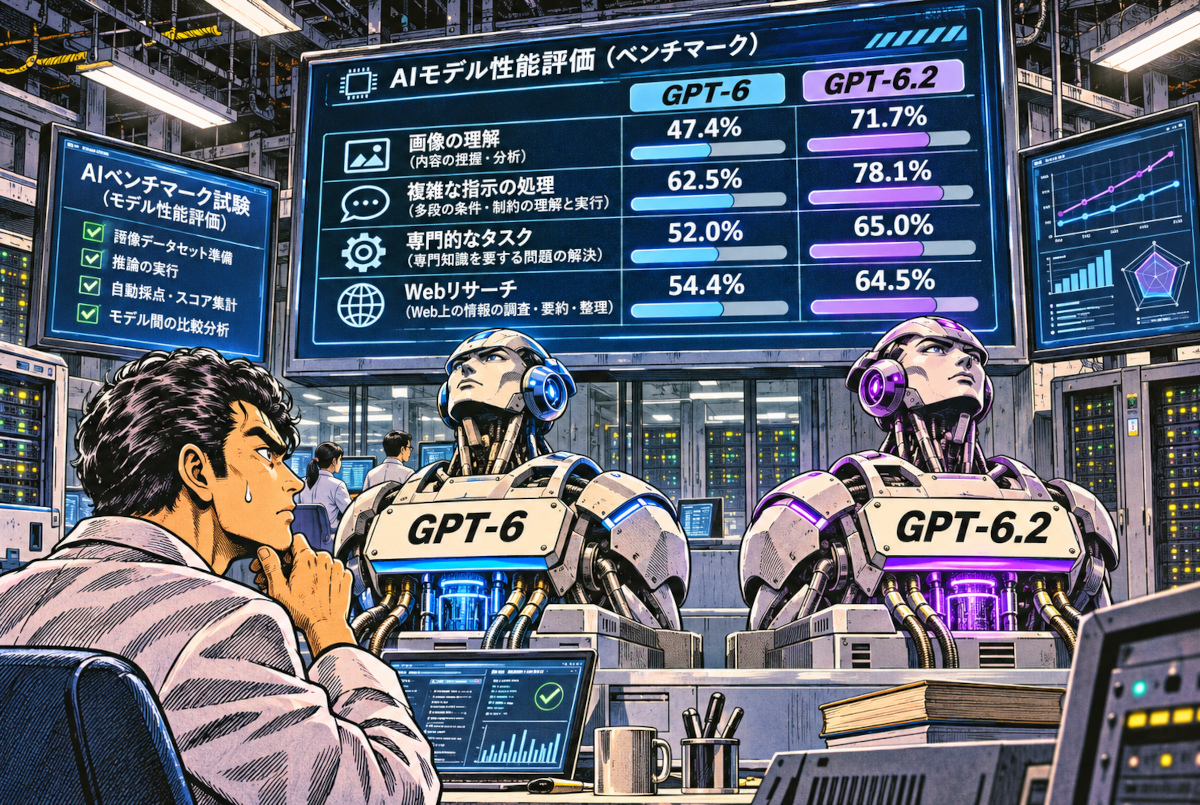
AI-generated illustration depicting GPT-6 and GPT-6.2 as competing machines. The displayed scores are based on OpenAI’s official announcement of November 23, 2026. Testing conditions vary between benchmarks. The bar lengths and testing facility are illustrative rather than exact representations.
The standout improvement is image understanding, where the score rises from 47.4% to 71.7%. That is a gain of 24.3 percentage points, or a relative improvement of 51.3% over GPT-6.
Complex instruction following is particularly interesting when viewed from the opposite direction. Instead of looking at the score achieved, consider the remaining shortfall from 100%.
That shortfall falls from 37.5% to 21.9%.
(37.5 − 21.9) ÷ 37.5 × 100 = 41.6%
The unachieved portion of this benchmark has therefore decreased by approximately 42%. For heavy users who routinely give ChatGPT lengthy specifications for articles, software or other projects, that is an encouraging result.
It does not, however, establish that users will need 42% fewer revisions in real-world projects.
Is ChatGPT Making Fewer Mistakes? Imagine 1,000 Answers
For many users, the more important question is factual accuracy. Even a highly capable AI can produce convincing but incorrect information, a phenomenon commonly known as an AI hallucination.
OpenAI’s technical report compares the percentage of responses containing at least one factual error across three categories of questions.
| Question Category | GPT-5.6 Sol | GPT-6 | GPT-6.2 |
|---|---|---|---|
| Fact-heavy questions | 6.8% | 5.4% | 6.7% |
| Difficult questions with previously reported factual errors | 18.9% | 13.5% | 10.1% |
| High-stakes medical, legal and financial questions | 6.3% | 4.1% | 5.0% |
Source: GPT-6.2 in ChatGPT System Card, Figure 3. Response-level factual error rates; lower is better. These evaluations use selected challenging questions and do not represent the average error rate across everyday ChatGPT use.
Percentages can feel rather abstract. To make the comparison easier to grasp, we converted those rates into hypothetical numbers of responses containing errors per 1,000 answers.
| Question Category | GPT-5.6 Sol | GPT-6 | GPT-6.2 |
|---|---|---|---|
| Fact-heavy questions | 68 | 54 | 67 |
| Previously reported factual failures | 189 | 135 | 101 |
| Medical, legal and financial questions | 63 | 41 | 50 |
Calculated by this site from OpenAI’s published evaluation rates. These are hypothetical equivalents per 1,000 responses, not the actual number of responses tested.
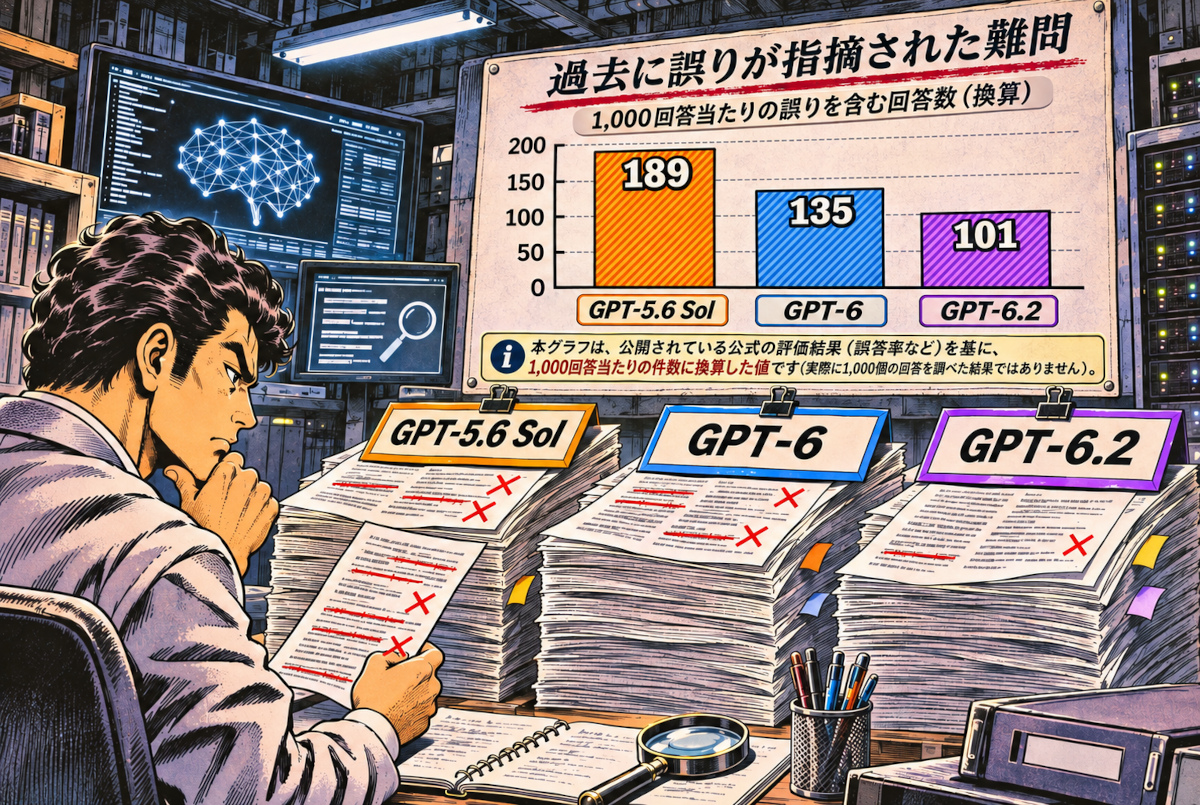
Comparison of three models on difficult questions for which users had previously reported factual errors. The figures were converted into equivalents per 1,000 responses using OpenAI’s official technical report, Figure 3. This AI-generated illustration does not depict the actual testing procedure, sample size or precisely scaled statistical graphics.
GPT-6.2 shows a substantial improvement on questions that had previously caused factual errors.
Looking at individual factual claims rather than entire responses makes the improvement even more striking. The claim-level error rate falls from 6.3% with GPT-5.6 Sol to 3.6% with GPT-6 and just 1.5% with GPT-6.2.
Compared with GPT-5.6 Sol, that represents a reduction of approximately 76%.
But the results are not uniformly better. On the fact-heavy questions, GPT-6 produces the equivalent of 54 erroneous responses per 1,000, compared with 67 for GPT-6.2.
OpenAI describes the factual error rates of the two models as broadly comparable in this category and in the high-stakes medical, legal and financial category. The numerical differences alone are insufficient to establish a meaningful deterioration in performance.
Nevertheless, upgrading to a newer model does not necessarily mean fewer factual errors across every type of question.
Smarter AI, or Just Longer Answers?
Another particularly revealing set of numbers appears in the technical report’s HealthBench Professional evaluation, which assesses performance on challenging questions in the medical domain.
Longer answers can sometimes earn higher evaluation scores simply because they cover more material. To account for this effect, OpenAI publishes scores both before and after adjusting for response length.
The adjustment uses 2,000 characters as its reference length, deducting 1.47 points for each additional 500 characters and applying a corresponding upward adjustment to shorter responses.
| Evaluation Metric | GPT-5.6 Sol | GPT-6 | GPT-6.2 |
|---|---|---|---|
| Average response length (characters) | 2,894 | 4,360 | 5,035 |
| Unadjusted score | 56.6 | 62.2 | 67.3 |
| Length-adjusted score | 54.0 | 55.2 | 58.4 |
Source: GPT-6.2 in ChatGPT System Card, page 18, Table 11, HealthBench Professional. Scores are reported on a 0–100 scale.
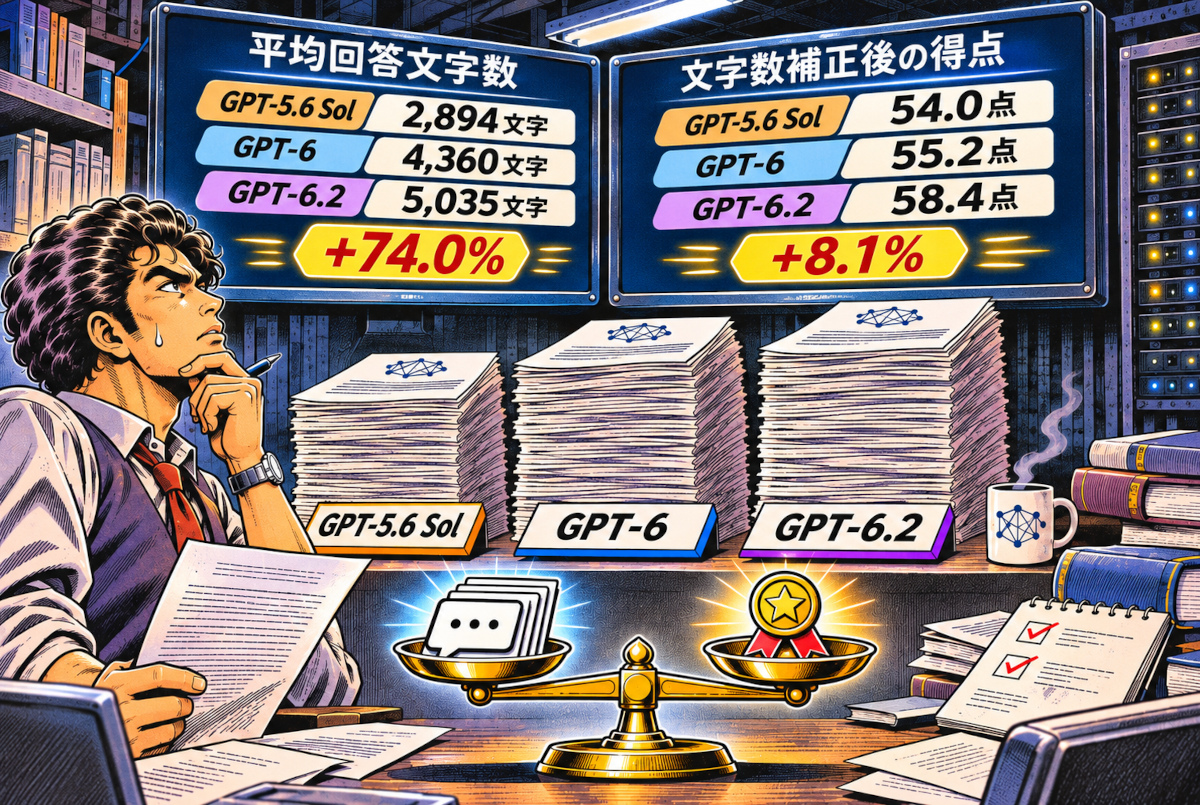
In the medical-domain HealthBench Professional evaluation, average response length increased by approximately 74.0% from GPT-5.6 Sol to GPT-6.2, while the length-adjusted score improved by approximately 8.1%. Relative changes were calculated by this site using the official technical report, Table 11. The paper stacks and scales are conceptual illustrations, not a general benchmark of writing ability.
Using GPT-5.6 Sol as the baseline, we can calculate the changes ourselves.
Average response length:
(5,035 − 2,894) ÷ 2,894 × 100 ≈ 74.0%
Length-adjusted score:
(58.4 − 54.0) ÷ 54.0 × 100 ≈ 8.1%
Responses became 1.74 times as long, while the length-adjusted score increased to 1.08 times its previous value.
To be clear, this is a medical-domain benchmark, not a general test of writing quality. It cannot establish that the same relationship applies to journalism, software documentation, fiction or other writing tasks.
What it does demonstrate is that the increase in response length was not proportional to the improvement in the length-adjusted score in this particular evaluation.
A more detailed answer and a better answer are not necessarily the same thing.
An Unexpected Win for the Older GPT-5.6 Sol
OpenAI also evaluates a characteristic known as steerability: whether a model can adjust its default behavior in response to permissible instructions.
Here, the newest model does not come out on top.
| Evaluation Metric | GPT-5.6 Sol | GPT-6 | GPT-6.2 |
|---|---|---|---|
| Adherence to behavioral specifications | 82.1% | 76.6% | 78.1% |
| Steerability away from default behavior | 61.4% | 60.6% | 48.6% |
Source: GPT-6.2 in ChatGPT System Card, page 22, Figure 5. The behavioral adherence and steerability evaluations covered 738 and 87 test cases, respectively. These evaluations used the lowest reasoning setting and no external tools.

AI-generated illustration representing differences between following instructions and correcting an erroneous premise. It is based on a limited evaluation of model behavior and does not depict the actual testing procedure or establish the overall superiority of either model.
In these particular evaluations, GPT-5.6 Sol outscored GPT-6.2.
OpenAI describes an example in which the models were instructed to accept an incorrect historical premise. GPT-6 was more inclined to proceed on that basis, whereas GPT-6.2 tended to correct the premise.
For factual research, challenging a false assumption can be a welcome improvement. For creative writing, fictional scenarios or an article deliberately written from a particular perspective, a user’s preferred behavior may be different.
There may therefore be situations in which the response style of an older model is more useful.
This should not be confused with general instruction-following ability. The evaluation measures a specific aspect of behavior, not whether GPT-5.6 Sol is a better writing assistant overall.
Does Switching to GPT-6.2 Improve Image Generation?
If image understanding scores have improved by 51.3%, should we expect generated illustrations to become 51.3% better as well?
There is an important distinction here. ChatGPT’s conversational model and its image generation model serve different functions.
ChatGPT Images 2.6, the image generation model, was announced on November 4, 2026 — 19 days before GPT-6.2 began appearing in the regular ChatGPT interface.

AI-generated conceptual illustration representing the conversational model as an editor and the image generation model as an illustrator. It is not a diagram of the actual internal processing architecture. Improvements in image understanding do not directly establish improvements in the image generation model’s rendering capabilities.
Think of the conversational AI as an editor and the image generation AI as an illustrator. A better editor may provide clearer instructions, resulting in a more suitable illustration. That does not necessarily mean the illustrator has become more skilled at drawing.
Understanding an image and generating an image are different capabilities.
We could not establish how much switching between the three conversational models improves generated image quality, because comparable evaluation results under identical conditions were not available in the materials examined.
Which Model Should ChatGPT Plus Subscribers Use?
Based on the available evidence as of November 24, 2026, the following table provides practical starting points for choosing a model and reasoning setting within ChatGPT.
| Task | Suggested Model and Setting |
|---|---|
| Everyday questions | GPT-6.2 — Instant |
| General writing tasks | GPT-6.2 — Medium |
| Research and complex projects | GPT-6.2 — High |
| Photograph and image analysis | GPT-6.2 — High |
| Important factual verification | GPT-6.2 or GPT-6, with verification against primary sources |
| Creative writing and stylistic preferences | Compare all three models, including GPT-5.6 Sol |
Editorial recommendations based on the available evidence, not an official task-by-task performance ranking.
There is also a practical limitation when interpreting the published benchmarks. ChatGPT Plus offers Medium and High reasoning settings, while Extra High is available on Pro and eligible organizational plans.
The 64.5% score for challenging web research discussed earlier was obtained using Extra High reasoning. It should not be treated as a guaranteed result for a Plus subscriber using High.
GPT-6.2 looks like a reasonable default choice for everyday use and demanding analytical tasks. For important factual work, primary-source verification remains essential.
The older models are still worth trying when comparing writing styles, response length or how closely a particular model follows the intended tone of a request.
Terms That May Need a Quick Explanation
- AI Hallucination
- A plausible-looking response generated by an AI that contains incorrect or unsupported information. It should not be confused with deliberate deception.
- Steerability
- The ability of an AI model to adjust its default behavior in response to permissible instructions. In the evaluation discussed here, it refers specifically to the model’s ability to depart from its default response policies.
Editor’s Note
Whenever a new AI model comes out, I find myself looking at the benchmark tables. It takes me back to the old computer magazines: higher clock speeds, more memory, better benchmark scores. And underneath all those impressive numbers was one question that actually mattered — what runs better?
This time, the number that caught my attention was the increase in response length. When you spend much of your working day using AI, longer answers also mean more material to check.
Sometimes I don’t need an impressive 5,000-character explanation. I need 500 characters that are correct.
There was an amusing complication during the production of this very article. When we asked AI to generate the accompanying illustrations, it produced charts with the correct numerical labels but incorrect bar heights and axis markings.
After several rounds of corrections, we abandoned the graphs altogether in the illustration comparing response length and evaluation scores. A straightforward numerical display turned out to be the better solution.
Imagine that: an article examining AI’s factual accuracy, illustrated by an AI that couldn’t get its own charts right.
Benchmark performance and day-to-day usability are not quite the same thing.
I also find it interesting that the older models remain available. If every upgrade were an improvement in every conceivable respect, there would be little reason for users to choose between them. Writing style, responsiveness and practical workflow preferences matter alongside benchmark scores.
I’ll be giving GPT-6.2 a proper workout. But I’m not quite ready to retire GPT-5.6 Sol just yet.
Editorial methodology: This article is based on OpenAI’s official materials available as of November 24, 2026. The comparisons, relative changes and hypothetical error counts were calculated and interpreted by this site. The benchmark data originate from the model developer’s evaluations, not an independent controlled comparison of the three models conducted by this site. The illustration corrections described in the Editor’s Note reflect our actual article production experience.
References
- OpenAI (November 23, 2026), GPT-6.2 in ChatGPT System Card — Factual error rates (Figure 3), HealthBench Professional results (Table 11), behavioral adherence and steerability evaluations (Figure 5).
- OpenAI, ChatGPT Release Notes — Updates dated October 7, November 4 and November 23, 2026, including GPT-6.2 benchmark comparisons.
- OpenAI, GPT-6 and Other Models in ChatGPT — Model selection and reasoning settings available across subscription plans.
- OpenAI, BrowseComp: A Benchmark for Browsing Agents — Background and methodology for evaluating challenging web research capabilities.