
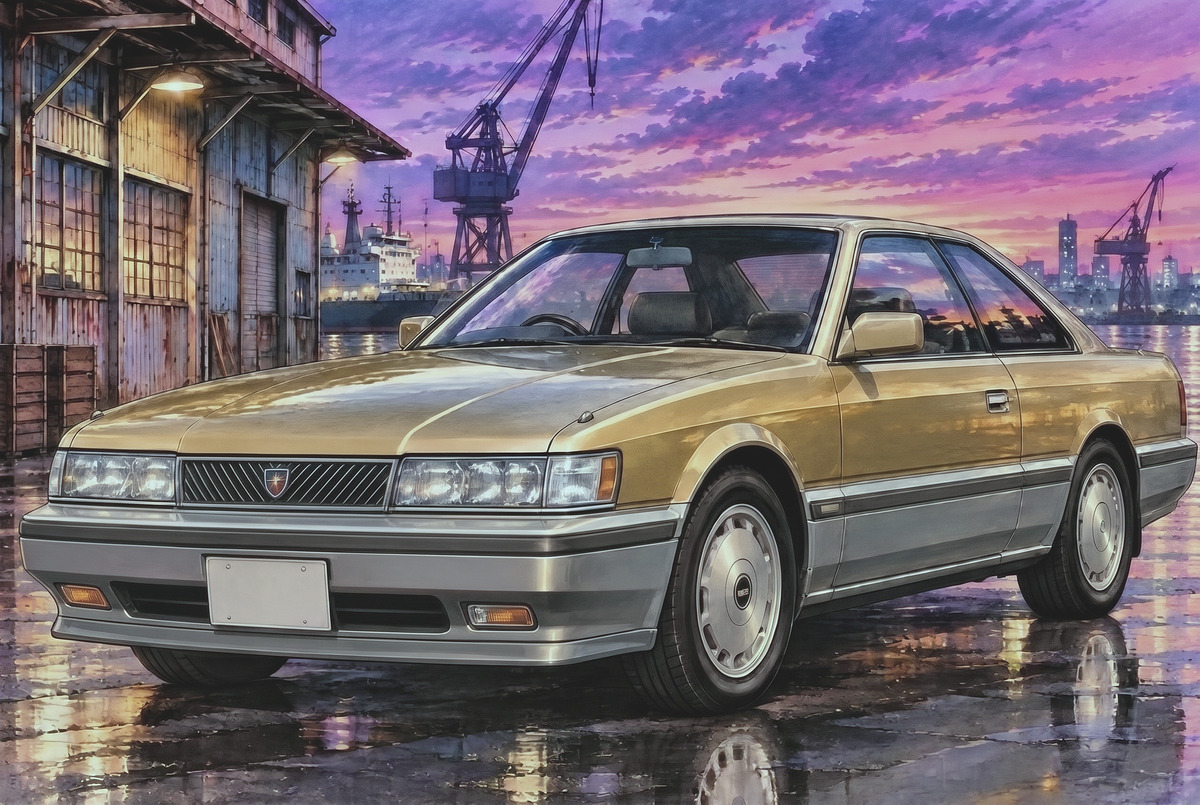
In 1986, a gold Nissan Leopard became one of the most memorable cars on the streets of Yokohama—at least on Japanese television. It was the car driven by Taka and Yuji, the detectives played by Hiroshi Tachi and Kyohei Shibata in Abunai Deka (literally “Dangerous Detectives”), a stylish Nippon TV police drama.
For an old-school Nissan fan, the F31 Leopard still means that gold-and-silver two-tone coupe.
But here is the awkward part. The Leopard looked terrific on television, yet it never came close to matching the Toyota Soarer in new-car sales. Decades later, a 2024 used-car survey reported a top Leopard asking price 3.3 times the Soarer’s.
How did the car that lost the showroom battle become such a coveted classic? I put the drama’s timeline beside period sales figures, then tested the supposed comeback against used-car prices rather than taking the legend at face value.
Minato 303 vs. Minato 302: The Faster Car Wasn’t Necessarily the Icon
First, a distinction that matters to Abunai Deka fans: the early and later F31 Leopards were not the same car. Minato 303 and Minato 302 are police radio call signs used in the drama, not Nissan model codes.
| Specification | Representative Minato 303 | Representative Minato 302 |
|---|---|---|
| Main TV series | Abunai Deka | Motto Abunai Deka (More Dangerous Detectives) |
| Model | Early F31 Leopard | Facelifted F31 Leopard |
| Grade | 3.0 Ultima | Ultima V30 Twin Cam Turbo |
| Color | Gold two-tone | Dark-blue two-tone |
| Engine | VG30DE | VG30DET |
| Induction | Naturally aspirated | Turbocharged |
| Maximum power | 185 PS | 255 PS |
These are representative screen-car configurations associated with the two shows, not a claim that the same call sign was permanently attached to a single car throughout the franchise. PS is metric horsepower.
As the previous installment showed, the later turbo model made 70 PS more than the original Ultima. On paper, that is a substantial upgrade.
Yet the 185-PS gold car repeatedly returned as the franchise’s visual signature. In this particular corner of car culture, maximum horsepower did not decide which version people remembered.
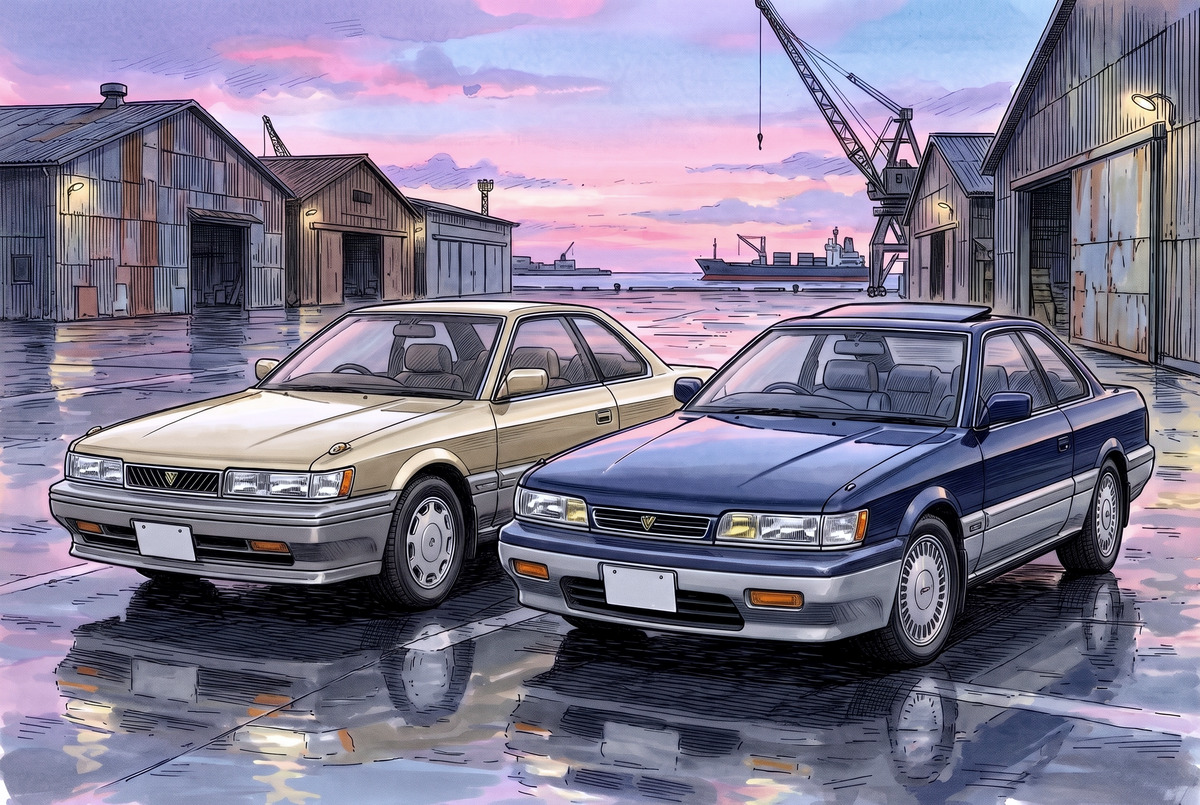 The early gold two-tone and later dark-blue two-tone F31s imagined at a harbor. Some exterior details are simplified.
Even While the Show Aired, the Soarer Sold About 4.8 Times as Many Cars
Did the show’s popularity translate into showroom sales? The dates make that a fair question: the Leopard appeared in a hit police drama only about eight months after its launch.
| Date | Event |
|---|---|
| January 1986 | Second-generation Toyota Soarer (Z20) launched |
| February 1986 | Second-generation Nissan Leopard (F31) launched |
| October 1986 | Abunai Deka began broadcasting |
| January–June 1987 | The original television series was still on air |
| September 1987 | The original television series ended |
| December 1987 | First theatrical film released |
| July 1988 | Matamata Abunai Deka (Another Dangerous Detectives) released |
| August 1988 | Facelifted F31 Leopard introduced |
| October 1988 | Motto Abunai Deka began broadcasting |
| March 1989 | The second television series ended |
That timing should have been a gift for Nissan’s marketing department. So I looked at the first half of 1987, when viewers could see the Leopard on television every week. A Japanese automotive specialist, quoted by Weekly Playboy News in 2022, reported the following average monthly sales:
| January–June 1987 | Nissan Leopard | Toyota Soarer |
|---|---|---|
| Average monthly sales | Approx. 600 | Approx. 2,900 |
| Six-month estimate (monthly average × 6) | Approx. 3,600 | Approx. 17,400 |
| Sales ratio (Leopard = 1) | 1 | Approx. 4.83 |
Independent calculations using monthly averages reported by Weekly Playboy News in 2022. The six-month totals are estimates obtained by multiplying the reported averages by six; they are not sums of original monthly registration records. The original period statistics have not been independently inspected.
That works out to an estimated six-month gap of 13,800 cars. The Leopard could be a television star and still lose badly at the dealership.
Becoming a famous car on TV and becoming a car people actually buy are two different achievements.
There is one important caveat. Without the show, the Leopard might have sold even fewer cars. We do not have a sufficiently complete before-and-after monthly registration series to measure the drama’s causal effect on sales.
 A fictional used-car lot. The sales figures for the first half of 1987 are compared in the table above, not depicted in the scene.
Outsold by 3.7 to 1 When New—Did That Help Make the Leopard Rare?
Japanese automotive publications put total new registrations for the F31 Leopard at roughly 38,000, compared with roughly 142,000 for the Z20 Soarer. These are secondary-source approximations, not figures we reconstructed from the original registration ledgers.
| Measure | F31 Leopard | Z20 Soarer |
|---|---|---|
| Approximate model-generation sales period | 1986–1992 | 1986–1991 |
| Reported new registrations | Approx. 38,000 | Approx. 142,000 |
| Share of combined registrations | Approx. 21.1% | Approx. 78.9% |
Independent calculations based on approximate figures discussed by specialist outlets including Motor Fan and WEB CARTOP. The generations were sold over different periods; publications report slightly different totals. The underlying original registration datasets were not directly verified, so these should not be treated as exact audited totals.
For every Leopard registered, the comparison suggests about 3.74 Soarers—or roughly 104,000 more Soarers altogether.
That looked like a crushing defeat in the 1980s. But years later, a smaller original production pool can mean fewer possible surviving cars. Here is the simplest thought experiment: if both models had exactly the same survival rate, the Soarer would still outnumber the Leopard by about 3.7 to 1.
Of course, we do not know the actual surviving fleets, scrappage figures or export totals. Original registrations alone cannot establish today’s rarity. Still, a limited supply combined with strong, unusually dedicated demand could help explain why certain Leopards command extraordinary prices.
 A fictional gathering of 1980s cars. The Leopard and Soarer registration totals are compared in the table above.
In 2024, One Leopard Was Advertised for ¥13.2 Million
The gold early F31 returned in the 2016 film Saraba Abunai Deka (Farewell, Dangerous Detectives). It made another appearance in Kaettekita Abunai Deka (The Dangerous Detectives Return), released on May 24, 2024—38 years after the model’s introduction.
In July 2024, Japanese magazine Best Car published a comparison of used-car listings. Its reported asking-price ranges were striking:
| Listings reported in July 2024 article | F31 Leopard | Z20 Soarer |
|---|---|---|
| Number of listed cars | More than 30 | About 50 |
| Lowest asking price | ¥1.38 million | ¥1.30 million |
| Highest asking price | ¥13.20 million | ¥4.00 million |
| Highest ÷ lowest asking price | Approx. 9.57× | Approx. 3.08× |
Our ratios are calculated from the listing figures reported in the July 2024 Best Car Web article. These are advertised asking prices, not confirmed transaction prices. Condition, mileage, trim and restoration history were not standardized across the listings.
At the very top of the advertised range, the Leopard was priced at 3.3 times the Soarer. But the two cheapest listings differed by just ¥80,000.
The gap between the cheapest and most expensive Leopard listing was about 9.6-fold. The same article said the Leopards advertised above ¥7 million were held by a specialist Leopard dealer.
That distinction matters. The existence of a few exceptionally expensive cars does not establish that the entire Leopard market is priced above the Soarer market.
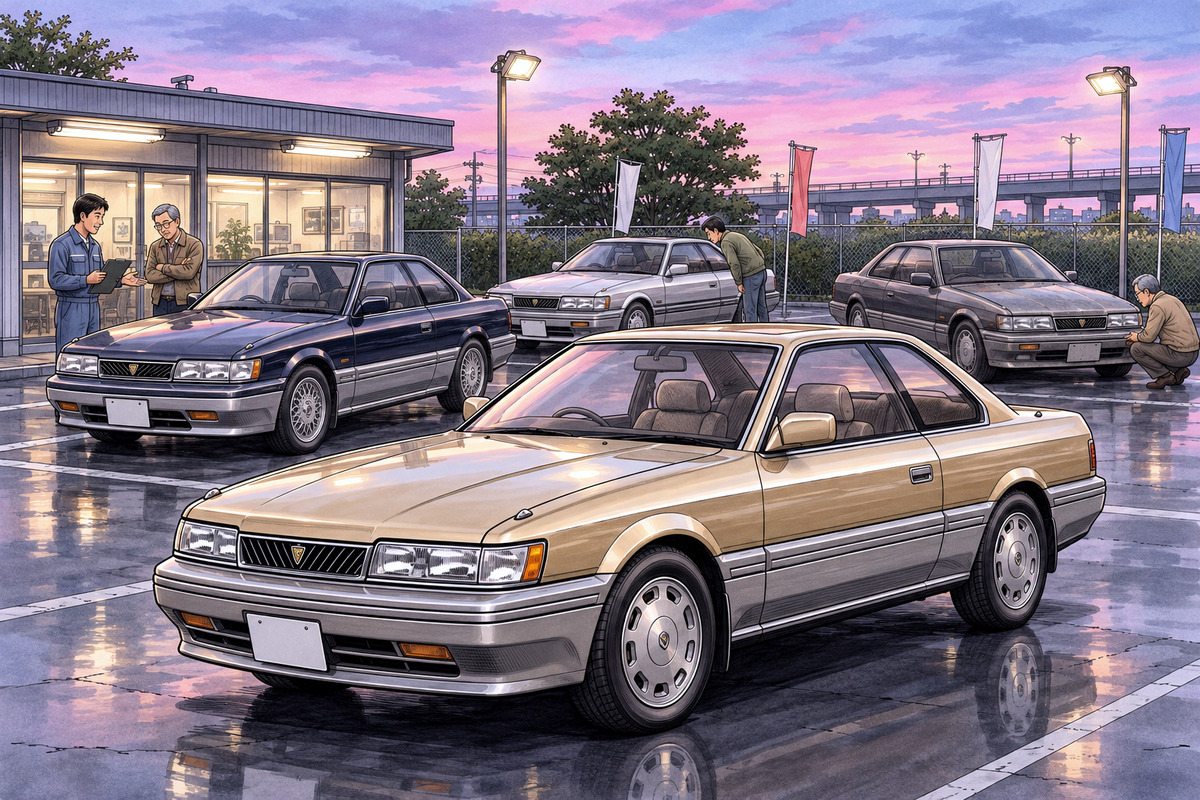 A fictional dealership scene, not photographs of the cars priced in the 2024 report. See the table for the actual reported listing ranges.
So Did the Leopard Really Beat the Soarer on the Used-Car Market?
To test that claim, I revisited the generation-specific Japanese used-car search pages on CarSensor while preparing this article on November 25, 2026.
| Displayed price information | F31 Leopard | Z20 Soarer |
|---|---|---|
| Displayed average price | ¥2.411 million | ¥2.863 million |
| Lower end of displayed range | ¥1.450 million | ¥1.280 million |
| Upper end of displayed range | ¥3.989 million | ¥5.290 million |
Figures recorded from the price summaries displayed at the top of the two generation-specific CarSensor pages. Cached pages may reflect slightly different underlying collection dates. “Price on request” cars have unknown asking prices. These figures are neither completed sale prices nor averages independently computed from every vehicle in the market.
This time the Soarer’s displayed average was ¥452,000 higher—approximately 18.7% above the Leopard’s ¥2.411 million.
Does that mean Leopard prices collapsed between 2024 and 2026? No. We are comparing different sites, listing mixes and statistical measures. A 2024 maximum asking price is not directly comparable to a 2026 displayed average.
A handful of exceptional cars disappearing from listings—or switching to “price on request”—can change a small classic-car market’s reported range dramatically. And an asking price tells us nothing certain about what a buyer actually paid.
The Leopard became exceptionally valuable to some enthusiasts. That does not mean every Leopard, or even the average listed Leopard, is worth more than a Soarer.
To isolate the actual Abunai Deka premium, we would need completed transaction prices for closely matched cars: same model year, trim, mileage, condition and degree of restoration. We do not have that dataset.
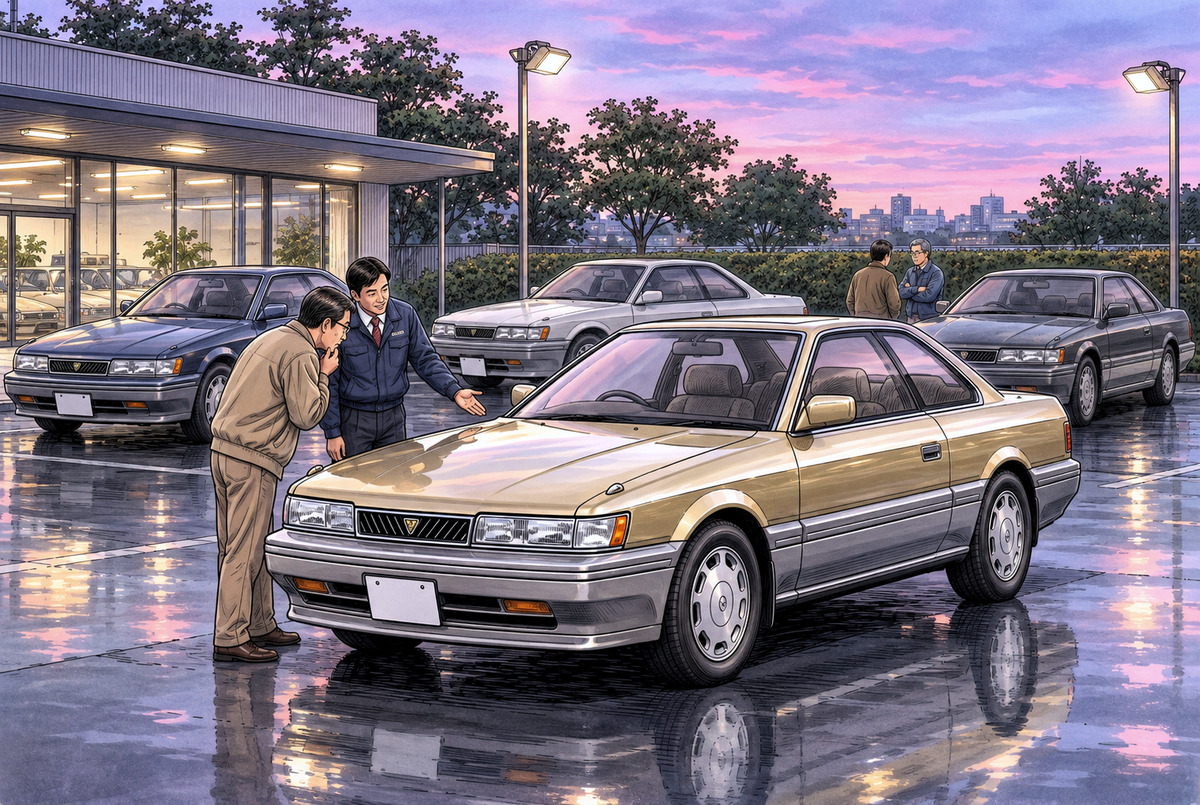 An imagined dealership scene. The November 2026 displayed asking-price data appear in the table above.
Fans Aren’t Just Buying a 185-PS Engine
There is a revealing detail in a MyNavi News interview with the owner of the gold Leopard used in the 2024 film.
The car was a 1987 early-model 3.0 Ultima. When the opportunity to appear in the film came along, the owner removed aftermarket aerodynamic parts and wheels, returned it closer to original specification, and searched for accessories such as the emergency beacon and antenna needed to recreate its screen appearance.
A separate 2017 GAZOO interview featured another owner who had started with a 2.0-liter XS-II and recreated aspects of the larger Ultima’s interior and exterior.
The normal tuning instinct is to add horsepower or bigger wheels. Yet some fans of this police drama do the opposite: they go hunting for original-style parts to make their cars look more like they did on television.
The body color, factory-style wheels, cabin trim and antenna can matter as much as engine performance. The object of ownership is not merely an F31 chassis; it is a particular remembered image of the F31.
The nostalgia has survived in miniature, too. TOMYTEC produced a gold Minato 303 model, while Aoshima offered a Minato 302 plastic kit. Long after the full-size car left production, the films, models and owners kept its appearance in circulation.
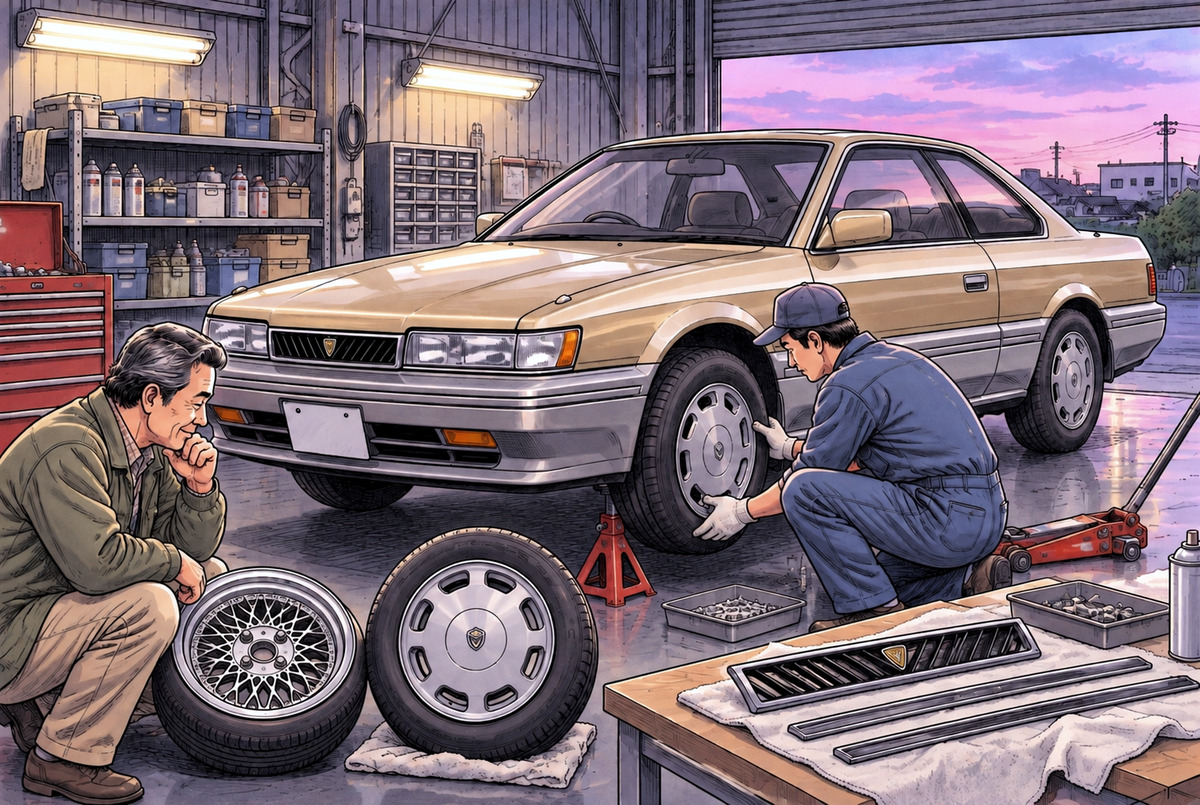 A fictional restoration workshop. Some trim, wheel and servicing details are simplified.
One More Nissan Police-Drama Car: The West Police Gazelle Convertible
The Leopard was not Nissan’s only link with Japanese television detectives.
In Seibu Keisatsu (“West Police”), which began in 1979, police chief Kogure—played by screen legend Yujiro Ishihara—drove a white Nissan Gazelle convertible.
It was no ordinary showroom convertible. A based on the first-generation S110 Gazelle was specially modified by removing the fixed roof. A 2017 feature prepared with assistance from the Ishihara Yujiro Memorial Museum identified the donor trim as the 2000XE-II.
| Comparison | Gazelle | F31 Leopard |
|---|---|---|
| Drama | Seibu Keisatsu | Abunai Deka |
| Screen-car identity | Custom-built convertible body | Unmarked police car based on a production coupe |
| How an owner might recreate it | Extensive body modification required | Closer exterior resemblance possible with a production car |
Finding period-correct parts for a convincing Leopard replica is hardly easy. But compared with building a one-off convertible Gazelle, an owner has a more achievable path to recreating the television Leopard from an existing road car.
Perhaps that difference in reproducibility is another reason the F31 could become something fans preserved and re-created for themselves—not merely a prop remembered from a television series.
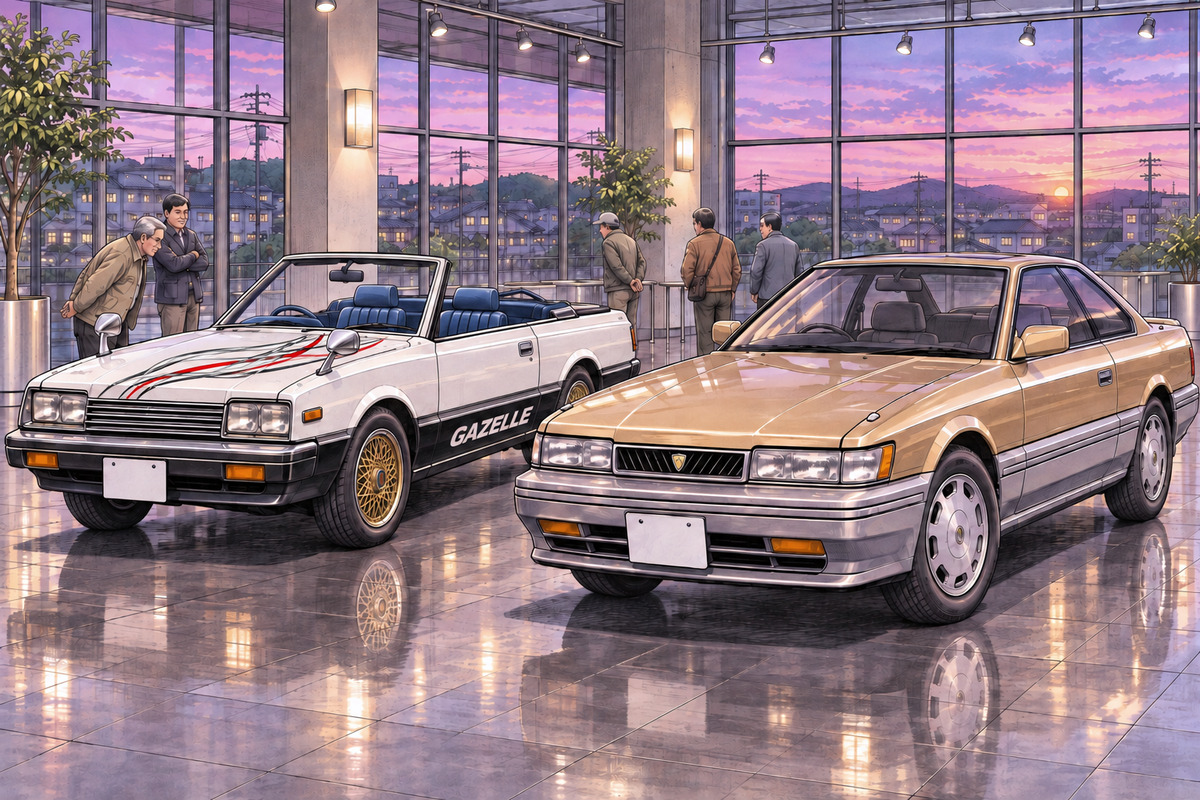 An imagined exhibit of the West Police Gazelle convertible (left) and the early Abunai Deka Leopard F31 (right). Some decorative and vehicle details are simplified.
Editor’s Note
As a Nissan partisan, I was hoping for a satisfying ending: the Abunai Deka Leopard finally got its revenge on the Toyota Soarer.
Then I checked the used-car figures. It wasn’t that simple. Nissan could win the contest for the single wildest asking price, while Toyota could still come out ahead on the displayed average.
What interested me more was something else. Nissan built a 255-PS turbocharged Leopard, yet the film revivals kept bringing back the older, gold, 185-PS version.
When I was younger, I assumed more horsepower meant a better car. Now there are enthusiasts spending time and money finding the original wheels just to undo years of modifications. A funny kind of progress, isn’t it?
When I see that gold Leopard, 185 PS is not the first thing that comes to mind. I think of Yokohama, Taka and Yuji, and the era in which the car belonged.
Maybe some people aren’t really trying to buy that car at all. Maybe they’re trying to buy back the time when that car was on the streets.
Good luck explaining that with an ordinary used-car price guide.
Nissan Leopard: Five-Part Series
The Nissan Leopard arrived before the Toyota Soarer, yet struggled to match its rival in the Japanese market. Across five articles, we examine sales figures, engine performance, pricing, technology, the influence of Abunai Deka, and the Leopard's changing identity through 2000.
- Part 1: How Did the Nissan Leopard Outsell the Soarer in One Class—Yet Lose Overall?
- Part 2: Did a 2.0L Toyota Soarer Really Beat Nissan’s 3.0L Leopard?
- Part 3: Why Did the Nissan Cima Get the Leopard’s 255-PS Turbo Engine First?
- Part 4: Did the Nissan Leopard Finally Beat the Toyota Soarer? The Abunai Deka Effect
- Final Part: Why Did the Nissan Leopard Give Up Being a Coupe? Two ¥3.95 Million Nissans and the End of an Icon Coming soon
References
- Nissan Heritage Collection: Leopard XS-II (Japanese) — Nissan’s official heritage information on the F31 Leopard, its launch and body design.
- Toyota 75-Year History: Second-Generation Soarer (Japanese) — Toyota’s historical model lineage and launch data for the Z20 Soarer.
- Nippon TV: Return of Abunai Deka, Television Premiere (2025, Japanese) — Official broadcaster overview of the television and film franchise.
- Nippon TV: Abunai Deka Blu-ray Box Vol. 1 (Japanese) — Original series broadcasting information.
- Nippon TV: Motto Abunai Deka Blu-ray Box (Japanese) — Second television series broadcasting information.
- Nippon TV: Matamata Abunai Deka Blu-ray (Japanese) — Release information for the 1988 movie.
- CarSensor Editorial: Cars of the Abunai Deka Series (Japanese) — Guide to the early and later Leopard police-drama cars.
- Weekly Playboy News: Why Did the Cima Get What the Later Leopard Missed? (May 19, 2022; Japanese) — Reported average monthly Leopard and Soarer sales in the first half of 1987, used for our calculations.
- Motor Fan: Second-Generation Soarer Sales and the Luxury Coupe Boom (Japanese) — Reported approximate model-generation registrations for the Soarer and Leopard.
- WEB CARTOP: How Abunai Deka Made the Second-Generation Leopard Famous (Japanese) — Supplementary comparison of the two models’ historical registration volumes.
- Best Car Web: Why Was the Leopard Overshadowed by the Soarer When New? (July 22, 2024; Japanese) — Used-car listing counts and asking-price ranges reported in 2024.
- CarSensor: Nissan Leopard, 1986–1992 Used-Car Listings (Japanese) — Generation-specific displayed market-price data captured for the November 25, 2026 comparison.
- CarSensor: Toyota Soarer, 1986–1991 Used-Car Listings (Japanese) — Corresponding Soarer displayed market-price data, subject to change.
- Car Watch: Leopard Displayed for the 2016 Abunai Deka Film (Japanese) — Exhibition details about the revived film car.
- MyNavi News: Meeting the Leopard Used in Abunai Deka (February 24, 2024; Japanese) — Interview with the owner of the film’s 1987 Ultima and its restoration to screen appearance.
- Toyota GAZOO: An Owner’s Leopard Built to Resemble an Abunai Deka Car (2017; Japanese) — Interview with an owner who recreated Ultima-style details from a 2.0-liter XS-II.
- TOMYTEC: T-IG4301 Leopard Minato 303 (Gold) (Japanese) — Official product information for the miniature drama car.
- Aoshima: Abunai Deka Minato 302 Unmarked Police Car Model Kit (Japanese) — Official model-kit product information.
- Nissan Heritage Collection: Gazelle Hatchback Turbo XE (Japanese) — Official information on the S110-series Gazelle; not the special convertible itself.
- MOTA: Inside the West Police Gazelle Convertible (Japanese) — Reporting with cooperation from the Ishihara Yujiro Memorial Museum on the custom drama car and its donor grade.