
In August 1988, the Nissan Leopard F31 finally got the engine it needed to take the fight to the Toyota Soarer: the VG30DET, a 3.0-liter turbocharged V6 with twin overhead camshafts per cylinder bank and 255 PS.
It had 15 PS more than Toyota’s 240-PS Soarer 3.0GT. For Nissan enthusiasts, this was the counterattack they had been waiting for.
But there is something rather peculiar about the VG30DET’s history. The first Nissan to receive this 255-PS engine was not the Leopard. It was the Cima.
The Cima arrived in January 1988. The Leopard had to wait until August, roughly seven months later.
According to a former Nissan product development executive, the engine had originally been developed for the Leopard. So why did another Nissan get it first?
And when the 255-PS Leopard finally faced the 240-PS Soarer in a 1988 acceleration test, the Toyota reportedly came out ahead. Look a little more closely at the numbers, however, and that story becomes considerably more complicated.
The Nissan VG30DET: Seven Months Ahead in the Cima
First, let’s establish the timeline.
| Date | Model and Development | Maximum Power |
|---|---|---|
| February 1986 | Second-generation Leopard F31 launched with the VG30DE | 185 PS |
| January 1988 | First-generation Cima launched with the VG30DET | 255 PS |
| January 1988 | Toyota Soarer Z20 updated with an uprated 7M-GTEU | 240 PS |
| August 1988 | Leopard F31 receives a major facelift and the VG30DET | 255 PS |
Timeline compiled from Nissan’s official historical materials, the Nissan Heritage Collection, and period-based vehicle specifications. All power figures are period net ratings in PS (metric horsepower).
While the Leopard’s flagship engine was producing 185 PS, Toyota’s 3.0-liter turbocharged Soarer was already making 230 PS. In January 1988, Toyota increased that figure to 240 PS.
That same month, Nissan launched the Cima with 255 PS.
Nissan’s own documentation, published in 2021 in connection with the restoration of a first-generation Cima, explicitly confirms that the VG30DET was introduced in the Cima ahead of the F31 Leopard.
In other words, Nissan already had an engine capable of challenging the Soarer on paper. It just wasn’t under the hood of the Leopard yet.
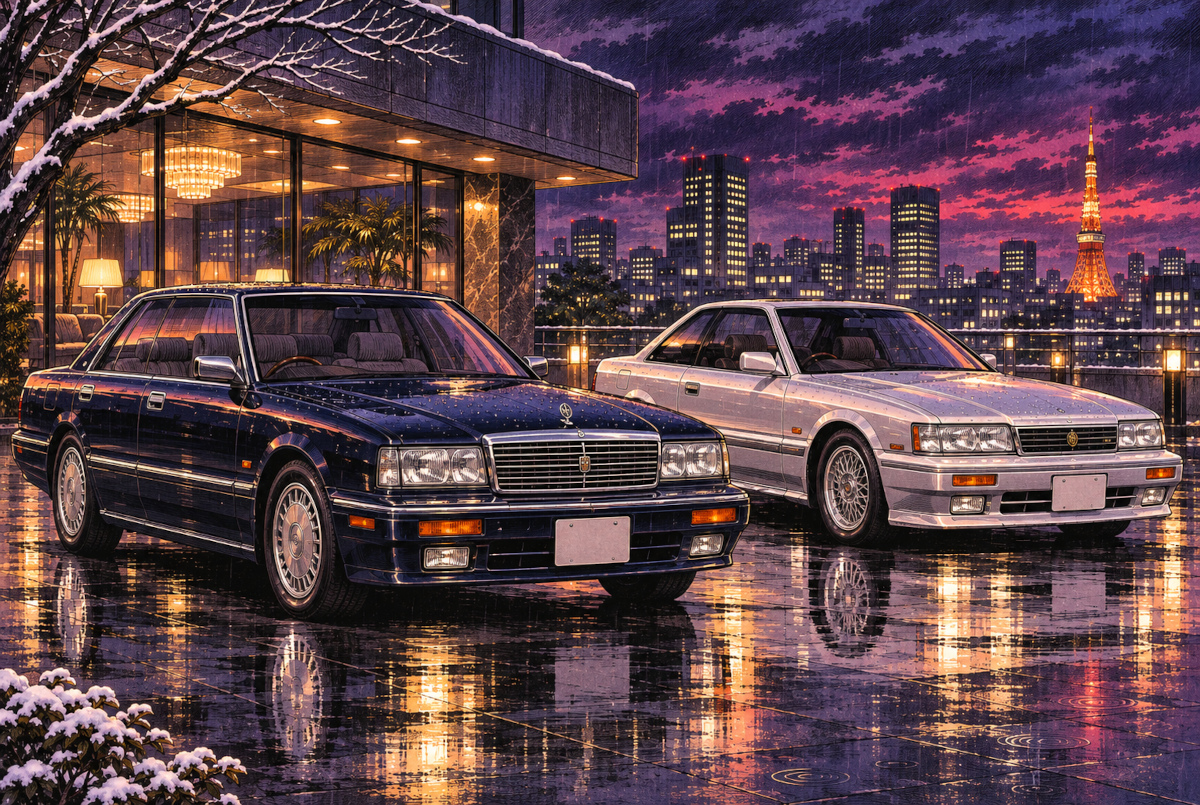
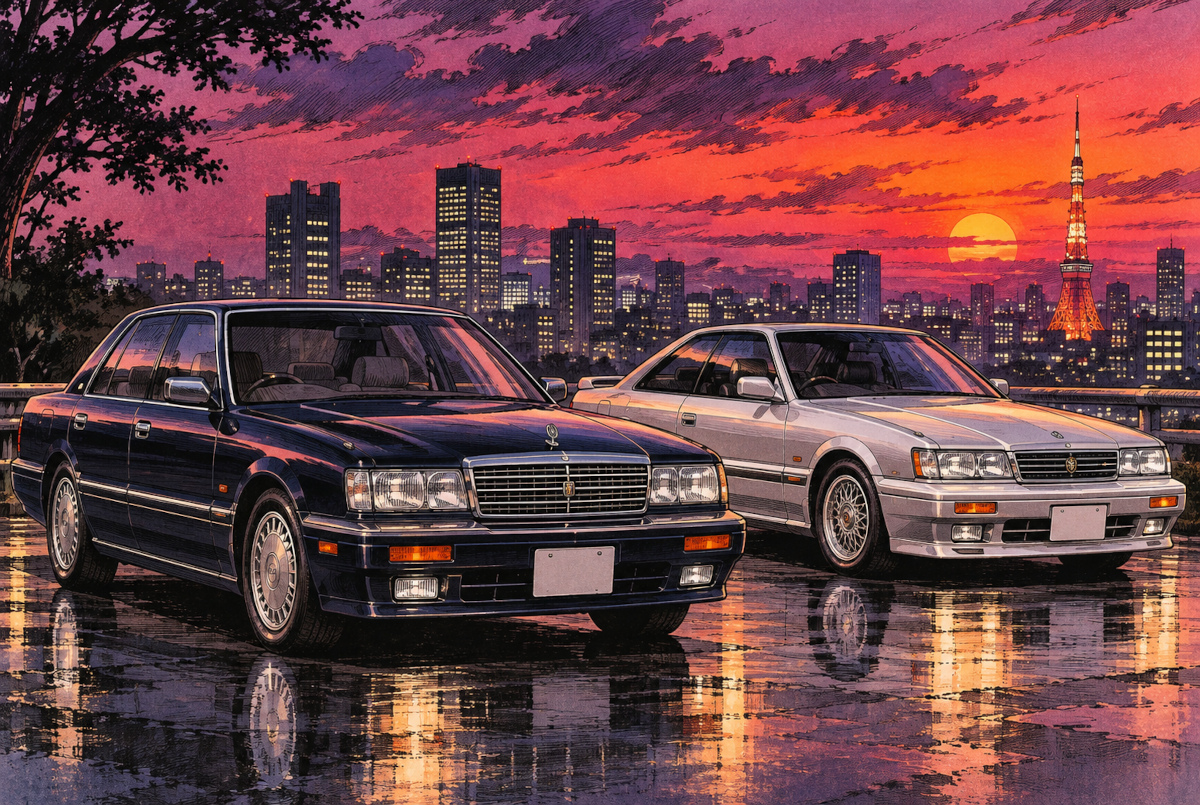
Illustration of the first-generation Nissan Cima FPY31 (left) and the facelifted Leopard F31 (right). The Cima received the 255-PS VG30DET turbocharged V6 in January 1988, followed by the Leopard in August. This is an imagined scene bringing the two cars together, not a historical launch photograph. Grille, lighting, emblem, and wheel details differ from the original production vehicles.
Did the Cima Get an Engine Intended for the Leopard?
The most revealing account comes from an interview published by automotive journalist Keisuke Maeda with Yasuhiko Misaka, a former Nissan executive responsible for product development of the Y31 Cedric, Gloria, and Cima.
According to Misaka’s recollection, the VG30DET had been developed by the Leopard team as a means of challenging the Toyota Soarer.
However, the people planning the Cima wanted a high-output turbocharged engine for their new luxury car. Following internal negotiations, the Cima secured the engine first.
Misaka also recalled initial resistance from the engine design department. After all, this was an engine being prepared for another Nissan model.
There is an important distinction here. Nissan’s official records establish which car received the engine first. The circumstances behind that decision come from Misaka’s later recollection, rather than a complete set of internal meeting minutes or corporate approval documents.
The launch sequence is documented fact. The account of the internal negotiations is firsthand retrospective testimony.
For a Nissan fan, it is still a rather uncomfortable story. The Leopard was chasing the Soarer, yet its new engine reached another car within the same company first.
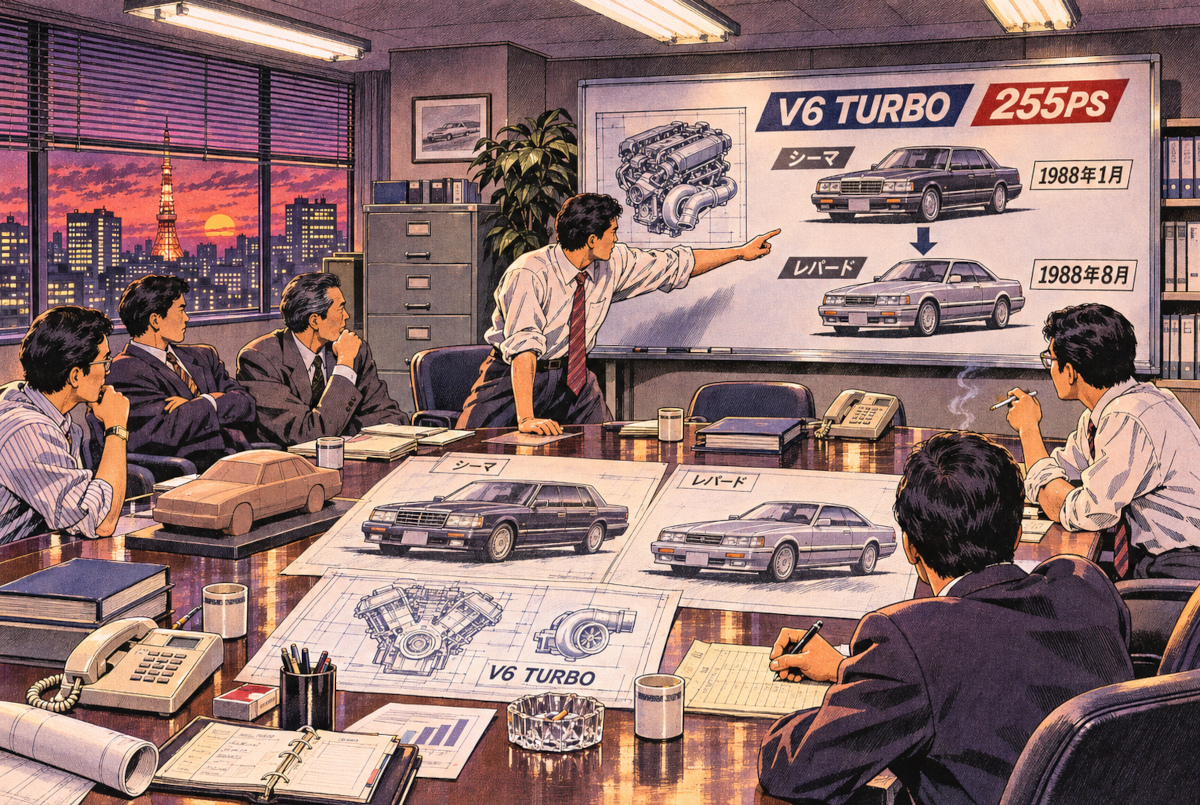
AI-generated illustration inspired by retrospective accounts of Nissan’s VG30DET product-planning decisions. It depicts the Cima’s January 1988 introduction and the Leopard’s subsequent August introduction. The people and meeting are fictional; this is not a reproduction of an actual Nissan meeting or its participants.
Why 255 PS Mattered Beyond the Horsepower Wars
The VG30DET was a turbocharged development of Nissan’s 3.0-liter VG30DE V6 engine, producing 255 PS and 35.0 kgf·m of maximum torque.
One particularly useful source is a 1989 article in the Journal of the Japan Society of Mechanical Engineers, titled “Planning and Development of the Nissan Cima.”
Written by someone directly involved in the project, it explains the Cima’s development from both an engineering and a product-planning perspective.
The VG30DET incorporated and a . Its development was concerned not only with peak power but also with smooth response and useful performance at lower engine speeds.
In the Cima, Nissan also employed technologies such as a controlled dual-mode muffler to deliver the refined driving characteristics expected of a luxury car.
That does not mean every VG30DET-powered Nissan used an identical exhaust system or the same vehicle-specific equipment.
What makes the engineering article particularly revealing is its discussion of the symbolic value of performance. A high-end car needed something that would make customers aspire to own it.
Misaka’s interview offers a similar perspective. With 200-PS-class cars becoming increasingly familiar, exceeding 250 PS provided a particularly persuasive figure for the sales department.
The VG30DET’s 255 PS was not merely an engineering achievement. It was also a selling point that helped convince customers they were buying something special.
That distinction helps explain why the Cima’s development team was so interested in an engine that had reportedly been intended for the Leopard.
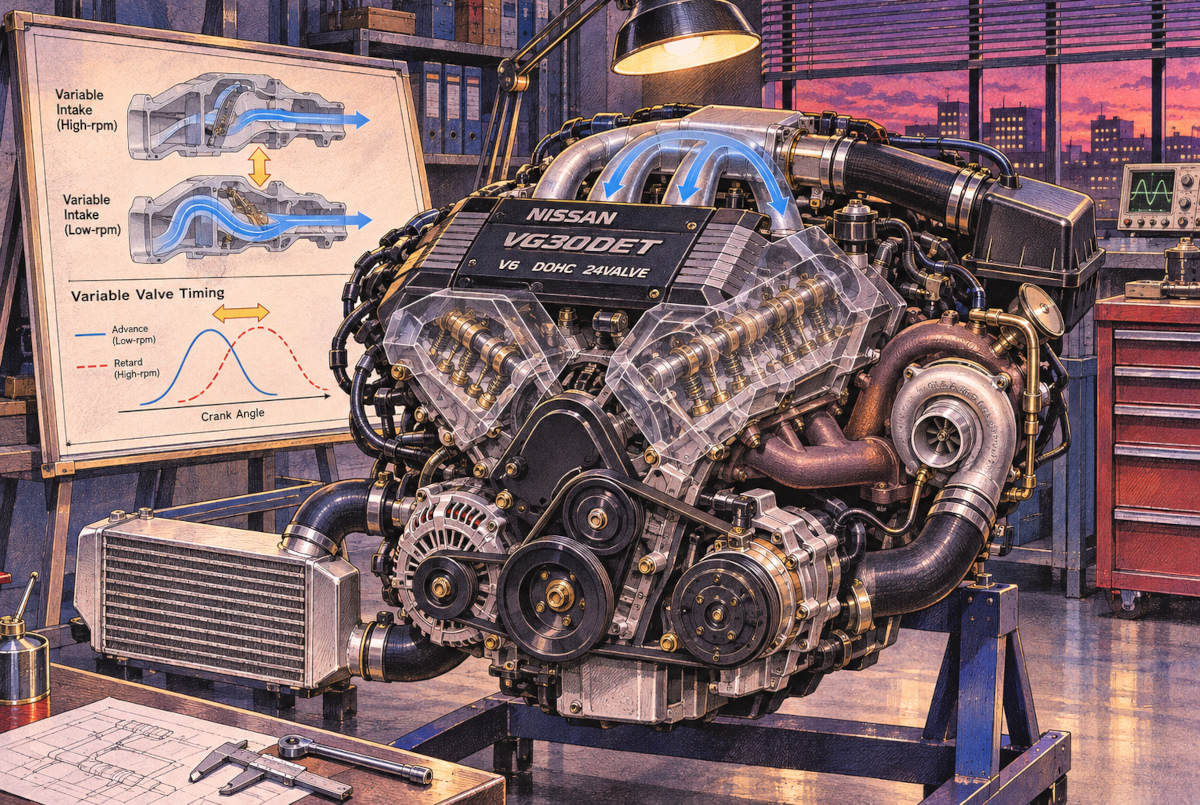
The Nissan VG30DET: a 2,960cc, 24-valve, single-turbo V6 DOHC engine producing 255 PS at 6,000 rpm and 35.0 kgf·m at 3,200 rpm. The illustration represents the engine and its variable valve timing and intake technologies. Intake and exhaust plumbing, camshaft mechanisms, accessories, intercooler depiction, and control diagrams are schematic. They do not reproduce the exact production hardware, factory equipment configuration, or engine control maps.
From 185 to 255 PS: How Much Better Did the Leopard Become?
Let’s compare the original 1986 Leopard Ultima with the facelifted Ultima V30 Twin Cam Turbo introduced in August 1988.
| Specification | 1986 Leopard Ultima | 1988 Leopard Ultima Turbo |
|---|---|---|
| Engine | VG30DE | VG30DET |
| Maximum power | 185 PS | 255 PS |
| Maximum torque | 25.0 kgf·m | 35.0 kgf·m |
| Vehicle weight | 1,460 kg | 1,520 kg |
| Weight per metric horsepower | 7.89 kg/PS | 5.96 kg/PS |
| Transmission | 4-speed automatic | 4-speed automatic |
| Original Japanese reference price | ¥3,837,000 | ¥4,162,000 |
Specifications are based on period vehicle data for the respective grades at introduction. Weight per PS is independently calculated by dividing vehicle weight by maximum power. Equipment and vehicle specifications differ between model years.
The headline gain was 70 PS, an increase of approximately 37.8%.
However, the new car also weighed 60 kg more. Accounting for that additional weight, maximum power per kilogram increased by approximately 32.4%.
The inverse measure, weight per unit of power, fell from 7.89 to 5.96 kg/PS, a reduction of approximately 24.5%.
Those percentages are not interchangeable. The 32.4% figure describes the increase in PS/kg, while the 24.5% figure describes the reduction in kg/PS. Each calculation uses the original 1986 model as its baseline.
The list price increased by ¥325,000. Since the facelift involved other equipment and specification changes, that difference cannot simply be treated as the price of an extra 70 PS.
Nevertheless, the numbers make one thing clear. The facelifted F31 was considerably more than a cosmetic update. Its powertrain represented a substantial improvement over the original 1986 Ultima.
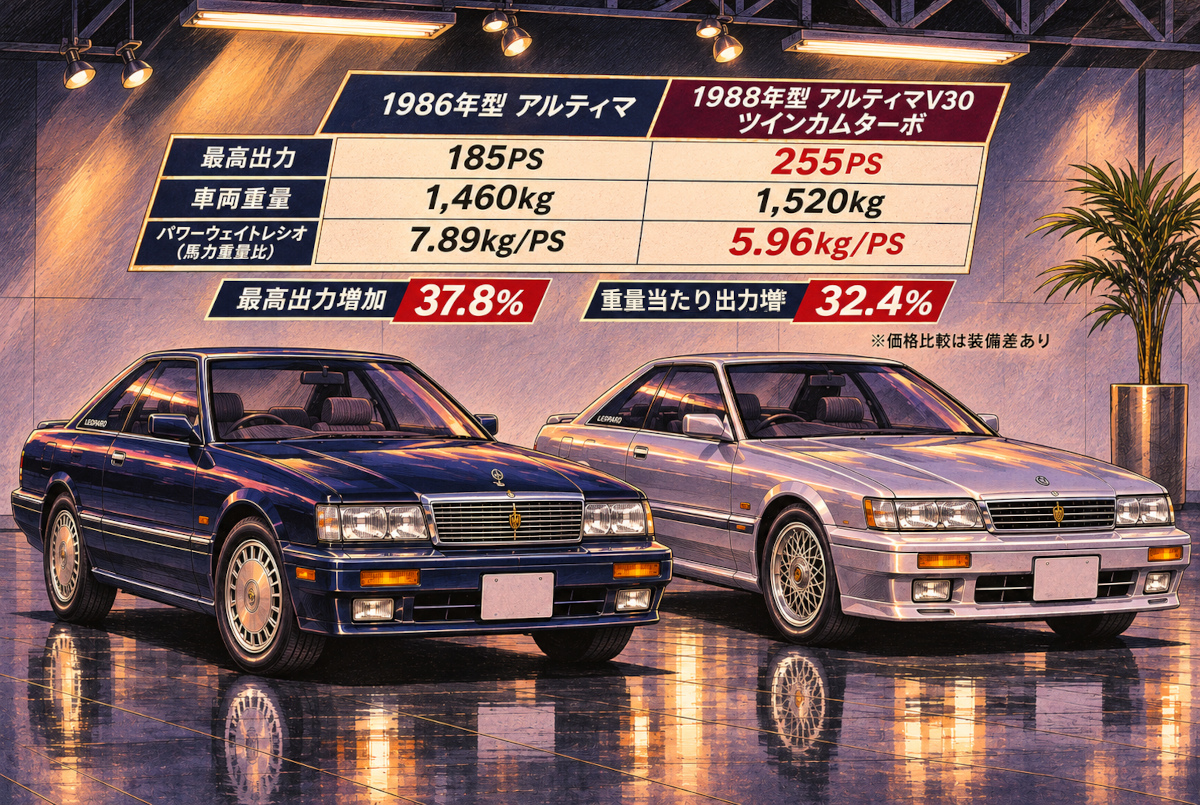
Comparison of the original 1986 Leopard F31 Ultima and the facelifted 1988 Ultima V30 Twin Cam Turbo. Maximum power increased from 185 to 255 PS, a gain of approximately 37.8%. Power per kilogram increased by approximately 32.4%, while weight per PS decreased by approximately 24.5%. The Japanese graphic displays the original vehicle specifications. Grilles, headlamps, bumpers, emblems, and wheels are illustrative rather than exact reproductions of the production cars. This is not a definitive guide to the exterior changes between the two model years.
The 1988 Acceleration Test: Did 255 PS Lose to 240 PS?
So, did the extra horsepower finally allow Nissan to beat Toyota?
In 2024, the Japanese automotive magazine Best Car republished a comparison test from its October 10, 1988 issue. The original test was conducted at the Yatabe automotive proving ground.
The cars were a Nissan Leopard Ultima V30 Twin Cam Turbo and a Toyota Soarer 3.0GT Limited equipped with air suspension.
Both used four-speed automatic transmissions, with the gear selectors left in Drive. Crucially, the magazine recorded acceleration times using two different launch procedures.
| Standing 0–400m Acceleration | Leopard — 255 PS | Soarer — 240 PS |
|---|---|---|
| Brake-assisted test launch | 15.63 s | 15.50 s |
| Conventional launch | 15.77 s | 15.88 s |
Figures from the 2024 republication of the October 10, 1988 issue of Best Car. Both cars used four-speed automatic transmissions in Drive. The test surface was drying following rain, and conditions changed during the testing session. The original printed magazine has not been independently inspected.
Using the brake-assisted test launch, the Soarer was 0.13 seconds quicker over the standing 400-meter run.
But using a conventional launch, the Leopard was 0.11 seconds quicker.
Within the very same comparison test, the finishing order was reversed between the two launch procedures.
There was another complication. The test report explains that the surface was still wet when the Leopard was tested first. By the time the Soarer was tested, the surface had begun to dry.
The report also describes considerable wheelspin from the Leopard during its launch. Having 255 PS is one thing; finding enough traction to transfer that power to the road is another.
These results do not establish that the Leopard was consistently slower than the Soarer. Nor do they establish that its additional horsepower made it consistently faster.
It is also impossible to isolate the effect of the launch procedure from the changing road conditions using these figures alone.
Even the Magazine’s Engine Specifications Need a Second Look
While examining the republished test, I noticed another problem: several engine specifications in the article do not match the published catalog figures for the cars concerned.
| Specification | Republished Best Car Article | Published Vehicle Specification |
|---|---|---|
| Leopard peak-power engine speed | 6,500 rpm | 6,000 rpm |
| Leopard maximum torque | 30.5 kgf·m at 4,500 rpm | 35.0 kgf·m at 3,200 rpm |
| Soarer peak-power engine speed | 6,500 rpm | 5,600 rpm |
| Soarer maximum torque | 30.5 kgf·m at 4,500 rpm | 35.0 kgf·m at 3,200 rpm |
The Leopard’s VG30DET was rated at 255 PS at 6,000 rpm. The 1988 specification of Toyota’s 7M-GTEU produced 240 PS at 5,600 rpm.
Both engines had a published maximum torque of 35.0 kgf·m at 3,200 rpm.
Whether the discrepancies originated in the 1988 article or were introduced during its later republication remains unknown.
This does not automatically invalidate the measured acceleration times. It does, however, demonstrate why historical road-test results and factory engine specifications should be checked independently rather than accepted as a single package.
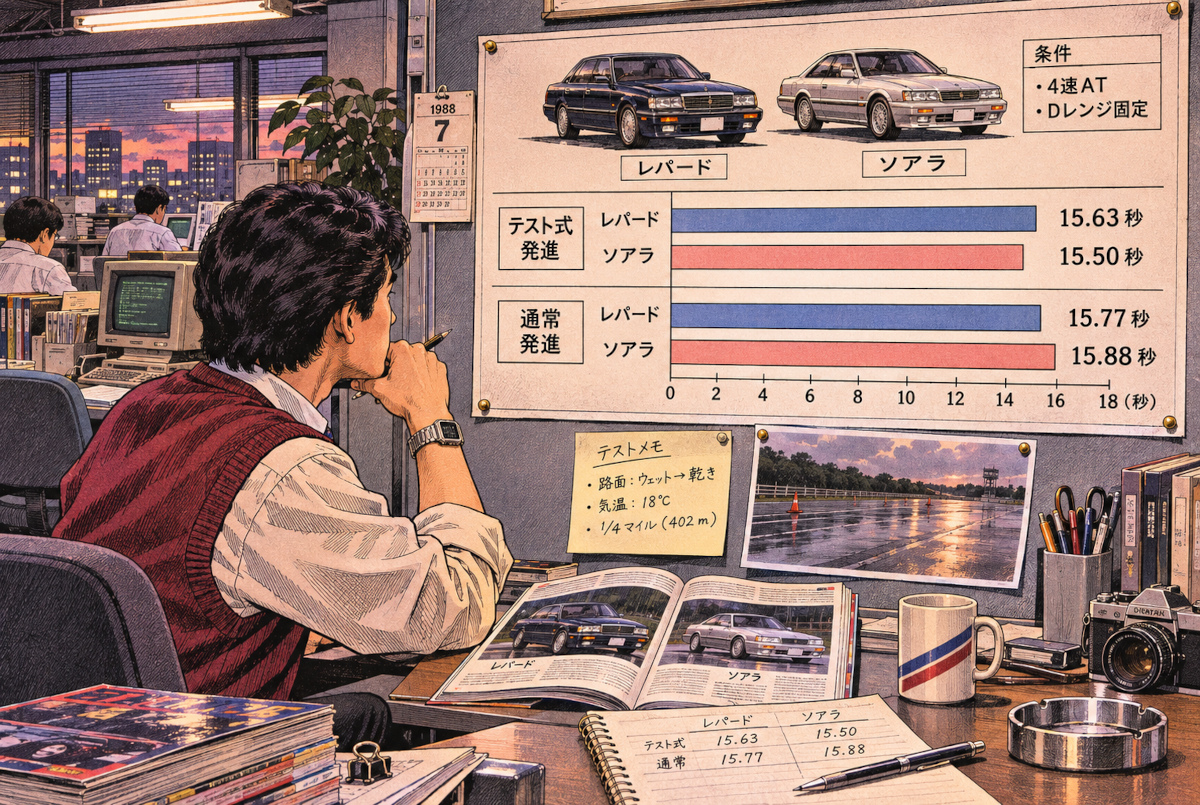
Comparison of standing 400-meter acceleration figures reproduced from the October 10, 1988 issue of Best Car. Both cars used four-speed automatic transmissions in Drive. The Soarer recorded 15.50 seconds against the Leopard’s 15.63 seconds in the brake-assisted test. With a conventional launch, the Leopard recorded 15.77 seconds against the Soarer’s 15.88 seconds. Changing surface conditions prevent the reversal from being attributed solely to launch technique. The July 1988 calendar, 18°C temperature note, and 402-meter quarter-mile reference in the background are fictional props, not verified test conditions. The actual measured distance was 400 meters. Bar lengths are illustrative; refer to the printed figures and the article’s table for precise comparisons.
Change the Soarer’s Trim Level and the Price Advantage Reverses Too
The 1988 Leopard Ultima V30 Twin Cam Turbo carried a reference price of ¥4,162,000.
Toyota’s regular Soarer 3.0GT with a four-speed automatic was listed at ¥3,772,000. On that basis, the Nissan was ¥390,000 more expensive.
But there is something else worth checking. The Soarer used in the acceleration test was not the regular 3.0GT. It was the more expensive 3.0GT Limited with air suspension.
Separate those two Toyota grades and the comparison starts to look rather different.
| 1988 Models — 4-Speed Automatic | Leopard Ultima Turbo | Soarer 3.0GT | Soarer 3.0GT Limited, Air Suspension |
|---|---|---|---|
| Engine | VG30DET | 7M-GTEU | 7M-GTEU |
| Maximum power | 255 PS | 240 PS | 240 PS |
| Maximum torque | 35.0 kgf·m | 35.0 kgf·m | 35.0 kgf·m |
| Vehicle weight | 1,520 kg | 1,510 kg | 1,530 kg |
| Weight per PS | 5.96 kg/PS | 6.29 kg/PS | 6.38 kg/PS |
| Original Japanese reference price | ¥4,162,000 | ¥3,772,000 | ¥4,775,000 |
| Grade used in the 1988 comparison test | Yes | No | Yes |
Comparison based on published grade-by-grade catalog data for the 1988 models. Weight per PS is independently calculated. Vehicle weights are published specifications, not the measured weights of the actual test cars. Prices are historical Japanese vehicle reference prices; equipment, options, and additional charges are not standardized between models.
Against the regular Soarer 3.0GT, the Leopard was ¥390,000 more expensive.
Against the air-suspension 3.0GT Limited used in the acceleration test, however, the Leopard was actually ¥613,000 cheaper.
Both Soarers produced 240 PS, yet simply changing the Toyota trim level being compared reversed the Leopard’s apparent price advantage.
Our calculations also give the Leopard approximately 5.6% more maximum power per kilogram than the regular Soarer 3.0GT, and approximately 6.9% more than the air-suspension GT Limited.
Despite that advantage, the acceleration results went both ways depending on the test procedure and conditions.
Finally getting the more powerful engine had not automatically turned the Leopard into an unbeatable grand tourer.
What Did the Leopard Really Lose by Getting the VG30DET Later?
From the perspective of Nissan’s overall product strategy, there is another way to interpret the decision.
The Cima was conceived as an expensive luxury car occupying Japan’s larger passenger-car registration category, commonly known as the 3-number class. It was intended to open up a new market for Nissan.
A 255-PS engine was a particularly effective way of giving that new car a sense of prestige.
For the Leopard, the VG30DET was a much-needed response to the Soarer. For the Cima, it was an important part of establishing the credibility of an entirely different luxury-car proposition.
Which car should have received the engine first for the benefit of Nissan as a whole?
Without access to the company’s complete internal profitability calculations, engineering schedules, and decision-making records, it is impossible to reach a definitive conclusion.
We cannot even establish whether a VG30DET-powered Leopard could have been launched in January 1988 if the Cima had not received the engine first.
What the evidence does establish is that the Cima received the engine ahead of the Leopard, that it had reportedly been developed with the Leopard in mind, and that the Cima went on to become a major commercial success.
While the Leopard was still chasing the Soarer, Nissan had already used the same engine designation to compete in another part of Japan’s luxury-car market.
Editor’s Note
Learning that the Leopard’s long-awaited 255-PS engine ended up in the Cima first gave me a rather predictable reaction.
Come on, Nissan. Your grand tourer is trying to catch the Soarer, and you’re giving its new engine to another Nissan?
But reading Misaka’s account changed my perspective a little.
The Cima team wasn’t simply looking for a faster car. It needed something that would persuade Japanese customers to spend around five million yen on a domestic luxury automobile. An impressive horsepower figure was an obvious weapon.
The engineers had their priorities. The sales department had its own. The awkward part is that both had perfectly understandable reasons.
And when the Leopard finally received its 255 PS, it still couldn’t simply dispatch the 240-PS Soarer in every acceleration run.
A wet road, wheelspin, and different launch procedures were enough to make that extra 15 PS far less decisive than it looked in the brochure.
Even the price comparison depends on which Soarer you put next to the Leopard. Against the regular 3.0GT, Nissan’s car was more expensive. Against the Toyota actually used in the road test, it was ¥613,000 cheaper.
That’s the kind of detail that disappears when old rivalries are reduced to model names and horsepower figures.
Building a great engine and building a successful product around that engine are two very different jobs.
Still, there’s a part of me that wishes Nissan had somehow managed to put those 255 PS into the Leopard in January 1988 as well.
That’s what being a Nissan enthusiast does to you.
Nissan Leopard: Five-Part Series
The Nissan Leopard arrived before the Toyota Soarer, yet struggled to match its rival in the Japanese market. Across five articles, we examine sales figures, engine performance, pricing, technology, the influence of Abunai Deka, and the Leopard's changing identity through 2000.
- Part 1: How Did the Nissan Leopard Outsell the Soarer in One Class—Yet Lose Overall?
- Part 2: Did a 2.0L Toyota Soarer Really Beat Nissan’s 3.0L Leopard?
- Part 3: Why Did the Nissan Cima Get the Leopard’s 255-PS Turbo Engine First?
- Part 4: English edition Coming soon
- Final Part: English edition Coming soon
Terms That May Need a Quick Explanation
- Weight per Unit of Power (kg/PS)
- Vehicle weight in kilograms divided by maximum engine power in PS, or metric horsepower. A lower figure indicates less vehicle mass per unit of rated power. Its inverse, PS/kg, expresses power per kilogram, where a higher figure is preferable. Percentage changes in these two measurements are not interchangeable. Neither directly predicts real-world acceleration times.
- Traction
- The ability of a vehicle’s tires to transmit driving force to the road surface. Even a powerful engine cannot deliver its full acceleration potential if excessive wheelspin prevents the tires from transmitting that force effectively.
- Zero-Yon (Standing 400-Meter Run)
- A standing-start acceleration test measuring the time required to travel 400 meters. Japanese automotive magazines and enthusiasts commonly refer to it as zero-yon. It is close to, but not exactly the same distance as, a quarter-mile acceleration test.
- Japan’s 3-Number Passenger-Car Class
- A Japanese vehicle registration category for ordinary passenger cars exceeding the displacement or dimensional limits of the smaller 5-number class. In the late 1980s, this distinction also carried important taxation and market-positioning implications, particularly for large-engined domestic luxury cars.
References
- Nissan Heritage Collection: Cedric Cima Type II Limited (Japanese) — Official historical information on the first-generation Cima, its January 1988 introduction, the 255-PS VG30DET, its maximum torque of 35.0 kgf·m, and the model’s market significance.
- Nissan Motor: First-Generation Cima Restoration Project Materials (2021) (Japanese PDF) — Nissan’s own documentation confirming that the VG30DET was introduced in the Cima ahead of the F31 Leopard.
- Nissan Motor: Major Model Update of the Nissan Leopard (August 1988) (Japanese) — Original manufacturer announcement covering the F31 facelift and the addition of the new engine.
- Miki Press: Nissan Leopard Ultima — Period Vehicle Specifications (Japanese PDF) — Specifications for the original 1986 Ultima, including its 185-PS VG30DE, vehicle weight, transmission, and introductory price.
- GAZOO: Nissan Leopard Ultima V30 Twin Cam Turbo, August 1988 (Japanese) — VG30DET engine specifications, 1,520 kg vehicle weight, and historical reference price of ¥4,162,000.
- Kusumi, “Planning and Development of the Nissan Cima,” Journal of the Japan Society of Mechanical Engineers, Vol. 92, No. 850 (September 1989) (Japanese PDF; author name in Japanese: 楠見記久) — Engineering and product-planning account by a project participant, covering the VG30DET’s development objectives, variable engine technologies, and the Cima’s market strategy.
- Keisuke Maeda, “Why Nissan Was So Good Back Then: Interviews with the People Involved, Part 2, Middle Section” (March 8, 2017) (Japanese) — Interview with Yasuhiko Misaka, former Nissan product development executive for the Y31 Cedric, Gloria, and Cima. Provides firsthand retrospective testimony concerning the VG30DET’s development for the Leopard and its earlier introduction in the Cima.
- CarSensor: Toyota Soarer 3.0GT, 1988 Model (Japanese) — Grade-specific catalog information, including 240 PS, 35.0 kgf·m, four-speed automatic transmission, and 1,510 kg vehicle weight.
- CarSensor: Toyota Soarer 3.0GT Limited with Air Suspension, 1988 Model (Japanese) — Catalog specifications for the grade used in the period acceleration comparison, including 240 PS, 35.0 kgf·m, four-speed automatic transmission, and 1,530 kg vehicle weight.
- CarSensor: Toyota Soarer, 1986–1991 Model Range and Grade Catalog (Japanese) — Historical grade-specific pricing used for comparing the regular 1988 3.0GT and the air-suspension 3.0GT Limited.
- Best Car Web: Revisiting the Leopard’s Rivalry with the Soarer 36 Years Later (July 22, 2024) (Japanese) — Republication of the comparison originally published in the October 10, 1988 issue of Best Car. Provides acceleration times for two launch procedures, test-car information, changing road conditions, and observations of wheelspin. The original printed issue has not been independently inspected.
- CAR and DRIVER Japan: Reproduced Catalog of the 1988 Nissan Cima (Japanese) — Historical information on the first-generation Cima’s luxury-market positioning and original vehicle prices.