

On January 17, 1989, Nissan added a rather peculiar model to the first-generation March lineup—the small hatchback known as the Micra in many export markets. Its engine displaced just 930cc. Yet Nissan did not stop at fitting a turbocharger. It added a supercharger as well.
This was the Nissan March Super Turbo. It produced 110 PS while the five-speed manual version weighed just 770 kg. For such a tiny front-wheel-drive hatchback, the specification sounds less like sensible transportation and more like an engineering department refusing to go home.
At first glance, it is tempting to file the car under “Bubble Era Japan”: fuel economy be damned, just bolt on another compressor. That was my assumption too. But once you look into why the engine displaced such an oddly specific 930cc, the story changes. Both the reduced displacement and the use of two different forms of forced induction were driven by surprisingly rational engineering decisions.
Why shrink a 987cc engine to 930cc?
The story begins before the road-going Super Turbo appeared.
In 1987, NISMO prepared rental race cars for the March Little Dynamite Cup. These machines combined a turbocharger and a supercharger and produced 110 PS. The basic twincharging idea therefore did not begin as a showroom gimmick.
Then, in August 1988, Nissan introduced the March R as a competition-oriented base model for domestic rallying. This was where the engine displacement was deliberately reduced from the regular March Turbo’s 987cc to 930cc.
That sounds backwards. If the goal is to make a car faster, why make the engine smaller?
The answer was rally classification.
Turbocharged engines were not always classified by their physical displacement alone. A multiplication factor was used to calculate an equivalent displacement for competition classes. Japanese domestic rules had used a factor of 1.4, while international regulations used 1.7, and a move toward the 1.7 factor was anticipated.
Apply 1.7 to the existing 987cc engine and this happens:
987cc × 1.7 = 1,677.9cc
That puts the car above the 1,600cc class ceiling Nissan was aiming for.
But reduce the physical displacement to 930cc and the calculation changes:
930cc × 1.7 = 1,581cc
Now it fits below 1,600cc.
So 930cc was not a random engineering curiosity, nor was it a Japanese tax trick. It was a number that made sense once the rally rulebook was brought into the calculation.

AI-generated comparison illustration. It is intended to show the contrast between an ordinary K10 March and its competition-inspired performance variants, not to reproduce the exact factory specifications of the March R or Super Turbo.
Less displacement, but 76 PS becomes 110 PS
This is where the engineering gets properly interesting.
The regular March Turbo used the 987cc MA10ET engine and produced 76 PS. The MA09ERT used in the March R and Super Turbo displaced only 930cc yet produced 110 PS.
In other words, displacement fell by about 5.8 percent while maximum output increased by roughly 45 percent.
The solution was not simply “more boost.” Nissan used two different types of compressor because each was good at a different part of the rev range.
At lower and medium engine speeds, a Roots-type supercharger driven mechanically from the engine provided quick boost response. At higher rpm, the supercharger was disengaged and the larger turbocharger took over the main job of supplying boost.
This was therefore not a case of Nissan fitting a turbocharger and then deciding that one forced-induction device somehow looked lonely.
The supercharger compensated for the weak low-speed response of a small turbo engine, while the larger turbocharger could handle the high-rpm work more efficiently.
The handover was not an absolutely binary “one off, one on” switch at precisely one engine speed—the system used a bypass path and the turbo was already spinning as exhaust flow increased—but around 4,000 rpm the supercharger’s role diminished, while the turbo became the dominant source of boost at higher engine speeds.
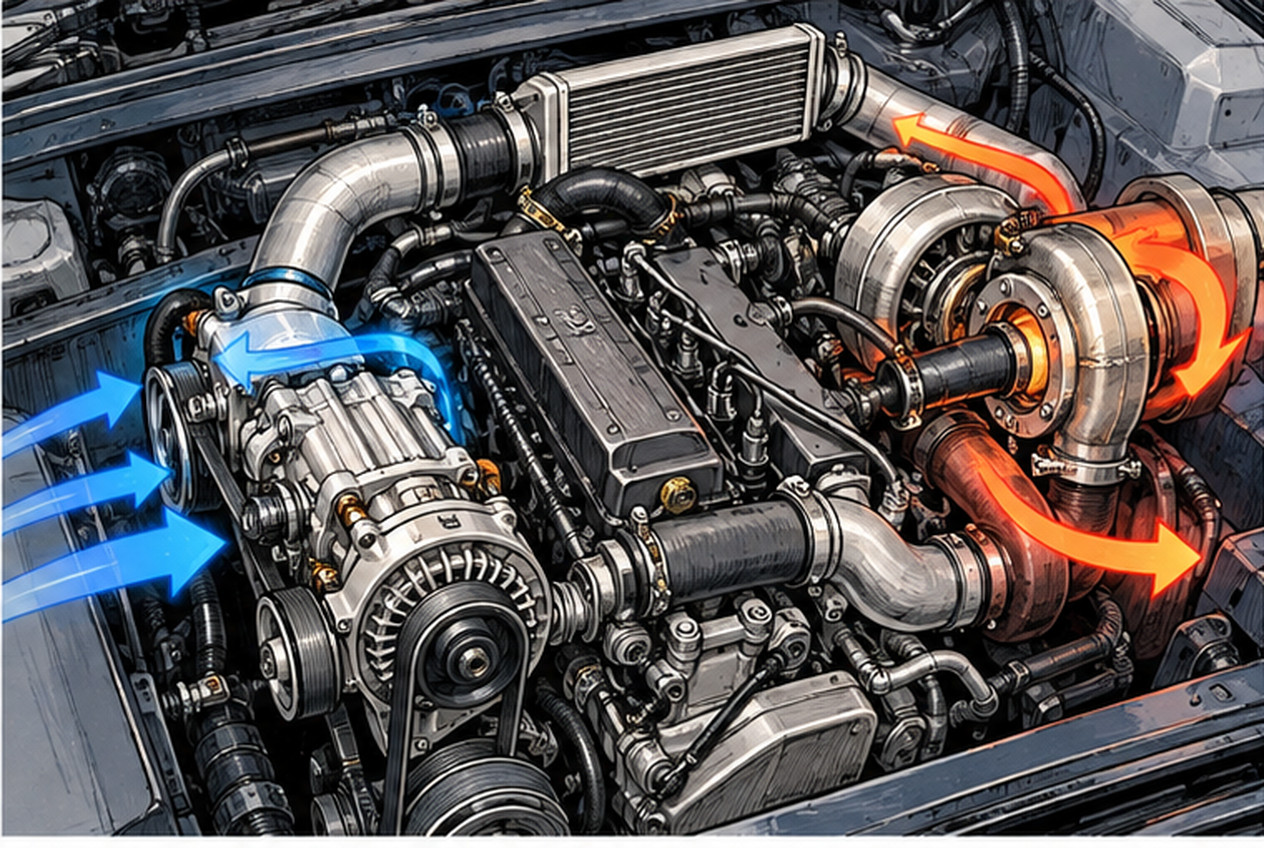
AI-generated conceptual illustration of twincharging. It does not accurately reproduce the component layout, pipe routing or intake path of the actual Nissan MA09ERT engine.
110 PS in 770 kg starts to look a little ridiculous
By modern standards, 110 PS does not sound particularly dramatic.
But the five-speed March Super Turbo weighed only 770 kg.
Divide 770 by 110 and you get a simple power-to-weight figure of 7.0 kg per PS.
And this was front-wheel drive, with no power-assisted steering. The five-speed manual version also came with a viscous limited-slip differential.
The March R was not merely a specification-sheet novelty either. At the second round of the 1989 All Japan Rally Championship, KANSAI-RALLY ’89, the official Japan Automobile Federation results show March Rs finishing first, second and third in Class B.
Nissan had not invented an eccentric engine simply to have something unusual to advertise. The basic idea worked in the competition environment it was designed for.
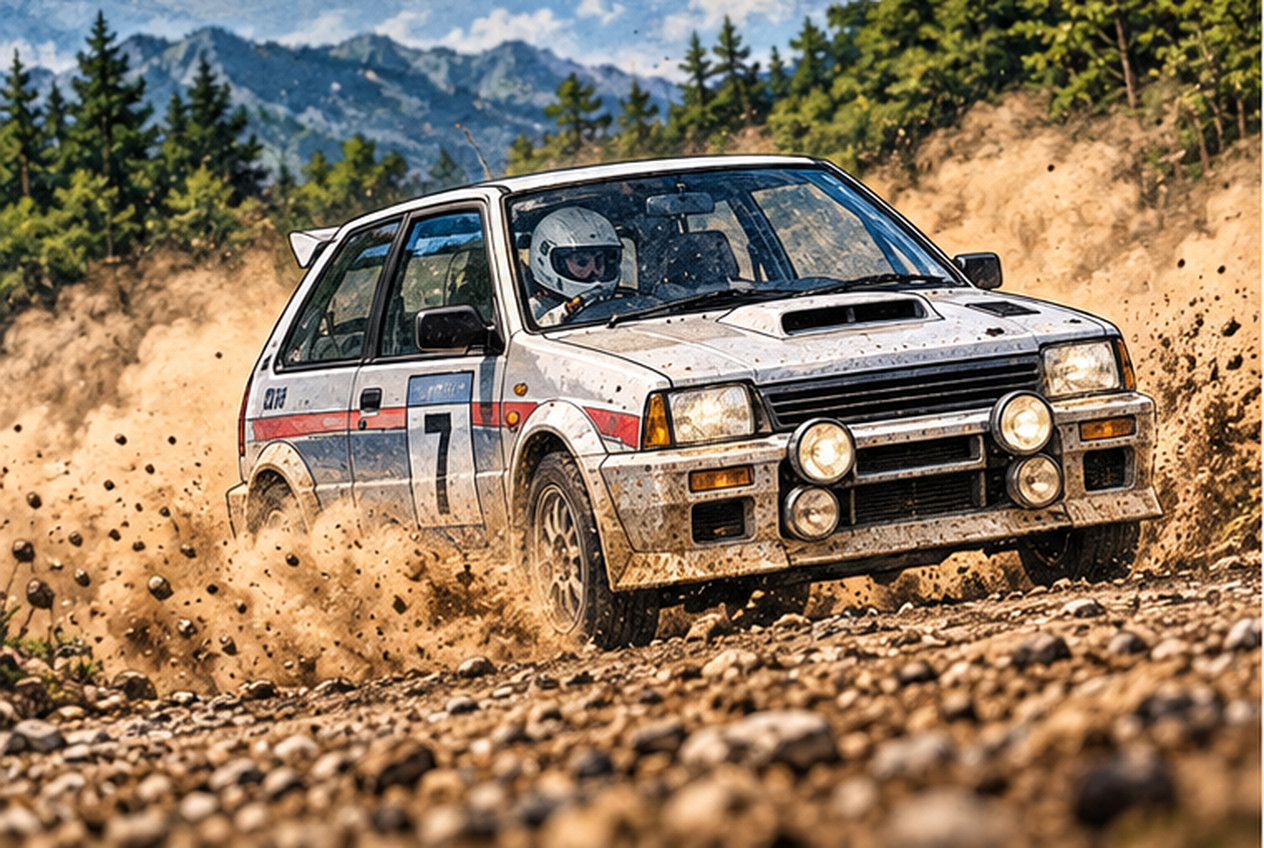
AI-generated image inspired by Japanese domestic rallying in the late 1980s. It does not depict a specific event or actual competition car; the number, livery and auxiliary equipment are illustrative.
Then Nissan sold the thing to ordinary customers
If the story ended with the March R, everything would make perfect sense. It was a competition base car built around the restrictions of a rally class.
But in January 1989, Nissan took the same MA09ERT twincharged concept and sold it as a regular road car: the March Super Turbo.
Contemporary catalog data lists the five-speed manual Super Turbo at ¥1,153,000. The ordinary March Turbo with a five-speed manual cost ¥1,100,000.
The difference was only ¥53,000.
For a relatively small step up in price, the buyer went from the 76 PS single-turbo March to a 110 PS twincharged version.
And Nissan did not stop with the enthusiast-friendly five-speed manual. It also offered the Super Turbo with a three-speed automatic.
A 930cc, 110 PS, turbo-plus-supercharger March with a three-speed automatic is the point where perfectly logical competition engineering turns into something that feels unmistakably late-1980s Japan.
Was it really an anti-economy Bubble Era machine?
Not entirely.
The five-speed Super Turbo’s official Japanese 10-mode fuel-consumption figure was 16.0 km/L. The regular five-speed March Turbo managed 18.0 km/L, so the Super Turbo was less economical, but not catastrophically so. It also ran on regular unleaded gasoline.
Those figures cannot be compared directly with modern WLTC ratings because the test procedures were completely different. Still, they make one thing clear: this was not simply an engine designed to turn fuel into noise and tire smoke.
The twincharging system itself was a rational response to a specific problem—how to get strong low-speed response and useful high-rpm power from an engine whose displacement had been restricted for competition reasons.
The crazy part was not the engineering
The March Super Turbo arrived in 1989, right in the middle of Japan’s Bubble Economy. That makes it easy to treat the car as another example of an era when Japanese manufacturers seemed willing to build almost anything.
But the timeline matters. The twincharged concept had already appeared in competition in 1987, and the March R was launched as a rally base car in August 1988.
NISMO’s own history also shows how different Japan’s amateur motorsport environment was at the time. Nissan produced a succession of competition-oriented road cars including the Bluebird SSS-R, Sunny VR, Pulsar R1 Twin Cam and March R. Rallying, dirt trials and gymkhana events for road-registered cars supported a market for factory-built competition base models that would be difficult to imagine at the same scale today.
So calling the March Super Turbo “a Bubble Era car with two compressors because one was not enough” misses the interesting part.
Nissan reduced the engine to 930cc because of rally classification, then used two different forms of forced induction to recover the performance lost by making the engine smaller. The truly unusual decision was taking that competition-derived engineering and selling it to ordinary customers in an inexpensive little hatchback.
Editor’s Note
I started with the same lazy assumption many people probably do: “Of course it had a turbo and a supercharger. It was Bubble Era Japan. Nobody cared about fuel economy.”
Then I did the arithmetic.
987 × 1.7 gives 1,677.9. That is too large for the class Nissan wanted. Drop the engine to 930cc and the equivalent becomes 1,581cc. Suddenly, the strange number printed on the specification sheet stops looking strange at all.
The engineering actually makes sense. What still feels slightly unhinged is what happened afterward. Nissan developed a 930cc twincharged engine to make a small rally car competitive, then apparently looked at it and thought, “Right, let’s sell that to normal people too. And we’d better offer an automatic.”
That may be what I miss most about Japanese cars from the late 1980s and early 1990s. The interesting part was not simply that manufacturers ignored fuel economy. They were prepared to take machinery that almost nobody strictly needed, give it a perfectly serious engineering justification, and then put it in a showroom.
References
- Nissan Heritage Collection — March Super Turbo, Little Dynamite Cup specification [Japanese]
- Nissan Heritage Collection — Nissan March Super Turbo (EK10)
- NISMO History — Domestic Rally Activities, 1987–1990 [Japanese]
- Japan Automobile Federation — KANSAI-RALLY ’89, All Japan Rally Championship Round 2, Class B Results [Japanese]
- GAZOO Vehicle Catalog — Nissan March Super Turbo, January 1989 [Japanese]
- GAZOO Vehicle Catalog — Nissan March Turbo, January 1989 [Japanese]
- Motor-Fan — EK10 March R and the reasoning behind its 930cc displacement [Japanese]
- Motor-Fan — How the MA09ERT combines a supercharger and turbocharger [Japanese]