

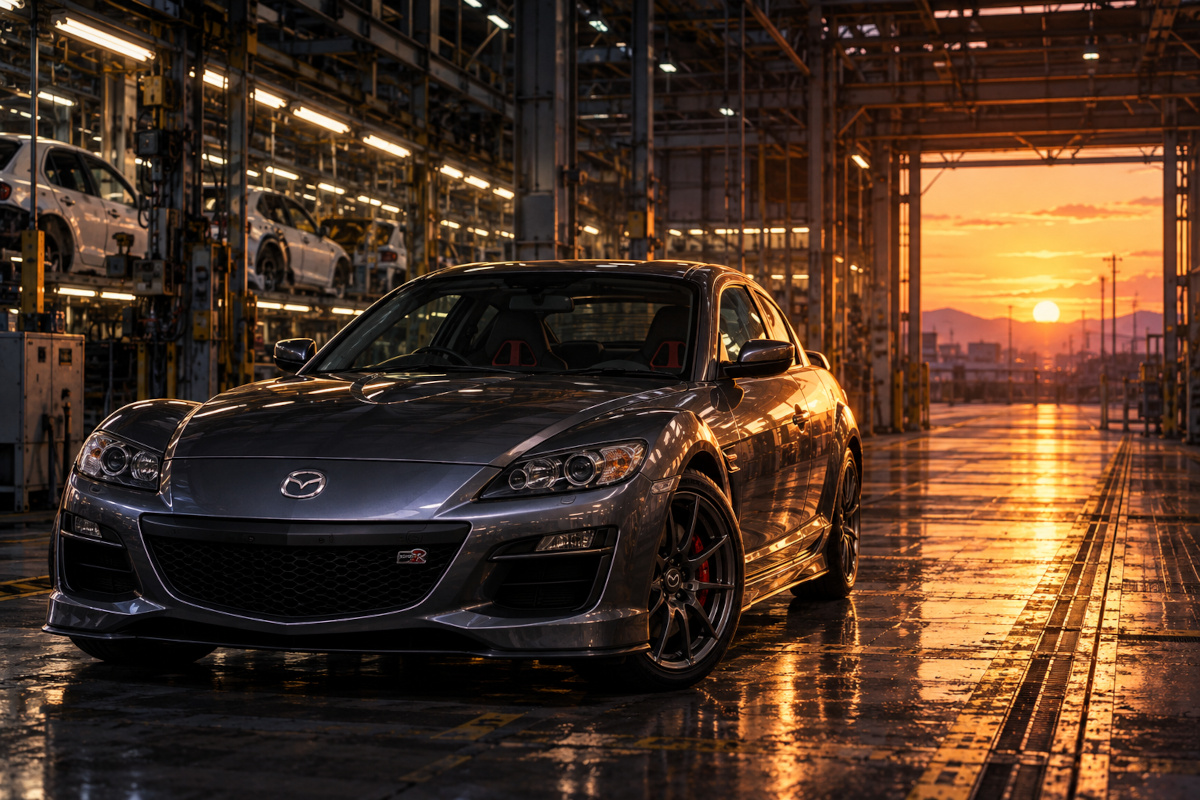
On September 29, 2004, Mazda produced its 100,000th RX-8. Just 18 months had passed since production began in April 2003. That was remarkably close to the 17 months it had taken the original MX-5 Miata to reach the same milestone.
Yet RX-8 production ended in June 2012. By the end of March that year, Mazda had built a cumulative total of 192,094 cars. More than half of those had already been produced during the first 18 months.
A launch strong enough to produce 100,000 cars in 18 months, followed by the end of production roughly nine years later. Was the Mazda RX-8 really a failed sports car?
To find out, we examined Mazda’s original production records, the RENESIS engine’s maintenance requirements, European emissions regulations and the surprising demand for the final SPIRIT R.
First, 100,000 Produced Does Not Mean 100,000 Sold
There is a distinction worth making before discussing the RX-8’s commercial success.
Mazda’s October 6, 2004 announcement celebrated the production of 100,000 RX-8s. It was not announcing 100,000 retail sales.
The same Japanese press release provided two other figures: approximately 23,000 cumulative domestic sales by the end of August 2004, and 71,595 vehicles exported for overseas markets by that date.
Those figures measure different things. Domestic retail sales and exports from Japan cannot simply be added together and presented as verified worldwide customer sales.
Nevertheless, the RX-8 was clearly finding customers beyond its home market. Mazda was exporting the model to more than 20 countries. Its naturally aspirated RENESIS rotary engine had also won the 2003 International Engine of the Year award.
Whatever one thinks of the RX-8 today, it was not a sports car that the market ignored from day one.
The more revealing question is what happened after the initial rush.
100,000 in 18 Months, Then 92,094 Over the Next 90: We Did the Math
Two Mazda announcements, published nearly eight years apart, make an unusual comparison possible.
The first reported cumulative production of 100,000 units on September 29, 2004. The second, issued in April 2012, reported cumulative production of 192,094 units as of March 31, 2012.
Subtracting the first figure from the second gives 92,094 additional vehicles. We then compared approximate monthly production rates across the two periods.
| Measure | Initial period | Following period |
|---|---|---|
| Approximate dates | April 2003–September 2004 | October 2004–March 2012 |
| Period length | 18 months | 90 months |
| Vehicles produced during period | 100,000 | 92,094 |
| Average production per month | Approx. 5,556 | Approx. 1,023 |
Method: The calculations use Mazda’s cumulative production milestone of September 29, 2004 and its cumulative total as of March 31, 2012. Periods are approximated in whole calendar months, without adjusting for the few days between September 29 and the end of that month. The monthly figures are mathematical averages, not actual monthly factory output or retail sales. Production during April–June 2012 is excluded.
The calculations are straightforward:
- First 18 months: 100,000 ÷ 18 = approximately 5,556 cars per month.
- Following 90 months: 92,094 ÷ 90 = approximately 1,023 cars per month.
Dividing those two averages gives a ratio of approximately 5.43 to 1.
There is another revealing figure:
100,000 ÷ 192,094 × 100 = approximately 52.1%.
The RX-8’s average monthly production rate during its first 18 months was about 5.4 times the rate of the following 90 months. And those first 100,000 cars represented roughly 52.1% of all RX-8s built through March 2012.
That is quite a front-loaded production history.
It does not prove sales declined every single year. Inventory levels, export-market demand and factory scheduling all affect production. Nor does a 5.4-fold difference in average production rates mean retail sales fell by exactly the same factor.
But the contrast in production scale is real, and it is difficult to overlook.
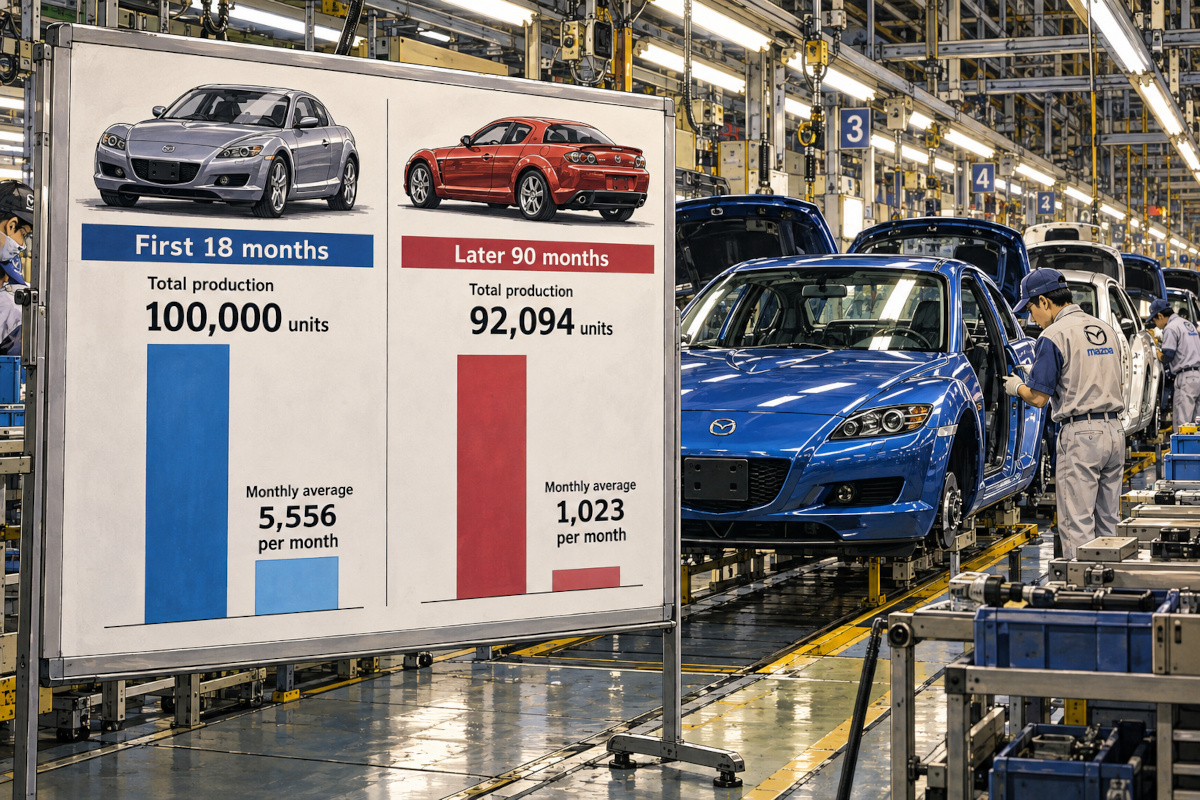
AI-generated illustration comparing RX-8 production periods. The figures are calculated from Mazda’s official cumulative production announcements. Bar heights are not drawn to a strictly proportional scale; use the table above for the numerical comparison. The assembly line, workers and vehicles include fictional visual details and do not reproduce an actual Mazda factory.
Was the RX-8 Unreliable? Start With Mazda’s Owner’s Manual
Any discussion of the RX-8’s reputation eventually reaches the RENESIS engine.
Owners and enthusiasts have long discussed oil consumption, difficult starting and concerns about engine life. But anecdotes alone cannot establish a model-wide failure rate.
Mazda’s Japanese RX-8 owner’s manual provides a useful starting point. It explicitly states that the RENESIS rotary engine consumes a small amount of engine oil internally as part of its normal operation.
In other words, some oil consumption is an expected characteristic of the engine, not automatic proof of a mechanical defect.
That does not mean the oil level can be ignored. Mazda recommends regularly checking it with the dipstick rather than relying entirely on the oil-level warning system.
The Japanese manual examined here specifies oil-change intervals of 10,000 km or one year under normal conditions, and 5,000 km or six months under severe operating conditions, whichever comes first.
These are specifications from a Japanese-market manual. Owners elsewhere should follow the maintenance schedule for their own model year and market rather than assume the Japanese intervals apply universally.
There is also a more substantial piece of evidence concerning durability.
In May 2008, Mazda North American Operations introduced the RX-8 Rotary Engine Core Limited Warranty Extension Program, known as SSP 77.
The program covered 2004–2008 model-year RX-8 vehicles and extended coverage for specified rotary-engine core components to eight years or 100,000 miles, whichever came first.
The listed components included rotary housings, internal engine parts, seals and gaskets.
This was a documented manufacturer decision to extend protection for major rotary-engine components. It carries more evidential weight than an anonymous online claim that the engine was unreliable.
Still, the warranty extension should not be misrepresented.
It was not the same as a safety recall. It did not establish that every RX-8 engine was defective, and its regional coverage should not be confused with warranty terms for Japanese domestic-market cars.
The documents examined here also do not provide enough information to calculate the RX-8’s overall engine failure rate or average engine lifespan.
For anyone buying a used RX-8, service records, oil maintenance, starting behavior and ignition-system condition deserve attention. A rotary-specific compression test, performed correctly by a qualified specialist, can provide another useful indication of engine condition.
That is more useful advice than declaring that every RX-8 engine fails at a particular mileage.
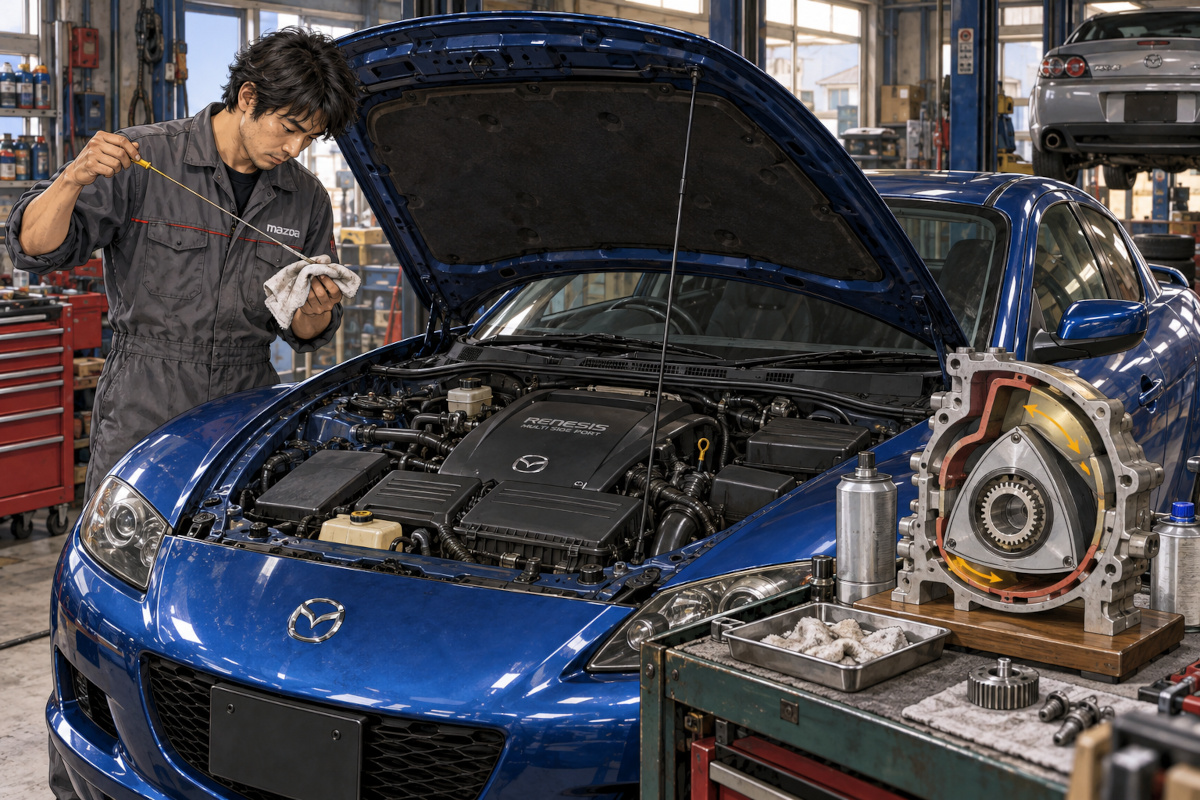
AI-generated illustration emphasizing the importance of oil-level checks on the RX-8’s RENESIS rotary engine. Engine-bay components, dipstick placement and the mechanic’s actions are not an exact maintenance procedure. Follow the vehicle’s official owner’s manual when performing checks. The rotary-engine model at right is also a simplified conceptual representation.
Euro 5: The RX-8 Lost Europe Before Production Ended Worldwide
The rotary engine faced another challenge beyond ownership and maintenance: increasingly demanding exhaust-emissions standards.
In May 2010, Japanese automotive publication Response reported that RX-8 sales in Europe were ending because the model could not meet the new Euro 5 emissions standard. Sales of existing inventory could continue, but the model’s future in that market was effectively over.
That did not mean Mazda had stopped building the RX-8 worldwide.
The car remained on sale in other markets, including Japan, and production continued until June 2012.
Europe’s 2010 market exit and the RX-8’s worldwide production ending in 2012 were two different events.
Meeting tighter emissions rules can require additional engineering and certification. For a specialty sports car with a relatively small production volume, the cost of continued compliance may also become a commercial consideration.
That is a reasonable business interpretation, not a verified breakdown of Mazda’s internal decision.
The sources examined here do not quantify how much of the final production decision was driven by emissions regulations, declining demand or development costs. Assigning the entire outcome to Euro 5 would be misleading.
The Final SPIRIT R: Mazda Planned 1,000, Then Added Another 1,000
On October 7, 2011, Mazda announced that RX-8 production would end in June 2012. At the same time, it introduced the SPIRIT R, a final Japanese-market special edition scheduled to go on sale on November 24, 2011.
The initial sales plan was 1,000 vehicles.
Then something rather fitting happened to a rotary sports car approaching the end of its life: orders exceeded Mazda’s plan.
On April 26, 2012, Mazda announced an additional 1,000 vehicles for SPIRIT R production.
The RX-8 was approaching retirement, yet demand for its farewell edition was strong enough to justify doubling the original production plan.
That does not prove exactly 2,000 SPIRIT R cars were eventually delivered to customers. A production decision and a verified final retail-sales total are not the same thing.
The SPIRIT R was offered with either a six-speed manual or a six-speed automatic transmission.
The manual version was based on the RX-8 Type RS, while the automatic version was based on the Type E.
According to Mazda’s April 2012 announcement, the six-speed manual accounted for 66% of SPIRIT R orders.
Its special equipment included RECARO bucket seats, Bilstein dampers, bronze-painted 19-inch forged aluminum wheels and aerodynamic body parts. Red-painted brake calipers were part of the special edition’s distinctive appearance.
Japanese prices were ¥3,250,000 for the manual and ¥3,120,000 for the automatic, including consumption tax.
The SPIRIT R did not restore the 280 PS output of the late RX-7. Its appeal lay elsewhere: the high-revving naturally aspirated rotary engine, the distinctive RX-8 chassis and the knowledge that this was the last chance to buy a new rotary-powered sports car of its kind.
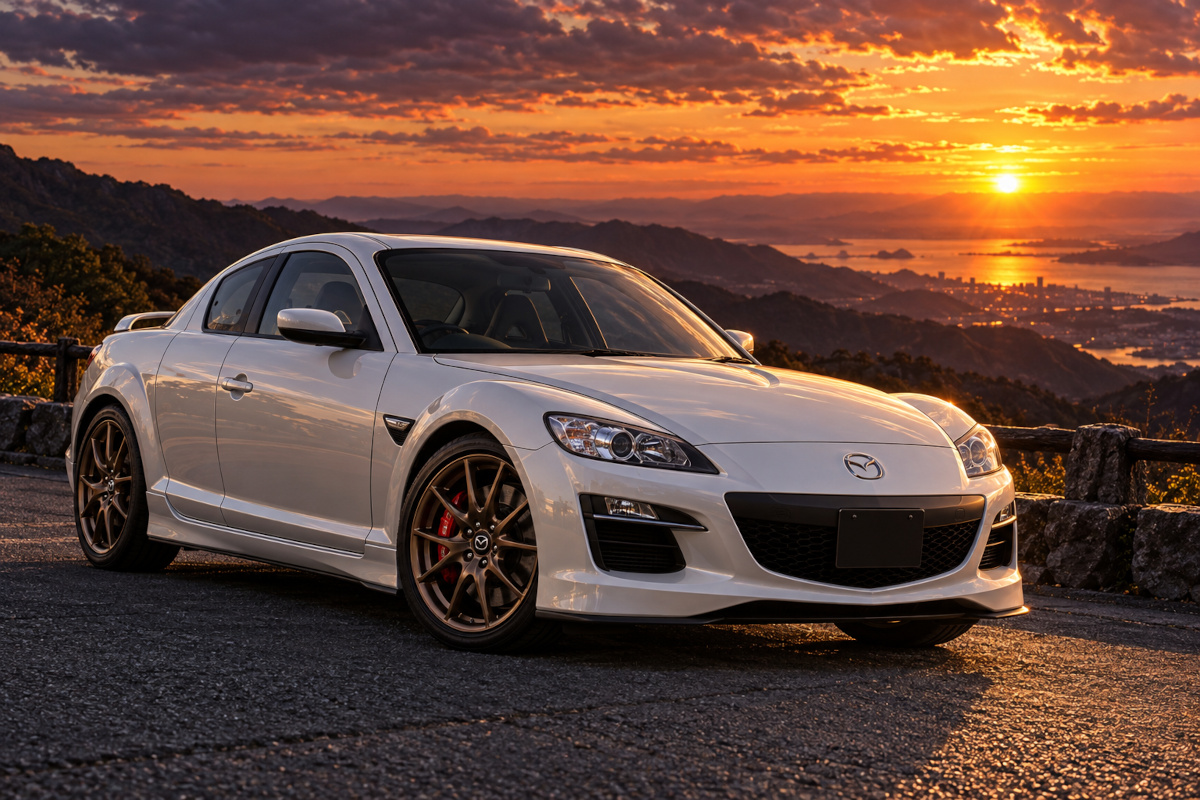
AI-generated illustration inspired by the final RX-8 SPIRIT R with six-speed manual transmission, introduced in 2011. It depicts a factory-available pearl-white body color, bronze-colored 19-inch forged wheels and red brake calipers. Some vehicle details are artistically simplified, and the scenic overlook is fictional rather than a documented location.
A Strong Launch Was Not the Same as Long-Term Commercial Success
So was the Mazda RX-8 a failure?
That depends on what is being measured.
Producing 100,000 vehicles in the first 18 months was a genuine achievement. Mazda accomplished it with a highly unconventional four-door, four-seat rotary sports car rather than a conventional successor to the RX-7.
On the other hand, the later average production rate was much lower. The RENESIS required rotary-specific maintenance awareness, and the car faced the growing challenge of emissions compliance in major markets.
It would be tempting to turn those facts into a simple business verdict. But the financial information needed to do that is missing.
Without verified RX-8-specific development costs, manufacturing expenses and profitability figures, we cannot establish whether the project generated a profit or loss over its lifetime.
The RX-8 was not an unwanted sports car that never found buyers. But neither was it a product that maintained its extraordinary early production momentum.
Production ended in June 2012, bringing Mazda’s line of production rotary-powered sports cars to a halt.
For enthusiasts expecting another two-door, turbocharged RX-7, the RX-8 may never have been the answer they wanted. Yet its four-seat body and naturally aspirated RENESIS kept a dedicated rotary-powered sports car in Mazda’s showrooms until 2012.
That contribution is difficult to dismiss, even if the RX-8 never became the RX-7’s equal in the eyes of every enthusiast.
Editor’s Note
Before looking into the numbers, I had a fairly simple impression of the RX-8: it probably sold poorly toward the end and quietly disappeared.
Then I found that first production milestone. One hundred thousand cars in 18 months, almost matching the original MX-5 Miata’s pace. That was not quite the story I expected.
What really caught my attention, though, was the next figure. More than half of the RX-8s produced through March 2012 had already been built during those first 18 months. Mazda made an enormous early push and then spent years adding to the total at a much slower average rate.
Production is not sales, of course. But that is still an unusually lopsided set of numbers.
And the rotary engine asks something of its owner. Keep an eye on the oil, pay attention to how it starts and runs, and find somebody who understands rotary engines when things get troublesome. For a dedicated enthusiast, that may be part of the relationship. For someone expecting the ownership experience of an ordinary family car, it is another matter.
Then there is the final SPIRIT R. Just when production was coming to an end, Mazda found enough buyers to approve another batch. Apparently, the words “last chance” still have considerable pulling power among car enthusiasts.
I don’t think the RX-8 ever truly replaced the RX-7. But without Mazda’s strange decision to build a four-door rotary sports car, perhaps the production rotary sports-car story would have ended sooner. That is speculation, but not an unreasonable thought.
Too successful at launch to dismiss as a flop. Too difficult to sustain to call an uncomplicated triumph.
That awkward territory between success and failure may be exactly what makes the RX-8 worth remembering.
Terms That May Need a Quick Explanation
- Severe Operating Conditions
- Driving conditions such as frequent short trips, heavy stop-and-go traffic or rough roads that can impose additional demands on the engine and its oil. The applicable conditions and maintenance intervals depend on the vehicle’s market, model year and official maintenance schedule.
- Euro 5
- A stage of European vehicle exhaust-emissions regulations that sets limits on pollutants released by road vehicles. It is not simply a fuel-economy rating or a measure of miles per gallon.
Mazda Rotary: A Seven-Part Series
From the pioneering Cosmo Sport to the RX-7 and RX-8, we trace Mazda's rotary-engine ambitions, engineering breakthroughs, commercial challenges, and the technology's eventual revival. Seven articles examine the history through original comparisons, calculations, and historical records.
- Part 1: Only 1,176 Mazda Cosmo Sports: What Was Mazda Really Building? (Part 1)
- Part 2: Did Mazda’s Rotary Engine Nearly Sink the Company? The 40% MPG Mystery (Part 2)
- Part 3: When Did the Mazda Cosmo Become a Luxury Car? From the Red AP to a ¥5.3 Million Three-Rotor GT (Part 3)
- Part 4: The Cosmo Had 280 PS. Why Did the First FD RX-7 Get Only 255?
- Part 5: Mazda Aimed for 280 PS—So Why Did the RX-8 Arrive with Four Doors and 250 PS?
- Final Part: Mazda Built 100,000 RX-8s in 18 Months. So Was It a Failure? (Final Part)
- Special Edition: Mazda’s Rotary Returned as a Generator. Is a 510-PS Coupe Next? [Special Edition]
References
- Mazda News Release, October 6, 2004: RX-8 Cumulative Production Reaches 100,000 Units (Japanese). Original figures for the first 18 months, Japanese domestic sales and vehicle exports. Official English edition: Mazda RX-8 Number 100,000 Rolls Out.
- Mazda News Release, April 26, 2012: Additional Production of the RX-8 SPIRIT R (Japanese). Confirms 192,094 vehicles produced through March 2012, the additional 1,000 units, equipment, prices and order composition. Official English edition: Mazda Extends Production of Special Edition RX-8 SPIRIT R.
- Mazda News Release, October 7, 2011: RX-8 SPIRIT R Final Special Edition (Japanese). Announces the November 24 launch, the original 1,000-unit plan and the scheduled end of production in June 2012. Official English edition: Mazda RX-8 SPIRIT R Coming to Japan in November 2011.
- Mazda RX-8 Owner’s Manual: Regular Engine Oil Level Checks (Japanese). Explains the RENESIS engine’s normal internal oil consumption and the need for regular dipstick inspection.
- Mazda RX-8 Owner’s Manual: Engine Oil and Replacement Intervals (Japanese). Japanese-market maintenance intervals under normal and severe operating conditions.
- Mazda North American Operations: 2004–2008 RX-8 Rotary Engine Core Limited Warranty Extension Program SSP 77 (May 2008, English PDF). Original manufacturer notice covering the eight-year/100,000-mile warranty extension and specified internal rotary-engine components.
- Response, May 7, 2010: Mazda RX-8 Sales to End in Europe (Japanese). Contemporary automotive reporting on the European withdrawal and Euro 5 emissions requirements.
- Mazda News Release, October 30, 2023: Cumulative Production of Rotary-Engine Vehicles Reaches Two Million (Japanese). Official rotary-engine vehicle chronology, including the end of RX-8 production in June 2012.