
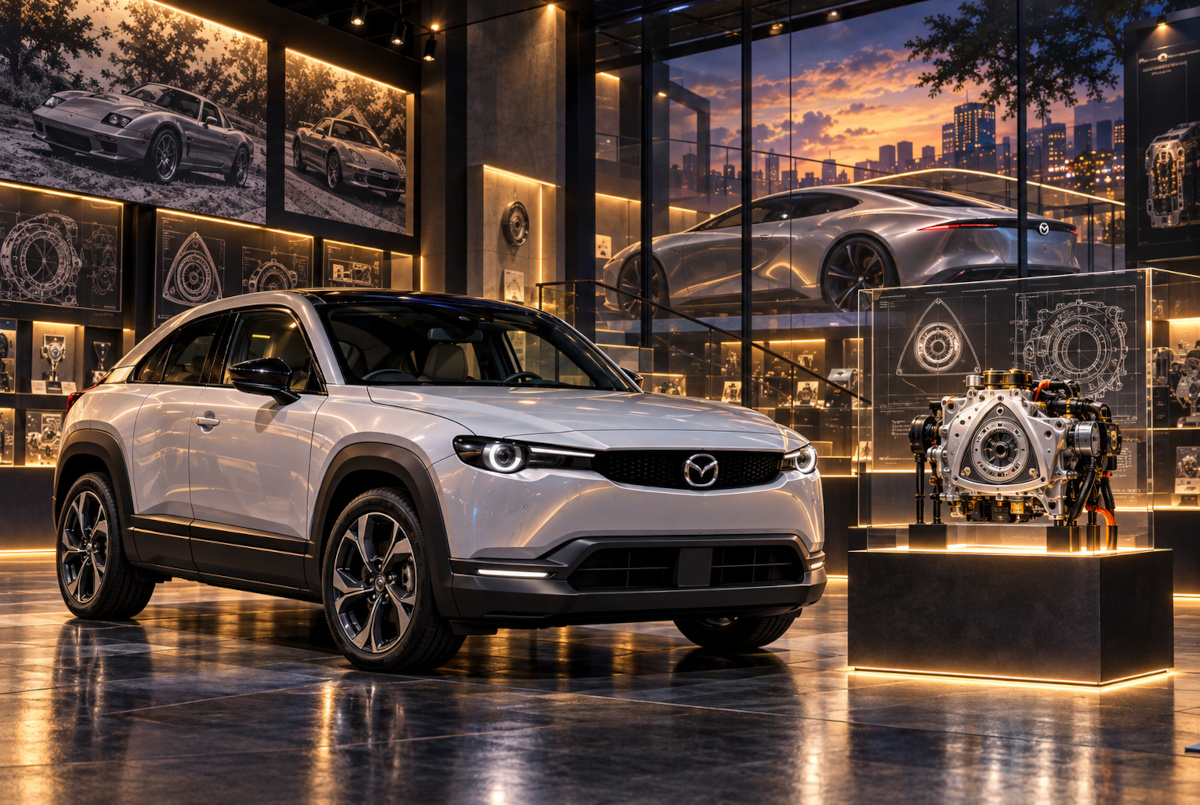
When Mazda ended RX-8 production in June 2012, it brought the curtain down on a remarkable chapter in automotive history. The line of production rotary-powered sports cars that began with the Cosmo Sport had finally come to a halt.
Eleven years later, Mazda put a rotary engine back into production. But the comeback wasn’t quite what RX-7 and RX-8 enthusiasts had been hoping for. In the 2023 MX-30 Rotary-EV, the rotary engine was no longer responsible for driving the wheels. Its new job was generating electricity.
Then, on October 29, 2025, Mazda unveiled the MAZDA VISION X-COUPE, a concept featuring a twin-rotor turbocharged engine and a claimed maximum output of 510 PS (metric horsepower).
Had Mazda gone from a 72-PS rotary generator to a 510-PS rotary sports coupe? Not exactly. The 510 PS figure refers to the combined hybrid system, not the rotary engine alone. And the car itself is not a production model.
So what has Mazda actually built, and what remains an engineering ambition? To find out, I went beyond the press releases and dug into Mazda’s own engineering papers, development interviews and production records.
The Rotary Really Did Return to Production in 2023—Just Not as a Sports Car
On June 22, 2023, Mazda restarted production of rotary-engine vehicles at its Ujina Plant No. 1 in Hiroshima, Japan. The first vehicles were European-market MX-30 e-SKYACTIV R-EV models. It was the first time Mazda had mass-produced a rotary-powered vehicle since the RX-8 ended production in June 2012.
This wasn’t a motor-show prototype or a limited engineering experiment. The MX-30 Rotary-EV was a genuine production vehicle. Mazda began accepting Japanese orders on September 14, 2023, with sales scheduled to begin that November.
But its powertrain was fundamentally different from the RX-7 or RX-8.
The MX-30 Rotary-EV uses a series plug-in hybrid system. Its newly developed 8C rotary engine drives a generator rather than the wheels. The vehicle is propelled exclusively by its electric motor.
The rotary engine had genuinely returned. What had not returned was a production sports car that sent rotary-engine power directly to the road.
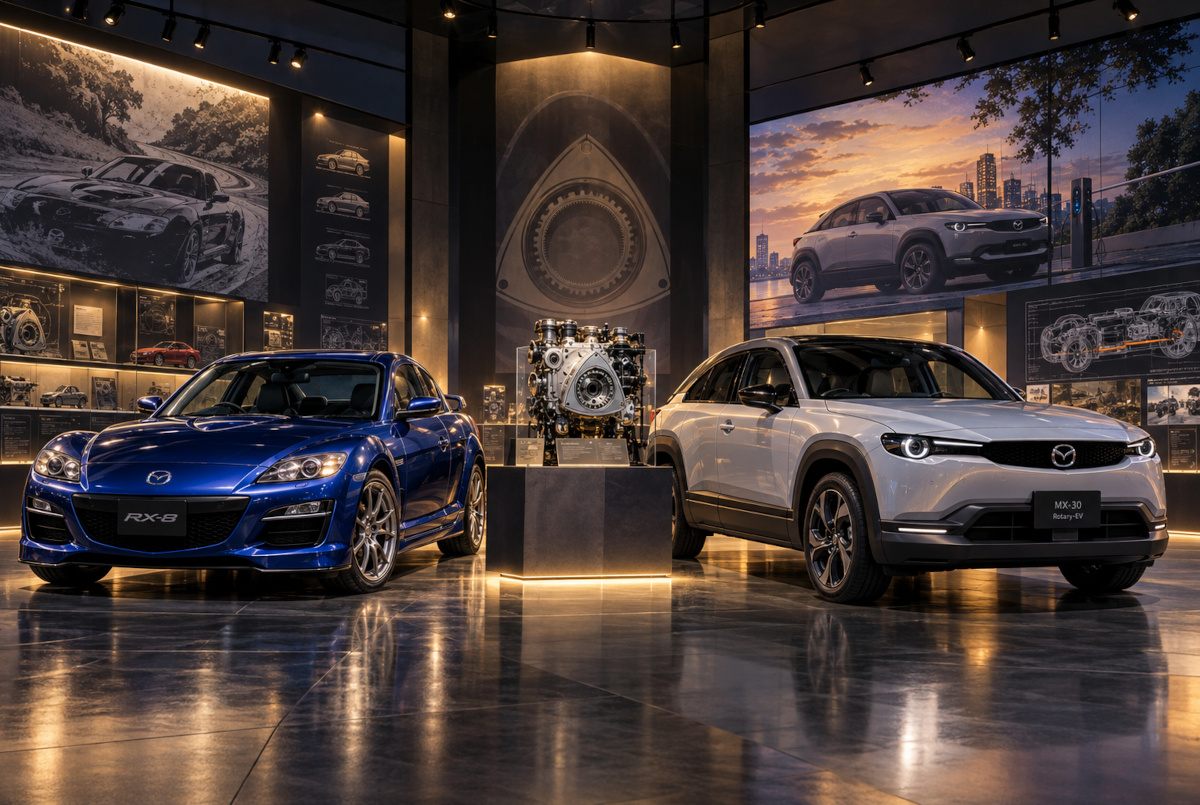 AI-generated illustration. This is a fictional comparison display, not a photograph of an actual exhibition. It illustrates the different roles of the RX-8’s drive engine and the MX-30 Rotary-EV’s generator engine.
A 72-PS Engine and a 170-PS Motor: Why the Numbers Don’t Match
Here’s where the specifications start to look peculiar.
The MX-30 Rotary-EV’s single-rotor 8C engine displaces 830 cc and produces 53 kW, approximately 72 PS. Yet the electric motor that actually drives the car produces 125 kW, or roughly 170 PS.
How can a 72-PS engine operate in a vehicle with a 170-PS drive motor?
| Specification | 2023 Mazda MX-30 Rotary-EV (Japan) |
|---|---|
| Rotary engine | 8C, 830 cc, single rotor |
| Engine maximum output | 53 kW at 4,500 rpm (approx. 72 PS) |
| Traction motor maximum output | 125 kW (approx. 170 PS) |
| Battery capacity | 17.8 kWh |
| Fuel tank capacity | 50 litres |
| Electric-only driving range | 107 km (Japanese WLTC test) |
| Wheel propulsion | Electric motor only |
Source: Mazda’s September 2023 Japanese-market specifications. Metric horsepower is calculated using 1 kW ≈ 1.3596 PS. Engine and motor outputs serve different functions and must not be added together to calculate total vehicle output. The quoted electric range is a laboratory-test figure, not a guaranteed real-world result.
The answer lies in the architecture. The engine generates electricity, while the battery stores energy that the motor can also draw upon. During acceleration, the motor can briefly deliver more power than the generator engine is capable of supplying continuously.
The generator engine also doesn’t need to follow road speed through a mechanical transmission. Mazda can select operating conditions intended to improve efficiency rather than asking the engine to respond directly to every movement of the accelerator.
Calling a 72-PS generator a downgrade from the RX-8 misses the point. Mazda hadn’t merely reduced the rotary’s output. It had given the engine an entirely different job.
One Rotor, 830 cc: Why the New 8C Isn’t Half a 13B
Something else caught my eye in the specifications published in the Mazda Technical Review.
The RX-8’s 13B-MSP RENESIS has two 654-cc rotor chambers, giving a nominal displacement of 1,308 cc. The MX-30’s 8C has just one rotor, but its displacement is 830 cc.
Remove one rotor from a two-rotor engine, and you might expect to end up with half the displacement. That is not what Mazda did.
- RX-8 13B-MSP: 654 cc × 2 = 1,308 cc
- MX-30 8C: 830 cc × 1 = 830 cc
- Total displacement: approximately 36.5% lower
- Displacement per rotor: approximately 26.9% higher
These percentages are calculated directly from Mazda’s published engine dimensions: (1,308 − 830) ÷ 1,308 for the reduction in total displacement, and (830 − 654) ÷ 654 for the increase per rotor.
The 8C is not simply a 13B with one rotor removed. Mazda increased displacement per rotor and revised the underlying design to create an engine suited to generating electricity.
The engineering changes go much further. The 8C replaces port fuel injection with direct injection, incorporates cooled exhaust gas recirculation (EGR), and uses an aluminium side housing instead of the previous cast-iron design.
According to Mazda’s engineering paper, the 8C achieved improvements in engine-unit fuel consumption of up to 25% compared with the 13B under the specified comparison conditions. It was also developed to comply with the European Euro 6d emissions standard.
That 25% figure needs careful handling. It is an engineering comparison between engines under specified conditions, not evidence that an MX-30 Rotary-EV consumes 25% less fuel in everyday driving than an RX-8.
For an engine type long criticised over fuel consumption and emissions, this is a rather unexpected development. Mazda hadn’t simply dusted off its old rotary design. It had reworked the combustion process and the engine’s basic architecture.
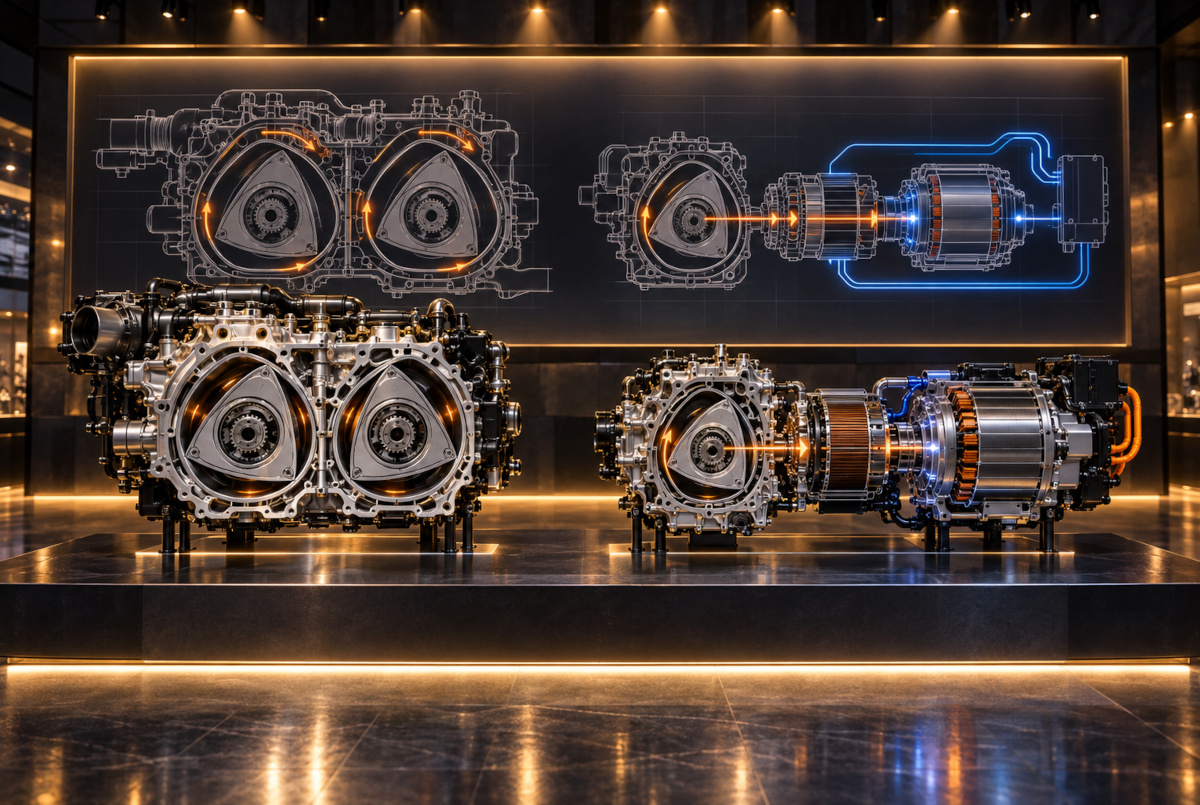 AI-generated technical illustration. This is not a Mazda engineering drawing or a photograph of actual engine assemblies. It is a simplified depiction of rotor count, engine roles and the coaxial powertrain arrangement.
Does the 510-PS Vision X-Coupe Put the Rotary Back in Charge?
On February 1, 2024, Mazda re-established its Rotary Engine Development Group after approximately six years. The new group brought together 36 engineers to work on rotary technology, including generator applications, emissions compliance and carbon-neutral fuels.
Then came the MAZDA VISION X-COUPE, unveiled at the Japan Mobility Show on October 29, 2025.
The concept combines a twin-rotor turbocharged rotary engine with an electric motor and battery in a plug-in hybrid system. Mazda announced a maximum system output of 510 PS, an electric-only range of 160 km and a combined engine-assisted range of up to 800 km.
For rotary enthusiasts, 510 PS is certainly an eye-catching figure. But there is a catch.
The 510 PS figure represents the hybrid powertrain’s system output. It is not a published standalone horsepower rating for the rotary engine. Comparing it directly with the 280 PS quoted for the final turbocharged RX-7 would therefore be misleading.
The more interesting detail came from Mazda’s own development interview.
Unlike the MX-30’s generator-only rotary, the engine proposed for the Vision X-Coupe is intended to provide mechanical drive directly to the wheels.
That changes the picture considerably. Mazda has demonstrated the production return of a rotary generator, while also presenting a concept that could bring the rotary engine back into a direct propulsion role.
But the distinction matters: the Vision X-Coupe is a vision model looking towards 2035. Its published output and range figures are part of Mazda’s concept proposal, not the certified specifications of a production car available to customers.
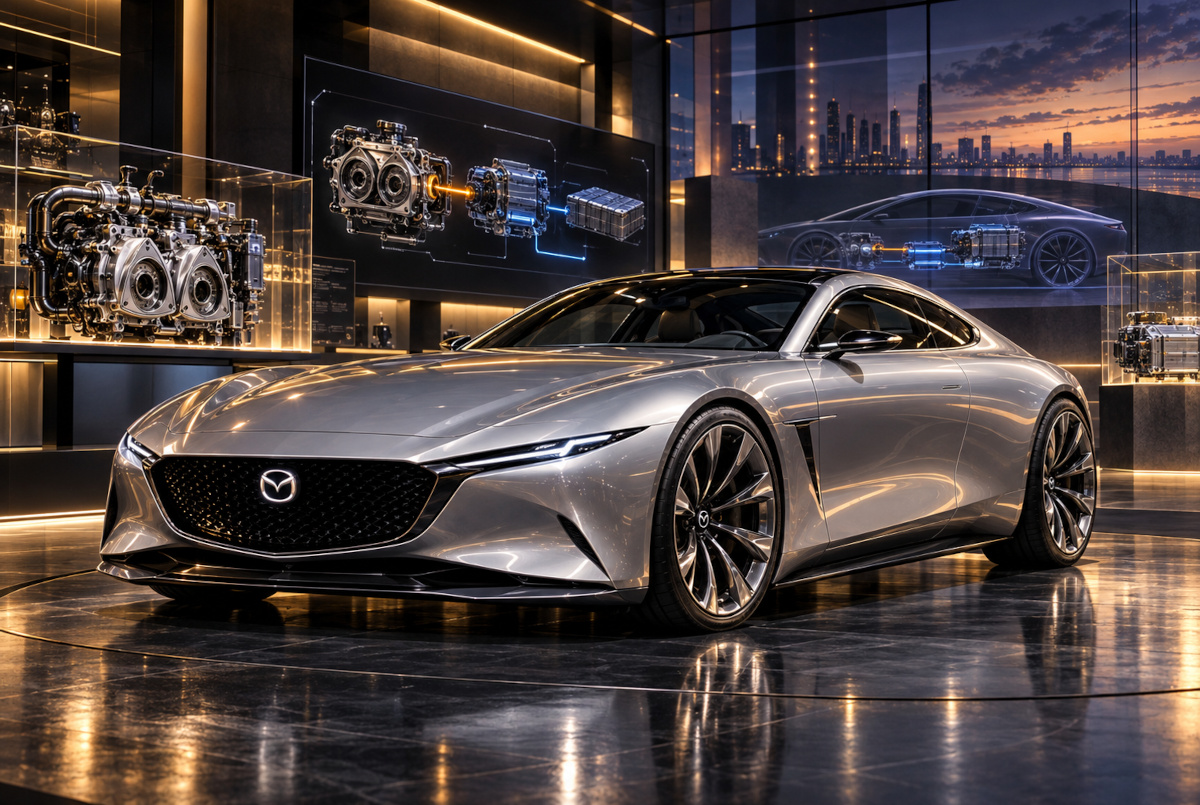 AI-generated concept illustration inspired by the MAZDA VISION X-COUPE. It is not an official Mazda photograph, an exact reproduction of the concept vehicle or confirmation of a future production model.
Could the Vision X-Coupe Really Remove CO₂ as It Drives?
There’s another ambition behind the Vision X-Coupe that is arguably even more radical than its power output.
Mazda has proposed combining carbon-neutral fuel derived from microalgae with an onboard exhaust-gas CO₂ recovery system called Mazda Mobile Carbon Capture.
In Mazda’s explanation, microalgae-derived fuel could reduce net fuel-related CO₂ emissions by approximately 90%. Capturing a further 20% of CO₂ from the exhaust would produce a simplified combined reduction of 110%, or a theoretical net-negative balance of 10% relative to the stated reference.
That is Mazda’s proposed carbon-accounting concept, not independent proof that the Vision X-Coupe already delivers a 10% net-negative carbon footprint over its full life cycle.
The company’s 2025 development interview makes the technology’s maturity clearer. Researchers had demonstrated that CO₂ could be separated from exhaust gases using an adsorbent material, but commercial application still faced technical and business challenges. Scaling up microalgae-based fuel production also presented cost and production issues.
The MX-30’s rotary generator is production engineering. The 510-PS Vision X-Coupe and onboard carbon-capture system represent a different, less mature stage of development.
That distinction is easy to lose when a spectacular concept car and an ambitious environmental claim appear in the same press presentation.
Europe Walked Away in 2026. Japan Still Listed the Rotary-EV.
There’s a less glamorous side to the rotary revival: whether Mazda can keep selling it profitably and at sufficient scale.
On January 14, 2026, British automotive publication Autocar reported that the MX-30 R-EV had been discontinued in Europe. A Mazda spokesperson cited a combination of factors, including consumer trends and production priorities.
The publication reported 678 registrations of the rotary range-extender model in the United Kingdom. That figure refers to the UK market, not worldwide sales.
Japan presented a different picture. Mazda’s official factory-shipment estimate, dated October 2, 2026, still listed the MX-30 e-SKYACTIV R-EV, with an estimated three to four months before factory shipment for a new order.
According to the European discontinuation report, the rotary range-extender had left that market while remaining listed for Japanese customers. A successful engineering comeback had not automatically become a worldwide commercial success.
It is a familiar problem for Mazda. The RX-8 had already demonstrated how difficult it could be to sustain a distinctive rotary-powered product beyond its initial appeal. The MX-30 Rotary-EV encountered a different market, but the commercial challenge was hardly imaginary.
The Rotary Survived. An RX-7 Successor Is Still Another Matter.
Looking across the years, three stages of Mazda’s rotary story emerge: direct propulsion, generator-only production and a proposed return to direct propulsion.
| Year | Vehicle or project | Rotary engine’s role | Verified status |
|---|---|---|---|
| 2012 | RX-8 | Direct vehicle propulsion | Production ended |
| 2023 | MX-30 Rotary-EV | Electricity generation only | Production and sales began |
| 2025 | MAZDA VISION X-COUPE | Direct propulsion proposed | Future vision concept |
| 2026 | MX-30 Rotary-EV | Electricity generation only | Still listed for sale in Japan |
Editorial comparison based on publicly available information checked as of October 30, 2026. No confirmed production launch date or retail price for the MAZDA VISION X-COUPE was identified. Market availability may change.
Mazda has achieved something substantial: bringing the rotary engine back into mass production after an eleven-year gap. It has also publicly presented a route towards using rotary power directly for driving again.
But a 510-PS concept is not an announcement that an RX-7-style sports car is ready for production.
The rotary engine didn’t die. It survived by changing jobs, and Mazda is exploring whether it can once again become the heart of a driver’s car. The story is still unfinished.
Editor’s Note
When the RX-8 disappeared, I assumed the next rotary Mazda—if there ever was one—would be another sports car. Eleven years later, Mazda brought the engine back as a generator. A generator! For anyone who remembers an RX-7 winding its way towards the redline, that takes some getting used to.
But the detail that really caught me wasn’t the generator itself. It was the displacement. An 830-cc single rotor? That’s larger per rotor than the old 13B. Then you find direct injection, revised combustion technology and a completely different operating strategy. This wasn’t Mazda keeping an old engine on life support.
And then there’s that magnificent 510 PS headline. For a moment, you can almost hear the old rotary crowd cheering. Read the small print, though, and it’s the hybrid system’s output. The rotary engine’s individual figure isn’t being advertised. Some things about studying car specifications never change.
The European withdrawal reports provide another reality check. Building a technically intriguing rotary is one thing. Convincing enough people to buy it year after year is quite another.
Still, the idea of a direct-drive rotary in the Vision X-Coupe is difficult to ignore. I’m glad the engine survived as a generator, but I’d rather hear it helping to drive the wheels again.
From the 1967 Cosmo Sport to an electric generator and now a futuristic hybrid coupe, Mazda’s rotary engine has been remarkably stubborn about refusing to disappear. I wouldn’t call that a happy ending just yet. But I wouldn’t write the obituary either.
Terms That May Need a Quick Explanation
- Series Plug-in Hybrid
- A powertrain combining an externally rechargeable battery, an electric drive motor and an engine used to generate electricity. In the MX-30 Rotary-EV, the rotary engine has no direct mechanical drive connection to the wheels. Propulsion is always provided by the electric motor.
Mazda Rotary: A Seven-Part Series
From the pioneering Cosmo Sport to the RX-7 and RX-8, we trace Mazda's rotary-engine ambitions, engineering breakthroughs, commercial challenges, and the technology's eventual revival. Seven articles examine the history through original comparisons, calculations, and historical records.
- Part 1: Only 1,176 Mazda Cosmo Sports: What Was Mazda Really Building? (Part 1)
- Part 2: Did Mazda’s Rotary Engine Nearly Sink the Company? The 40% MPG Mystery (Part 2)
- Part 3: When Did the Mazda Cosmo Become a Luxury Car? From the Red AP to a ¥5.3 Million Three-Rotor GT (Part 3)
- Part 4: The Cosmo Had 280 PS. Why Did the First FD RX-7 Get Only 255?
- Part 5: Mazda Aimed for 280 PS—So Why Did the RX-8 Arrive with Four Doors and 250 PS?
- Final Part: Mazda Built 100,000 RX-8s in 18 Months. So Was It a Failure? (Final Part)
- Special Edition: Mazda’s Rotary Returned as a Generator. Is a 510-PS Coupe Next? [Special Edition]
References
- Mazda, June 22, 2023 — Start of MX-30 e-SKYACTIV R-EV Production (Japanese). Official confirmation of the rotary engine’s return to mass production after approximately eleven years.
- Mazda, September 14, 2023 — MX-30 Rotary-EV Orders Open in Japan (Japanese). Official technical specifications, including the 8C engine, 125-kW motor, 17.8-kWh battery, 50-litre fuel tank and 107-km electric range.
- Mazda Technical Review, No. 40 (2023) — Combustion Technology for the New 8C Rotary Engine (PDF, Japanese). Mazda engineers’ study of direct injection, cooled EGR, fuel-consumption improvements and Euro 6d compliance.
- Mazda Technical Review, No. 40 (2023) — Development of the New Rotary Engine: Structural Technologies for Lightweight Design, Fuel Economy and Reliability (PDF, Japanese text with English abstract and tables). Primary engineering source for the 13B/8C displacement, rotor count, materials and architecture comparison.
- Mazda, February 1, 2024 — Accelerating Rotary Engine Research and Development (Japanese). Official announcement of the reinstated Rotary Engine Development Group.
- Mazda, October 29, 2025 — World Premiere of Two Vision Models at Japan Mobility Show 2025 (Japanese). Official announcement of the Vision X-Coupe, its 510-PS system output and proposed driving ranges. Official English edition.
- Mazda Mirai Base — The MAZDA VISION X-COUPE and the Future of Driving Enjoyment (Japanese). Interviews discussing direct rotary propulsion, CO₂ capture experiments, microalgae-derived fuel and commercialisation challenges. Official English edition.
- Autocar, January 14, 2026 — Mazda Pulls the Plug on Rotary-Engined MX-30 R-EV After Two Years. Automotive industry reporting on the European withdrawal, UK registration figures and comments attributed to Mazda. Secondary source.
- Mazda Japan — Estimated Factory Shipment Timing (Japanese). Official listing dated October 2, 2026, showing the MX-30 e-SKYACTIV R-EV and its estimated shipment lead time in Japan.