
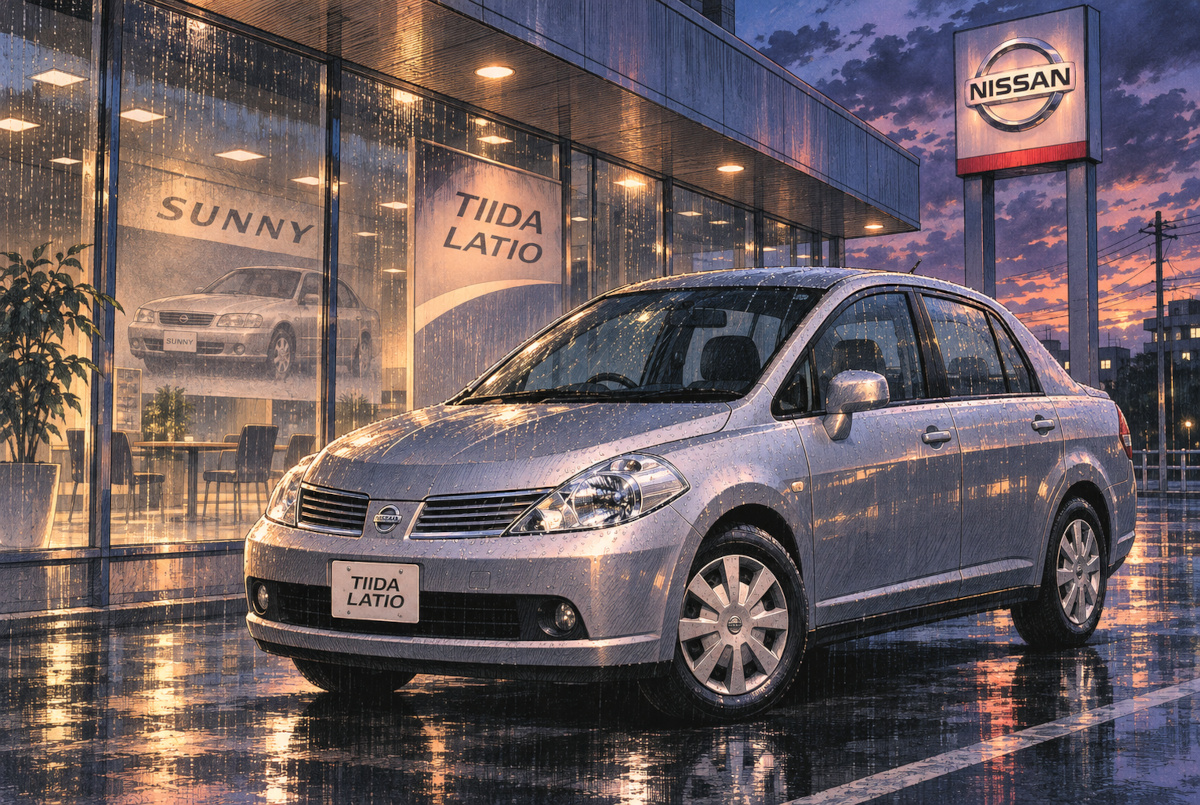
On October 29, 2004, Nissan launched the Tiida Latio, a new compact sedan for the Japanese market. At the same time, the Sunny name disappeared from Japan after 38 years, having been in use since 1966.
But here is the curious part. The executive responsible for developing the Tiida Latio said it had not been conceived simply as the next Sunny. Nissan also intended to attract buyers younger than the Sunny’s established customer base.
Twelve years later, in December 2016, the Latio itself disappeared from Japanese showrooms.
Why did Nissan abandon a name it had spent 38 years building? And did replacing the Sunny actually help the company attract younger buyers?
To investigate, I went back to interviews with Nissan’s product planners, compared the company’s official monthly sales targets, and followed the Sunny name into China. The result is a rather ironic chapter in Nissan’s history.
2004: Nissan’s Product Planner Said the Tiida Latio Wasn’t Simply the Next Sunny
On October 30, 2004, Japanese automotive publication Response.jp interviewed Shuji Matsumoto, Nissan’s Chief Product Specialist responsible for the Tiida Latio.
Matsumoto acknowledged that the new sedan would serve existing Sunny owners looking for a replacement. In that sense, it could be considered a successor.
But he made an important distinction: Nissan had not developed the Tiida Latio with the intention of simply creating the next Sunny.
Instead, the company wanted a new kind of compact sedan, one offering a more upscale experience rather than merely inexpensive, practical transportation.
Nissan’s October 29 launch announcement supports that positioning. The Tiida Latio featured the newly developed HR15DE engine, available continuously variable transmission (CVT), soft-touch interior materials, and a spacious cabin. Its trunk offered 467 liters of cargo capacity.
The emphasis had shifted toward comfort, perceived quality, and a more sophisticated small-car experience.
Nissan wanted to retain the Sunny’s place in the market without being constrained by the image associated with the Sunny name.
That is my reading of Matsumoto’s explanation, rather than a separately documented corporate decision to reject the name itself.
 AI-generated illustration comparing the facelifted Nissan Sunny B15 with the Tiida Latio introduced in 2004. The vehicles are based on their real designs, but minor styling details and the showroom setting are illustrative rather than historically exact.
The Sunny’s Core Buyers Were in Their 60s. Nissan Wanted Latio Buyers in Their 50s
A second interview, published by Response.jp on November 1, 2004, reveals another part of Nissan’s strategy.
Matsumoto explained that the Sunny’s core customers were people in their 60s. For the Tiida Latio, Nissan was targeting customers in their 50s.
That is a surprisingly specific reason to question a famous model name.
Nissan wasn’t merely redesigning an aging sedan. It was attempting to change the kind of customer attracted to the car.
There is, however, an important complication.
Another Response.jp article, published on October 1, 2004, described the Sunny’s average user as being in their 50s. That report concerned the Tiida hatchback, which was being introduced shortly before the sedan.
One article refers to an average customer age; the other describes the core customer group. Neither provides the underlying survey population or calculation method.
Consequently, we cannot establish what percentage of Sunny buyers were in their 60s, or how many years younger Tiida Latio buyers actually became.
What the interviews do establish is that Nissan’s product planning team deliberately wanted to move beyond the Sunny’s traditional customer image.
From 5,000 to 3,000 Cars a Month: What Was Nissan Expecting?
If Nissan wanted a fresh start, what did its own sales projections say about the opportunity?
I compared three separate Nissan press releases covering the final Sunny and the two generations of its successor.
| Announcement | Model | Monthly Sales Target in Japan |
|---|---|---|
| May 2002 | Sunny B15 | 5,000 vehicles |
| October 2004 | Tiida Latio | 3,000 vehicles |
| October 2012 | Latio N17 | 1,200 vehicles |
Sources: Nissan’s official Japanese-market announcements issued in May 2002, October 2004, and October 2012. These figures are monthly sales targets announced by Nissan, not actual sales results.
The first comparison is straightforward.
The Sunny’s announced monthly target in May 2002 was 5,000 vehicles. For the Tiida Latio in October 2004, Nissan set a target of 3,000.
That is a reduction of 2,000 vehicles per month:
(5,000 − 3,000) ÷ 5,000 × 100 = 40%
Then, in October 2012, the new Latio N17 arrived with a monthly target of just 1,200 vehicles.
Compared with 2004, that represented a further 60% reduction. Against the Sunny’s 2002 target, it was a 76% reduction.
By the time Nissan introduced the Tiida Latio in 2004, its published monthly sales target was already 40% below the target announced for the Sunny two years earlier.
The figures show another substantial change by 2012.
But there is a crucial distinction: sales targets are business plans, not measured consumer demand. They may reflect management expectations, product positioning, and different market circumstances.
This comparison does not prove that changing the Sunny name caused sales to fall. Nor does a 76% reduction in targets mean the market itself had contracted by 76%.
What it does reveal is that Nissan was planning for a considerably smaller domestic sales volume as its compact-sedan strategy evolved.
Japan Dropped the Sunny Name. China Kept It.
Here is the detail that made me question the whole argument about the Sunny name being outdated.
While Nissan retired the Sunny name in Japan, it continued to use it in China.
At the 2003 Shanghai Motor Show, Nissan unveiled a new sedan called the Sunny, marketed in China under the Chinese name Yangguang (陽光). The model formed an important part of the company’s business with Dongfeng Motor.
The story did not end there.
In December 2010, Nissan announced another all-new Sunny for China, with sales scheduled to begin in January 2011. The company also planned to introduce that global sedan across other markets under different model names.
In other words, the Sunny name had not become so obsolete that Nissan considered it unusable everywhere.
Japan received the Tiida Latio, while China continued to see the Sunny name on a Nissan sedan.
These were not identical vehicles. The Chinese-market Sunny was not simply the Japanese B15 with different badges.
Nevertheless, the contrast matters. Nissan’s decision about whether to retain an established model name depended on the market in which the car was sold.
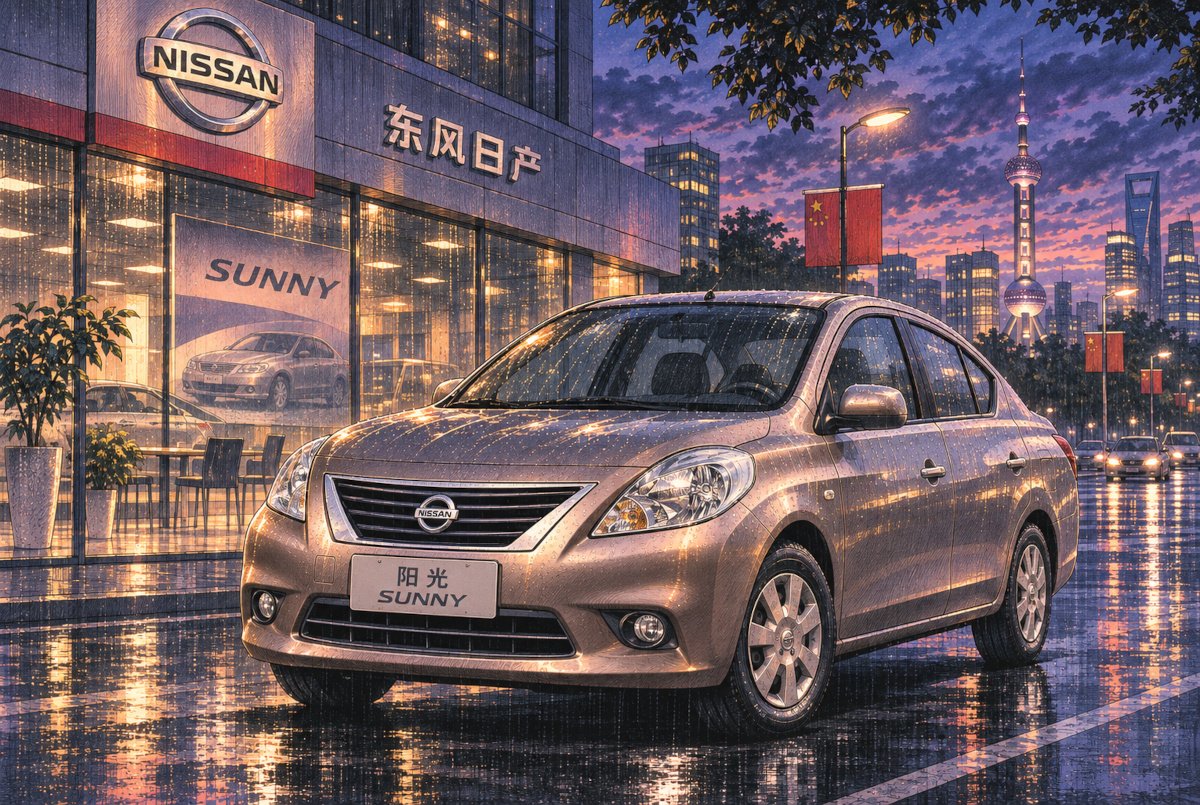 AI-generated illustration inspired by the Nissan Sunny (Yangguang) introduced in China in 2011. Nissan continued using the Sunny name in China after its retirement in Japan. The dealership and urban background are fictional, and vehicle details are approximate.
2012: The Latio’s Target Buyer Was Older Again
On October 5, 2012, Nissan launched a completely redesigned Latio in Japan.
The Tiida portion of the name was dropped, leaving the car simply called the Nissan Latio.
The new N17-generation sedan was manufactured in Thailand and imported into Japan. Its Japanese-market specification used a 1.2-liter HR12DE engine and CVT, achieving a published fuel-economy rating of 22.6 km/L under Japan’s JC08 test cycle.
The mechanical specification and product positioning were quite different from those of the 2004 Tiida Latio.
But the most revealing detail concerned the intended customer.
On the same day as the launch, Response.jp published an article drawing on an interview with Kuniyasu Tsuzuki, the new Latio’s Chief Product Specialist.
According to the report, Nissan’s envisioned private buyer in Japan was a 65-year-old man from the country’s postwar baby-boom generation.
Now compare the two product-planning messages.
In 2004, Nissan described the Sunny’s core customers as people in their 60s and said the Tiida Latio would target people in their 50s.
Eight years later, the next-generation Latio was being positioned around a 65-year-old buyer.
Nissan had changed the Sunny name partly to reach younger customers. Yet by the next generation, its Japanese compact sedan was once again being marketed primarily toward older buyers.
That makes for an intriguing reversal in the company’s stated targeting strategy.
It is not, however, proof that the average buyer’s age rose from the 50s to 65. These figures describe target customer profiles at different times, not a consistent statistical series of actual purchasers.
Whether the 2004 rebranding genuinely attracted younger customers remains unanswered by the available evidence.
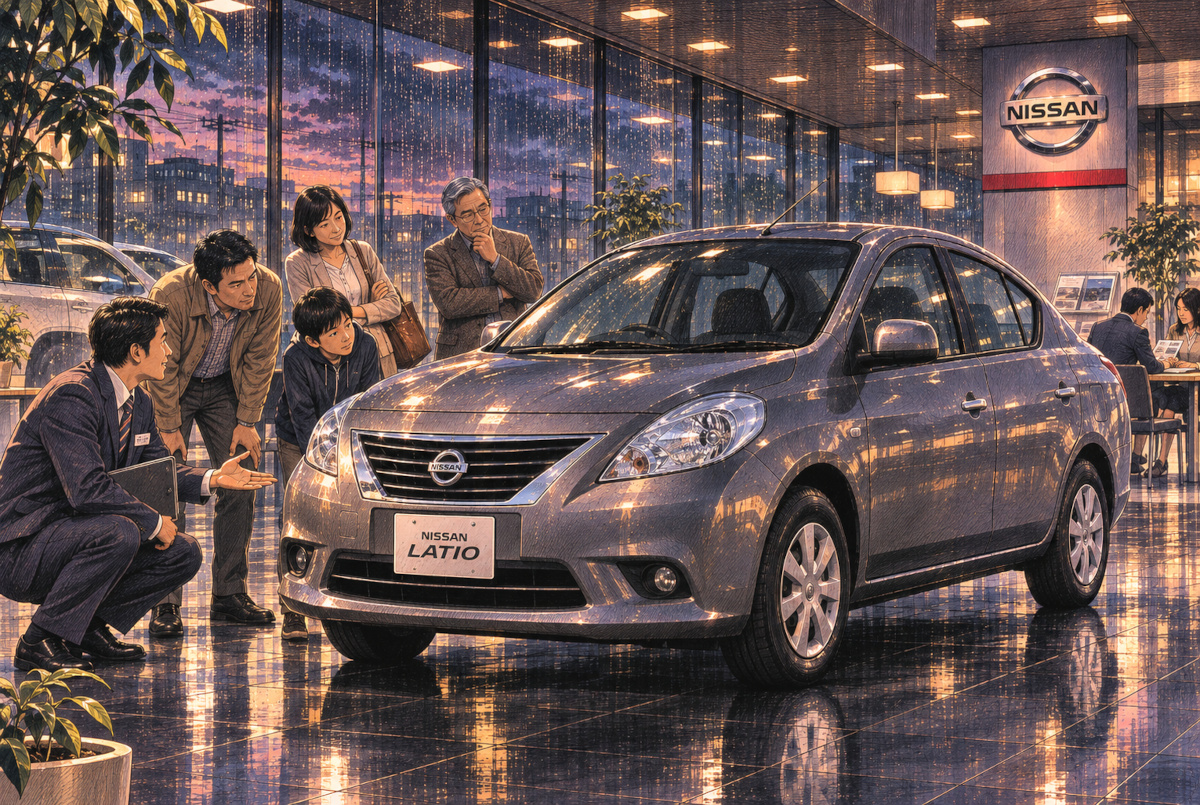 AI-generated illustration based on the Japanese-market Nissan Latio N17 introduced in 2012. The showroom, people, and sales discussion are fictional. Minor vehicle details may differ from the production model.
December 2016: The Latio Also Disappeared from Japan
The N17 Latio continued in Japan after receiving an update in October 2014.
But Nissan’s official vehicle information confirms that Japanese sales ended in December 2016.
That completed an approximately 12-year chapter: the Sunny name disappeared in 2004, the Tiida Latio became the standalone Latio in 2012, and the Latio itself left the Japanese market in 2016.
What can we establish from the documents?
In 2004, Nissan wanted to change both the product image and the intended customer base of its compact sedan. Its published monthly sales targets subsequently became smaller. By 2012, the new Latio was again targeting an older segment of Japanese buyers.
But we cannot establish that retaining the Sunny name would have preserved sales, or that adopting the Latio name caused the model’s eventual decline.
That would require comparable sales evidence isolating the effect of the name itself, or access to Nissan’s internal product-planning and customer research.
Nor does the evidence show that Nissan retired the Sunny because it had become an inferior car.
The more defensible interpretation is that Nissan wanted to reposition its Japanese compact sedan, and the Sunny name became a casualty of that strategy.
At least, that is what the contemporary interviews and official product announcements suggest.
Editor’s Note
The part I keep coming back to is Nissan’s apparent belief that giving the car a new name could help bring in different buyers. After 38 years, the Sunny badge certainly carried plenty of associations. I can understand wanting a fresh start.
But if an old name was such a problem, what about the Toyota Corolla? That name had been around for decades too, and Toyota wasn’t throwing it away.
Even better, Nissan itself kept using Sunny in China. Retire it in Japan, keep it overseas. Maybe the name wasn’t the real problem after all. Maybe it came down to which customers Nissan wanted in which market.
Then there is that age comparison. In 2004, the idea was to move from the Sunny’s customers in their 60s toward Latio buyers in their 50s. By 2012, the new car was being aimed at a 65-year-old buyer. You couldn’t script a much neater irony for an old motoring magazine.
I have nothing against the Latio. It wasn’t a bad little sedan simply because it replaced a famous name. But couldn’t Nissan have pursued the same upscale image and younger buyers while keeping the Sunny badge?
Perhaps it would have made no difference whatsoever. Nobody can prove the alternative would have worked.
Still, the Sunny had been trading punches with the Corolla since 1966. As someone who enjoys old Japanese cars, I can’t help thinking that was a lot of history to leave behind.
Nissan Sunny: 60 Years of History - Eight-Part Series
Born in 1966, the Nissan Sunny challenged the Toyota Corolla and helped shape Japan's mass-market car industry. Across eight articles, we examine its development, engineering, performance, sales, motorsport history, and why the Sunny name disappeared from Japan while surviving in overseas markets.
- Part 1: Did Toyota’s “Extra 100cc” Really Beat the Datsun Sunny? The 89cc Battle (Part 1)
- Part 2: Did the Datsun Sunny Really Make the Corolla Look Small? The B110 and GX-5 (Part 2)
- Part 3: Was the Datsun Sunny Really No. 2 in World Production? The B210 and B310 (Part 3)
- Part 4: The Sunny Went FWD 19 Months Before the Corolla—Was the B12 Really That Good? (Part 4)
- Part 5: The Nissan Sunny Got Better. So Why Did Sales Fall? B13, B14 and the 300-PS Race Car
- Part 6: Nissan Gave Its Last Sunny 175 PS. Why Did the Name Disappear?
- Part 7: Why Did Nissan Drop the Sunny Name—Only to Target Older Buyers Again? (Part 7)
- Final Part: The Sunny Disappeared in Japan. Why Did It Live On Abroad? (Final Part) Coming soon
References
- Response.jp, “Nissan Tiida Latio Launch: It Wasn’t Intended Simply as the Sunny’s Successor” (October 30, 2004; Japanese) — Interview with Chief Product Specialist Shuji Matsumoto explaining why the Tiida Latio was not developed merely as the next Sunny.
- Response.jp, “Nissan Tiida Latio Launch: Targeting a Broader Customer Base Than the Sunny” (November 1, 2004; Japanese) — Matsumoto’s remarks describing Sunny customers primarily in their 60s and the Tiida Latio’s intended core market in their 50s.
- Response.jp, “Nissan Tiida Launch: Seeking Customers from Both Ends of the Market” (October 1, 2004; Japanese) — An earlier report about the Tiida hatchback, including its reference to Sunny users averaging in their 50s.
- Nissan Motor Co., “Sunny Receives a Minor Model Change” (May 2002; Japanese) — Official Nissan announcement establishing the Sunny B15’s monthly Japanese sales target of 5,000 vehicles.
- Nissan Motor Co., “Nissan Launches New Compact Sedan Tiida Latio” (October 29, 2004; Japanese) — Original product positioning, interior features, 467-liter trunk, and monthly sales target of 3,000 vehicles.
- Nissan Motor Co., “Nissan Unveils New Sunny (Yangguang) at the 2003 Shanghai Motor Show” (April 2003; Japanese) — Official evidence of the Sunny name’s continued use in China.
- Nissan Motor Co., “Nissan Unveils New Global Sedan at the 8th China (Guangzhou) International Automobile Exhibition” (December 2010; English) — Announcement of the new Sunny in China, scheduled to go on sale in January 2011, and Nissan’s international naming strategy.
- Nissan Motor Co., “Nissan Launches the New Latio” (October 5, 2012; Japanese) — Official information about the N17, Thai production, 1.2-liter engine, JC08 fuel economy of 22.6 km/L, and monthly sales target of 1,200 vehicles.
- Response.jp, “New Nissan Latio Targets Japan’s Male Baby-Boom Generation” (October 5, 2012; Japanese) — Reporting based on an interview with Chief Product Specialist Kuni yasu Tsuzuki concerning the intended 65-year-old male customer profile.
- Nissan Official FAQ, “Latio N17: Chassis Number, Model Plate, and Engine Identification” (Japanese) — Confirms the N17 generation’s Japanese sales period from October 2012 through December 2016.