The Nissan Sunny RZ-1 arrived in Japan in February 1986 and disappeared from the production lineup in December 1989. Counting both the first and last months, its production-model lifespan covered just 47 calendar months—less than four years.
Was it simply beaten by Toyota’s Corolla Levin and Sprinter Trueno? That sounds plausible until you look at what Nissan itself was selling at the time.
Eight months after the RZ-1 arrived, Nissan launched the EXA. Then came the hugely popular S13 Silvia in May 1988. By that point, Nissan had several coupes competing for the attention—and potentially the money—of similar buyers.
The RZ-1’s competition wasn’t limited to Toyota. Some of its most intriguing rivals were sitting in Nissan’s own lineup.
Why Was Nissan Selling Three Different Coupes at Once?
The RZ-1 was a front-wheel-drive coupe derived from the B12-generation Sunny, one of Nissan’s mainstream compact cars. Its styling, however, was anything but ordinary: sharp edges, a low nose, and a distinctive wraparound rear window.
In October 1986, Nissan introduced the KEN13 EXA, developed from the N13 Pulsar family. Also front-wheel drive, it offered a different kind of appeal, with pop-up headlights, a removable T-bar roof, and a choice of coupe or canopy-style bodywork. The EXA was related to the model sold internationally as the Pulsar NX.
Then, in May 1988, the S13 Silvia entered the picture. Its flowing bodywork, rear-wheel-drive layout, and 1.8-liter engine gave it a distinctly different character. It wasn’t in exactly the same class as the RZ-1, but buyers shopping for a stylish Japanese coupe could reasonably have considered both.
| Model | Japan launch | Platform family / drive | Defining character |
|---|---|---|---|
| Sunny RZ-1 | February 1986 | B12 / FWD | Sharp-edged personal coupe |
| Nissan EXA | October 1986 | N13 / FWD | T-bar roof and canopy body |
| S13 Silvia | May 1988 | S13 / RWD | Fluid styling and sporting appeal |
Source: Nissan’s official heritage documentation. Platform families, launch dates, and drivetrain layouts refer to Japanese-market models. Potential overlap between customers is an editorial assessment, not evidence that Nissan officially designated these vehicles as direct competitors.
Put simply, Nissan was offering three different interpretations of the coupe: the RZ-1 was angular and personal, the EXA was playful and unconventional, and the Silvia combined elegant styling with rear-wheel-drive performance.
Different concepts, certainly. But a prospective buyer still had only one budget. That makes the possibility of competition within Nissan’s own showrooms worth examining.
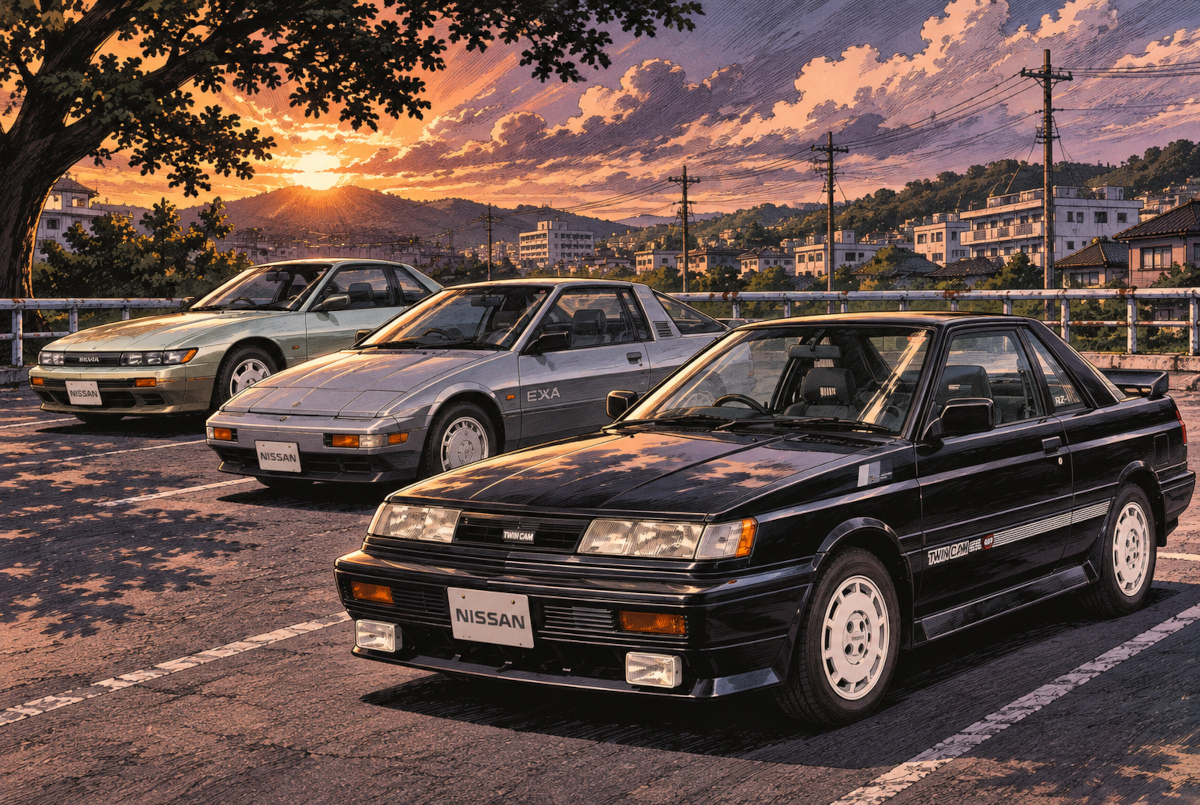
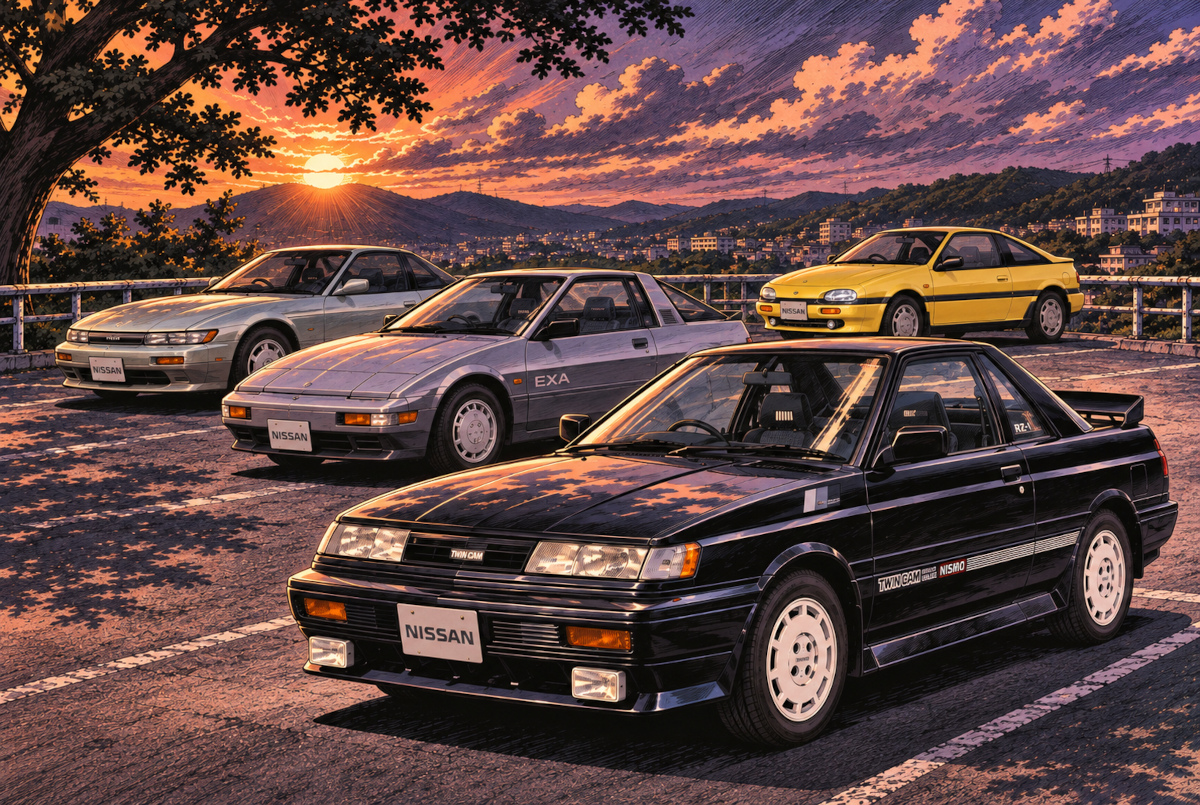
AI-generated comparison illustration of three Nissan coupes available in 1988. From left: S13 Silvia, EXA, and Sunny RZ-1. This is not an actual group photograph, and some body and equipment details have been simplified.
The Silvia Q’s Was ¥174,000 Cheaper Than the RZ-1 NISMO
Here’s where the story becomes particularly awkward for the RZ-1. Let’s take the price comparison from the previous installment and add the S13 Silvia.
At its Japanese-market launch in 1988, the five-speed manual Silvia Q’s had a listed vehicle price of ¥1,556,000. It came with a naturally aspirated 1.8-liter DOHC engine producing 135 PS, driving the rear wheels.
The five-speed Sunny RZ-1 Twincam NISMO, meanwhile, was listed at ¥1,730,000 with a 1.6-liter engine producing 120 PS and front-wheel drive.
That is not a trivial difference. Subtracting the two prices gives:
¥1,730,000 − ¥1,556,000 = ¥174,000
Using the RZ-1 NISMO’s price as the baseline:
¥174,000 ÷ ¥1,730,000 × 100 ≈ 10.1%
The Silvia Q’s cost approximately 10.1% less while offering 15 PS more peak power.
These are period Japanese vehicle list prices, compared using the published figures. They are not adjusted for inflation or differences in equipment, and they do not represent actual transaction prices.
The RZ-1 NISMO had its own selling points, including dedicated suspension tuning, aerodynamic parts, and a distinctive interior. Nor can horsepower and price alone establish which car was better to drive.
Still, the fact remains: in 1988, Nissan offered buyers a less expensive, more powerful rear-wheel-drive coupe alongside the RZ-1 NISMO.
That makes the RZ-1’s position in Nissan’s lineup rather more complicated than a simple Nissan-versus-Toyota rivalry.
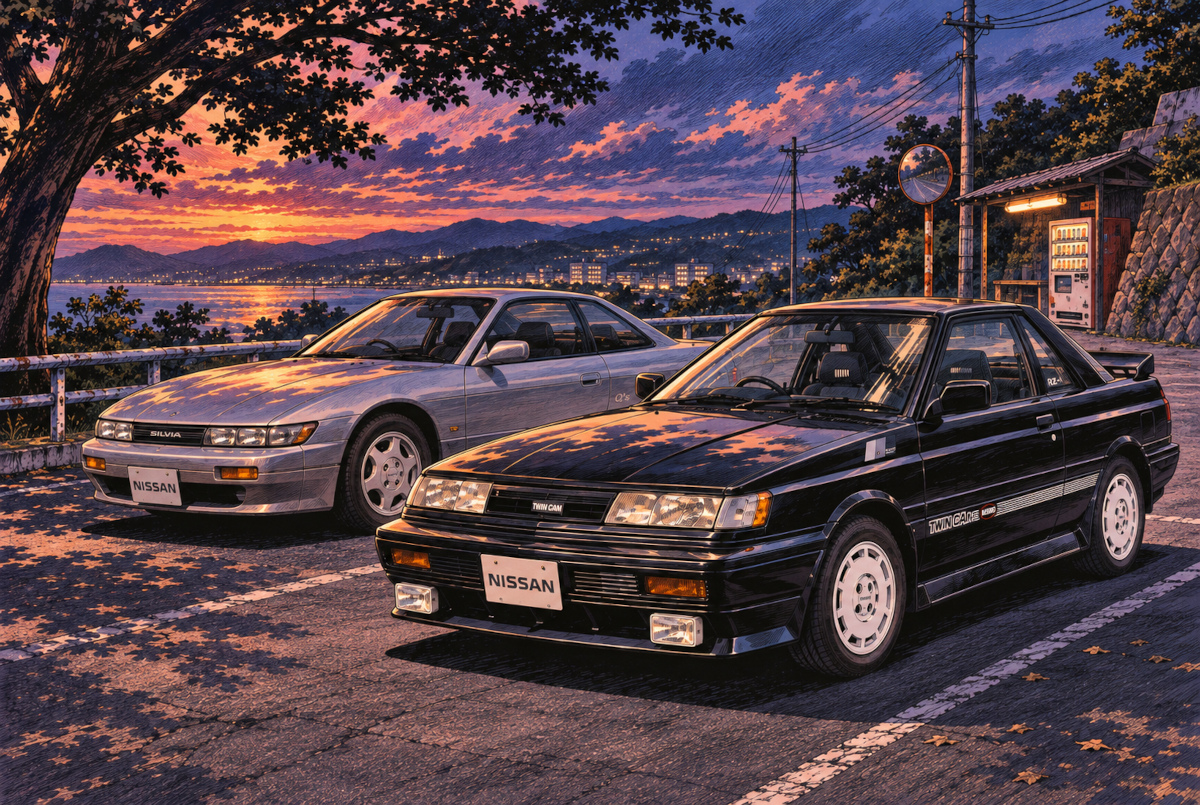
AI-generated comparison illustration of the Sunny RZ-1 Twincam NISMO and early S13 Silvia Q’s. It emphasizes the contrast between an angular front-wheel-drive coupe and a curvier rear-wheel-drive model. Some equipment and exterior details may differ from the actual cars.
Did the RZ-1 Really Sell Only 25,241 Units?
If the RZ-1 disappeared so quickly, surely its sales must have been disastrous. Or were they?
During this investigation, I encountered a reported total of 25,241 new registrations for the RZ-1. The figure is attributed to page 15 of issue 76 of De Agostini Japan’s Weekly Japanese Classic Cars (Shukan Nihon no Meisha).
There is an important limitation: I was unable to inspect that page directly or reconcile the figure with Nissan’s model-specific registration records. It should therefore be treated as an unverified reference figure, not a confirmed production or sales total.
For comparison, Japanese automotive publication Motor-Fan reports that the S13 Silvia sold approximately 300,000 units over about five years.
But those figures cannot simply be divided to produce a meaningful verdict. The periods differ, the counting methods may differ, and the RZ-1 number has not been independently confirmed against its original source.
Even verified sales totals would tell us nothing directly about profitability, engineering development costs, or Nissan’s internal product-planning decisions.
Short production life does not automatically prove poor sales, and poor sales would not automatically prove defeat by the Levin or Trueno. The neat three-step explanation is appealing, but the available evidence does not establish it.
The 1990 NX Coupe: Same Wheelbase, a Completely Different World
In January 1990, Nissan launched the Sunny NX Coupe alongside the B13-generation Sunny family. It succeeded the RZ-1’s place in the Sunny coupe lineage, but its design philosophy had changed dramatically.
Nissan’s Heritage Collection describes the NX as a more casual, approachable coupe, a clear departure from the RZ-1’s aggressive, sharp-edged image.
Now for the odd detail: the dimensions.
I compared the specifications of Nissan’s preserved 1989 Sunny RZ-1 Twincam NISMO with those of its 1990 Sunny NX Coupe Type B.
| Dimension | RZ-1 NISMO | NX Coupe Type B | NX minus RZ-1 |
|---|---|---|---|
| Overall length | 4,230 mm | 4,140 mm | −90 mm |
| Overall width | 1,665 mm | 1,680 mm | +15 mm |
| Overall height | 1,335 mm | 1,310 mm | −25 mm |
| Wheelbase | 2,430 mm | 2,430 mm | 0 mm |
Source: Nissan Heritage Collection, 1989 Sunny RZ-1 Twincam NISMO and 1990 Sunny NX Coupe Type B. The vehicles are from different generations and equipment grades. Differences were calculated independently from the published dimensions.
Both cars had exactly the same 2,430 mm wheelbase, yet the NX was 90 mm shorter, 15 mm wider, and 25 mm lower.
The differences in appearance were even greater than the numbers suggest.
And here’s another curious coincidence: the 1986 Nissan EXA also had a 2,430 mm wheelbase, according to Nissan’s preserved vehicle specifications.
That does not mean all three cars shared the same underlying platform. A matching wheelbase is a dimensional fact, not proof of common engineering architecture.
What the comparison does show is how radically Nissan changed the identity of its compact coupes without necessarily changing their most basic exterior dimensions.
The RZ-1 was all straight lines and hard angles. The NX had rounded headlights, flowing surfaces, and an altogether softer character.
Nissan’s own historical account adds another layer to that change. The NX Coupe was conceived with female buyers in the North American market in mind, and its styling was developed by Nissan Design International (NDI), the company’s North American design operation.
In other words, this was more than a new front end grafted onto an old idea. The intended audience and product concept had shifted as well.
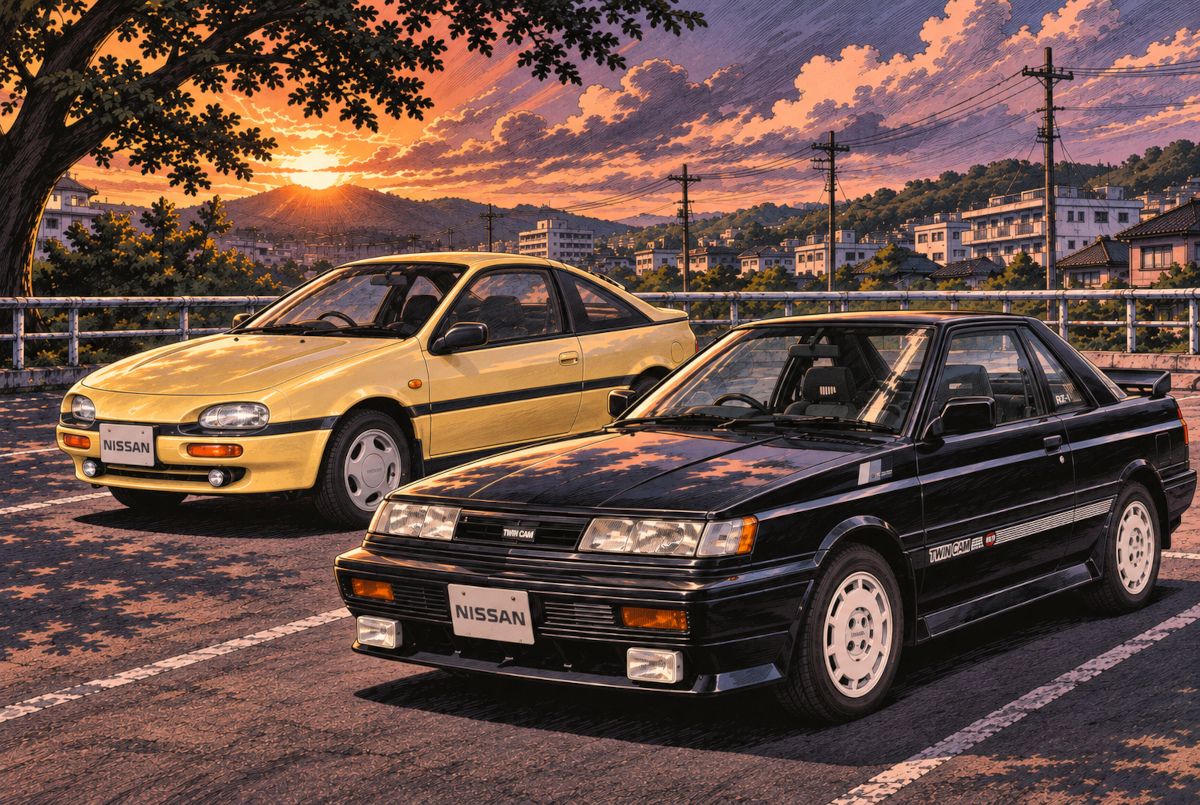
AI-generated illustration of the transition from the angular Sunny RZ-1 to the curvier 1990 NX Coupe. Both vehicles had a 2,430 mm wheelbase, although their exterior designs differed substantially. Some details are illustrative rather than exact reproductions.
The RZ-1 Disappeared. Nissan Didn’t Give Up on Coupes.
There’s one final chronological detail worth checking.
The NX Coupe arrived in January 1990, but the Nissan EXA remained in the Japanese lineup until August of that year.
So Nissan did not discontinue the RZ-1 and EXA simultaneously and replace both with a single new model overnight. Their production and sales periods overlapped during the transition.
What Nissan’s published history does establish is that the RZ-1 name disappeared, the Sunny-related coupe moved toward the NX concept, and the car’s intended character changed significantly.
What it does not establish is the decisive internal reason for ending the RZ-1. I found no company planning document that identifies development costs, weak sales, competition from the Silvia, or pressure from Toyota as the determining factor.
It would therefore be premature to dismiss the RZ-1 as simply a car that lost to Toyota.
A more defensible interpretation is that Nissan continued making compact coupes but reconsidered what kind of personality those cars should have.
The RZ-1’s disappearance was not the end of Nissan’s coupe ambitions. It was the end of one particularly angular answer to the question of what a small personal coupe ought to be.
Editor’s Note
For years, I assumed the Sunny RZ-1 had simply failed to keep up with Toyota’s Levin and Trueno. That seemed like the obvious explanation for its short life.
But the deeper I looked, the more interested I became in Nissan’s own showroom. There was the EXA. There was the Silvia. And, remarkably, an S13 Silvia Q’s could cost less than an RZ-1 NISMO.
Imagine walking into a Nissan dealership in 1988. Before you even started worrying about Toyota, you might have had trouble choosing between Nissan’s own coupes. I wonder what the sales staff made of that.
Personally, I’ve always liked the RZ-1’s hard-edged face. There’s nothing wrong with the NX’s friendlier styling, but I wish Nissan had kept that oddly stern little coupe around for one more generation.
I’m not prepared to call it a failure, though. There’s something irritating about a car being labeled a loser when nobody can show exactly which numbers—or which decisions—sealed its fate.
Nissan Sunny RZ-1: Four-Part Series
From its unusual 1986 debut as a personal coupe to the CA16DE twin-cam engine, NISMO models, and rivalry with the Toyota Levin and Trueno. Across four articles, we examine the RZ-1, its engineering, and why it disappeared.
- Part 1: A Date Car With a Scowl: The Nissan Sunny RZ-1’s Curious 1986 Debut
- Part 2: The 10-PS Trap: Was Nissan’s Sunny RZ-1 Really Outgunned by the AE86?
- Part 3: Same 120 PS, ¥240,000 More: What Was Nissan Selling with the Sunny RZ-1 NISMO?
- Final Part: Was the Nissan Sunny RZ-1 Beaten by Toyota—or Crowded Out by Nissan? | Final Part
References
- Nissan Heritage Collection — Sunny RZ-1 Twincam NISMO (Japanese): Background of the B12 RZ-1, dimensions, equipment, and specifications of the preserved 1989 vehicle.
- Nissan Heritage Collection — Nissan EXA Canopy Type B (Japanese): October 1986 introduction, KEN13 specifications, wheelbase, and design concept.
- Nissan Heritage Collection — Silvia Q’s (S13) (Japanese): May 1988 introduction, 1.8-liter engine, 135 PS output, and rear-wheel-drive layout.
- Nissan Heritage Collection — Sunny NX Coupe Type B (Japanese): 1990 specifications, dimensional comparison, North American design concept, and styling development by NDI.
- Goo-net — 1988 Nissan Silvia S13 Grade Specifications (Japanese): Original Japanese-market list price of ¥1,556,000 for the five-speed manual Q’s.
- CarSensor — Nissan Sunny RZ-1, June–December 1988 Grade List (Japanese): Published vehicle list price of ¥1,730,000 for the five-speed manual Twincam NISMO.
- CarSensor — First-Generation Nissan Sunny RZ-1 (Japanese): Model listing period from February 1986 to December 1989 and period vehicle specifications.
- Meisha Bunka Kenkyujo — Nissan EXA Canopy (Japanese): The EXA’s product history, end of Japanese-market sales in August 1990, and transition toward the NX Coupe.
- Motor-Fan — The History and Appeal of the Nissan S13 Silvia (Japanese, June 22, 2025): The S13’s approximate five-year sales total of 300,000 units and its position in Japan’s coupe market.
- De Agostini Japan, Shukan Nihon no Meisha (Weekly Japanese Classic Cars), Issue 76, p. 15 (Japanese). Cited elsewhere as the source of the RZ-1’s reported 25,241 registrations. The original page was not directly verified; the figure is treated as provisional.