
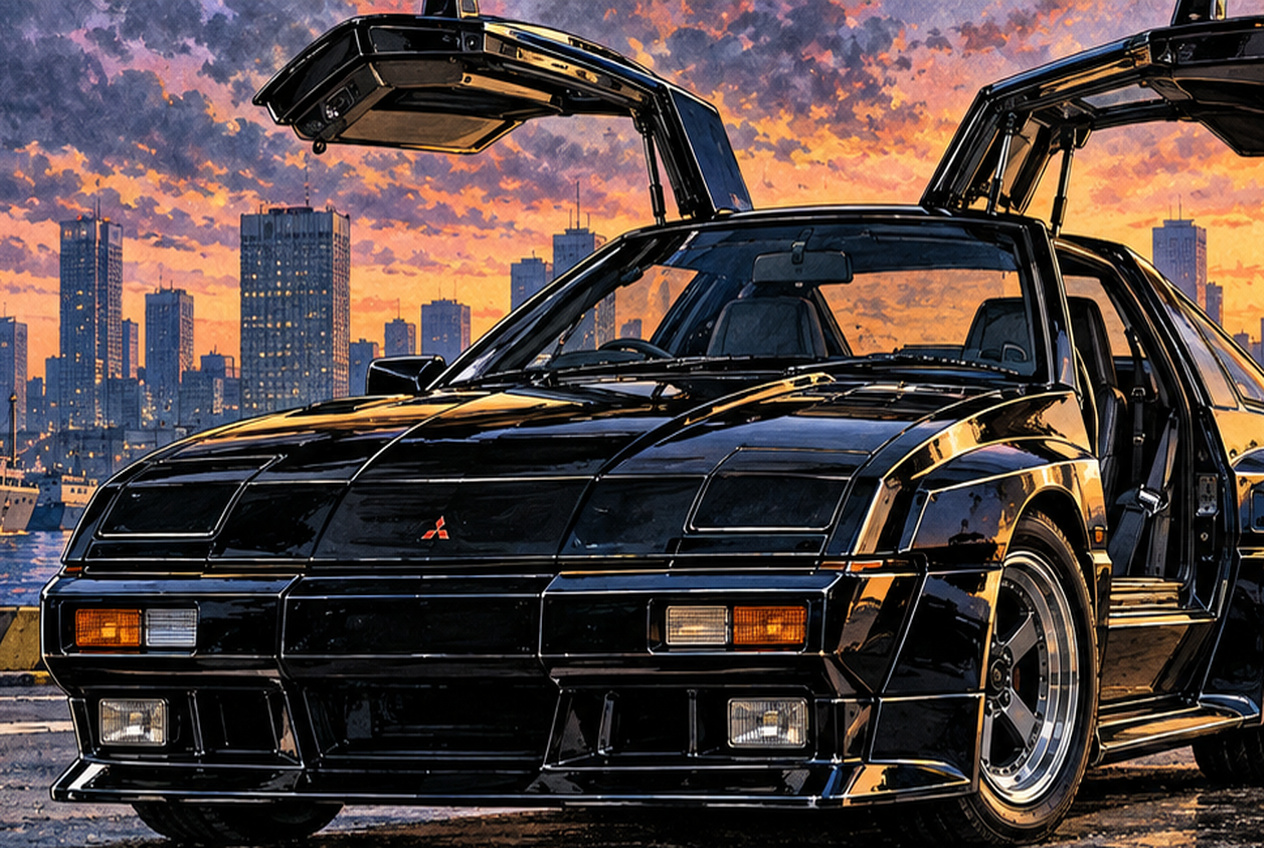
In April 1989, Japanese television viewers were introduced to an extraordinary Mitsubishi Starion. It appeared in Gorilla: Metropolitan Police Department Investigation Unit 8, a detective drama produced by Ishihara Productions.
The car was a black, wide-bodied Starion with doors that rose dramatically into the air. Known in the series as “G2,” it was driven by detective Ken Date, played by Japanese actor Hiroshi Tachi.
It looked like something built exclusively for television. Except Mitsubishi also offered a road-going gullwing version to private customers later that year, with reservations limited to just five cars.
That is already an unusual story. But the specifications in the original sales material reveal something even stranger.
Converting the Starion to gullwing doors reduced its seating capacity from five to two, increased its weight by 230 kg, and shortened its published interior length by 620 mm.
Why did making the doors open upward require such dramatic compromises? I went back to the period sales documentation and compared the publicly offered conversion with the television car that inspired it.
Not Seibu Keisatsu: This Starion Came from a Different Detective Drama
To understand the Starion G2, it helps to know a little about Japanese television car culture in the 1980s.
Ishihara Productions was famous for the action-packed police series Seibu Keisatsu, or Western Police, which featured extensively modified Nissan vehicles. One of its most memorable machines was the gullwing-equipped Nissan Fairlady Z known as the Super Z.
But the Mitsubishi Starion belonged to a later production: Gorilla: Metropolitan Police Department Investigation Unit 8, which began airing in April 1989.
For this series, Mitsubishi supplied vehicles including the Galant VR-4, Debonair V, and Pajero. Among them was the remarkable black Starion, identified as the special vehicle G2.
Its mechanical foundation was the Starion 2600 GSR-VR, introduced to Japan in April 1988. The production version featured a 2,555cc G54B turbocharged inline-four producing 175 PS, driving the rear wheels.
That distinction matters. The television car was not based on the limited-production 2.0-liter GSR-VR introduced in 1987, nor was it related mechanically to the experimental 350 PS Starion 4WD rally prototype discussed elsewhere in this series.
According to the historical material published by Miki Press, Mitsubishi’s special-vehicle division worked with Ishihara Productions staff to create the television machine.
The gullwing doors were only part of its appeal. The drama also featured command-and-control communications, early-warning equipment, weapons-control systems, and other extraordinary technologies associated with the G2.
Some belonged to the fictional world of the television series rather than functioning as the real-world equipment their names suggested.
Only Five in the World? That’s Not What the Original Sales Offer Proves
The gullwing Starion is often described as a five-car limited edition.
That description is broadly correct for the public sales offer, but it does not establish how many gullwing Starions were ultimately built.
The period sales notice reproduced by Miki Press specifies that the special edition was offered through Mitsubishi Galant dealerships and Car Plaza dealerships in the Tokyo area.
Applications were accepted from August 21 through September 30, 1989, with delivery scheduled for approximately four months after the application period ended.
Counting both the opening and closing dates, that was a 41-day reservation window.
In other words, Mitsubishi offered a spectacularly unusual specialty coupe through a narrowly defined dealer network, with just five reservation slots available over 41 days.
There is an important catch, however.
The sales notice does not establish the total number of vehicles constructed for filming, nor does it conclusively document every privately converted car or prove that all five public orders resulted in deliveries.
“Five cars offered for public reservation” is not the same claim as “only five examples ever existed.”
That may sound like a minor distinction, but for collectors and automotive historians, it is exactly the kind of detail that separates a documented production claim from a legend repeated so often that it starts to sound official.
The Price of Gullwing Doors: Three Seats Lost and 230 kg Added
The really interesting part begins when we compare the original Mitsubishi sales material for the gullwing version with the standard Starion 2600 GSR-VR’s published specifications.
The result is a much bigger transformation than a simple door conversion.
| Specification | Standard 2600 GSR-VR | Gullwing Version |
|---|---|---|
| Seating capacity | 5 | 2 |
| Vehicle weight | 1,320 kg | 1,550 kg |
| Published interior length | 1,590 mm | 970 mm |
| Door operation | Conventional side-hinged | Electro-hydraulic |
| Door locking | Conventional system | Electromagnetic |
| Door opening/closing time | Not applicable | Approx. 4–4.5 seconds |
Note: Gullwing specifications are from the 1989 public sales notice reproduced by Miki Press. The standard car’s 1,320 kg weight refers to the five-speed manual version. The figures describe the publicly offered conversion, not every modification made to the television prop.
Let’s put those numbers into perspective.
First, the weight increase:
(1,550 − 1,320) ÷ 1,320 × 100 = approximately 17.4%
The gullwing model was 230 kg heavier, an increase of roughly 17.4% over the standard car.
Now look at the interior length:
(1,590 − 970) ÷ 1,590 × 100 = approximately 39.0%
The published interior length fell by 620 mm, or about 39.0%.
That does not mean front-seat legroom literally decreased by 39%. Japanese vehicle specifications use a defined interior-length measurement, and a change in that figure must not be confused with an equal percentage reduction in every part of the cabin.
But the disappearance of three seating positions was unmistakable. The gullwing conversion transformed a five-seat grand tourer into a two-seat specialty vehicle.
There is also a useful performance calculation.
If we assume that the converted car retained the standard engine’s 175 PS output, the published power-to-weight ratio changes as follows.
| Calculation | Standard GSR-VR | Gullwing Version |
|---|---|---|
| Assumed maximum power | 175 PS | 175 PS |
| Vehicle weight | 1.320 tonnes | 1.550 tonnes |
| Power-to-weight ratio | 132.6 PS/tonne | 112.9 PS/tonne |
Under that assumption, the power-to-weight ratio falls by approximately 14.8%.
The gullwing conversion was not an exercise in extracting more performance. It substantially changed the car’s weight, cabin layout, and theoretical performance-to-weight balance.
Of course, these figures alone do not establish how much slower the converted car was in real-world acceleration. No directly comparable acceleration tests or complete gearing and performance measurements were verified for this calculation.
Nor can we attribute all 230 kg of additional weight to the door mechanism itself. The available material does not provide a component-by-component weight breakdown.
What the numbers do establish is that the conversion involved far more than replacing a pair of hinges.
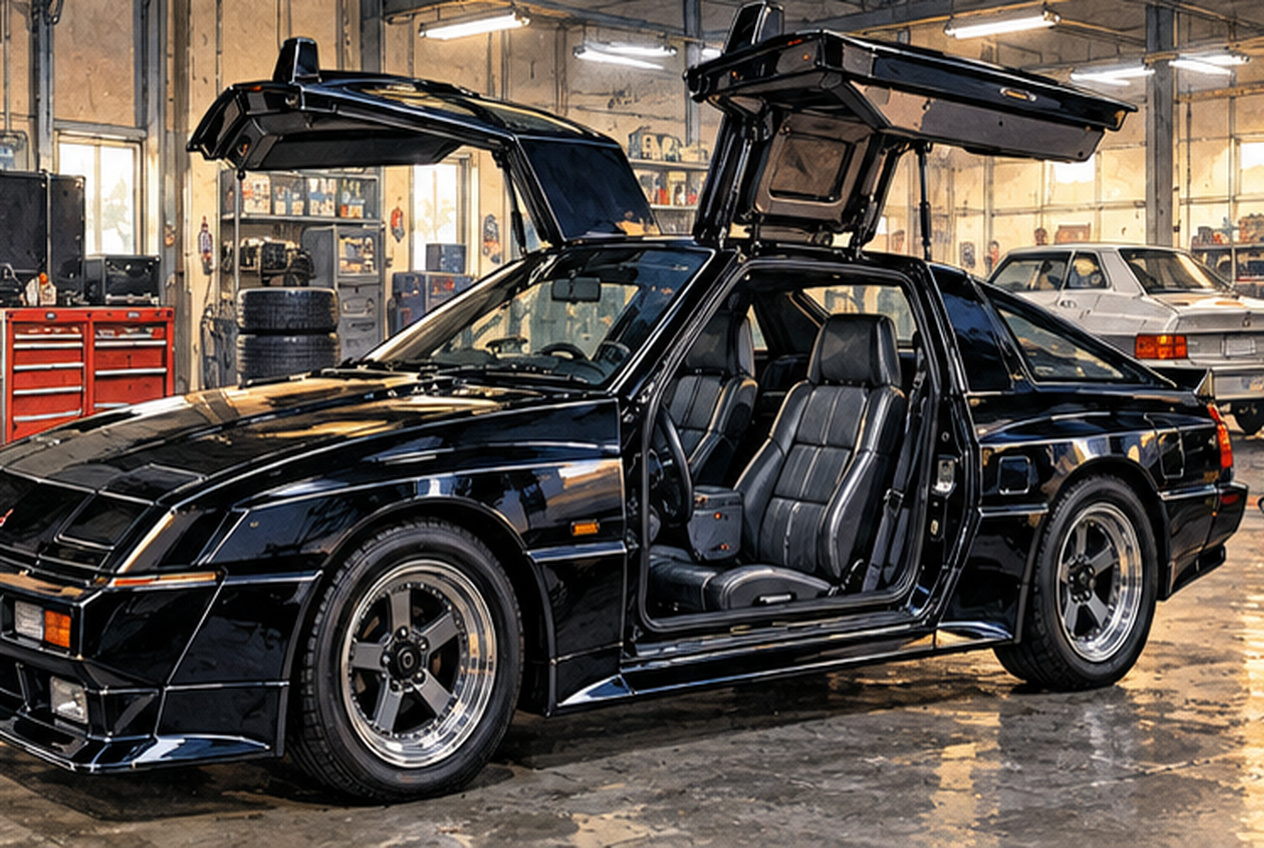
AI-generated artistic interpretation of the 1989 gullwing Starion. The illustration emphasizes the raised doors and two-seat layout. Details such as the wheels, front spoiler, and door-support structure differ from the actual vehicle. This is not an engineering drawing.
Why the Conversion Could Never Be Just a Door-Swap
The visual appeal of the Starion G2 was obvious: its doors rose dramatically into the air, taking part of the roof structure with them.
But that meant the conversion had to address how those unusually large moving panels were supported, powered, and locked. The surrounding body structure also needed attention.
Period and later examinations of the surviving television vehicle document reinforcement around the side-sill structure and hydraulic cylinders used to operate the doors.
The rear seating area was repurposed to accommodate equipment for the hydraulic opening system. The conversion therefore affected the interior layout as well as the outer body panels.
This was not a five-seater with upward-opening doors attached as an afterthought.
The television car was still in existence when Holiday Auto examined it in December 2018. The vehicle was being maintained by Murayama Shoji, a company involved in the care of Ishihara Productions’ special vehicles.
The published report noted that the left-hand door had become manually operated by the time of the visit, although the vehicle was otherwise described as being in impressive condition.
That observation belongs specifically to the 2018 inspection. It does not prove that the original conversion was defective, nor does it establish the car’s present mechanical condition.
For a machine originally developed for television spectacle, surviving long enough to receive that kind of detailed mechanical inspection is itself an important part of its history.
The TV Starion G2 Was Not the Same as the Customer Version
There is another distinction that often disappears when photographs of the gullwing Starion circulate without much explanation.
The G2 featured in Gorilla was portrayed as a highly sophisticated police vehicle. Its cabin incorporated monitors, specialized communications equipment, switches, and other electronic devices.
Published accounts of the surviving television prop also describe equipment including radio systems and an automotive fax machine. The drama added fictional functions involving radar, surveillance, and weapons control.
The road-going gullwing version offered to private buyers was a different proposition.
According to the 1989 sales material, customers did not receive the television car’s elaborate array of special devices. The publicly offered cars retained ordinary production-style equipment apart from the specified conversion.
In other words, a private buyer could order a two-seat Starion with those extraordinary upward-opening doors, not the entire collection of secret-agent hardware seen in the drama.
That is a significant distinction. Without it, fictional weapons systems and television props can easily be mistaken for equipment fitted to genuine customer cars.
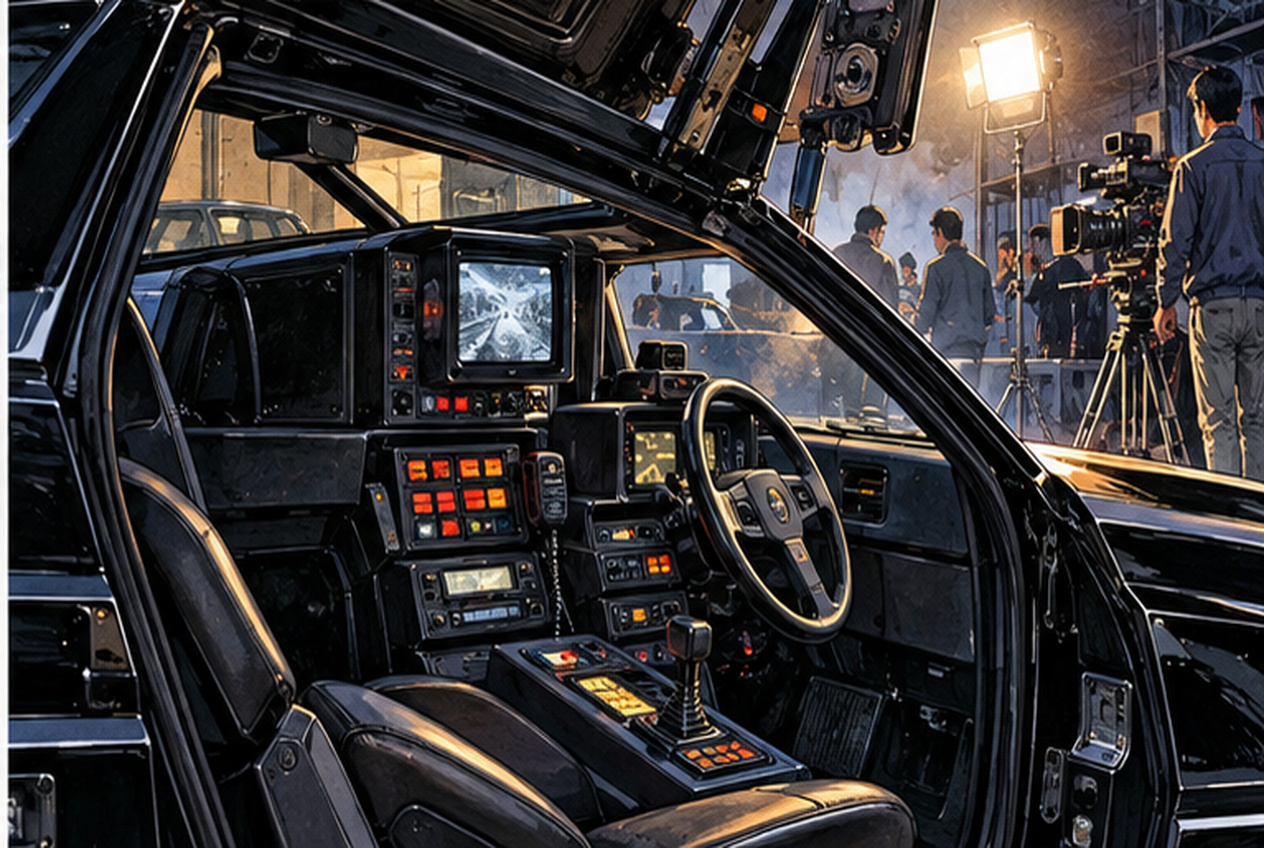
AI-generated illustration inspired by the special equipment seen in Gorilla: Metropolitan Police Department Investigation Unit 8. The positions and designs of the monitors, communications devices, and controls do not faithfully reproduce the original television vehicle. The filming set and crew are fictional. These special devices were not included in the publicly offered gullwing conversion.
Why Go This Far with a Starion Near the End of Its Production Life?
The standard Starion 2600 GSR-VR reached the Japanese market in April 1988. Gorilla began broadcasting the following year, and the limited gullwing sales offer opened in August 1989.
GAZOO’s model records place the end of the relevant Japanese Starion sales period in February 1990.
That makes the timing especially interesting.
Mitsubishi was not introducing a radical new body style at the beginning of a model’s life. It was giving an established sports coupe, already approaching the end of its Japanese-market run, one last remarkably theatrical identity.
There is another way to interpret the project.
Rather than treating the gullwing Starion merely as a custom television prop, it can be viewed as a small, unusually ambitious promotional venture connecting a television production, Mitsubishi’s special-vehicle expertise, and its retail dealer network.
The television appearance created the spectacle. The limited public offer allowed a handful of potential buyers to order a version of that spectacle for the road.
That interpretation fits the timing and sales arrangement, but there are limits to what can be established.
I have not found verified figures showing the project’s development cost, profitability, or measurable effect on ordinary Starion sales. Those questions remain unanswered.
What is documented is that, near the end of its production life, the Starion was transformed into a car intended to attract attention for reasons quite different from horsepower or outright speed.
Editor’s Note
When I think of Ishihara Productions’ black Starion, the first image that comes to mind is the gullwing door rising into the air, followed by Hiroshi Tachi stepping out.
It’s a great piece of automotive theater.
But the number I couldn’t get past was 230 kg.
Here was a perfectly respectable 2.6-liter turbocharged grand tourer. Then somebody decided its doors needed to open like something from an exotic supercar. The result gained all that weight and lost three seats.
If you were engineering an ordinary performance coupe, wouldn’t you normally be trying to do the opposite?
And then there’s the sales offer: just five reservation slots, available over 41 days, through selected Mitsubishi dealerships. This wasn’t simply a workshop building an eccentric one-off. Someone went to the trouble of turning a television fantasy into an actual retail product.
I can make a perfectly sensible argument that the standard GSR-VR was the better choice for someone interested primarily in driving performance. It was lighter, retained its rear seats, and didn’t require the complications of powered gullwing doors.
But if I were standing beside the converted car, watching those enormous doors rise over four seconds or so, I’m not sure I’d care about any of that.
There’s something wonderfully excessive about going to so much trouble for a feature that makes virtually no practical sense.
And the fact that Mitsubishi was willing to offer it to ordinary customers, however briefly, is what makes this particular piece of late-1980s automotive history so difficult to forget.
Mitsubishi Starion $2014 5-Article Series
From its 1982 origins and DASH engine to the rare GSR-VR, the ambitious 4WD rally project, and a gullwing special: four main articles and one special feature.
- Part 1: The 1982 Mitsubishi Starion Was Meant to Be Smaller—Until Chrysler Stepped In
- Part 2: Why Did Mitsubishi’s 200 PS Starion Shut Off an Intake Valve?
- Part 3: Why Did Mitsubishi Give the Starion GSR-VR a 2.6L Engine for Just 5 More PS?
- Final Part: The “Phantom” Mitsubishi Starion 4WD: 350 PS, No Group B Approval—and a Second-Place Rally Finish
- Special: Why Did a Gullwing Conversion Add 230 kg? The Mitsubishi Starion G2 Mystery
References
- Miki Press M-BASE — Mitsubishi Starion, Part 2 (Japanese-language automotive history feature reproducing period documents. Includes the 1989 five-car reservation offer, application dates, seating capacity, vehicle weight, interior dimensions, door mechanism, and differences between the television prop and publicly offered conversion).
- Car Sensor — Vehicles Featured in the Detective Drama Gorilla: Metropolitan Police Department Investigation Unit 8 (Japanese-language feature discussing the series, Mitsubishi’s vehicles, and the Starion G2’s role and specifications).
- Web Motor Magazine / Holiday Auto — Revisiting Mitsubishi’s Gullwing Starion and Eclipse (December 10, 2018. Contemporary inspection of surviving Ishihara Productions television vehicles, their maintenance, and the operating condition of the Starion’s doors).
- Hachimaru Hero / Nostalgic Hero — The Gullwing G-II, Part 2: Special Equipment Inside the Mitsubishi Starion 2600 GSR-VR (Originally published in the September 2017 issue, subsequently made available online in Japanese. Documents the rear-seat hydraulic equipment, monitors, communications devices, and specialized television-prop interior).
- Car Sensor — Mitsubishi Starion 2.6 GSR-VR Specifications (Japanese-market production specifications, including the standard car’s 1,320 kg weight, five-seat layout, 1,590 mm interior length, and 175 PS G54B engine).
- GAZOO — Mitsubishi Starion, April 1988–February 1990 (Japanese-language historical model guide covering the 2.6-liter GSR-VR, equipment, specifications, and listed production-model period).
- Mitsubishi Motors — Vehicle History: Starion (Official manufacturer historical reference).