

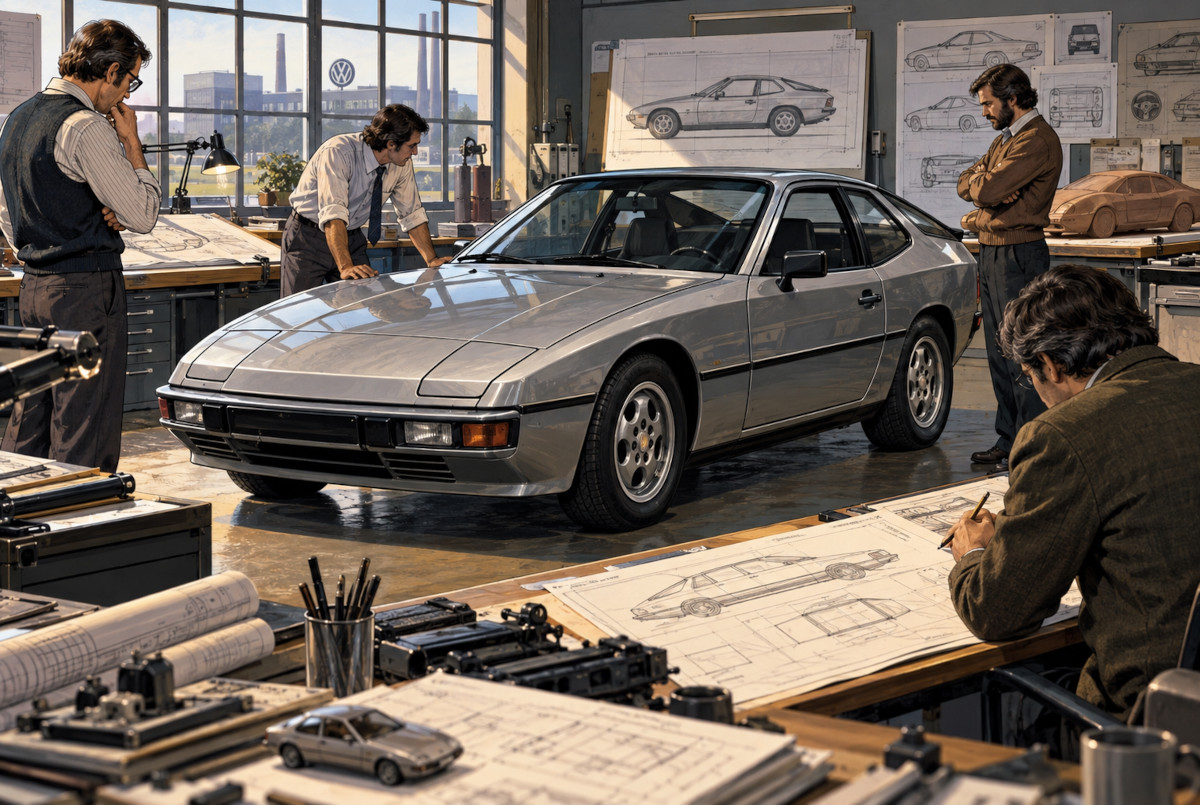
The Porsche 924 arrived as the entry-level successor to the 914, but its family tree is even more complicated. It had neither a rear-mounted engine nor a flat-four or flat-six. Instead, there was a water-cooled inline-four up front. The engine was Audi-derived, and the car itself was assembled at an Audi plant. Most strangely of all, the 924 was not originally commissioned to become a Porsche at all.
If you grew up with old-school import-car magazines, that specification sheet almost invites the obvious reaction: “And this was supposed to be a Porsche?” But the deeper you dig, the less convincing the familiar story becomes. The 924 was not simply a discarded Volkswagen with a Porsche badge stuck on the nose. Instead, it raises the same awkward question as the 912 and 914 before it: what, exactly, makes a Porsche a Porsche?
The Other Porsche — 6-Part Series
Not every Porsche followed the 911 formula. From the four-cylinder 912 and VW-linked 914 to the 924, 944, 968 and the later mid-engine generation, this six-part series traces the strange history of Porsche's more accessible sports cars.
- Part 1: Four-Cylinder Porsches and a VW-Powered 914 — Were the 912 and 914 Really “Fake” Porsches?
- Part 2: Porsche 924: The VW Project That Became a Porsche
- Part 3: In preparation Coming soon
- Part 4: In preparation Coming soon
- Part 5: In preparation Coming soon
- Final Part: In preparation Coming soon
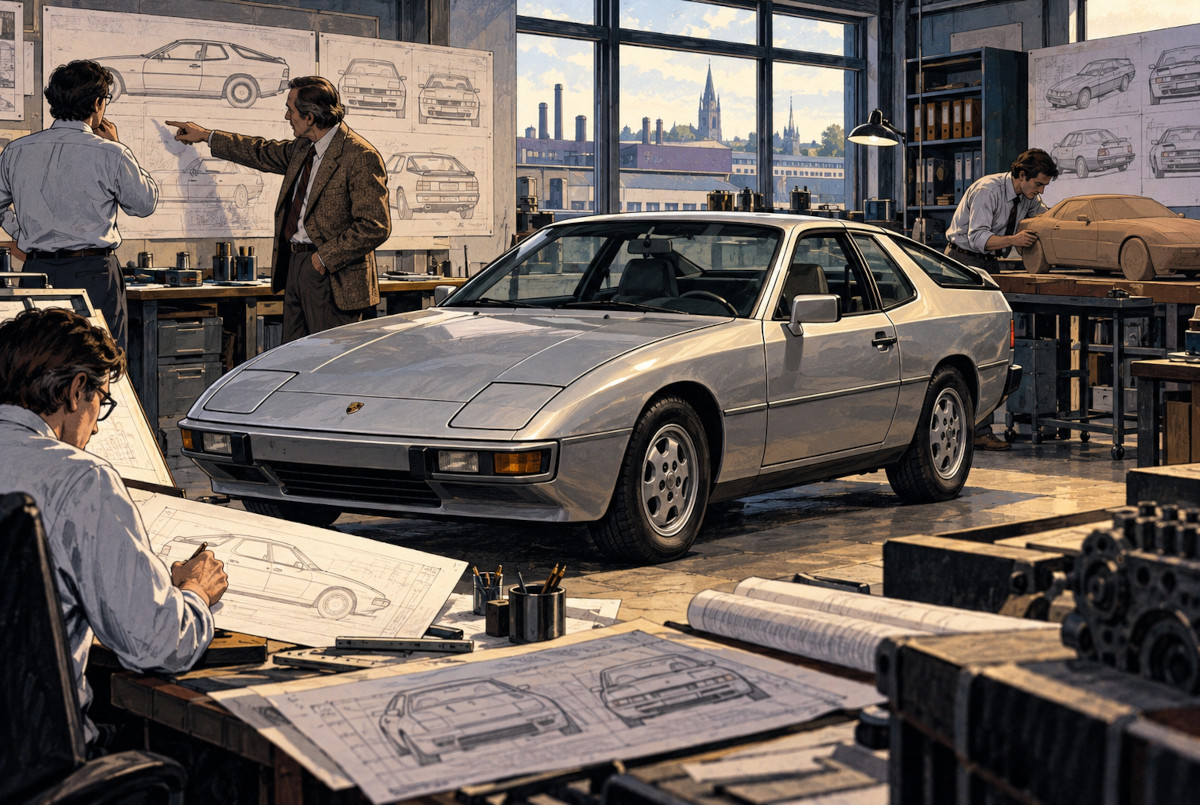 AI-generated development illustration. It does not reproduce the actual EA 425 development studio or a specific prototype.
Calling It a “Rejected VW Project” Misses Half the Story
The 924 began as EA 425, a development project commissioned by Volkswagen and assigned to Porsche. It was intended as the successor to the 914 and, at that stage, was expected to be sold as a Volkswagen. But during the mid-1970s, the market changed. The energy crisis hurt demand, Volkswagen was reshaping its model strategy, and it already had the Golf-based Scirocco as a sporty coupe. VW eventually cancelled EA 425.
That makes it tempting to say Porsche simply picked up a Volkswagen project that nobody wanted. The important detail is that Porsche had been designing and developing EA 425 from the beginning. Volkswagen was the client; Porsche was the engineering company. By the time VW withdrew, the project was already far advanced. Porsche assumed the development costs and acquired the project for itself. In effect, Porsche bought back the car it had been developing for Volkswagen and turned it into its own product.
An Audi-Derived Engine, Built in an Audi Factory
When the 924 reached production in 1976, almost every line on the specification sheet looked strange next to a 911. Early European-market cars used a 2.0-liter, water-cooled inline-four producing 125 PS. Porsche’s own historical material describes the engine as being derived from the Audi 100 and modified for the 924. Final assembly took place not at Porsche’s Zuffenhausen plant, but at Audi’s factory in Neckarsulm, Germany.
Put those facts together and the car sounds almost deliberately provocative: commissioned by Volkswagen, powered by an Audi-derived engine, and assembled in an Audi factory—yet wearing a Porsche badge. It is not difficult to understand why the 924 acquired a reputation in some enthusiast circles as a “cheap Porsche” or an Audi in Porsche clothing.
But that description goes too far in the other direction. Porsche was responsible for the vehicle’s development, calibration and overall driving concept. The 924 was not simply an existing Audi or Volkswagen model with different badges.
There is also the old story that the 924 used “a Volkswagen van engine.” That claim has a grain of truth because engines from the same basic family were also used in the Volkswagen LT commercial vehicle. But saying Porsche simply dropped a van engine into the 924 is a much more dramatic story than the engineering history actually supports.
Engine in Front, Gearbox in Back — This Part Was Very Much Porsche
The more important feature of the 924 was arguably not where its engine came from, but where Porsche put the major components. The engine sat up front while the transmission was mounted at the rear axle, connected by a shaft. This transaxle arrangement helped distribute mass more evenly instead of concentrating the complete drivetrain at the nose.
Porsche did not invent the transaxle layout; other manufacturers had used similar arrangements before. What mattered was that Porsche adopted it as the foundation of an entirely new family of front-engine sports cars. Former Porsche test driver Roland Kussmaul later highlighted the 924’s balance, forgiving handling and high-speed stability. Porsche may have used existing components to control costs, but it did not cheapen the thinking behind how the car should drive.
More Than 150,000 Cars for Something That “Wasn’t a Real Porsche”
The production numbers make it difficult to dismiss the 924 as a failed experiment. Across its derivatives, more than 150,000 examples were built between 1976 and 1988. Porsche notes that this was close to the number of 911s built over the same period, and the company now describes the 924 as an important contributor to its commercial success during a period of transition.
It would be an exaggeration to claim that the 924 single-handedly “saved Porsche.” But it clearly expanded the brand beyond customers who could or wanted to buy a 911, and it became one of the company’s important volume cars. The supposedly “un-Porsche-like” Porsche ended up doing a remarkable amount of business for Porsche.
The Cheap Entry Model Eventually Reached 210 PS
Porsche did not leave the 924 frozen in its original entry-level role. A Turbo followed, and the 1980 924 Carrera GT took the 2.0-liter turbocharged four-cylinder to 210 PS, with a claimed top speed of 240 km/h. What had begun as a Volkswagen-commissioned sports-car project had evolved into a motorsport homologation special.
Then came an even stranger twist. At the 1981 24 Hours of Le Mans, Walter Röhrl and Jürgen Barth drove the 924 GTP Le Mans to seventh overall. Porsche now openly describes that car as essentially a prototype for the future 944. Beneath its 924 identity was a newly developed 2.5-liter engine being tested in competition before the 944 reached customers.
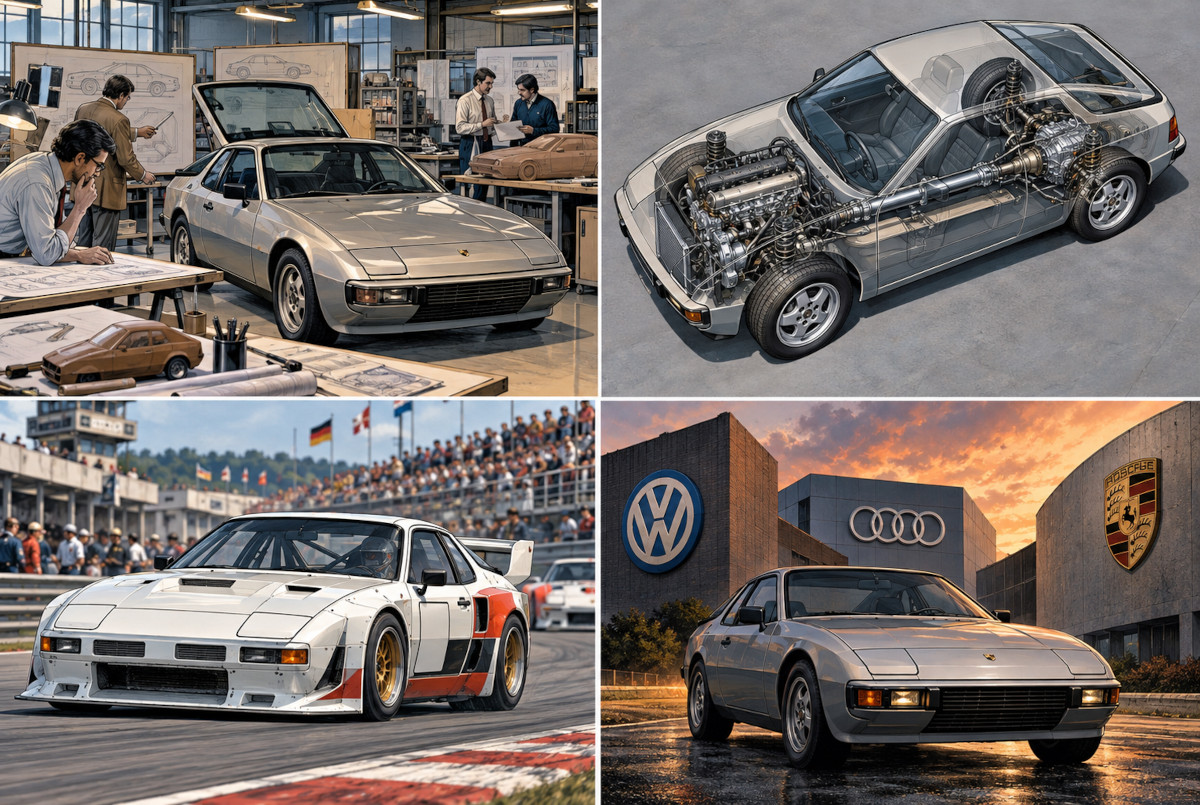 AI-generated conceptual illustration. The mechanical cutaway is explanatory rather than an official Porsche technical drawing, and the depicted corporate locations do not represent an actual site.
The 924 Was Not a Fake Porsche — It Was Partway to Becoming the 944
By the end of the story, the irony becomes almost too neat. The 924 S finally received Porsche’s own 2.5-liter four-cylinder from the 944. The car had started as Volkswagen’s EA 425 project, became a Porsche with an Audi-derived engine, evolved into the line that produced the 944, and then ended its life using the 944’s Porsche-built engine.
Seen in that sequence, calling the 924 “Volkswagen leftovers” simply does not explain enough. It was not originally meant to wear a Porsche badge, but Porsche had designed it from the beginning. Once Porsche took ownership of the project, it developed the concept far enough to become the foundation of the 944. Its origins were unconventional. Its engineering career was not fake.
And the next chapter gets even stranger. With the 944, Porsche replaced the Audi-derived heart with a Porsche-developed engine and kept pushing the performance upward. Eventually, the supposedly lower-ranking front-engine Porsche would reach a point where describing it simply as “the model below the 911” became increasingly difficult.
Editor’s Note
If I look at the 924 through the eyes of the old import-car magazines I grew up with, the jokes almost write themselves. Audi-derived engine, Audi factory, Volkswagen origins—and then somebody puts a Porsche crest on the front. You can understand why some enthusiasts treated it as the bargain-bin Porsche.
But the part that keeps bothering me is this: who actually designed the thing? Once you ask that question, the easy joke starts falling apart. Porsche developed the car from the beginning. Volkswagen happened to be the original customer.
Then it sold more than 150,000 units, evolved into the Carrera GT, helped test what would become the 944, and eventually received the 944’s Porsche-built engine itself. Car enthusiasts love talking about “bloodlines,” but perhaps the more interesting question is what the engineers actually did with the ingredients they were given. The 924 is fascinating precisely because that boundary is such a mess.