
In 1983, the third-generation Nissan Z, the Z31, did something that looked almost unthinkable at the time: it abandoned the inline-six layout that had defined the Z since the S30 and switched to a new V6.
Then, barely two years later, Nissan put an inline-six back into the Z.
So why not keep the inline-six in the first place? Once you trace the engine lineup carefully, the answer turns out to be more interesting than “the V6 didn’t work.” Nissan actually ended up using both inline-six and V6 engines within the same Z31 generation, before simplifying everything again with the Z32. It was a strangely experimental six-year stretch in Z history.
Nissan Z — 3-Part Series
From the birth of the original S30 and its American-market mission, through the Z31 and Z32 era, to the Z33 revival and today’s Z, this three-part series traces how the Fairlady Z changed while preserving the idea behind Nissan’s long-running sports GT.
- Part 1: Was the Datsun 240Z a Jaguar E-Type Copy? Why Nissan Built It
- Part 2: Why Did Nissan Bring the Inline-Six Back to the Z31? From Z31 to Z32
- Final Part: English edition Coming soon
In 1983, the Z dropped the inline-six
The Z31 arrived in September 1983. The L-series inline-six engines used in the S30 and S130 were replaced by new VG-series V6s in 2.0-liter and 3.0-liter form. Nissan explained that the more compact V6 helped improve weight distribution and overall handling balance.
In Japan, the turbocharged VG20ET produced 170 PS, while the 3.0-liter VG30ET made 230 PS under the output measurement standards of the time. The Z31 also introduced a drag coefficient of Cd 0.31 and its distinctive parallel-rising headlights, whose lenses remained partly visible even when switched off. Mechanically and visually, the Z had suddenly entered the 1980s.
It would also be too easy to say that the V6 turned the Z into a softer grand tourer. A VG30ET-powered 300ZX entered the 1985 All-Japan Rally Championship partway through the season and still went on to win the series title. The V6 Z was not just a luxury cruiser.
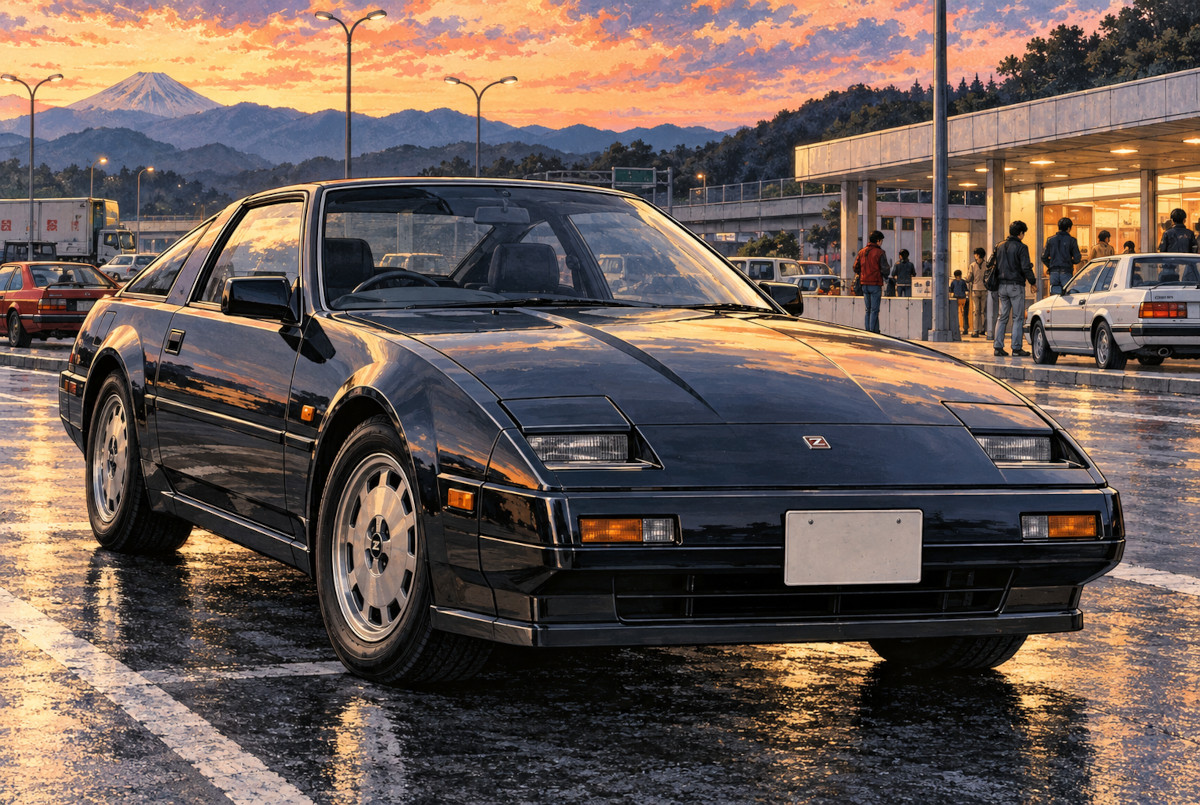
AI-generated illustration inspired by the Z31-generation Fairlady Z introduced in 1983. It does not reproduce one specific model year or factory trim in exact detail.
Then Nissan brought the inline-six back in 1985
This is where the story gets strange. In October 1985, Nissan added the 200ZR, powered by the 2.0-liter RB20DET: a turbocharged, intercooled, DOHC 24-valve inline-six producing 180 PS.
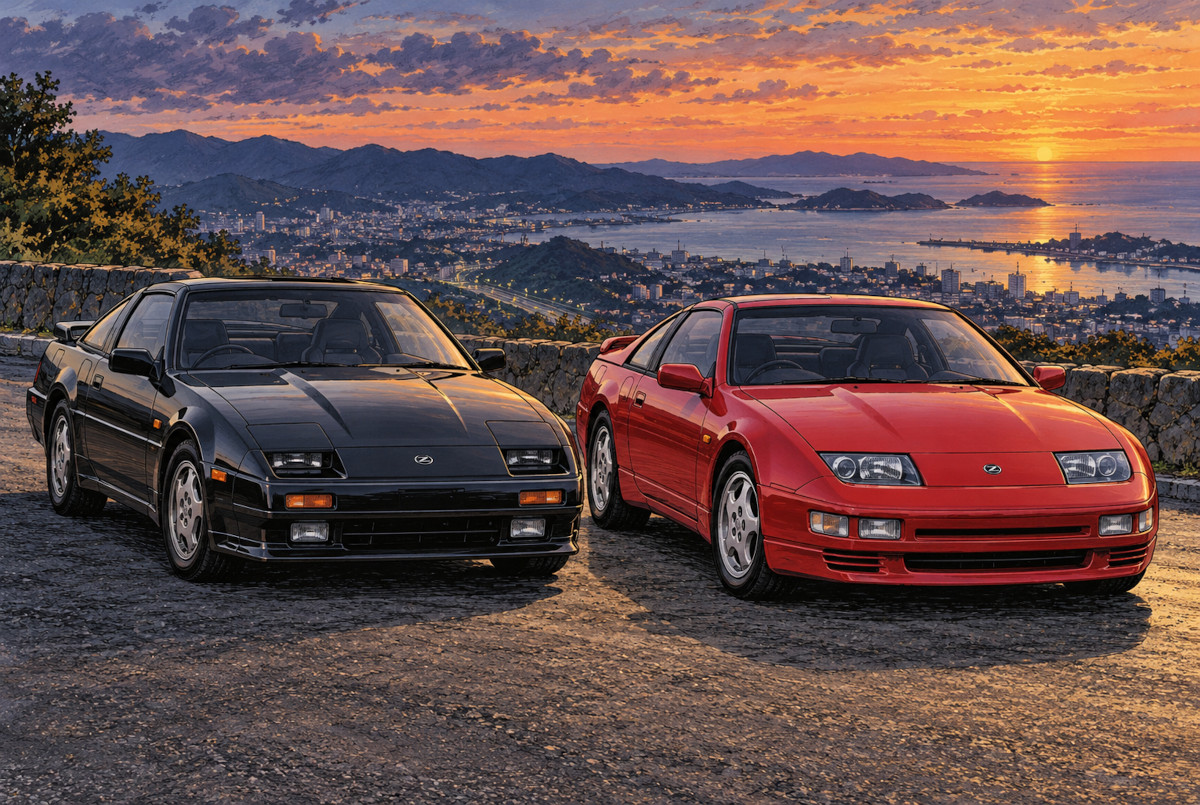
In other words, the Z had supposedly switched from an inline-six to a V6—only to get an inline-six back roughly two years later. And this was not an old L-series engine dragged out of storage. Nissan installed its new-generation RB straight-six, which was also appearing in the Skyline family.
Did that mean the VG V6 had been a mistake? The 1986 facelift suggests otherwise. Nissan consolidated the 2.0-liter performance range around the RB20DET-powered 200ZR, while the 3.0-liter side gained the 300ZR with the DOHC 24-valve VG30DE V6. The VG30DE produced 190 PS, while the VG30ET turbo remained in the lineup.
So the later Z31 was not simply “going back” to the inline-six. Nissan was effectively using the RB inline-six for the 2.0-liter sporting models and the VG V6 for the larger 3.0-liter range.
Old horsepower figures come with a trap
Look only at the numbers and the Z31 story can become confusing. The early 300ZX is listed at 230 PS, yet the later VG30ET is rated at 195 PS, while the 200ZR makes 180 PS. Did the facelift somehow make the car slower?
Not necessarily. The mid-1980s were when Japanese manufacturers were changing from gross engine-output figures to net figures measured with more of the engine’s actual accessories installed. Nissan itself noted in its 200ZR material that the newer net figures appeared roughly 15 percent lower than the older gross figures.
That means you cannot compare the Z31’s early 230 PS figure directly with the later 180 PS and 195 PS numbers at face value. It is a small technical detail, but exactly the kind of thing that can make old catalog specifications misleading if you line them up without context.
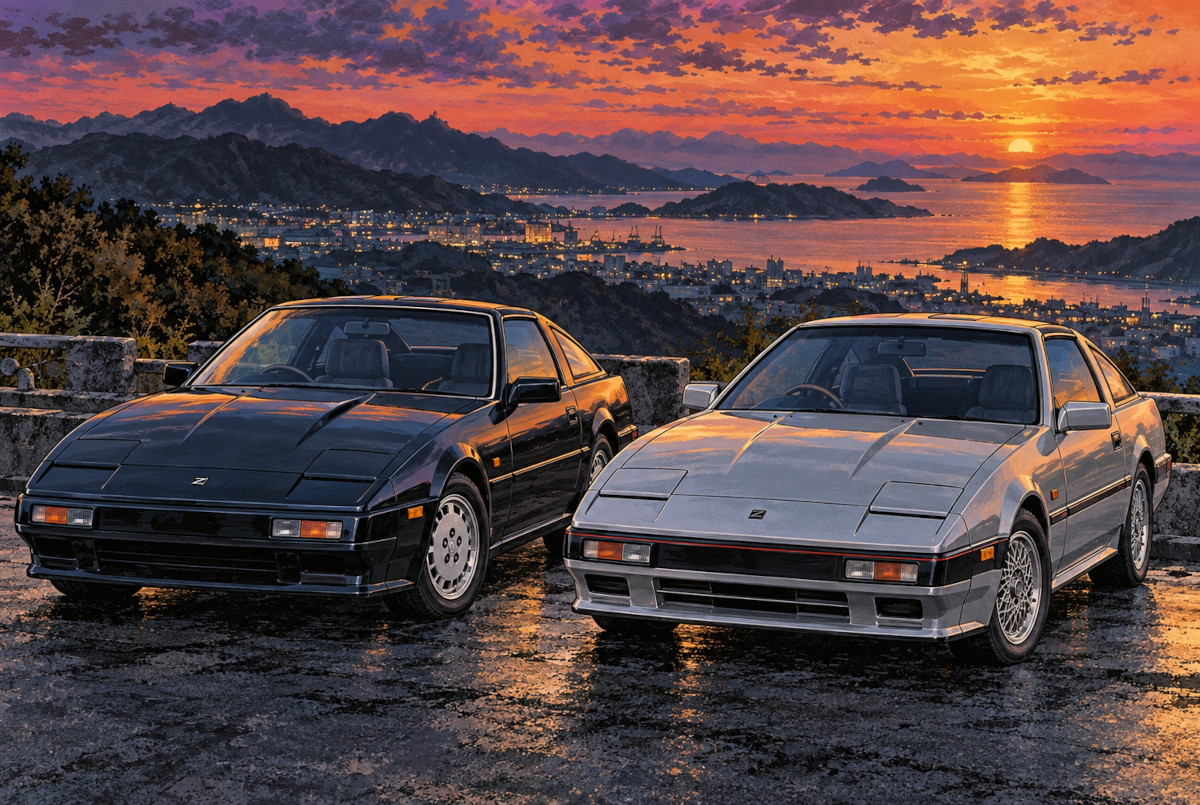
AI-generated comparison illustrating the coexistence of V6-powered and RB20DET inline-six Z31 models. Vehicle details do not reproduce one exact model year or factory specification.
With the Z32, the inline-six disappeared for good
The fourth-generation Z32 arrived in July 1989. This time, Nissan dropped the 2.0-liter engine entirely and standardized the range around 3.0-liter V6 power. The naturally aspirated VG30DE produced 230 PS, while the twin-turbo VG30DETT reached 280 PS.
The engine was not the only major change. The Z32 moved away from the long-nose proportions of the Z31 and adopted a much wider, lower body with the cabin pushed farther forward. Comparing two-seaters, Nissan’s own figures show the Z32 was 95mm shorter than the late Z31 300ZR, yet 65mm wider and 45mm lower.
So the Z32 did not simply become “bigger.” It became shorter, wider and lower. That helps explain why it suddenly looked far more like an exotic sports car than the angular Z31.
The Z32 was more than a 280 PS headline
The twin-turbo Z32 is usually remembered for its 280 PS output, but Nissan threw far more at the car than extra boost. It used four-wheel multi-link suspension, Super HICAS rear-wheel steering, and aluminum four-piston opposed front brake calipers—technology that reflected just how ambitious Nissan had become by the end of the 1980s.
The Z32 was also one of the cars associated with Nissan’s “901 Activity,” an internal effort aimed at achieving world-class dynamic performance by 1990. This was the same era that produced cars such as the R32 Skyline and GT-R and the P10 Primera. The Z32’s 280 PS was not just a product of horsepower competition; it came from a period when Nissan was seriously trying to build cars that could stand with the world’s best.
There was a cost, though: weight. An early Z31 300ZX two-seater weighed 1,325kg. A Z32 two-seater Twin Turbo with a five-speed manual weighed 1,510kg. That is an increase of 185kg, or about 14 percent.
That is a long way from the lightweight, relatively simple philosophy people often associate with the original 240Z. The Z32 made speed through power, suspension sophistication, electronics and braking hardware—not by being especially light.
AI-generated comparison illustrating the proportion change from the Z31 to the Z32. It is not a scale drawing, and the cars do not reproduce one exact factory trim in every detail.
Then, in 2000, the Z disappeared
The Z32 remained in production for more than a decade, from 1989 until production ended in August 2000. For the first time, the Fairlady Z line went quiet.
But it would be too neat to say the Z died simply because it had become too heavy or too complicated. Nissan itself was going through major corporate restructuring, while the Z32 had already become an unusually long-lived model. There is not enough evidence to blame its disappearance on high performance alone.
What is more interesting is that Nissan had already been experimenting with the idea of a smaller next-generation Z before the Z32 disappeared.
Nissan’s Heritage Collection preserves one such Z33 advance-study prototype from the mid-1990s. It was based on the S14 240SX/Silvia platform, used a 2.4-liter KA24DE four-cylinder tuned to 200 PS, and repositioned the engine in a front-midship layout. Nissan also records that Yutaka Katayama drove the car at its Tochigi proving ground in 1997.
So while the production Z had reached 280 PS with a twin-turbo V6, Nissan was simultaneously asking whether the next Z could be smaller, lighter in concept and mechanically simpler.
Then, in 2002, the Z finally returned. But that is the next chapter.
Editor’s Note
I used to remember the Z31 simply as “the generation where the Z went V6.” Then I looked more closely and found Nissan deliberately putting an RB inline-six back into the same generation. That is the part that stuck with me.
If preserving the inline-six was what made a Z a Z, why drop it in the first place? And if the V6 was clearly the better answer, why bother bringing the RB into the Z31 at all? My impression is that Nissan in this period was less interested in protecting tradition than in trying whatever seemed useful.
That experimentation eventually produced the Z32: 3.0-liter twin-turbo V6, 280 PS, sophisticated suspension, rear-wheel steering, serious brakes—the full late-1980s Nissan technology buffet. At the same time, by the mid-1990s the company was already experimenting with a much smaller four-cylinder successor. You could call that inconsistent. You could also call it a company still arguing with itself about what a Z was supposed to be. Either way, that near-chaotic willingness to try things feels very Nissan of the late Showa and early Heisei years.
References
- Nissan Heritage Collection — Nissan 300ZX Turbo T-Bar Roof 50th Anniversary
- Nissan Heritage Collection — Fairlady Z 300ZX, 1985 All-Japan Rally Championship Winner
- Nissan FAIRLADY STORY — Z31 200ZR
- Nissan FAIRLADY STORY — 200ZR-1 Specifications
- Nissan FAIRLADY STORY — Z31 Refinement and Engine Lineup
- Nissan Heritage Collection — Fairlady Z 2by2 300ZX Twin Turbo
- Nissan FAIRLADY STORY — Z32 Body and Proportions
- Nissan FAIRLADY STORY — Z32 300ZX Specifications
- Nissan — Legendary Cars, Cars of the Future #06
- Nissan Heritage Collection — Fairlady Z Z33 Advance Study Vehicle
- Nissan Heritage Collection — Fairlady Z Version ST