

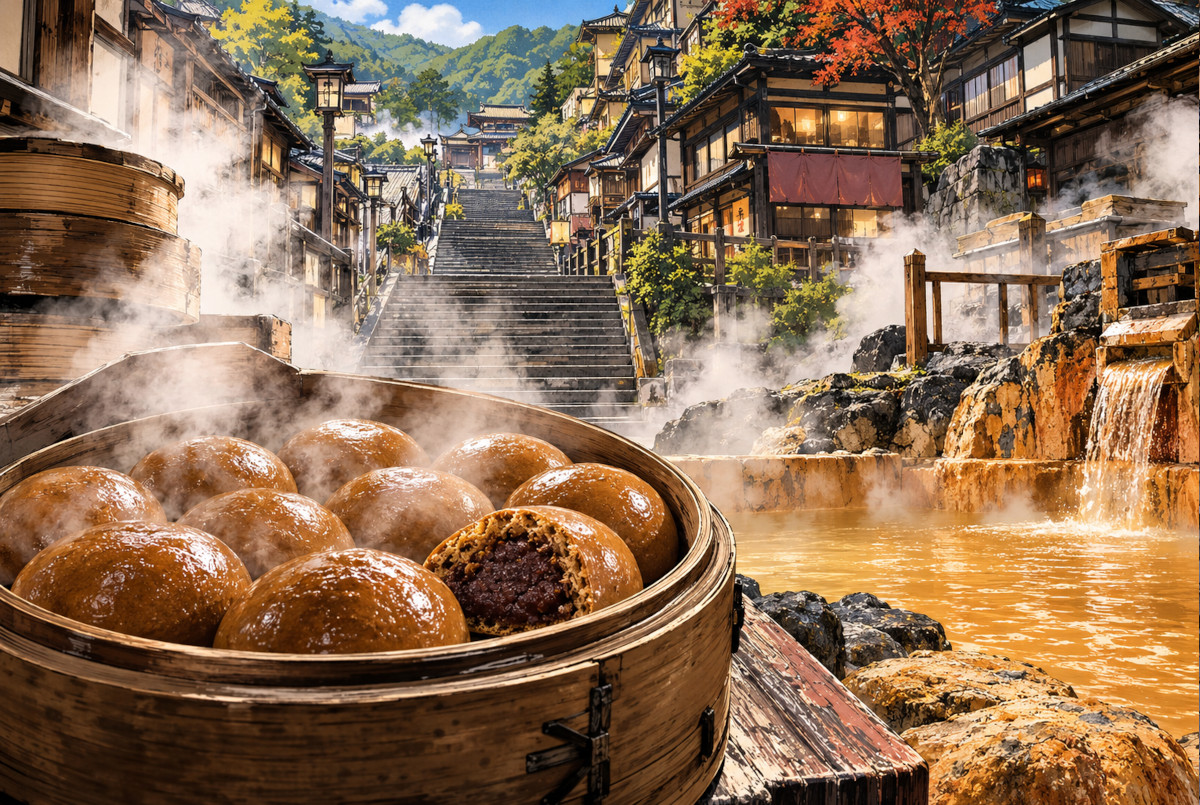
You visit a hot-spring town. You take a bath. On the way home, you stop at a souvenir shop. Then you buy a box of small brown buns filled with sweet red-bean paste.
In Japan, they are called onsen manju—literally, “hot-spring manju.” You see something remarkably similar in Kusatsu, Hakone, Atami, and countless other hot-spring resorts.
Of course, the recipes are not all identical. The dough, filling, sweetness, and production methods vary from shop to shop. But there is still an awkward question worth asking: are people buying them because they genuinely want the manju, or because a trip somehow feels incomplete unless they come home carrying a souvenir box?
Do we really need the souvenir—or are we paying for the habit of believing that every trip requires one?
The familiar brown onsen manju is commonly traced back to Ikaho
One name frequently cited in the origin story of modern onsen manju is Shogetsudo, a confectionery in Ikaho Onsen, Gunma Prefecture.
According to Shogetsudo, its founder Katsuzo Handa opened the shop in 1910 after training in Tokyo. A local elder asked him to create a souvenir that Ikaho could be proud of. After months of experimentation, Handa developed what became known as Yunohana Manju.
The important detail is the color.
The bun’s brown sugar dough was designed to resemble the brownish color associated with Ikaho’s mineral-rich hot-spring deposits. In other words, that familiar brown exterior was not originally a generic visual shorthand for “Japanese hot spring.” It was meant to evoke one particular hot-spring town.
At the beginning, this was not a standardized souvenir waiting to be reproduced across the country. It was a strongly local product whose appearance referred directly to Ikaho.
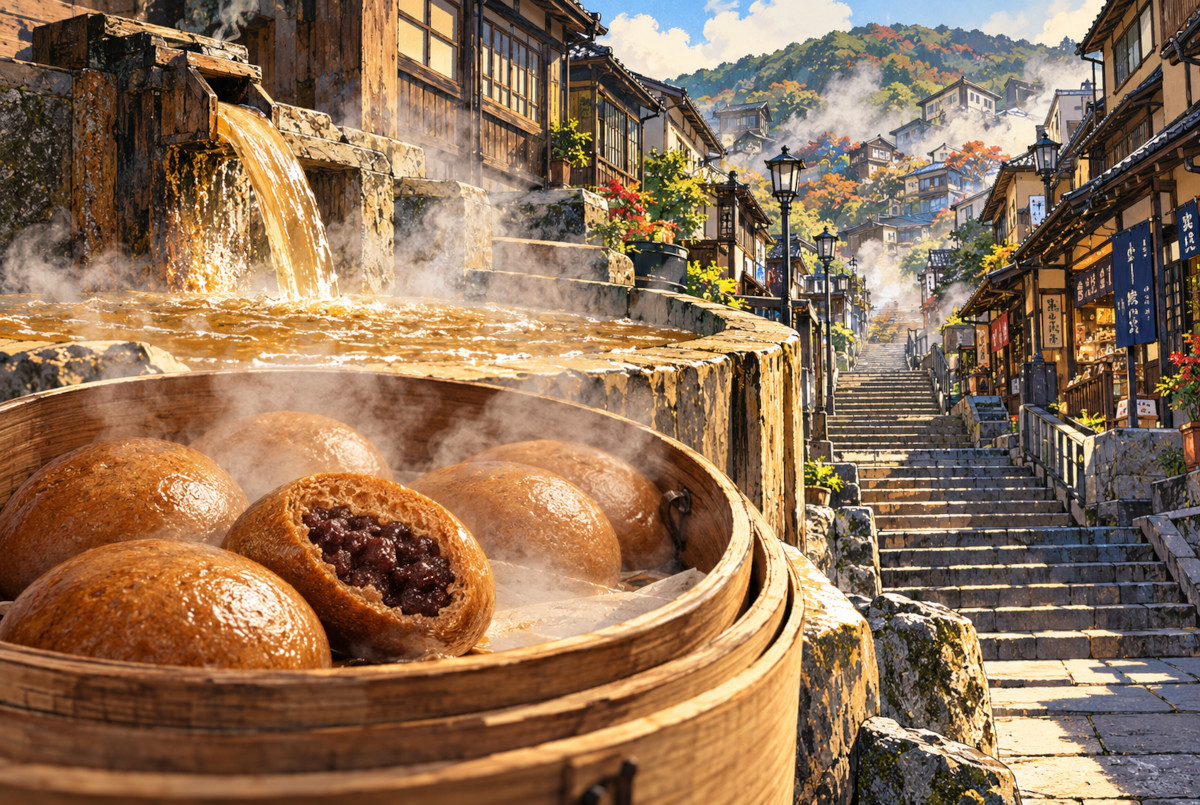 AI-generated illustration. It does not reproduce the actual scenery of Ikaho Onsen, Shogetsudo’s shop, or its historical production process.
Shogetsudo also says that in 1934, during an Imperial Japanese Army special exercise held mainly in Gunma Prefecture, the prefectural government presented Yunohana Manju to Emperor Showa. The shop credits the resulting word of mouth and newspaper coverage with helping the confection become widely known, after which similar brown manju began appearing in hot-spring resorts around Japan.
There is something wonderfully strange about that progression.
A color that began as a specific piece of Ikaho identity became so successful that it eventually looked like the standard color of “hot-spring souvenirs” everywhere in Japan.
Except Atami also has an “origin of onsen manju” story
And then the history becomes less tidy.
Shizuoka Prefecture’s official food-culture website describes Enmeido in Atami as a birthplace of onsen manju.
Enmeido dates its confectionery business to the early Taisho era. According to the shop’s history, its founder noticed naturally rising hot-spring steam behind his home and came up with the idea of using that geothermal heat to steam manju.
So the two origin stories are not actually making exactly the same claim.
Ikaho’s story is about a confection whose appearance represented the hot spring itself. Atami’s story is about a confection literally steamed using hot-spring heat.
Ikaho’s 1910 product is earlier chronologically, but this is not especially useful as a “which shop is fake?” contest. What makes the subject interesting is that the term onsen manju never depended on one perfectly uniform definition in the first place.
“They’re all the same” is wrong. “They all look familiar” is not
If you actually compare products from different hot-spring towns, the idea that every onsen manju is the same quickly falls apart.
Honke Chichiya in Kusatsu, for example, sells a traditional brown manju made with brown-sugar dough and smooth red-bean paste, but it also sells a white manju containing two layers of filling. Marushima Honten in Hakone offers both a lighter version made with white sugar and a darker version made with black syrup.
So it would be inaccurate to claim that Japan is selling one identical bun under hundreds of different local labels.
What seems to have spread instead is the format: a small, easy-to-box sweet associated with a hot-spring trip, often brown, familiar, shareable, and instantly recognizable as a Japanese travel souvenir.
A 2023 tourism study based on an online survey of 700 Japanese respondents identified six factors people seek in food omiyage: “certainty,” “gift,” “uniqueness,” “locality,” “experiences/memories,” and “famousness.”
Omiyage deserves a little explanation for readers outside Japan. The word is usually translated simply as “souvenir,” but in practice it often includes boxed food bought not only for yourself but also for family members, coworkers, friends, or neighbors. That helps explain why small individually portioned sweets have such a powerful position in Japanese travel culture.
Looking at those six factors, onsen manju seems particularly strong on certainty. You know what it is. It is easy to divide among several people. It works with tea. It requires very little explanation. Giving someone a box rarely feels wildly inappropriate.
But there is a trade-off. Once essentially the same visual format appears in hot-spring towns across the country, its sense of locality inevitably becomes less obvious.
That last point is my interpretation, not the conclusion of the academic study. But it explains the odd appeal of onsen manju rather well: its very lack of surprise may be one reason it survives.
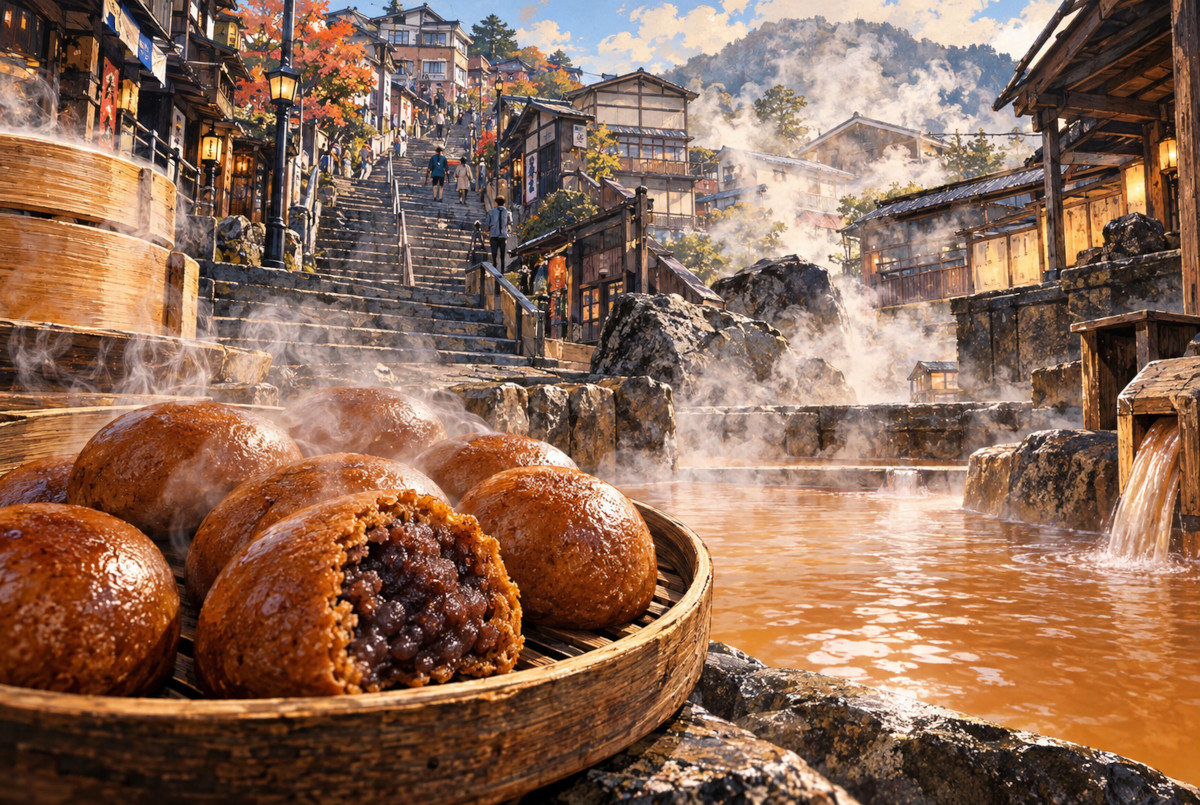 AI-generated illustration. It does not depict any specific hot-spring town, confectionery, or commercial product.
Now calculate what happens if you buy them every time
As of October 2026, Shogetsudo lists a 12-piece box of Yunohana Manju at ¥1,850.
Suppose a traveler buys one box for home and another for the workplace on every trip. That is ¥3,700 per trip.
Take six trips a year and the total becomes ¥22,200. Keep the habit for 20 years and you have spent ¥444,000.
This is obviously a model calculation, not a claim that every Japanese traveler spends exactly that amount. Some people travel much less. Others buy gifts for parents, relatives, neighbors, friends, and themselves and could easily spend more.
The point is what happens when a small purchase becomes automatic.
“It’s only one box” can quietly turn into hundreds of thousands of yen when repeated as a ritual for decades.
And that brings us back to the uncomfortable question. Do you actually want the manju? Or did your hand reach for the box because “I went on a trip, therefore I need to bring something back” has become part of the travel routine?
If it is the latter, the purchase starts looking less like buying food and more like paying an admission fee to a social ritual.
Even in 1960, not everyone in Japan bought souvenirs
This habit is not quite as universal—or timeless—as it can seem.
A 1960 public opinion survey now hosted by Japan’s Cabinet Office asked respondents whether they were more likely to buy souvenirs when traveling.
Forty-three percent answered that they usually did. But 23 percent said they usually did not, 19 percent answered neither way, and 15 percent said they could not answer because they had not traveled.
It would be wrong to compare those numbers directly with a modern survey without accounting for differences in travel, incomes, sampling, and methodology.
But the historical result still tells us something useful: even in Showa-era Japan, “you went somewhere, therefore you must buy a souvenir” was never a rule followed by absolutely everyone.
If they were allowed to come home empty-handed in 1960, we probably are too.
This is not an argument against manju. It is an argument against autopilot
If you visit Ikaho and want to eat one of Shogetsudo’s Yunohana Manju on the spot, that is part of the trip. If you discover a particular manju in Kusatsu that you genuinely enjoy and want to take home, buy it.
The problem begins when every hot-spring trip automatically ends with several boxes stacked at the cash register.
Buy the things you would actually miss if you left without them. Stop buying something merely because “I should probably bring back a souvenir.”
The money you do not spend on obligatory sweets can pay for fuel, tolls, another meal, or part of the next trip.
You do not have to package every travel memory in cardboard and carry it home. You have photographs. You have video. You remember what you ate and where you went.
If you buy souvenirs on every trip simply because that is what you have always done, try coming home with zero boxes once.
You may discover that absolutely nothing happens.
Editor’s Note
The thing that bothered me from the beginning was embarrassingly simple: “Why does every hot-spring town seem to have these things?”
After digging into the history, I ended up liking the original Ikaho idea more, not less. A brown bun modeled on the appearance of the local hot spring is exactly what a regional souvenir is supposed to be. It says something about the place.
Then the format spread so widely that the regional idea became a national template: go to an onsen, encounter a brown manju.
That is almost more interesting than the confection itself.
Showa-era Japanese tourist spots had a familiar ecosystem of souvenirs—pennants, miniature lanterns, postcards, wooden swords, and boxes of sweets. Most of those objects gradually lost their grip on travelers. Somehow, the manju kept fighting.
I am not saying onsen manju tastes bad, and I am not arguing that nobody should buy it. Eating one locally, especially when you actually want one, is exactly the kind of small pleasure travel is for.
But the moment you start piling up boxes for home and work simply because returning empty-handed feels somehow improper, the transaction changes. Nobody asked for them. You are no longer paying only for the sweet. You are paying for the habit.
So on your next trip, try going home with zero boxes. I suspect your life will continue without incident.
References
- Shogetsudo, “History of Shogetsudo” (Japanese)
- Shogetsudo, Yunohana Manju product information and current prices (Japanese)
- Shizuoka Prefecture, Food Culture Information Center: “Onsen Manju (Atami)” (Japanese)
- Enmeido Honten, history of the Atami confectionery and its use of hot-spring steam (Japanese)
- Hakone Tourism Association, Marushima Honten and Hakone onsen manju (Japanese)
- Honke Chichiya, Onsen Manju product information (Japanese)
- Ryotaro Suzuki, Tomomi Hanai and Jinman Kim, “What Do Tourists Require for Omiyage? — Clarification of Basic Elements by Web Survey,” The Tourism Studies, Vol. 35, No. 1
- Cabinet Office, Government of Japan, “Public Opinion Survey on Travel,” November 1960 (Japanese)