

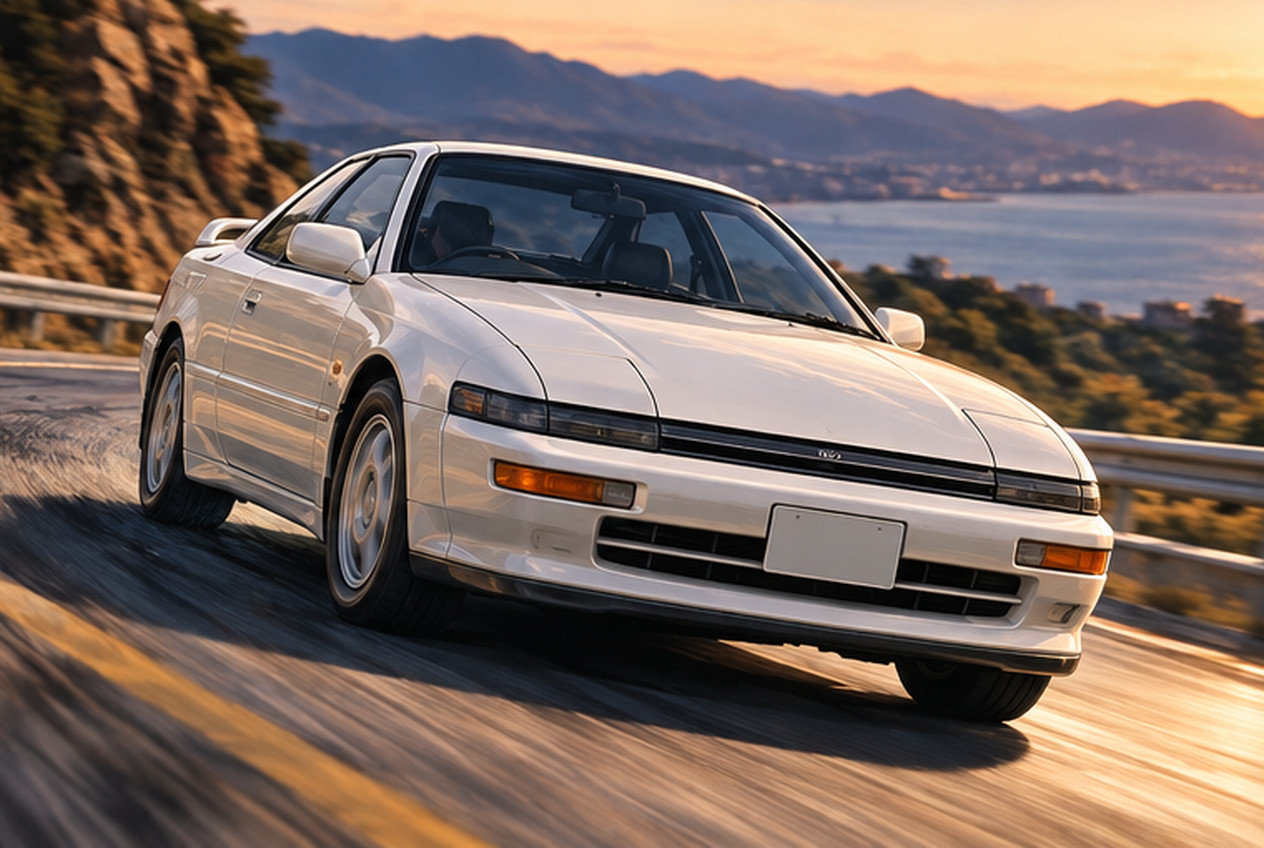
In September 1989, Toyota unveiled a rather strange version of the fifth-generation Celica. It was not turbocharged. It was not four-wheel drive. It used the naturally aspirated 3S-GE engine and drove only the front wheels—yet it cost ¥3.2 million.
The 225-hp Celica GT-FOUR was priced at ¥2.685 million. That meant this front-wheel-drive Celica cost ¥515,000 more, or roughly 19 percent extra.
Its name was the Celica Active Sports. The reason for the extraordinary price was Toyota’s Active Control Suspension, which the company promoted at the time as a world-first technology.
But the part that interests me is what happened afterward. Where did such an elaborate suspension system go? Did it eventually turn into today’s AVS? Was it simply a Bubble Era engineering experiment that went nowhere? And what about that vague memory some Japanese car enthusiasts have that “Tokico was involved in active suspension”?
This was not just a shock absorber that could change its stiffness
It is easy to misunderstand the system if you approach it from the perspective of modern electronically controlled dampers. The Celica’s setup was fundamentally different from Toyota’s TEMS systems or today’s AVS, which mainly vary damper force.
The Celica used hydraulic pressure supplied by a pump and accumulators to control hydropneumatic suspension units at all four wheels. Vehicle speed, steering angle, ride height and acceleration were monitored, allowing the system to vary hydraulic pressure and fluid volume in order to control body roll, pitch, brake dive, ride height and vibrations caused by road inputs.
It was not merely making the dampers “harder” or “softer.” It was using external energy to actively control the attitude of the body. That is the important distinction.
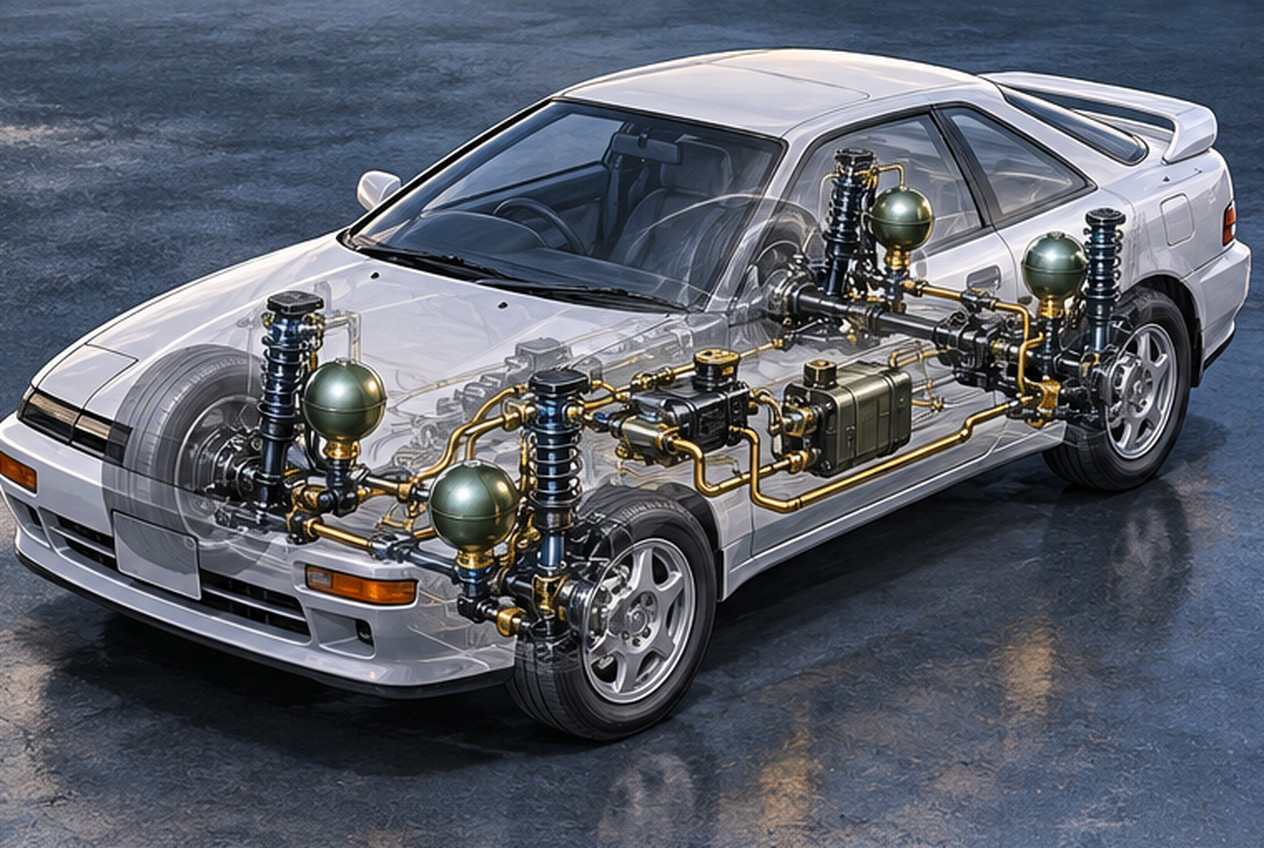
AI-generated technical illustration. The hydraulic lines, accumulators and other components are shown conceptually and do not reproduce the exact number, shape or location of parts on the production car.
Just how strange was a ¥3.2 million Celica?
The price makes more sense—or perhaps less sense—when the other Celicas are placed next to it.
A five-speed GT-R 4WS cost ¥1.97 million. The turbocharged four-wheel-drive GT-FOUR cost ¥2.685 million. The Active Sports cost ¥3.2 million.
That made it ¥1.23 million more expensive than the GT-R 4WS, an increase of about 62 percent. Yet the Active Sports used the same naturally aspirated 3S-GE producing 165 PS and remained front-wheel drive.
You were clearly not paying ¥1.23 million extra for more horsepower. In practical terms, this was almost like buying a production car wrapped around an unusually ambitious suspension engineering project.
Toyota’s later corporate history describes the Active Sports as a made-to-order model limited to 300 units. There is one curious wrinkle, however. Toyota’s September 1989 launch announcement says it would first accept orders for 300 cars and also mentions a second limited sale planned for autumn 1990. Later official histories simply describe the model as a 300-unit limited production car. What ultimately happened to that second batch is less clear.
It did not end with the Celica—the Soarer came next
So this was not a case of Toyota building 300 oddball cars and quietly abandoning the idea.
A 1991 paper published by the Japan Society of Mechanical Engineers describes simulations and real-car testing using the Celica Active Sports, including body attitude control, ride comfort, handling stability and coordination with four-wheel steering.
Then came the third-generation Toyota Soarer in 1991, where the idea was taken further into a true full active suspension system.
A 1992 SAE technical paper explicitly states that the Soarer system was based on the active suspension developed for the 1989 Celica. In the Soarer, Toyota went even further: the full active system dispensed with conventional coil springs and was integrated with Active 4WS, traction control and ABS as part of a broader vehicle dynamics control system.
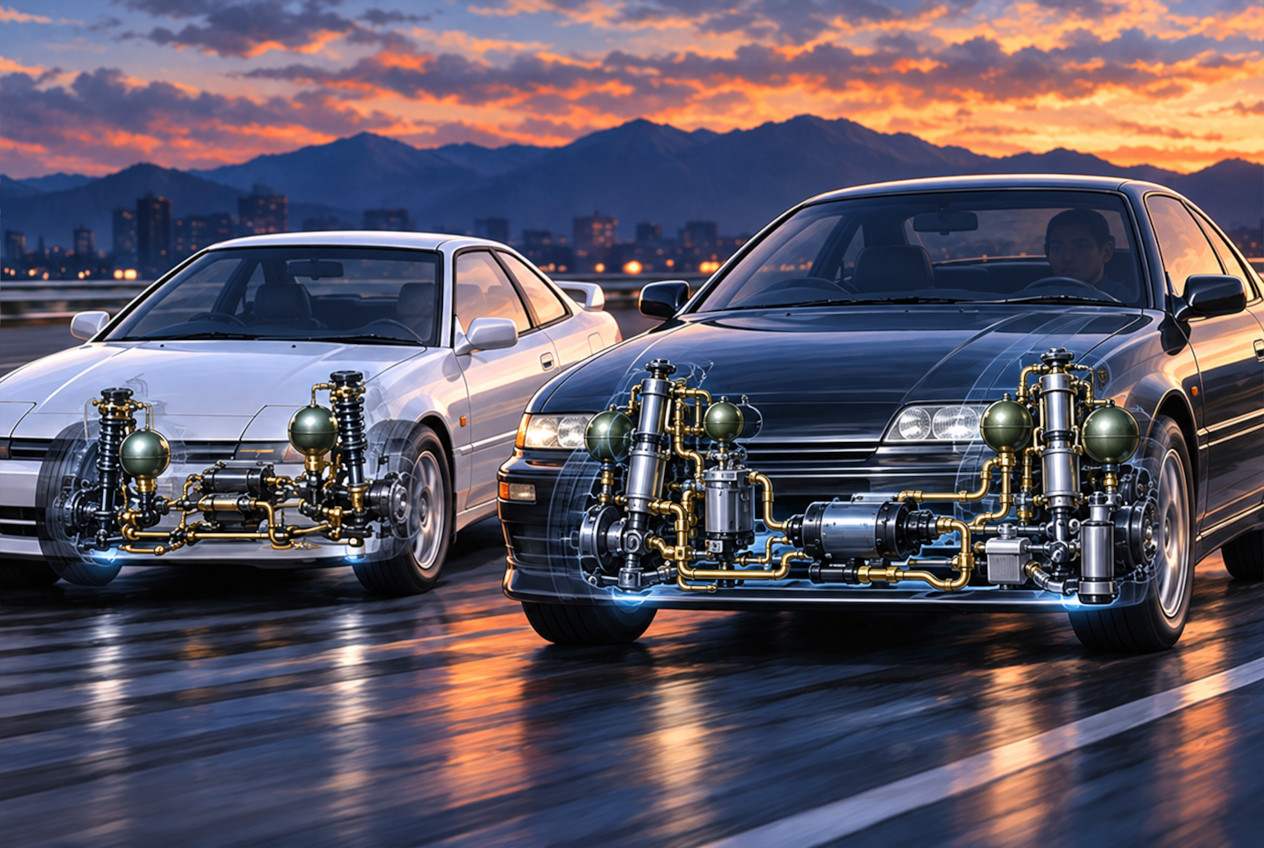
AI-generated comparison illustration. The left side conceptually represents the Celica system using conventional coil springs together with hydraulic control, while the right represents the Soarer’s full active system without coil springs. Vehicle styling, hydraulic components and pipe routing are not exact reproductions of the production cars.
So why did it disappear? Toyota’s engineers gave a surprisingly simple answer
There are plenty of tempting explanations for why systems like this vanished. They must have been unreliable. They were too complicated to service. The Japanese asset-price bubble burst and expensive technology suddenly became unfashionable.
Those explanations may sound plausible, but I could not find primary documentation strong enough to make them the main reason.
There is a much better source.
In a 2010 technical paper on Toyota’s electric active stabilizer suspension, engineers looked back at the earlier full active suspension systems introduced from 1989 onward. Their explanation was blunt: the systems fell out of use by the late 1990s because of their large mass and high energy consumption, at a time when efficiency was becoming increasingly important.
In other words, the technology did work. The problem was that making an entire passenger car fight roll, pitch and vertical motion hydraulically required a lot of hardware and a lot of energy.
It was not necessarily a dead-end idea. It was simply a very expensive way of solving the problem.
Tokico was working on active suspension too—but that does not make the Celica a “Tokico system”
The Tokico connection is not imaginary.
Tokico Ltd., one of Japan’s major suspension suppliers at the time, filed a patent application in March 1989 for an “active suspension” system that used hydraulic cylinders to control vehicle attitude. In other words, Tokico really was working seriously in the same field during exactly the same period.
But when the Celica itself is traced through development papers and related technical material, the names that can be confirmed include Toyota Motor Corporation, Toyota Central Research and Development Laboratories, and Aisin Seiki.
I could not find primary documentation supporting the statement that “Tokico developed the Celica’s active suspension.”
That does not prove Tokico supplied no individual components to the program. But unless stronger documentation turns up, describing the complete Celica system as “made by Tokico” goes further than the evidence allows.
Did it become today’s AVS? Not quite
Modern Toyota and Lexus AVS—Adaptive Variable Suspension—works mainly by electronically varying the damping force of the shock absorbers according to vehicle and road conditions.
The 1989 Celica was doing something much more aggressive. Hydraulic pressure could actively support or oppose body movement rather than simply changing the resistance of a damper.
So it would be misleading to draw a straight line and say, “The Celica’s active suspension evolved into today’s AVS.” The hardware architecture is fundamentally different.
But the underlying obsession did not disappear.
In 2005, Lexus introduced an electric active stabilizer system on the GS 430. Instead of hydraulically controlling almost everything the body did, the system actively attacked one specific problem—body roll—using electric actuators. Interestingly, one of the researchers on the later development paper was Shuuichi Buma, who had also been involved in Toyota’s Celica active-suspension research.
And the story is still not over.
In 2026, Toyota engineers published research on a torsion-bar active suspension using electric motors. It is completely different in hardware from the large hydraulic system of 1989, and it should not be described as a direct descendant of the Celica system.
Yet the basic engineering question is remarkably familiar: instead of merely reacting to body movement with passive springs and dampers, can the vehicle actively generate force to control what the body does?
Thirty-seven years after the Celica Active Sports appeared, Toyota engineers are still asking variations of that question.
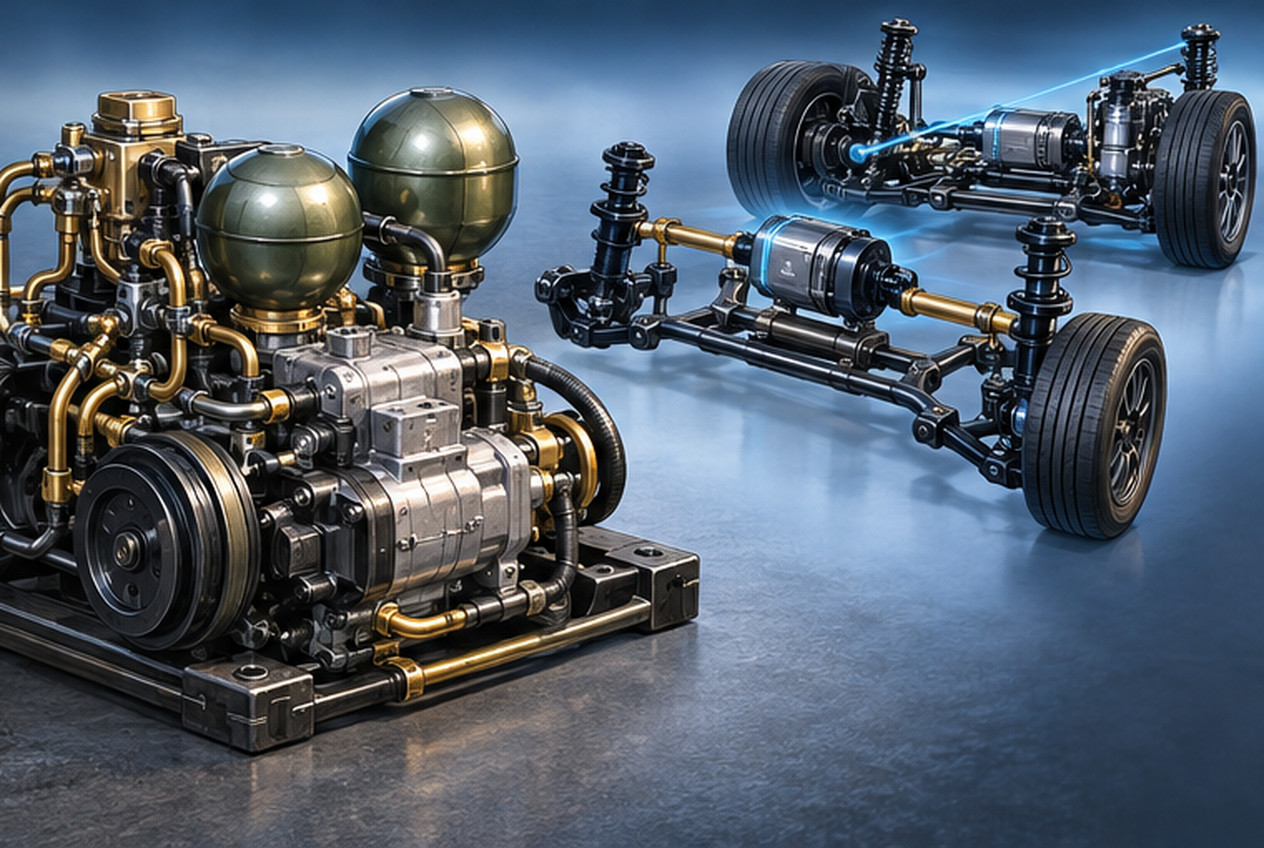
AI-generated conceptual illustration showing the broader shift from hydraulic active suspension toward electrically controlled chassis systems. It does not reproduce the exact hardware layout of the Lexus GS 430 system or Toyota’s 2026 research prototype.
Editor’s Note
I started with the assumption that the Celica’s active suspension had simply failed and disappeared. Once I followed the technical papers, that explanation became much harder to defend.
The Celica led directly to the Soarer’s more ambitious full active system, and at least one engineer involved with the Celica research, Shuuichi Buma, later worked on Toyota’s electric active stabilizer technology. What seems to have disappeared was not the desire to actively control body motion, but the idea of doing almost all of it with a large, energy-hungry hydraulic system.
And I still cannot quite get over the product planning behind the car itself. Toyota took a 165-PS, naturally aspirated, front-wheel-drive Celica and priced it ¥515,000 above the turbocharged GT-FOUR. Seen from today, that is wonderfully excessive.
Calling the Active Sports a failure simply because only 300 were built misses the interesting part. It may make more sense to think of it as a laboratory that Toyota was willing to sell to actual customers. There were quite a few Japanese cars around the end of the 1980s and beginning of the 1990s that felt like this: engineering first, business case somewhere further down the page.
References
- Toyota Motor Corporation, “Full Model Changes for Celica,” September 6, 1989
- GAZOO vehicle data: Toyota Celica Active Sports
- Toyota Motor Corporation, 75 Years of Toyota: Fifth-Generation Celica
- Shuuichi Buma et al., “Analysis and Development of an Active Control Suspension,” Transactions of the Japan Society of Mechanical Engineers, Series C, 1991
- H. Kawakami et al., “Development of Integrated System Between Active Control Suspension, Active 4WS, TRC and ABS,” SAE Technical Paper 920271, 1992
- Toyota Motor Corporation, “Full Model Changes for the Toyota Soarer,” May 7, 1991
- Shuuichi Buma et al., “Design and Development of Electric Active Stabilizer Suspension System,” Journal of System Design and Dynamics, 2010
- Tokico Ltd., Japanese Patent JP3002782B2, “Active Suspension”
- Toyota Motor Corporation, “Lexus Unveils GS, SC and IS Vehicle Series for Japan,” 2005
- Lexus, Adaptive Variable Suspension (AVS) technical overview
- Hiroki Furuta et al., “Application of Database-Driven Preview Control to a Torsion-Bar-Type Active Suspension,” Transactions of Society of Automotive Engineers of Japan, 2026