


Dead people becoming ghosts is easy enough to understand—at least by the internal logic of ghost stories.
But what if the person is still perfectly alive? They are eating dinner, taking a bath, sleeping in their own bed—and yet somehow, “they” appear somewhere else.
Japanese folklore has a particularly troublesome explanation for that. It is called an ikiryō (生霊), literally a “living spirit.”
Today, ikiryō are often described as spirits sent out by intense jealousy, hatred, or obsession. But the older tradition is stranger than that. The person does not necessarily sit there thinking, “I’m going to haunt someone tonight.” In some of the best-known stories, the person does not even realize that their spirit has left them.
You do not have to say, “I’m going to curse you”
The classic example comes from The Tale of Genji, written in Japan around the beginning of the 11th century. One of its most famous women, Lady Rokujō—Rokujō no Miyasudokoro—is deeply attached to Prince Genji and humiliated by his relationship with Aoi, his principal wife.
Jealousy, wounded pride, emotional attachment, and the humiliation of the famous carriage dispute build around her. Meanwhile, Aoi begins suffering from a terrifying supernatural affliction.
What makes the episode interesting is that Lady Rokujō is not consciously deciding to send a ghost after her rival.
As explained by the Art Research Center at Ritsumeikan University, Lady Rokujō does not initially understand that she herself may be appearing as a living spirit. After an exorcistic ritual is performed elsewhere, she notices the same smell of burned mustard seeds clinging to her own body—and begins to suspect what has happened.
The person doing the haunting may know less about it than the person being haunted. That is the peculiar logic of the ikiryō.
 AI-generated explanatory illustration. It does not reproduce a specific scene from The Tale of Genji, a real historical person, or an archaeologically exact reconstruction of Heian-period clothing and architecture.
And it was not always about hatred
The Database of Folklore and Strange Phenomena maintained by Japan’s International Research Center for Japanese Studies contains regional records concerning ikiryō from around the country.
One belief recorded in Wakayama Prefecture in 1939 says that a living spirit may possess someone whether the sender is “fond of them or hates them.” At least in this local tradition, hatred was not the only emotional route by which an ikiryō was thought to appear.
A folklore survey from Ōita Prefecture goes even further. It records a belief in particular family “lines” associated with living spirits, with such reputations sometimes affecting whom people considered suitable to marry.
None of this proves that living spirits exist. These are records of what people believed. But that distinction may actually make the story more interesting. A supernatural belief could reach beyond ghost stories and influence real decisions about marriage.
Victorian Britain catalogued 702 strange cases
Here is where things become even stranger: Japan was not the only culture fascinated by the idea of living people somehow appearing at a distance.
The Society for Psychical Research, or SPR, was founded in Britain in 1882. In 1886, three of its leading researchers—Edmund Gurney, Frederic W. H. Myers, and Frank Podmore—published the massive two-volume work Phantasms of the Living.
The books contain 702 numbered cases, including experiments interpreted at the time as telepathy, dreams, visions, and reports in which people seemed to perceive someone who was physically far away. Not all 702 cases were simple visual apparitions.
This was not quite the same thing as the Japanese ikiryō. British psychical researchers were particularly interested in what later became known as crisis apparitions—cases in which someone reportedly saw or heard a distant person around the time of that person’s death, accident, or other serious crisis.
Even so, the underlying idea is oddly familiar: the body is in one place, yet something resembling the person appears somewhere else.
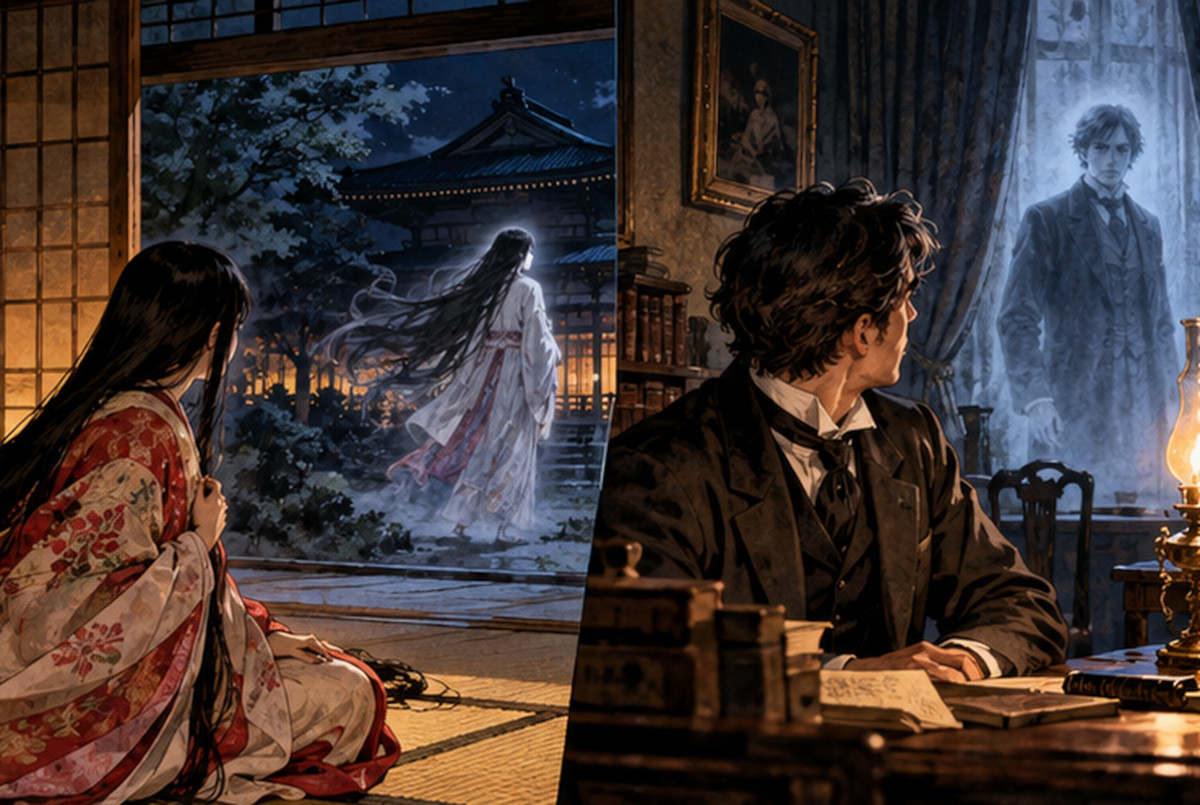 AI-generated comparative illustration. It symbolically contrasts Japanese ikiryō traditions with 19th-century British apparition reports and does not reproduce an actual person, incident, or case from Phantasms of the Living.
Science also studies the feeling that “someone is there”
So what does modern science make of all this?
There is currently no established scientific evidence that intense emotion causes a soul or spirit to leave a living body, travel across a distance, and possess another person.
But there is a related human experience that researchers do study: the powerful sensation that someone is present even when there is no clear sensory evidence of another person. In research literature, this is often called a felt presence.
A 2023 review in The Lancet Psychiatry discussed felt-presence experiences in connection with sleep paralysis, anxiety, neurological conditions, endurance sports, and spiritual settings. In other words, the experience is not limited to one diagnosis or one type of person.
That does not mean science has confirmed ikiryō. What science has established is narrower—and perhaps more interesting: human beings really can experience an intense sense that another presence is nearby, even without clear sensory evidence for it.
 AI-generated conceptual illustration of a “felt presence.” It does not depict a specific medical case and should not be interpreted as evidence of an actual supernatural event.
Why a living spirit may be more disturbing than a dead one
This is the part I kept coming back to.
If someone claims to have seen the ghost of a dead person, you cannot exactly ask the dead person whether they were there. That is obvious enough.
But with an ikiryō, the supposed source is still alive. In theory, you can simply ask.
“Did you come and stand beside my bed last night?”
The other person will presumably say, “No.”
Yet in the model suggested by The Tale of Genji, that denial does not necessarily settle the matter. The person may not know what their own living spirit has supposedly been doing.
As a supernatural concept, that is remarkably hard to escape. The person can deny it. They can be asleep. They can be miles away. They do not even have to be dead.
Perhaps that is why the ikiryō is ultimately less about fearing a living person than fearing the emotions that even the person themselves cannot fully control.
Editor’s Note
I think that is what bothers me more than an ordinary ghost story: the idea that the person themselves has no idea.
A dead person appearing at night is frightening, but at least it follows the normal rules of a ghost story. An ikiryō breaks those rules. You could see someone standing beside your bed at two in the morning—and then meet the same person the next afternoon. They say “Morning” as if nothing happened. You remember seeing them. They remember absolutely nothing.
And once I started looking into it, the idea turned out not to be uniquely Japanese. Nineteenth-century British researchers were already cataloguing hundreds of strange reports involving dreams, visions, and apparent encounters with living people at a distance.
Science has not established that living spirits travel around at night. But the experience of sensing someone who is not clearly there is real enough to be studied. In the end, perhaps the strangest part is not whether ghosts exist. It is that people separated by centuries and cultures have repeatedly reported experiences that feel oddly similar.
References
- Ritsumeikan University Art Research Center — “F1-1: The Carriage Dispute” (Japanese)
- Ritsumeikan University Art Research Center — “F1-5: Lady Rokujō Becomes a Hannya” (Japanese)
- International Research Center for Japanese Studies — Database of Folklore and Strange Phenomena: Ikiryō / Soul, Wakayama Prefecture, 1939 (Japanese)
- International Research Center for Japanese Studies — Database of Folklore and Strange Phenomena: Ikiryō, Ōita Prefecture / Kokugakuin University Folklore Research Society (Japanese)
- Society for Psychical Research — Official Website
- Gurney, Myers & Podmore, Phantasms of the Living, Vol. II (1886) — Internet Archive
- Barnby JM, et al. “The felt-presence experience: from cognition to the clinic.” The Lancet Psychiatry, 2023.