
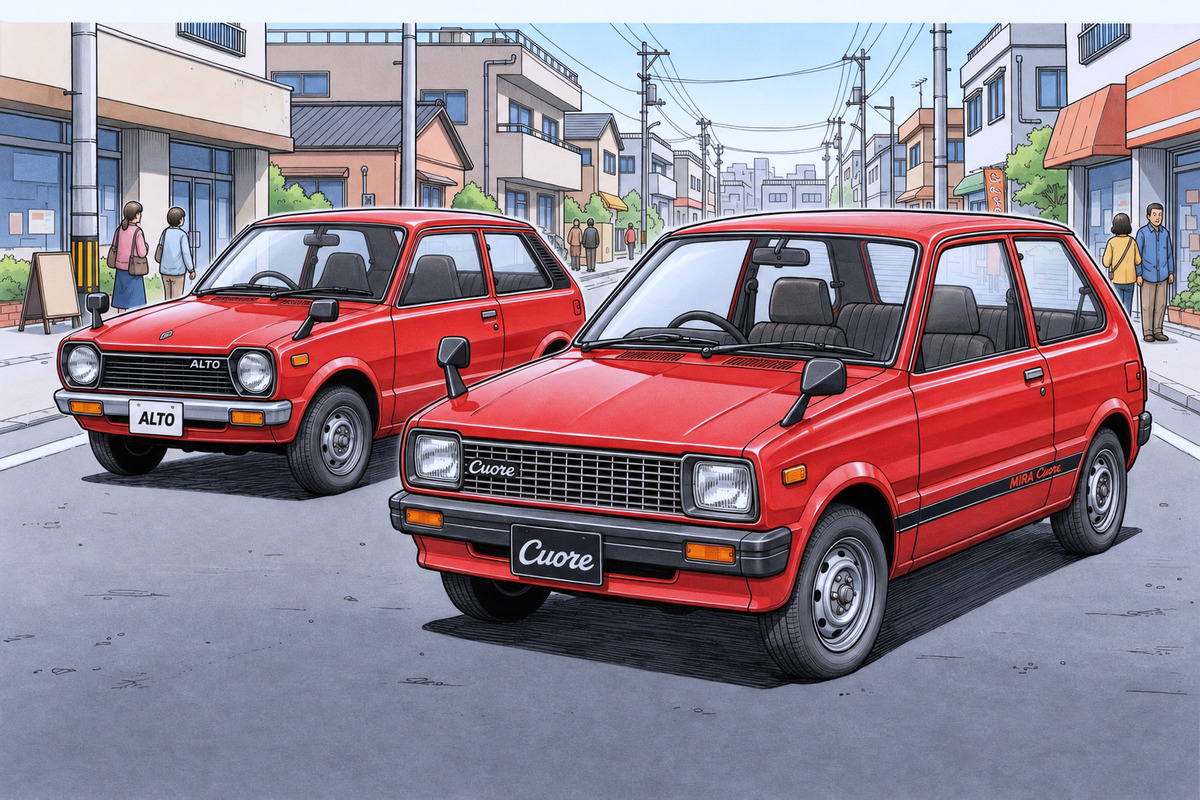
In May 1979, Suzuki shook up Japan’s small-car market with the Alto, a practical little vehicle priced at just ¥470,000 nationwide. Thirteen months later, in June 1980, Daihatsu answered with the Mira Cuore.
But there was a catch. The Mira started at ¥493,000, making it ¥23,000 more expensive than the car it was supposed to challenge.
For a latecomer competing in the budget-car market, that seems like an odd decision. Why not undercut Suzuki by a few thousand yen?
Comparing the original Alto and Mira reveals something more interesting than a simple price war: two manufacturers working within almost identical vehicle dimensions but making very different engineering choices.
Why Was a Family Runabout Classified as a Commercial Vehicle?
First, a little background. Both cars belonged to Japan’s kei-car category, a class of exceptionally small vehicles subject to strict limits on engine displacement and body dimensions.
In 1976, the maximum permitted engine displacement increased from 360cc to 550cc. Daihatsu responded with the Fellow Max 550 and, in 1977, the Max Cuore. Yet Japan’s kei-car market was facing difficult conditions as the price advantage over larger passenger cars narrowed.
Suzuki’s answer involved a feature that had little to do with engines or handling: Japan’s former commodity tax.
At the time, kei passenger cars were subject to a 15% , while qualifying light commercial vehicles were exempt. This created an unusual opportunity: sell a vehicle that looked and functioned much like a personal car, but was legally classified as a commercial vehicle.
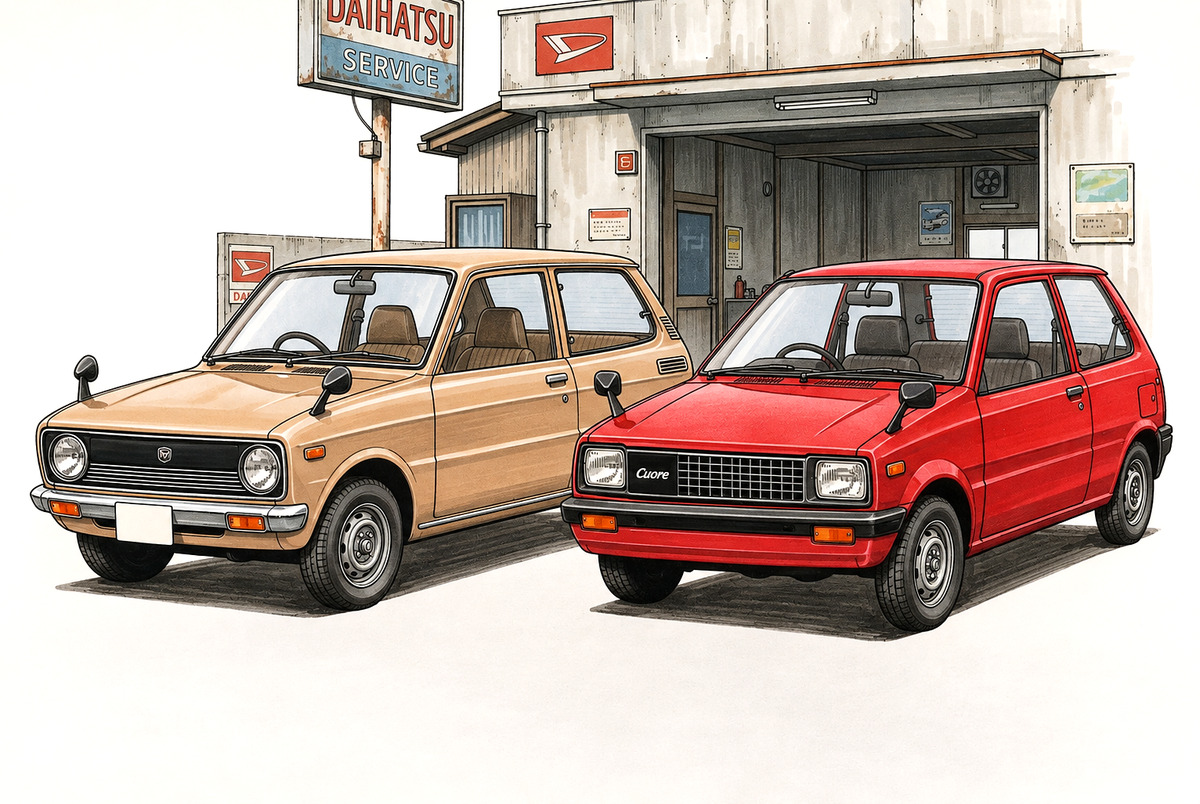
Illustrative comparison of two early Daihatsu models. Some year-specific styling details may differ from the original production vehicles.
That was the thinking behind the original Alto. Although designed as a light commercial vehicle with cargo space, it was marketed to private buyers rather than exclusively to businesses. Suzuki saw an opportunity among women who wanted an affordable car for shopping and everyday travel.
Combining this tax advantage with aggressive cost reduction helped Suzuki offer the Alto at ¥470,000.
It was a clever piece of product planning. Japan’s commercial-vehicle classification had become a tool for making an inexpensive personal car.
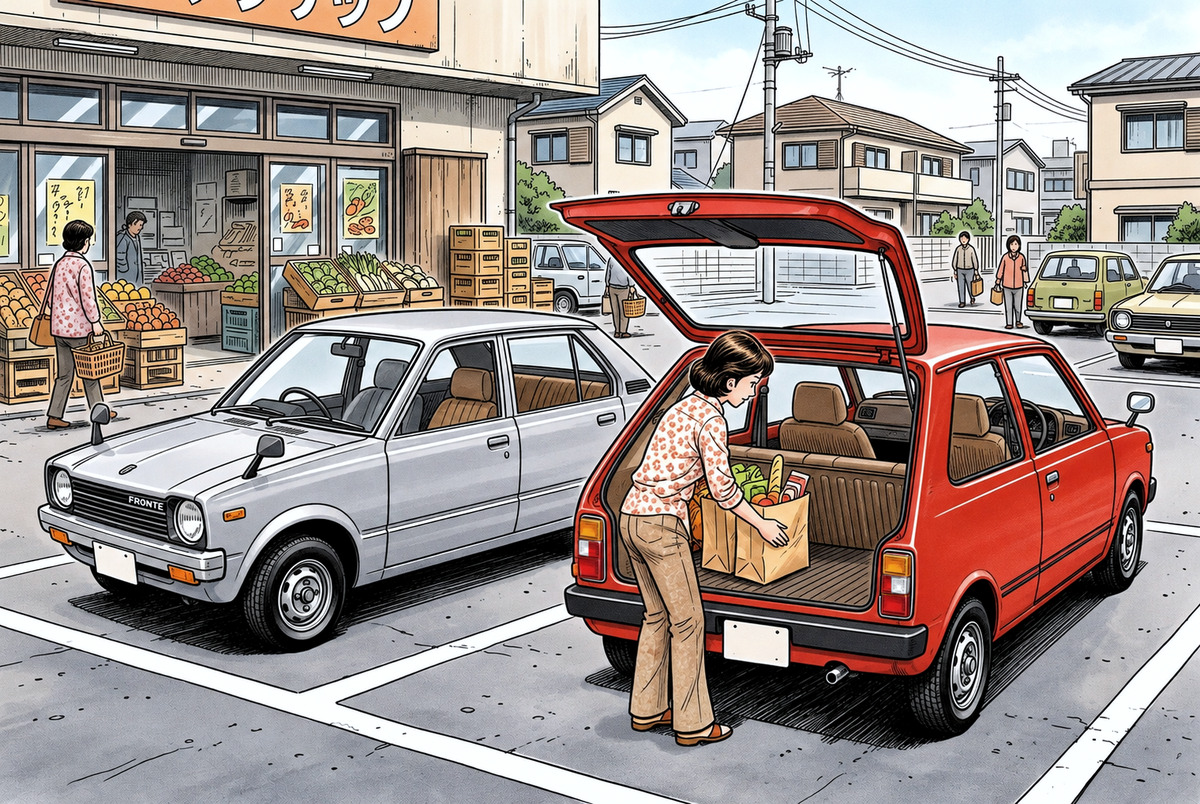
AI-generated illustration of everyday life in Japan around 1979. It does not depict an actual historical location or event.
The Mira Cost 4.9% More. What Did Buyers Get?
To investigate that ¥23,000 difference, we compared representative specifications of the original Alto and Mira Cuore using Suzuki’s historical vehicle records and documentation compiled by the Society of Automotive Engineers of Japan (JSAE).
| Specification | Suzuki Alto (1st generation) | Daihatsu Mira Cuore (1st generation) |
|---|---|---|
| Launch date | May 1979 | June 1980 |
| Starting price | ¥470,000 | ¥493,000 |
| Length | 3,195mm | 3,195mm |
| Width | 1,395mm | 1,395mm |
| Height | 1,335mm | 1,370mm |
| Wheelbase | 2,150mm | 2,150mm |
| Vehicle weight | 545kg | 535kg |
| Engine displacement | 539cc | 547cc |
| Engine configuration | Two-stroke inline-three | Four-stroke OHC inline-two |
| Maximum power | 28PS | 29PS |
| Drivetrain | Front-wheel drive | Front-wheel drive |
| Vehicle classification | Light commercial vehicle | Light commercial vehicle |
Sources: Suzuki’s H-SS30V Alto MX specifications and JSAE documentation for the L55V-DKR Mira Cuore. Prices are introductory base prices; the specifications and prices may not correspond to exactly the same equipment grades. PS refers to metric horsepower.
The overall length, width, and were identical. Yet in the representative specifications examined here, the Mira was 35mm taller and 10kg lighter.
Its price premium was:
(¥493,000 − ¥470,000) ÷ ¥470,000 × 100 = approximately 4.9%.
That difference was certainly noticeable in a market built around affordability. But it is difficult to argue that the Mira was simply a more expensive copy of the Alto.
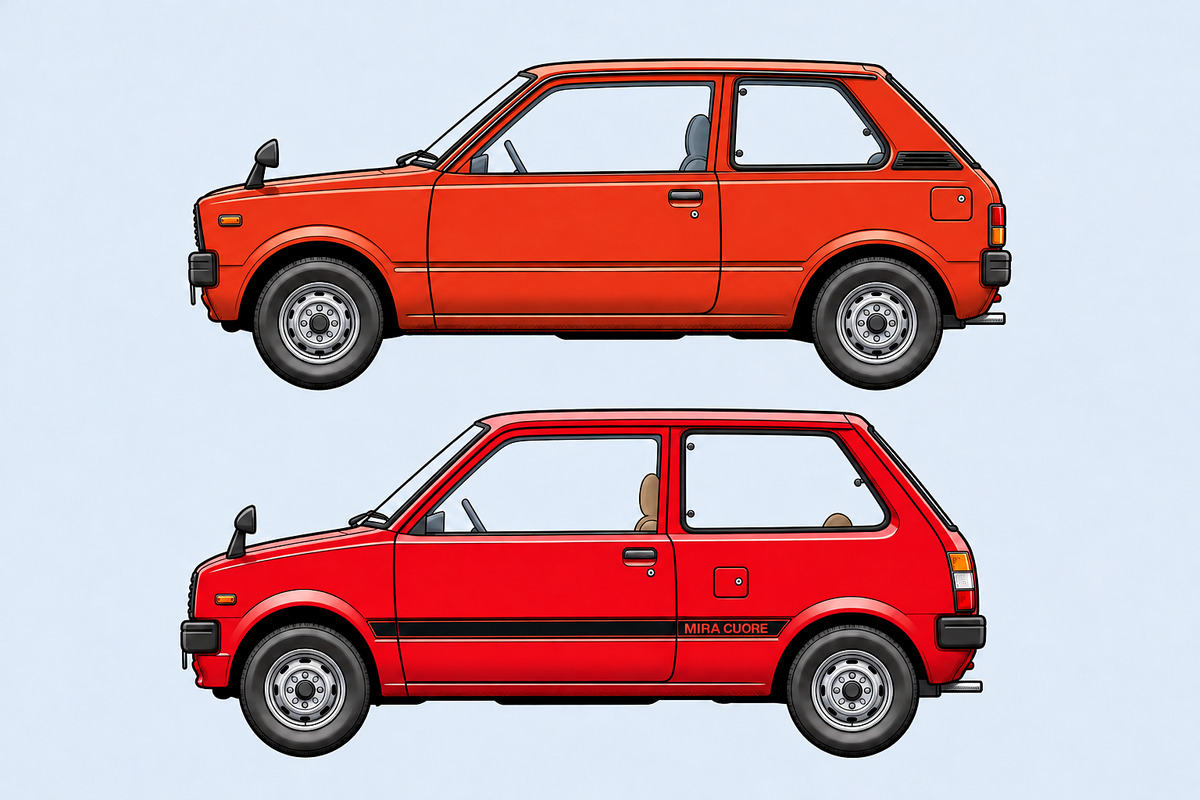
Illustrative vehicle comparison, not a dimensionally accurate engineering drawing. Body shapes and scale are schematic.
Three Cylinders for Suzuki, Two for Daihatsu
The most revealing difference was under the bonnet.
The Alto used a 539cc two-stroke, three-cylinder engine. Daihatsu chose a 547cc four-stroke, two-cylinder for the Mira.
In a , each cylinder completes a power cycle during one crankshaft revolution. A four-stroke engine requires two revolutions. Two-stroke designs can be mechanically simpler, but they also present challenges involving emissions, fuel efficiency, and lubricating oil consumption.
The Mira’s four-stroke engine was an improved version of Daihatsu’s AB-series unit, already used in the earlier Max Cuore.
For another perspective, divide the engine capacities by the number of cylinders. The Alto had approximately 179.7cc per cylinder, compared with 273.5cc in the Mira. That is a difference of about 52.2% per cylinder, despite their total capacities differing by only 8cc.
This does not establish which engine was better. It does, however, show how differently Suzuki and Daihatsu approached the same small-engine problem.
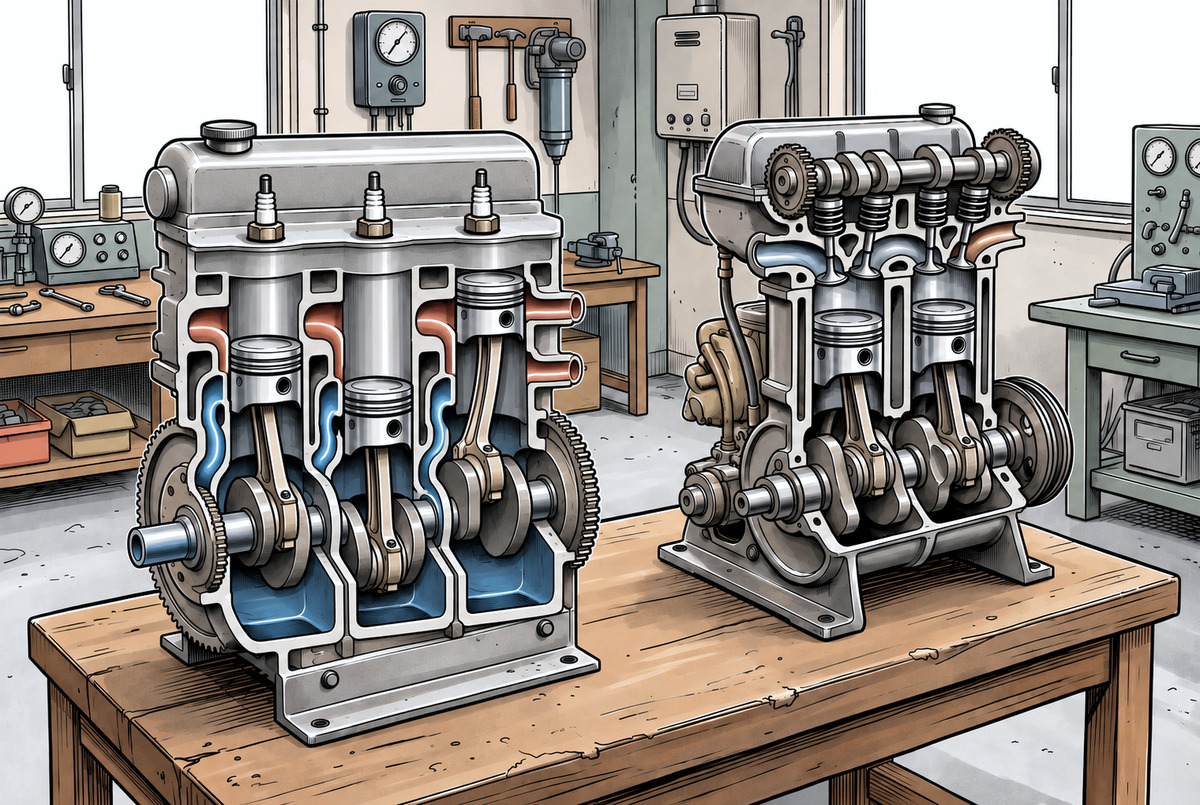
Schematic comparison of the original Alto’s three-cylinder two-stroke engine and Mira’s two-cylinder four-stroke engine. It illustrates their basic configurations rather than faithfully reproducing every internal component of the T5B and AB engines.
Daihatsu also retained its existing engine expertise while adopting what it called a 1.5-box design: a compact engine compartment intended to leave more of the vehicle’s limited dimensions available for the cabin.
That suggests a product strategy concerned with everyday usability as well as price. However, the detailed manufacturing-cost breakdown behind the ¥23,000 premium has not been verified, so it would be misleading to assign the entire difference to the engine or body design.
The Commercial-Vehicle Tax Loophole Did Not Last
Here is where the story becomes particularly interesting.
Descriptions of the original Alto and Mira often emphasize their tax-exempt commercial-vehicle classification. But a closer look at the legislation reveals that this advantage began to shrink surprisingly soon.
On March 31, 1981, Japan promulgated Act No. 14 of 1981, amending the Commodity Tax Act. It introduced a 5% commodity tax on a category of light commercial vehicles designed for both passenger and cargo use.
The law took effect on May 1, 1981, but its transitional provisions maintained the exemption through September 30. In principle, the new tax applied to qualifying vehicles released from manufacturing premises from October 1 onward, subject to the applicable statutory conditions.
To make the effect easier to understand, we calculated the tax on an identical hypothetical taxable base of ¥500,000 for both vehicle categories.
| Vehicle category | Before the amendment | From October 1981 |
|---|---|---|
| Kei passenger car | ¥75,000 (15%) | ¥75,000 (15%) |
| Passenger/cargo light commercial vehicle | ¥0 (exempt) | ¥25,000 (5%) |
| Difference in tax | ¥75,000 | ¥50,000 |
Original calculation by this publication using a hypothetical taxable value of ¥500,000 for both categories. This illustrates the tax structure; it does not reproduce the actual retail prices or tax liabilities of the Alto or Mira. Not all commercial-vehicle classifications were subject to identical treatment.
The tax advantage in this example fell from ¥75,000 to ¥50,000, a reduction of one-third.
That is an important distinction. It was not simply a case of an unusual tax exemption making cheap kei cars possible indefinitely. The regulatory environment changed soon after the Mira’s debut.
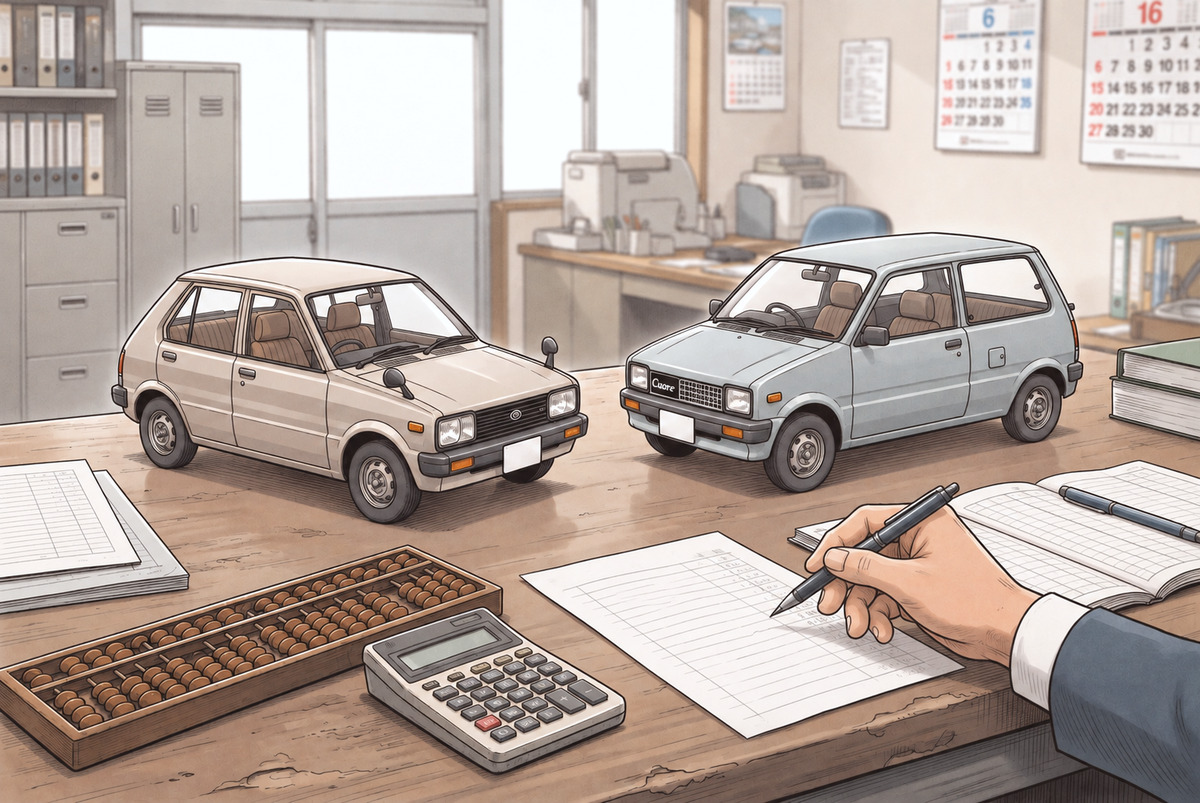
Conceptual illustration of vehicle classifications and taxation. It does not depict an actual sales negotiation or historical tax document.
The Mira continued selling even after its category’s tax advantage was reduced. That alone does not prove how much the amendment affected sales, but it suggests that taxation cannot fully explain the car’s continued appeal. Practicality, engineering choices, and an expanding model range also deserve attention.
From a Commercial Cuore to a Daihatsu Mainstay
In May 1982, the Mira Cuore received a facelift and became known simply as the Mira.
Daihatsu broadened the range in 1983 with turbocharged and four-wheel-drive versions. The Mira Walk-Through Van followed in 1984, offering a distinctive tall-bodied commercial vehicle designed for delivery work.
According to specialist automotive sources, domestic sales of the first-generation Mira exceeded 600,000 units before its replacement in 1985.

AI-generated depiction of a Japanese shopping street around 1984. The vehicles are modeled on the first-generation Mira and Mira Walk-Through Van, but some styling details and background elements are illustrative rather than exact historical reproductions.
A Daihatsu press release issued in 2000 states that cumulative domestic sales of the Mira series reached one million in March 1986.
Counting 69 months from the June 1980 launch gives a simple average of approximately 14,493 vehicles per month:
1,000,000 ÷ 69 = approximately 14,493 vehicles per month.
That figure is an average across the period, not a claim about sales in any individual month.
There is, however, a curious inconsistency in Daihatsu’s own records. Its corporate chronology lists February 1987 as the month in which the Mira reached one million domestic sales, rather than March 1986.
The two dates differ by 11 months. Without additional evidence, it is not possible to determine which record is definitive or whether the discrepancy reflects different counting methods.
What both records establish is that the Mira had become a major Daihatsu nameplate within its first several years.
Editor’s Note
My first reaction to the ¥23,000 price gap was simple: had Daihatsu already lost the price war before the Mira even arrived?
Then I started comparing the specifications. Same length, same width, same wheelbase. But different engines, a slightly taller body, and even a lower listed weight for the Mira specification examined here.
And just when the familiar tax-exemption explanation seemed to settle the matter, the 1981 amendment complicated the story.
Perhaps the really interesting point is that Daihatsu was competing for the Alto’s customers without trying to build exactly the same car.
Then came another twist. In 1985, Daihatsu began turning this modest shopping-and-commuting machine into something enthusiasts could get excited about. The Mira TR-XX was about to enter the picture.
Terms That May Need a Quick Explanation
- Kei car
- A Japanese category of very small motor vehicles governed by limits on dimensions and engine displacement. Kei cars benefit from certain tax and ownership advantages. The regulations have changed over time.
- Commodity tax (buppinzei)
- A former Japanese national tax imposed on selected goods, including passenger vehicles and certain consumer products. It was abolished when Japan introduced its consumption tax in 1989.
- 1.5-box design
- An automotive body-design term describing a compact front engine compartment combined with a relatively large passenger or cargo space. It is a descriptive design concept, not a legal vehicle classification.
46 Years of the Daihatsu Mira — A Six-Part Series
From its rivalry with the Suzuki Alto and the rise of kei sports cars to the fuel-efficient Mira e:S. Across six articles, we explore the Mira's evolution from 1980 to 2026 through engineering, pricing, taxation, sales figures, and Daihatsu's product strategy.
- Part 1: Part 1: Suzuki’s Alto Cost ¥470,000. Why Was the Daihatsu Mira ¥23,000 More?
- Part 2: 14 More PS for Just ¥46,000? The Mira TR-XX and Japan’s Kei-Car Power War Coming soon
- Part 3: English edition Coming soon
- Part 4: English edition Coming soon
- Part 5: English edition Coming soon
- Final Part: English edition Coming soon
References
- Suzuki Digital Library: Alto (Japanese) — Historical specifications, launch price, and development background of the original Suzuki Alto.
- Society of Automotive Engineers of Japan (JSAE): Daihatsu Mira Cuore, 330 Landmarks of Japanese Automotive Technology (Japanese) — Original vehicle specifications and engineering background, drawing on Daihatsu’s June 9, 1980 technical documentation.
- Daihatsu: Historical Products from 1975 (Japanese) — Official timeline covering the Max Cuore, Mira Cuore, and subsequent Mira models.
- Japan Light Motor Vehicle Inspection Organization: What Is a Kei Vehicle? (Japanese) — Historical changes to Japan’s kei-vehicle regulations.
- House of Representatives of Japan: Act No. 14 of 1981, Partial Amendment to the Commodity Tax Act (Japanese) — Tax rates and transitional provisions affecting qualifying light commercial vehicles.
- Daihatsu: Mira Series Reaches Four Million Cumulative Domestic Sales, June 6, 2000 (Japanese) — Historical domestic sales milestones.
- Daihatsu: Corporate Chronology from 1975 (Japanese) — An alternative official date for the Mira’s one-million-unit domestic sales milestone.
- JAF Mate Online: Cars Nominated for Japan’s First Car of the Year Award (Japanese) — Contemporary pricing and historical information on the original Mira Cuore.
- Meisha Culture Research Institute: Mira Cuore (Japanese) — Development background, engine specifications, sales history, and model variations.
- Response.: Daihatsu Mira — The Alto Challenger with an Italian Influence (Japanese) — Historical model development based on period catalogues.